Best NFL Tight Ends In 2026
The best tight ends in the NFL combine receiving production, offensive versatility and blocking ability. The position has evolved considerably, with leading tight ends…


Travis Kelce, George Kittle, Mark Andrews, Sam LaPorta, T.J. Hockenson, Trey McBride and Brock Bowers are among the notable players whose performances have shaped recent discussions about the position. Their respective strengths vary, from receiving volume and route-running to blocking efficiency and touchdown production.
This guide examines the leading NFL tight ends, their statistical achievements, historical receiving records and the betting markets associated with their performances. It also explains how receiving yards, receptions, touchdowns and player usage can be evaluated when comparing NFL odds.

Best NFL Tight Ends 2026 – Rankings and Analysis
Evaluating the best tight ends requires consideration of more than receiving yards alone. Receptions, touchdowns, offensive involvement, blocking contributions, availability and performance against different defensive schemes all contribute to an assessment of the position.
The following table identifies established and emerging tight ends who warrant consideration in a current NFL positional comparison. It is a reference list rather than a verified 2026 statistical ranking; the players are not ordered by current-season production.
| Player | Established Strength | Relevant Statistical Measures |
|---|---|---|
| Travis Kelce | Route-running, receptions and postseason production | Targets, receptions, receiving yards |
| George Kittle | Receiving efficiency and blocking | Yards per reception, receiving yards, blocking contribution |
| Mark Andrews | Red-zone receiving and touchdown production | Receiving touchdowns, targets, receptions |
| Sam LaPorta | Receiving versatility and scoring opportunities | Receptions, receiving yards, red-zone targets |
| T.J. Hockenson | Reception volume and intermediate receiving | Targets, receptions, receiving yards |
| Trey McBride | Target volume and receiving involvement | Target share, receptions, receiving yards |
| Brock Bowers | Receiving versatility and offensive usage | Receptions, yards after catch, receiving yards |
A definitive current-season ranking should use verified statistics from the same reporting period. Receiving totals alone may favour players with greater passing volume, while blocking contributions and offensive responsibilities require additional evaluation.
How NFL Tight Ends Are Ranked
A comprehensive tight end ranking considers both receiving performance and contributions to the broader offence. Several measures are particularly relevant.
- Receiving yards: The total yardage accumulated through completed passes.
- Receptions: The number of completed passes caught by the player.
- Receiving touchdowns: The number of receiving plays resulting in touchdowns.
- Yards per reception: Receiving yards divided by completed receptions.
- Target share: The proportion of team pass attempts directed towards the player.
- Route participation: The frequency with which the player runs a receiving route on passing plays.
- Blocking contribution: Effectiveness in supporting the running game and pass protection.
- Consistency and availability: Production across games and the ability to remain involved throughout the season.
No single measure captures every responsibility of the position. A tight end with fewer receiving yards may still provide substantial value through blocking, while another may function primarily as a receiving option.
Best Tight Ends in the NFL Right Now
The following player profiles examine established performance, positional strengths and the factors relevant to evaluating individual tight ends. Historical statistics are identified by season rather than presented as current totals.
Travis Kelce
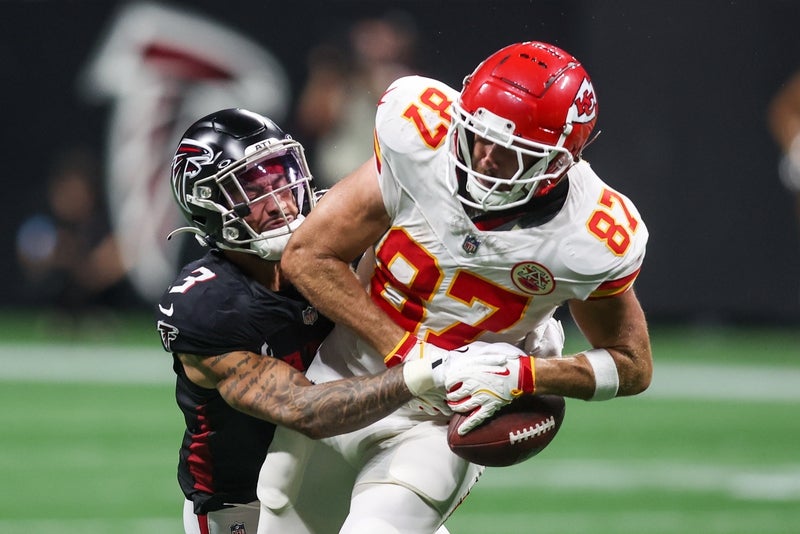
Travis Kelce established himself as one of the most productive receiving tight ends in NFL history through his career with the Kansas City Chiefs. His connection with quarterback Patrick Mahomes became a central feature of the Chiefs’ passing offence and contributed to multiple Super Bowl championships.
Kelce’s receiving strengths include identifying space in zone coverage, adjusting routes to defensive movements and producing receptions in critical situations. His ability to operate across the middle of the field has made him particularly important on passing downs.
During the 2023 regular season, Kelce recorded 984 receiving yards. That figure provides historical context for his production, although it should not be treated as representative of a later season without reviewing his subsequent performance.
When evaluating Kelce’s receiving markets, target volume, route participation, quarterback availability and defensive coverage are particularly relevant. Career achievements establish his historical standing but do not independently predict individual game outcomes.
George Kittle
George Kittle has distinguished himself through a combination of receiving production and blocking ability. His versatility allows him to contribute as a receiving target while supporting the San Francisco 49ers’ rushing offence.
Kittle recorded 1,377 receiving yards in 2018, demonstrating his ability to produce substantial yardage from the tight end position. He also accumulated 1,020 receiving yards during the 2023 regular season, leading all tight ends that year.
His receiving production can be influenced by the distribution of opportunities across the offence. A team with several established receiving options may distribute targets differently from an offence that relies heavily on one tight end.
Kittle’s blocking responsibilities are also relevant when comparing him with receiving-focused tight ends. Statistical rankings based exclusively on catches and yardage do not fully reflect that contribution.
Mark Andrews
Mark Andrews established himself as a prominent receiving tight end with the Baltimore Ravens, particularly through his involvement in the passing game and scoring opportunities.
His most productive receiving season through 2024 came in 2021, when he recorded 107 receptions for 1,361 yards. Those totals demonstrated his capacity to function as a primary receiving option rather than exclusively as a complementary target.
Andrews also recorded 10 receiving touchdowns during the 2019 season, illustrating his value in scoring situations.
His 2023 season was affected by an ankle injury sustained in November. He subsequently returned during the postseason, although that historical injury should not be treated as evidence of his current physical condition.
Receiving-yard and touchdown markets involving Andrews should be assessed using current route participation, target distribution, red-zone usage and the opposing defence’s coverage tendencies.
Sam LaPorta
Sam LaPorta made an immediate impact during his rookie season with the Detroit Lions in 2023. He recorded 889 receiving yards and 10 receiving touchdowns, establishing himself as a significant contributor to the team’s passing offence.
His production was notable because rookie tight ends often face considerable responsibilities when adapting to professional offensive systems, including route assignments and blocking requirements.
LaPorta’s receiving involvement should be evaluated alongside the Lions’ broader offensive personnel and the distribution of passing opportunities.
Touchdown production can fluctuate substantially between seasons, making red-zone targets and offensive usage more informative than simply extrapolating an earlier touchdown total.
T.J. Hockenson
T.J. Hockenson has demonstrated substantial receiving ability during his NFL career, including his time with the Minnesota Vikings.
During the 2023 season, Hockenson recorded 95 receptions for 960 receiving yards despite missing the final portion of the regular season after suffering knee injuries.
His production illustrates the importance of reception volume when evaluating tight ends. Players consistently targeted on intermediate routes can accumulate substantial yardage without relying exclusively on long receptions.
When assessing Hockenson’s subsequent performance, player availability, offensive personnel and quarterback usage should be considered alongside historical receiving statistics.
Trey McBride
Trey McBride developed into a prominent receiving option during his early NFL career with the Arizona Cardinals. His involvement in the passing game has made target volume, reception frequency and receiving efficiency particularly relevant measures of his performance.
A tight end receiving a substantial share of a team’s targets may produce consistent reception totals even when the offence struggles to generate explosive passing plays.
McBride’s receiving-yard markets should therefore be assessed using current target share, quarterback performance, average depth of target and opposing defensive coverage.
Current-season statistics are necessary to establish his precise position relative to other leading tight ends.
Brock Bowers
Brock Bowers entered the NFL with a reputation for receiving versatility following his collegiate career at Georgia. His ability to operate in different alignments and contribute after the catch made him an important prospect at the tight end position.
Receiving tight ends who can operate from multiple alignments may create different defensive challenges from players used predominantly as traditional in-line blockers.
Relevant measures for evaluating Bowers include targets, receptions, yards after the catch, route participation and receiving-yard production.
As with other players, his current standing should be determined from verified season-specific performance rather than reputation alone.
NFL Tight End Receiving Yards Leaders
Receiving yards provide one of the most widely used measures of tight end production. However, totals are influenced by games played, offensive passing volume, target distribution and the player’s responsibilities within the offence.
For current-season comparisons, receiving yards should be considered alongside receptions, touchdowns and yards per game. The NFL receiving yards resource provides additional context for receiving production across the league.
Tight End Receiving Yards Leaders – 2023 Season
The 2023 regular season provides a historical comparison of several established tight ends. George Kittle led the position in receiving yards, while Travis Kelce, Evan Engram, T.J. Hockenson and Sam LaPorta also recorded substantial receiving totals.
| Player | Receiving Yards | Team in 2023 |
|---|---|---|
| George Kittle | 1,020 | San Francisco 49ers |
| Travis Kelce | 984 | Kansas City Chiefs |
| Evan Engram | 963 | Jacksonville Jaguars |
| T.J. Hockenson | 960 | Minnesota Vikings |
| Sam LaPorta | 889 | Detroit Lions |
Kittle was the only tight end to exceed 1,000 receiving yards during the 2023 regular season. LaPorta also distinguished himself through touchdown production, recording 10 receiving touchdowns as a rookie.
These figures are historical and should not be interpreted as the 2026 receiving-yard leaderboard.
Most Receiving Yards by a Tight End in a Season
The NFL single-season receiving-yard record for a tight end demonstrates how significantly the position has evolved as a receiving role.
Travis Kelce established the single-season record with 1,416 receiving yards in 2020, surpassing George Kittle’s previous mark of 1,377 yards from 2018.
Mark Andrews subsequently recorded 1,361 receiving yards in 2021, joining the group of tight ends whose production approached the highest single-season totals in league history.
| Player | Season | Receiving Yards |
|---|---|---|
| Travis Kelce | 2020 | 1,416 |
| George Kittle | 2018 | 1,377 |
| Mark Andrews | 2021 | 1,361 |
| Travis Kelce | 2018 | 1,336 |
| Rob Gronkowski | 2011 | 1,327 |
The table identifies notable historical single-season performances through 2024 rather than asserting an updated all-time order for 2026. Subsequent seasons must be included when establishing the latest official record rankings.
All-Time Tight End Receiving Yards Leaders
Career receiving yards provide a measure of both production and longevity. Players who remain effective across many seasons can accumulate substantial career totals even when their individual seasons do not approach the single-season record.
Tony Gonzalez holds the established career receiving-yard record for an NFL tight end with 15,127 regular-season yards. His career included extensive production with the Kansas City Chiefs and Atlanta Falcons.
Jason Witten and Antonio Gates also rank among the most productive receiving tight ends in league history. Their careers demonstrate the importance of consistency and sustained involvement in the passing game.
| Player | Historical Career Receiving Yards | Career Context |
|---|---|---|
| Tony Gonzalez | 15,127 | Retired career total |
| Jason Witten | 13,046 | Retired career total |
| Antonio Gates | 11,841 | Retired career total |
| Shannon Sharpe | 10,060 | Retired career total |
| Travis Kelce | 11,328 entering 2024 | Historical snapshot; not a current career total |
The table distinguishes completed career totals from Kelce’s historical total entering the 2024 season. It is not intended as a definitive current all-time ranking because additional career production must be incorporated.
Tony Gonzalez
Tony Gonzalez played 17 NFL seasons and established the standard for sustained receiving production at tight end. He recorded 15,127 receiving yards and earned 14 Pro Bowl selections.
Gonzalez was inducted into the Pro Football Hall of Fame in 2019. His career demonstrated that a tight end could function as a consistently productive receiving option over an extended period.
Jason Witten
Jason Witten recorded 13,046 receiving yards during his NFL career, primarily with the Dallas Cowboys.
His longevity and consistent reception volume established him as one of the most productive players in the history of the position.
Antonio Gates
Antonio Gates accumulated 11,841 receiving yards during his NFL career with the Chargers franchise.
He was particularly notable for his receiving touchdown production, finishing his career with 116 receiving touchdowns, the established NFL career record for a tight end.
Shannon Sharpe
Shannon Sharpe recorded 10,060 receiving yards during his NFL career and helped establish the tight end position as a significant component of modern passing offences.
Sharpe won three Super Bowls and was inducted into the Pro Football Hall of Fame in 2011. His achievements can also be considered within the broader history of the Super Bowl.
NFL Tight End Receiving Records
Several career and single-season records demonstrate the statistical achievements of leading tight ends. Receiving yards, receptions and touchdowns measure different aspects of performance and should be evaluated separately.
| Record | Player | Record Total |
|---|---|---|
| Career Receiving Yards | Tony Gonzalez | 15,127 |
| Career Receptions | Tony Gonzalez | 1,325 |
| Career Receiving Touchdowns | Antonio Gates | 116 |
| Single-Season Receiving Yards | Travis Kelce | 1,416 in 2020 |
| Single-Season Receiving Touchdowns | Rob Gronkowski | 17 in 2011 |
These are established historical records. Current record status and any newly established marks should be checked against official NFL statistics before publication.
Betting on NFL Tight Ends
NFL tight end betting markets generally focus on individual statistical performances, including receiving yards, receptions and touchdowns.
Sportsbooks may also offer season-long markets and alternate player props. Availability varies by operator, game and jurisdiction.
| Betting Market | What It Measures | Relevant Factors |
|---|---|---|
| Receiving Yards Over/Under | Whether a player exceeds or falls below a listed yardage threshold | Targets, route participation, defensive coverage |
| Alternate Receiving Yards | Whether a player reaches a different yardage threshold | Receiving volume, average depth of target |
| Receptions Over/Under | Whether a player records more or fewer receptions than the listed line | Targets, catch rate, passing volume |
| Alternate Receptions | Whether a player reaches a specified reception total | Target consistency, offensive usage |
| Anytime Touchdown Scorer | Whether a player scores a qualifying touchdown | Red-zone usage, scoring opportunities |
| Season Receiving Yards | Receiving production across the relevant season | Availability, role, offensive passing volume |
| Season Receiving Touchdowns | Touchdowns scored through receptions across the season | Red-zone involvement, offensive efficiency |
The precise statistical thresholds and prices must be obtained from current sportsbook markets. Historical lines are not reliable substitutes for live prices.
Tight End Receiving Yards Odds and Player Props
Receiving-yard props are among the most common betting markets involving NFL tight ends.
A sportsbook may offer a receiving-yard line of 49.5 for a particular player. An over selection would require at least 50 receiving yards, while an under selection would succeed with 49 or fewer.
The example is hypothetical. Actual lines depend on the player, opponent, expected usage and sportsbook pricing.
Historical Tight End Receiving Yard Markets – 2024
The following table reproduces season-long receiving-yard thresholds cited in the original 2024 analysis. These are historical figures and are not available current-season prices.
| Player | 2024 Historical Line | 2023 Receiving Yards |
|---|---|---|
| Travis Kelce | 900.5 | 984 |
| Sam LaPorta | 850.5 | 889 |
| George Kittle | 800.5 | 1,020 |
| Mark Andrews | 800.5 | 544 |
| Kyle Pitts | 775.5 | 667 |
Season-long lines reflect sportsbook expectations and pricing at a particular point in time. They may change as information about injuries, playing time and team circumstances becomes available.
Historical lines can illustrate how sportsbooks differentiated between players, but they should not be used as current betting opportunities.
How to Analyse NFL Tight End Player Props
Evaluating tight end player props requires consideration of the player’s role, recent statistical production, opposing defence and the specific conditions of the betting market.
Target Share
Target share measures the proportion of team passing attempts directed towards a particular player.
A tight end receiving a substantial share of targets may have more opportunities to accumulate receptions and receiving yards. However, target share does not guarantee a particular number of completed receptions.
Route Participation
Route participation describes how frequently a player runs a receiving route on passing plays.
Tight ends are sometimes required to remain in pass protection, reducing their opportunities to receive targets. Changes in offensive line personnel or opponent pass-rushing strength can influence this responsibility.
Catch Rate and Receiving Efficiency
Catch rate measures the proportion of targets resulting in receptions. It is influenced by quarterback accuracy, route depth, defensive coverage and the difficulty of individual catches.
Receiving efficiency can also be evaluated through yards per target, yards per reception and yards gained after the catch.
Average Depth of Target
Average depth of target measures how far downfield a player is targeted relative to the line of scrimmage.
A tight end primarily targeted on shorter routes may accumulate receptions without producing substantial yardage. Players receiving deeper targets may generate more yards per reception but face different completion probabilities.
Red-Zone Targets
Red-zone targets are particularly relevant when evaluating receiving touchdown markets.
A player regularly targeted near the opponent’s goal line may receive more scoring opportunities, although the offence’s rushing preferences and defensive coverage remain important.
Defensive Matchups
Defensive coverage schemes, linebacker personnel and safety responsibilities can influence tight end receiving production.
Opponent statistics should be evaluated alongside the quality of previous opponents and the defensive personnel available for the upcoming game.
Injuries and Offensive Personnel
Injuries to quarterbacks, receivers and offensive linemen can alter passing volume, target distribution and route participation.
Player availability should be verified through official reports and relevant NFL injury updates.
Game Script
Game script describes how the score and game circumstances influence offensive strategy.
A team trailing by a substantial margin may increase passing attempts, potentially creating additional receiving opportunities. Conversely, a team protecting a lead may rely more heavily on rushing plays.
These tendencies vary between teams and should not be treated as universal outcomes.
Tight End Receiving Yards vs Receptions
Receiving yards and receptions are related but distinct measures of tight end production.
A player can accumulate numerous receptions through short passes while recording a relatively modest yardage total. Another player may exceed a receiving-yard threshold with fewer catches through longer completions.
| Factor | Receiving Yards | Receptions |
|---|---|---|
| Target Volume | Creates yardage opportunities | Creates reception opportunities |
| Average Depth of Target | Can substantially affect yardage | Can affect completion probability |
| Catch Rate | Influences completed receiving plays | Directly affects reception totals |
| Yards After Catch | Contributes directly to receiving yards | Does not increase reception count |
| Game Script | Can alter target depth and volume | Can alter target volume |
Both markets should be assessed using the player’s actual receiving role rather than assuming that high reception totals always correspond to high yardage totals.
Tight End Anytime Touchdown Betting
Anytime touchdown scorer markets concern whether a selected player records a qualifying touchdown during a game.
For tight ends, relevant considerations include red-zone targets, end-zone opportunities, route participation and the offence’s passing tendencies near the goal line.
Historical touchdown totals can help describe a player’s role, but touchdown production is subject to substantial game-to-game variation.
For example, Sam LaPorta recorded 10 receiving touchdowns during his 2023 rookie season, while Mark Andrews recorded 10 receiving touchdowns in 2019. Those figures demonstrate historical scoring production but do not establish future touchdown probabilities.
Additional information about scoring markets is available through the NFL anytime touchdown scorer odds resource.
Tight End Props in Same-Game Parlays
Some sportsbooks permit tight end receiving props to be combined with other eligible selections from the same NFL game.
Potential combinations may involve receiving yards, receptions, quarterback passing statistics, team totals or game outcomes, subject to operator restrictions.
Correlations between selections are particularly important. For example, a quarterback’s passing-yard total and a tight end’s receiving-yard total may both be influenced by the same passing offence.
Sportsbooks may adjust the combined price to account for related outcomes or prohibit certain combinations altogether.
Every selection in a standard same-game parlay generally must satisfy its settlement conditions for the wager to succeed. The applicable sportsbook rules determine how voided selections are handled.
Comparing NFL Tight End Prop Odds Across Sportsbooks
Comparing sportsbook prices is an important part of evaluating tight end player props because different operators may offer different statistical thresholds and prices for the same player.
For example, one sportsbook might hypothetically list a tight end’s receiving-yard line at 49.5, while another lists 52.5. Although the difference is only three yards, it changes the outcome required for an over or under selection to succeed.
The price also matters. Two sportsbooks may offer the same threshold at different American odds, producing different potential returns for an identical stake.
Eligible player prop markets can be reviewed through DraftKings, with availability depending on the game, operator and jurisdiction.
The BestOdds odds comparison tool provides comparisons for supported betting markets, including spreads, moneylines and totals.
When comparing tight end props, relevant considerations include the exact statistical threshold, available odds, market settlement conditions and whether alternate lines are offered.
Common Mistakes When Evaluating Tight End Props
Relying Exclusively on Season Averages
Season averages can conceal substantial variation between games. A player averaging 60 receiving yards may have recorded several performances considerably above or below that figure.
Recent usage, opponent characteristics and the distribution of individual performances provide additional context.
Ignoring Route Participation
A tight end may participate in many offensive snaps without running a receiving route on every passing play.
Blocking assignments can reduce target opportunities, making route participation important when interpreting playing time.
Overvaluing Historical Touchdowns
Touchdown production can fluctuate considerably because scoring opportunities depend on offensive possessions, field position and play-calling.
Historical touchdown totals should not be interpreted as guarantees of future scoring.
Using Outdated Player Information
Team affiliations, quarterback personnel, injuries and offensive responsibilities can change between seasons.
Current information should be used when evaluating live markets rather than relying on historical profiles alone.
Comparing Odds Without Comparing Lines
Different statistical thresholds represent different wagers, even when they involve the same player.
A receiving-yard over at 49.5 should not be treated as identical to an over at 54.5, regardless of the quoted prices.
NFL Tight Ends Frequently Asked Questions
Who is the best tight end in the NFL right now?
The answer depends on the criteria used. Receiving yards, receptions, touchdowns, blocking contributions and overall offensive involvement can produce different rankings. Travis Kelce, George Kittle, Mark Andrews, Trey McBride and Brock Bowers are among the notable players to consider, although a definitive current-season ranking requires verified 2026 performance data.
Which tight end has the most receiving yards this season?
The current leader must be determined using the latest official regular-season statistics. Receiving-yard rankings can change throughout the season, and games played should also be considered when comparing players.
Who has the most receiving yards by a tight end in NFL history?
Tony Gonzalez holds the established NFL career receiving-yard record for a tight end with 15,127 regular-season receiving yards.
What is the NFL record for tight end receiving yards in one season?
Travis Kelce established the single-season tight end receiving-yard record with 1,416 yards during the 2020 regular season.
Which tight end has the most career receptions?
Tony Gonzalez recorded 1,325 regular-season receptions during his NFL career, establishing the career benchmark at the tight end position.
Which tight end has the most receiving touchdowns?
Antonio Gates holds the established NFL career record for receiving touchdowns by a tight end, with 116 during his career.
Who are the best receiving tight ends in NFL history?
Tony Gonzalez, Travis Kelce, Jason Witten, Antonio Gates, Rob Gronkowski and Shannon Sharpe are among the most accomplished receiving tight ends in NFL history. Their respective achievements include career receiving records, single-season production and postseason success.
Who are the best blocking tight ends?
George Kittle has been widely recognised for combining receiving production with substantial blocking responsibilities. Comparing blocking ability across the league requires film evaluation and reliable blocking performance data rather than receiving statistics alone.
How are NFL tight ends ranked?
Tight ends can be ranked using receiving yards, receptions, touchdowns, target share, efficiency, blocking contribution, consistency and overall importance to their team’s offence. Different methodologies may produce different rankings.
What is a tight end receiving yards prop?
A receiving yards prop is a betting market based on whether a selected tight end records more or fewer receiving yards than a specified threshold during a game or another defined period.
Can bettors wager on tight end receptions?
Yes. Many sportsbooks offer reception totals for eligible tight ends, allowing selections based on whether the player records more or fewer catches than the listed line.
How do tight end anytime touchdown markets work?
Anytime touchdown markets concern whether a selected player scores a qualifying touchdown during the game. Settlement depends on the operator’s market rules, including which types of touchdowns qualify.
What factors affect tight end receiving yards?
Receiving yards are influenced by targets, route participation, catch rate, average depth of target, yards after the catch, quarterback performance, defensive coverage and game script.
Can tight end props be included in same-game parlays?
Some sportsbooks allow eligible tight end props to be combined with other markets from the same game. Availability and combined pricing depend on operator restrictions and correlations between selections.
Why do tight end prop odds differ between sportsbooks?
Sportsbooks may use different statistical projections, pricing margins and market thresholds. As a result, the same player’s receiving-yard or reception market may be listed at different lines and odds across operators.
Best NFL Tight Ends – Final Overview
The tight end position combines receiving responsibilities with blocking and offensive versatility. Leading players can contribute through consistent receptions, substantial receiving yardage, touchdown production and support for the running game.
Historical records established by Tony Gonzalez, Antonio Gates and other accomplished tight ends provide context for the position’s development, while the achievements of Travis Kelce, George Kittle and subsequent generations demonstrate its continuing importance in modern NFL offences.
Current-season comparisons should use verified receiving statistics, player availability and offensive usage. Historical production remains relevant but should not be substituted for current performance.
For tight end betting markets, receiving yards, receptions and touchdowns should be evaluated using the specific player’s role, opponent and available sportsbook prices. Comparing the statistical threshold and quoted odds is important because different operators may offer materially different conditions.
Additional market information is available through the NFL odds, receiving yards and anytime touchdown scorer resources.
All betting involves risk. Market availability and eligibility depend on the sportsbook and applicable regulations. Wagering decisions should take account of individual financial circumstances and the possibility of losing the amount staked.