2026 NFL Receiving Yards Leader Odds
The NFL receiving yards leader market allows bettors to select the player who will finish the regular season with the most receiving yards. Unlike individual game…


Jaxon Smith-Njigba won the 2025 NFL receiving yards title with 1,793 yards for the Seattle Seahawks, finishing ahead of Los Angeles Rams receiver Puka Nacua, who recorded 1,715 yards. Their performances provide a useful starting point for evaluating the leading receiving threats entering the 2026 season.
This guide examines NFL receiving yards leader odds, the leading receiving contenders, historical records and the differences between season-long futures and individual game receiving markets. It also explains how to evaluate standard and alternate receiving yards props while comparing prices across NFL sportsbooks.

NFL Receiving Yards Leader Odds 2026
NFL receiving yards leader odds represent the sportsbook’s price for a player to finish the regular season with more receiving yards than every other eligible player. The market generally includes wide receivers, tight ends and running backs, although wide receivers have historically dominated the annual receiving yards leaderboard.
Season-long futures prices can change throughout the regular season as receiving totals accumulate, player availability changes and sportsbooks adjust their assessments of the remaining schedule. A player with an early statistical advantage may be priced differently from a receiver whose production is expected to increase later in the season.
Current receiving yards leader futures should be compared directly through available sportsbook markets. Historical prices from the 2024 preseason are not representative of 2026 betting opportunities, and no unverified live prices are reproduced here.
| American Odds | Implied Probability | Profit on a $100 Stake |
|---|---|---|
| +300 | 25.00% | $300 |
| +500 | 16.67% | $500 |
| +800 | 11.11% | $800 |
| +1200 | 7.69% | $1,200 |
| +2000 | 4.76% | $2,000 |
The table illustrates how positive American odds translate into implied probability and potential profit. These are mathematical examples rather than current prices for any particular receiver. Implied probabilities derived from sportsbook odds also include the effects of the operator’s pricing margin.
For additional markets, compare available NFL odds and review the individual operator’s rules before placing a wager.
NFL Receiving Yards Leaders 2026
The current receiving yards leaderboard measures total regular-season receiving yards accumulated by each player. It differs from receiving yards per game, which measures average production across appearances rather than total season yardage.
As the 2026 season progresses, the official leaderboard should be used to determine the current order. Early-season totals can change considerably following individual games, particularly when a receiver produces several long completions or receives an unusually high number of targets.
The following completed 2025 leaderboard provides a verified statistical benchmark for comparing established receiving production without presenting historical totals as current-season results.
2025 NFL Receiving Yards Leaders – Final Regular-Season Standings
| Rank | Player | 2025 Team | Receptions | Receiving Yards | TDs |
|---|---|---|---|---|---|
| 1 | Jaxon Smith-Njigba | Seattle Seahawks | 119 | 1,793 | 10 |
| 2 | Puka Nacua | Los Angeles Rams | 129 | 1,715 | 10 |
| 3 | George Pickens | Dallas Cowboys | 93 | 1,429 | 9 |
| 4 | Ja’Marr Chase | Cincinnati Bengals | 125 | 1,412 | 8 |
| 5 | Amon-Ra St. Brown | Detroit Lions | 117 | 1,401 | 11 |
| 6 | Trey McBride | Arizona Cardinals | 126 | 1,239 | 11 |
| 7 | Zay Flowers | Baltimore Ravens | 86 | 1,211 | 5 |
| 8 | Chris Olave | New Orleans Saints | 100 | 1,163 | 9 |
| 9 | Nico Collins | Houston Texans | 71 | 1,117 | 6 |
| 9 | Jameson Williams | Detroit Lions | 65 | 1,117 | 7 |
Smith-Njigba finished 78 receiving yards ahead of Nacua, while the gap between second and third place was 286 yards. The results also demonstrate that reception totals do not necessarily determine the receiving yards leader. Nacua recorded more receptions than Smith-Njigba but finished with fewer receiving yards.
Trey McBride’s sixth-place finish illustrates that tight ends can compete with leading wide receivers in total receiving production. The final rankings are based on regular-season receiving yards rather than positional classifications.
The 2025 figures are completed-season statistics and should not be interpreted as the 2026 leaderboard.
Who Will Lead the NFL in Receiving Yards?
Several factors influence whether a receiver can finish at the top of the league. Target volume is particularly important, but receiving efficiency, yards after the catch, quarterback performance and availability can produce substantial differences between players with similar offensive roles.
The following receivers warrant consideration based on established performances and their demonstrated ability to produce substantial receiving yardage. These assessments are not presented as a verified ranking of current sportsbook favourites.
Jaxon Smith-Njigba
Jaxon Smith-Njigba established himself among the NFL’s leading receiving threats with his 2025 season for the Seattle Seahawks. He recorded 119 receptions for 1,793 yards and 10 receiving touchdowns, finishing first in the league in receiving yards.
His 2025 production represented a substantial increase from the 1,130 receiving yards he recorded in 2024. The improvement demonstrates how changes in offensive involvement and receiving efficiency can affect season-long statistical totals.
Smith-Njigba averaged approximately 15.1 yards per reception in 2025. That combination of reception volume and yardage efficiency was central to his receiving title.
For the 2026 receiving yards market, the principal considerations include his continuing target share, passing volume within Seattle’s offence, defensive coverage and availability across the remaining schedule.
Puka Nacua
Puka Nacua has demonstrated exceptional receiving volume during his career with the Los Angeles Rams. His 2023 rookie season produced 1,486 receiving yards, establishing a new NFL rookie receiving-yardage record at the time.
Nacua followed with 1,715 receiving yards and 129 receptions during the 2025 regular season. He finished second in total receiving yards despite leading the league in receptions.
His 2025 average of approximately 13.3 yards per reception illustrates the distinction between reception volume and yardage efficiency. A receiver can generate considerable total production through frequent completions without requiring the highest average gain per catch.
Relevant considerations for Nacua include target share, route participation, quarterback accuracy and the Rams’ distribution of passing opportunities. His 2025 production provides evidence of his receiving capabilities but does not independently establish his probability of winning a subsequent receiving title.
Ja’Marr Chase
Ja’Marr Chase has been among the NFL’s most productive receivers since entering the league in 2021. His rookie season included 1,455 receiving yards, followed by several seasons of substantial production for the Cincinnati Bengals.
Chase led the NFL in receiving yards during the 2024 regular season with 1,708 yards. He also recorded 127 receptions and 17 receiving touchdowns that year.
During 2025, Chase accumulated 1,412 receiving yards on 125 receptions, demonstrating continued receiving volume despite finishing below his 2024 yardage total.
His connection with quarterback Joe Burrow has been a significant feature of Cincinnati’s passing offence. When evaluating Chase’s receiving yards outlook, the relevant considerations include quarterback availability, target volume, passing efficiency and the team’s offensive circumstances.
Amon-Ra St. Brown
Amon-Ra St. Brown has established a reputation for consistent receiving production with the Detroit Lions. His receiving totals increased from 912 yards in 2021 to 1,161 in 2022 and 1,515 in 2023.
St. Brown recorded 1,401 receiving yards and 117 receptions during the 2025 regular season, alongside 11 receiving touchdowns.
His statistical profile illustrates the importance of reliable target volume and repeated involvement in the passing game. Receivers regularly targeted on shorter and intermediate routes can accumulate substantial season totals through consistent receptions.
Current receiving markets involving St. Brown should be assessed using target share, yards per reception, offensive passing volume and the availability of other receiving options.
George Pickens
George Pickens finished third in the NFL in receiving yards during the 2025 regular season, recording 1,429 yards and nine receiving touchdowns with the Dallas Cowboys.
Pickens accumulated those yards on 93 receptions, averaging approximately 15.4 yards per catch. His production demonstrates how receiving efficiency and substantial gains per completion can influence the league-wide leaderboard.
Players with a higher average depth of target can generate considerable yardage from fewer receptions, although deeper passing attempts may also carry different completion probabilities.
When assessing Pickens, relevant measures include target volume, yards per reception, quarterback performance and the distribution of receiving opportunities within the offence.
Justin Jefferson
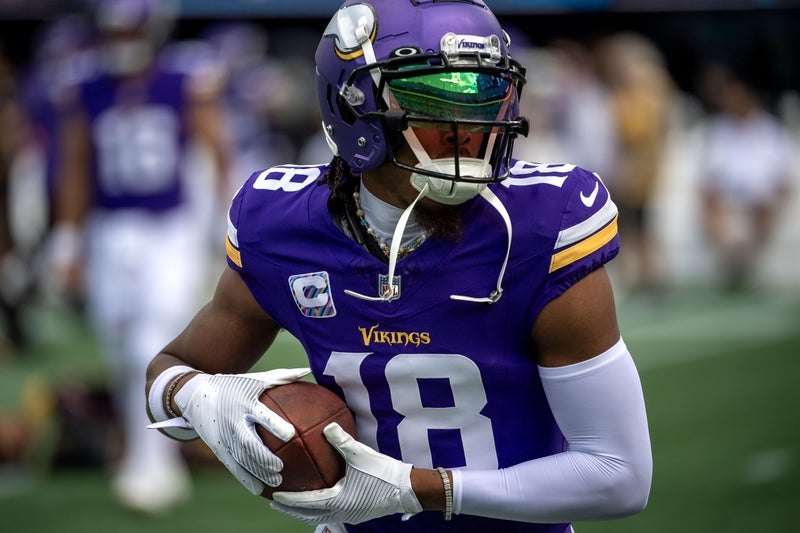
Justin Jefferson has been one of the NFL’s most accomplished receivers since entering the league in 2020. His receiving production includes a league-leading 1,809 yards in 2022 and 1,533 yards during the 2024 regular season.
Jefferson’s route-running, receiving consistency and ability to generate yards across different areas of the field have contributed to his historical production.
Quarterback performance, offensive passing volume and player availability remain important considerations when evaluating Jefferson’s potential to compete for another receiving yards title.
Previous league-leading seasons establish a player’s demonstrated capabilities but do not determine current futures prices or future receiving totals.
CeeDee Lamb
CeeDee Lamb produced one of the NFL’s strongest receiving seasons in 2023, recording 135 receptions for 1,749 yards and 12 receiving touchdowns with the Dallas Cowboys.
He finished second in receiving yards that season behind Tyreek Hill, while leading the league in receptions.
Lamb’s receiving profile demonstrates how substantial target volume can create opportunities for high season-long production. However, his precise standing in the 2026 market must be assessed using current statistics, offensive responsibilities and verified sportsbook prices.
Comparing the Leading NFL Receiving Yards Contenders
The 2025 receiving statistics provide a useful comparison of how leading players accumulated their production. Some receivers relied on high reception totals, while others generated more yardage per completed catch.
| Player | 2025 Receptions | 2025 Yards | Yards/Reception | Targets |
|---|---|---|---|---|
| Jaxon Smith-Njigba | 119 | 1,793 | 15.1 | 163 |
| Puka Nacua | 129 | 1,715 | 13.3 | 166 |
| George Pickens | 93 | 1,429 | 15.4 | 137 |
| Ja’Marr Chase | 125 | 1,412 | 11.3 | 185 |
| Amon-Ra St. Brown | 117 | 1,401 | 12.0 | 172 |
| Trey McBride | 126 | 1,239 | 9.8 | 169 |
Chase received more targets than the other players in this comparison, but Smith-Njigba accumulated more receiving yards. The difference illustrates why target volume must be considered alongside completion efficiency and yards gained per reception.
Pickens recorded fewer receptions than the other leading wide receivers but generated a higher average gain per catch than several players above and below him in the overall receiving yards standings.
McBride’s presence in the comparison also demonstrates that receiving yards leader markets are not restricted to wide receivers. Tight ends with substantial passing-game involvement can produce competitive receiving totals. Additional positional analysis is available in the Best NFL Tight Ends guide.
How to Bet on the NFL Receiving Yards Leader
The NFL receiving yards leader market is a season-long futures wager. A selection succeeds when the chosen player finishes the applicable regular season with the highest receiving-yard total under the sportsbook’s settlement rules.
Sportsbooks commonly make receiving yards leader futures available before the season begins. Some operators continue offering the market during the regular season, although available players and prices can change.
When Is the Receiving Yards Leader Determined?
The receiving yards leader is ordinarily determined after the completion of the NFL regular season. Postseason receiving yards do not count towards the regular-season receiving yards title.
The final settlement is based on the statistics and rules recognised by the sportsbook, including any applicable official statistical corrections.
What Happens If Two Players Finish Tied?
A tie for the highest receiving-yard total is settled according to the individual operator’s market rules. Some markets may apply dead-heat settlement, while others may specify different conditions.
Settlement rules should be reviewed before placing a season-long futures wager rather than assuming every sportsbook handles ties identically.
How Do Injuries Affect Receiving Yards Futures?
Injuries can substantially affect season-long receiving totals by reducing games played, targets and offensive involvement.
In most conventional futures markets, an injury does not automatically void a selection once the applicable market conditions have been met. The precise treatment depends on the operator’s rules.
Player availability can be assessed using official team reports and NFL injury information.
NFL Receiving Yards Futures vs Weekly Player Props
Season-long receiving yards futures and weekly receiving-yard props concern different outcomes, despite both relying on receiving statistics.
| Feature | Receiving Yards Leader Futures | Weekly Receiving Yards Props |
|---|---|---|
| Market Period | Full regular season | Individual game |
| Objective | Finish with the most receiving yards | Exceed or fall below a listed threshold |
| Settlement | Following the relevant regular season | Following the relevant game |
| Main Considerations | Season-long production, availability and competition | Opponent, usage, injuries and game conditions |
| Market Availability | Varies by season and operator | Generally associated with scheduled games |
| Odds Movement | Influenced by season-long developments | Influenced by game-specific information |
A receiver may consistently exceed individual game receiving-yard thresholds without finishing as the overall season leader. Conversely, a player with several exceptionally productive games may accumulate substantial season yardage despite recording more variable weekly performances.
NFL Receiving Yards Leaders by Season
The history of NFL receiving yards leaders demonstrates how the position has evolved and how different offensive systems have influenced statistical production.
The following table identifies the regular-season receiving yards leaders from 2009 through 2025. These totals are historical results rather than current sportsbook projections.
| Season | Player | Receiving Yards | Team |
|---|---|---|---|
| 2025 | Jaxon Smith-Njigba | 1,793 | Seattle Seahawks |
| 2024 | Ja’Marr Chase | 1,708 | Cincinnati Bengals |
| 2023 | Tyreek Hill | 1,799 | Miami Dolphins |
| 2022 | Justin Jefferson | 1,809 | Minnesota Vikings |
| 2021 | Cooper Kupp | 1,947 | Los Angeles Rams |
| 2020 | Stefon Diggs | 1,535 | Buffalo Bills |
| 2019 | Michael Thomas | 1,725 | New Orleans Saints |
| 2018 | Julio Jones | 1,677 | Atlanta Falcons |
| 2017 | Antonio Brown | 1,533 | Pittsburgh Steelers |
| 2016 | T.Y. Hilton | 1,448 | Indianapolis Colts |
| 2015 | Julio Jones | 1,871 | Atlanta Falcons |
| 2014 | Antonio Brown | 1,698 | Pittsburgh Steelers |
| 2013 | Josh Gordon | 1,646 | Cleveland Browns |
| 2012 | Calvin Johnson | 1,964 | Detroit Lions |
| 2011 | Calvin Johnson | 1,681 | Detroit Lions |
| 2010 | Brandon Lloyd | 1,448 | Denver Broncos |
| 2009 | Andre Johnson | 1,569 | Houston Texans |
Calvin Johnson won consecutive receiving yards titles in 2011 and 2012. His 2012 total of 1,964 yards remains one of the defining receiving performances in NFL history.
Julio Jones and Antonio Brown also won multiple receiving titles during the period covered by the table. Their achievements demonstrate how consistent offensive involvement and receiving efficiency can sustain elite production across different seasons.
More recent leaders include Tyreek Hill in 2023, Ja’Marr Chase in 2024 and Jaxon Smith-Njigba in 2025, illustrating the continuing competition for the league’s annual receiving yards title.
Most Receiving Yards in a Single NFL Season
The NFL single-season receiving yards record is 1,964 yards, established by Calvin Johnson with the Detroit Lions in 2012.
Cooper Kupp approached that record in 2021, finishing with 1,947 receiving yards for the Los Angeles Rams. His performance was among the most productive receiving seasons in NFL history but did not surpass Johnson’s record.
The following table highlights notable single-season receiving performances.
| Player | Season | Receiving Yards | Team |
|---|---|---|---|
| Calvin Johnson | 2012 | 1,964 | Detroit Lions |
| Cooper Kupp | 2021 | 1,947 | Los Angeles Rams |
| Julio Jones | 2015 | 1,871 | Atlanta Falcons |
| Jerry Rice | 1995 | 1,848 | San Francisco 49ers |
| Antonio Brown | 2015 | 1,834 | Pittsburgh Steelers |
| Justin Jefferson | 2022 | 1,809 | Minnesota Vikings |
| Tyreek Hill | 2023 | 1,799 | Miami Dolphins |
| Jaxon Smith-Njigba | 2025 | 1,793 | Seattle Seahawks |
These performances span different eras of NFL football, including seasons played under different regular-season schedules. The league expanded from 16 to 17 regular-season games beginning in 2021.
Comparisons between historical seasons should therefore consider both total receiving yards and average yards per game. Total yardage determines the single-season record, but receiving yards per game can provide additional context when comparing players from different scheduling eras.
All-Time NFL Receiving Yards Leaders
Career receiving yards measure accumulated production across a player’s regular-season career. Unlike season-long leader markets, career rankings reflect longevity as well as individual-season performance.
Jerry Rice holds the NFL career receiving yards record with 22,895 regular-season receiving yards. His career total remains substantially ahead of the next generation of leading receivers.
| Rank | Player | Career Receiving Yards |
|---|---|---|
| 1 | Jerry Rice | 22,895 |
| 2 | Larry Fitzgerald | 17,492 |
| 3 | Terrell Owens | 15,934 |
| 4 | Randy Moss | 15,292 |
| 5 | Isaac Bruce | 15,208 |
| 6 | Tony Gonzalez | 15,127 |
| 7 | Tim Brown | 14,934 |
| 8 | Steve Smith Sr. | 14,731 |
| 9 | Marvin Harrison | 14,580 |
| 10 | Reggie Wayne | 14,345 |
The table covers the leading completed career totals in this historical group. It is not a live ranking incorporating every active player’s subsequent production.
Tony Gonzalez’s inclusion illustrates the receiving contribution of tight ends at the highest level. Although wide receivers dominate most receiving-yard rankings, the statistical category includes eligible receptions by players at other offensive positions.
NFL Receiving Yards Over/Under Betting
Receiving yards over/under markets allow bettors to select whether a player will finish a particular game with more or fewer receiving yards than the threshold listed by the sportsbook.
For example, a hypothetical receiving-yard line of 82.5 requires at least 83 receiving yards for an over selection to succeed. An under selection succeeds if the player records 82 receiving yards or fewer, subject to the operator’s settlement conditions.
Because the line includes half a yard, there is no possibility of finishing exactly on the threshold. Whole-number receiving-yard lines may allow a push when the player’s final total matches the listed number, depending on sportsbook rules.
How Receiving Yards Are Calculated
Receiving yards are credited when an eligible player catches a completed forward pass and gains or loses yardage on the resulting play. The official statistical total reflects the net receiving yards credited to the player.
Rushing yards and passing yards are separate statistical categories. A player can accumulate receiving yards and rushing yards in the same game, but only receiving yards count towards a conventional receiving-yard prop.
Official statistical corrections may affect final settlement. Individual sportsbook rules determine how such corrections are treated.
What Determines Receiving Yards Lines?
Sportsbooks may consider historical receiving production, expected targets, offensive passing volume, opposing defensive performance, player availability and other relevant information when setting receiving-yard thresholds.
Market prices and lines can change before kickoff as new information becomes available or betting activity influences the operator’s pricing.
Comparing available prices through BestOdds odds comparisons can help identify differences between supported markets.
What Are Alternate Receiving Yards?
Alternate receiving yards markets allow bettors to select different receiving-yard thresholds from the sportsbook’s standard line.
For example, a player with a hypothetical standard receiving-yard line of 82.5 may also have alternate thresholds of 50 or more, 70 or more, 100 or more and 125 or more receiving yards.
The prices for these thresholds differ because each selection represents a different statistical outcome.
| Market | Example Threshold | General Pricing Relationship |
|---|---|---|
| Standard Receiving Yards | 82.5 | Main market |
| Alternate Receiving Yards | 50+ | Generally shorter price |
| Alternate Receiving Yards | 70+ | Price depends on market conditions |
| Alternate Receiving Yards | 100+ | Generally longer price |
| Alternate Receiving Yards | 125+ | Generally longer price |
Lower receiving-yard thresholds generally have a higher probability of being reached than higher thresholds for the same player and game. Sportsbooks account for those differences when pricing the markets.
The thresholds above are illustrative. Actual alternate lines and prices depend on the player, game and sportsbook.
How Does Alternate Receiving Yards Betting Work?
An alternate receiving yards selection generally succeeds when the player reaches the specified minimum number of receiving yards, provided the market’s participation and settlement requirements are satisfied.
For example, a selection requiring 70 or more receiving yards succeeds if the player finishes with at least 70 officially credited receiving yards.
A selection requiring 100 or more yards would need a higher total and would ordinarily be priced differently.
Alternate receiving-yard markets may be available individually or as eligible selections within same-game parlays.
Which Sportsbooks Offer Alternate Receiving Yards?
Several established sportsbook operators have offered receiving-yard player props and alternate thresholds, although current availability depends on the game, jurisdiction and operator.
Other operators may also offer receiving-yard props. The presence of a sportsbook in this section does not establish that a particular alternate market is currently available.
Available operators and their supported markets can be compared through the sportsbook directory.
How to Analyse NFL Receiving Yards Props
Receiving-yard markets depend on a combination of individual player usage, offensive performance and opposing defensive conditions. A season average provides useful context, but it does not fully explain how a player’s opportunities may change in a particular matchup.
Target Share
Target share measures the proportion of team passing attempts directed towards a particular player. A receiver with a substantial target share generally has more opportunities to record receptions and receiving yards.
However, targets do not always result in completed catches. Catch rate, route depth and quarterback accuracy can influence how target volume translates into yardage.
Receptions and Catch Rate
Receptions measure completed passes caught by a player, while catch rate expresses receptions as a proportion of targets.
A receiver with 10 targets and eight receptions has an 80% catch rate for that sample. The number of receiving yards accumulated depends on the yardage generated from those eight catches.
Yards Per Reception
Yards per reception measures the average receiving yardage gained on each completed catch.
Players frequently targeted on deeper routes may record more yards per reception than receivers primarily used on shorter passing plays. However, route depth can also influence the probability of completing individual passes.
Average Depth of Target
Average depth of target describes the average distance downfield at which a player is targeted.
Receivers used on deeper routes may generate substantial yardage from relatively few catches, while players frequently targeted close to the line of scrimmage may rely more heavily on yards after the catch.
Yards After the Catch
Yards after the catch measure the additional yardage a receiver gains after completing a reception.
This statistic is relevant for players whose receiving production depends partly on their ability to advance the ball after catching shorter passes.
A player can generate substantial receiving yardage without consistently receiving deep targets when yards after the catch contribute significantly to overall production.
Quarterback Performance
Quarterback accuracy, passing volume and offensive efficiency influence receiving opportunities.
A change in quarterback can affect target distribution, route selection and the frequency of completed passes. Historical receiver performance should therefore be considered alongside the current quarterback situation.
Defensive Matchups
Opposing defensive schemes can affect how frequently a receiver is targeted and the types of routes available.
Man coverage, zone coverage, safety support and defensive personnel can all influence receiving opportunities.
Opponent receiving-yard allowances should be interpreted in context because defensive statistics can be influenced by previous opponents, injuries and game circumstances.
Injuries and Player Availability
Injuries to receivers, quarterbacks and offensive linemen may affect target volume, passing efficiency and offensive strategy.
Injuries to other receiving options can also change target distribution, although the effect depends on how the offence adjusts.
Game Script
Game script describes how the score and circumstances influence a team’s offensive approach.
Teams trailing by substantial margins may increase passing volume, while teams protecting a lead may rely more heavily on rushing plays.
These tendencies vary by team and opponent. They should be evaluated alongside offensive strategy rather than treated as guaranteed outcomes.
Receiving Yards vs Receptions: What Is the Difference?
Receiving yards and receptions measure different aspects of passing-game production. A reception records a completed catch, while receiving yards measure the yardage credited from that catch.
A player can record eight receptions for 48 yards, averaging six yards per catch. Another player may record four receptions for 100 yards, averaging 25 yards per catch.
The first player has more receptions, but the second has substantially more receiving yards.
| Factor | Receiving Yards | Receptions |
|---|---|---|
| Targets | Creates yardage opportunities | Creates catch opportunities |
| Catch Rate | Influences completed receiving plays | Directly affects reception totals |
| Route Depth | Can substantially influence yardage | Can influence completion probability |
| Yards After Catch | Contributes directly to yardage | Does not increase the number of catches |
| Passing Volume | Can increase receiving opportunities | Can increase target opportunities |
Receiving-yard and reception markets should therefore be assessed separately, even when they concern the same player and game.
Receiving Yards in Same-Game Parlays
Some sportsbooks allow receiving-yard props to be combined with other eligible markets from the same NFL game.
Potential combinations may include receiving yards and quarterback passing yards, receiving yards and receptions, receiving yards and touchdown scorer markets, or receiving yards and game totals.
These selections may be correlated because they can depend on the same offensive performance. For example, a quarterback’s passing-yard total and a receiver’s receiving-yard total are both influenced by completed passing plays.
Sportsbooks may account for these relationships when pricing combined markets or may restrict particular combinations.
In a conventional same-game parlay, all selections must satisfy their settlement conditions for the wager to succeed, subject to the operator’s rules concerning voided selections.
Alternate receiving-yard thresholds may also be eligible for certain parlays, although a lower threshold does not eliminate the possibility of losing the wager.
Comparing Receiving Yards Odds Across Sportsbooks
Sportsbooks can offer different receiving-yard thresholds and prices for the same player and game. These differences can affect the outcome required for a wager to succeed and the potential return.
For example, one operator might hypothetically list a receiving-yard line at 74.5 while another offers 77.5. Although the difference is three yards, the two markets require different outcomes for an over selection to succeed.
Prices may also differ when the statistical threshold is identical. Comparing both the line and the odds is therefore necessary when evaluating equivalent markets.
Comparing American Odds
American odds express the potential profit relative to a $100 stake for positive prices, or the stake required to generate $100 in profit for negative prices.
For example, hypothetical odds of +150 represent a potential profit of $150 on a successful $100 wager, excluding the return of the original stake.
At -150, a stake of $150 would generate $100 in profit if the selection succeeds.
These examples explain the pricing format and are not quotations from a current receiving-yard market.
Why Sportsbook Prices Differ
Sportsbooks may use different projections, risk assessments and pricing margins when establishing player prop markets.
Differences in market availability, alternate thresholds and settlement conditions can also influence comparisons.
Relevant sportsbook information is available through FanDuel, DraftKings and bet365, subject to operator availability and applicable regulations.
For broader comparisons, consult the BestOdds sportsbook directory and available NFL betting markets.
Common Mistakes When Evaluating Receiving Yards Markets
Using Outdated Player Statistics
Receiving production can change between seasons because of injuries, quarterback changes, offensive personnel and changes in target distribution.
Historical statistics are useful for establishing a player’s demonstrated capabilities but should not be presented as current-season performance.
Relying Only on Receiving Yards Per Game
Receiving yards per game can provide useful context, but a player with a high average may still finish below another receiver in total yardage because of missed games.
Season-long receiving yards leader markets are determined by total regular-season receiving yards, not average receiving yards per appearance.
Ignoring Target Volume
Receiving efficiency matters, but sustained target volume creates opportunities for accumulating season-long yardage.
A receiver with a high average gain per catch may still finish behind a player who receives substantially more opportunities throughout the season.
Comparing Prices Without Comparing Thresholds
A receiving-yard over at 69.5 is not equivalent to an over at 74.5. The statistical requirement differs, even if both markets concern the same player.
Both the price and the threshold should be considered when comparing receiving-yard props.
Treating Historical Odds as Current Prices
Preseason futures prices and weekly player prop lines can change considerably over time.
Historical odds should be clearly dated and should not be presented as available betting opportunities without current verification.
NFL Receiving Yards Frequently Asked Questions
Who leads the NFL in receiving yards?
The current leader is determined by the latest official regular-season receiving-yard totals. The leaderboard changes as games are completed. Jaxon Smith-Njigba finished as the 2025 receiving yards leader with 1,793 yards.
Who led the NFL in receiving yards in 2025?
Jaxon Smith-Njigba led the NFL with 1,793 receiving yards during the 2025 regular season, finishing ahead of Puka Nacua, who recorded 1,715 yards.
Who is favoured to lead the NFL in receiving yards in 2026?
The current favourite depends on the latest available sportsbook prices. Receiving yards leader futures can change throughout the season, and no player should be identified as the current favourite without verified market information.
How do NFL receiving yards leader odds work?
The market allows a selection on which eligible player will finish the regular season with the highest receiving-yard total. The quoted odds determine the potential return if the selection succeeds under the sportsbook’s rules.
Can receiving yards leader odds change during the season?
Yes. Prices may change as players accumulate receiving yards, injuries affect availability and sportsbooks reassess the remaining schedule and competition.
Do playoff receiving yards count towards the regular-season leader?
No. Conventional regular-season receiving yards leader markets are settled using regular-season statistics rather than postseason receiving yards.
What happens if two players finish with the same receiving yards?
Settlement depends on the sportsbook’s rules. Some operators may apply dead-heat rules, while others may specify different conditions for tied outcomes.
Who has the most receiving yards in NFL history?
Jerry Rice holds the NFL career receiving yards record with 22,895 regular-season receiving yards.
What is the NFL single-season receiving yards record?
Calvin Johnson established the NFL single-season receiving yards record with 1,964 yards for the Detroit Lions in 2012.
Has anyone led the NFL in receiving yards in consecutive seasons?
Yes. Calvin Johnson led the NFL in receiving yards in both 2011 and 2012, recording 1,681 and 1,964 yards respectively.
What is a receiving yards over/under bet?
A receiving yards over/under market concerns whether a player records more or fewer receiving yards than a specified threshold during the relevant game or period.
What are alternate receiving yards?
Alternate receiving yards are betting markets offering different yardage thresholds from the standard line. Each threshold may carry a different price because it represents a different statistical requirement.
How do receiving yards and receptions differ?
Receptions measure completed catches, while receiving yards measure the net yardage credited from those catches. A player can record more receptions than another player while accumulating fewer receiving yards.
Can tight ends lead the NFL in receiving yards?
Tight ends are eligible to lead the league in receiving yards because the statistical category is not restricted to wide receivers. However, wide receivers have historically accounted for most annual receiving yards titles.
How do injuries affect receiving yards futures?
Injuries can reduce a player’s games played, receiving opportunities and total season production. The treatment of injured players in futures markets depends on the sportsbook’s settlement conditions.
What factors influence receiving yards odds?
Relevant factors include target volume, receiving efficiency, quarterback performance, defensive matchups, offensive passing volume, injuries and game circumstances.
Can receiving yards props be included in same-game parlays?
Some sportsbooks permit eligible receiving-yard props to be combined with other markets from the same game. Availability and pricing depend on the operator’s rules and relationships between selections.
Why do sportsbooks offer different receiving-yard lines?
Sportsbooks may use different statistical projections, pricing margins and market adjustments. As a result, the same player’s receiving-yard market can feature different thresholds and prices across operators.
How are receiving yards calculated?
Receiving yards are the net yards credited to a player from completed forward passes. Rushing yards and passing yards are recorded separately.
When are NFL receiving yards futures settled?
Regular-season receiving yards leader futures are ordinarily settled following the completion of the regular season, subject to official statistics and the sportsbook’s settlement rules.
NFL Receiving Yards Leader Odds – Final Overview
NFL receiving yards leader futures focus on total regular-season receiving production. Leading contenders must combine substantial receiving opportunities with efficiency and availability across the season.
Jaxon Smith-Njigba’s 2025 receiving title, Puka Nacua’s substantial reception volume and the historical achievements of players such as Ja’Marr Chase, Justin Jefferson and Calvin Johnson demonstrate the different statistical profiles associated with leading receiving performances.
For individual game markets, receiving yards, receptions and alternate thresholds should be evaluated separately. Target volume, receiving efficiency, defensive matchups and game circumstances can influence the relevant statistical outcomes.
Comparing sportsbook thresholds and prices is important because seemingly similar receiving-yard markets can require different outcomes. The NFL odds comparison page and sportsbook directory provide additional information about supported markets and operators.
All betting involves financial risk. Market availability, eligibility and settlement rules vary by operator and jurisdiction. Wagering decisions should account for the possibility of losing the amount staked.