NFL Injury Report
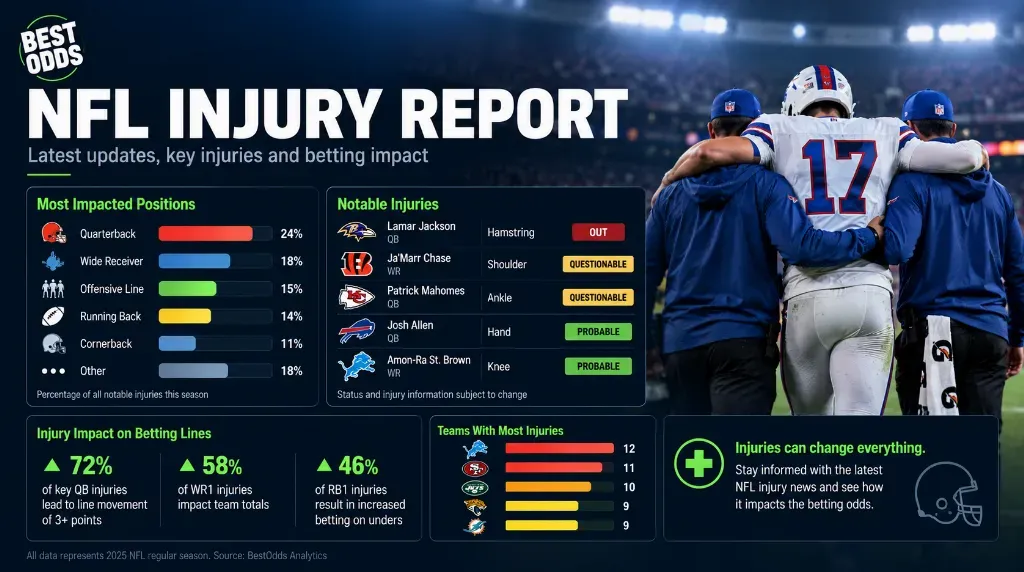
NFL injuries are one of the most powerful forces shaping the weekly betting market, yet they remain one of the most underutilized edges for casual bettors. Every week…


These reports are not just roster housekeeping. They are live market signals, capable of moving point spreads by multiple points, flipping totals, and reshaping player prop prices within minutes of a major update hitting the wire.
The data bears this out. In the 2025 adjusted games lost (AGL) standings, seven of the 10 healthiest teams reached the playoffs, while only three of the 10 most injury-ravaged franchises did. The Arizona Cardinals, viewed by some preseason forecasters as an NFC West sleeper, finished 3-14 after posting the second-highest single-season AGL total ever measured.
Conversely, the New England Patriots recorded the lowest AGL total in the league and finished 14-3, the exact inverse of Arizona’s record. Health is not just a roster detail in the NFL. It is one of the strongest predictors of team success and betting value.
At BestOdds, we provide updated NFL injury coverage throughout the season to help you make sharper, better-informed wagers. Whether you are betting point spreads, game totals, player props, or same-game parlays, knowing which players are trending toward active or inactive before kickoff is essential.
The sections below break down the key injury designations, how different position groups affect the betting market, historical injury statistics by team and position, and a practical guide to using injury information in your weekly handicapping routine.
Best Sportsbooks for NFL Betting
NFL betting remains the most popular form of sports wagering in the United States, offering everything from point spreads and totals to player props, futures, live betting, and same-game parlays. Whether you’re betting on weekly matchups, division winners, playoff races, or the Super Bowl, choosing the right sportsbook can significantly enhance the experience.
The best NFL betting sites combine competitive odds, extensive betting markets, reliable mobile apps, and valuable promotions throughout the season. Below are some of the top sportsbooks for NFL betting.
DraftKings

DraftKings has established itself as one of the premier destinations for NFL bettors. The sportsbook offers one of the deepest football betting menus available, covering spreads, moneylines, totals, player props, same-game parlays, and season-long futures.
NFL bettors also benefit from DraftKings’ extensive promotional calendar, which frequently includes profit boosts, no-sweat bets, and enhanced odds on marquee games. The platform’s intuitive design makes it easy to navigate even during busy NFL weekends.
Key Features
- Extensive NFL betting markets
- Strong same-game parlay options
- Weekly NFL promotions
- Excellent mobile betting app
FanDuel

FanDuel remains one of the most popular sportsbooks for NFL wagering thanks to its user-friendly interface and competitive odds. The operator consistently posts a wide range of betting markets for every NFL game throughout the season.
FanDuel is particularly strong in player props and same-game parlays, allowing bettors to build customized wagers around individual performances and game outcomes. The sportsbook also offers regular NFL-specific promotions and boosted odds.
Key Features
- Easy-to-use mobile platform
- Large player prop selection
- Competitive NFL odds
- Frequent odds boosts
BetMGM

BetMGM provides a comprehensive NFL betting experience with robust futures markets and extensive game-day wagering options. Bettors can find odds on everything from weekly matchups to MVP, Rookie of the Year, and Super Bowl futures.
The sportsbook also delivers a variety of promotions throughout the NFL season, making it attractive for both casual bettors and experienced players looking for additional value.
Key Features
- Deep NFL futures markets
- Competitive game-day odds
- Numerous promotional offers
- Strong player prop coverage
Caesars

Caesars Sportsbook offers a straightforward NFL betting experience backed by one of the most recognizable names in sports wagering. The sportsbook features all major NFL markets along with an easy-to-navigate platform.
NFL bettors can also take advantage of Caesars Rewards integration, allowing wagers to contribute toward rewards and benefits within the Caesars ecosystem.
Key Features
- User-friendly sportsbook
- Full NFL betting menu
- Caesars Rewards integration
- Regular NFL promotions
Bet365

Bet365 has become a favorite among NFL bettors due to its extensive betting menu and live wagering capabilities. The sportsbook offers numerous alternate spreads, totals, and player props beyond standard betting options.
Its live betting platform is particularly strong, providing bettors with opportunities to react to changing game situations throughout NFL contests.
Key Features
- Exceptional live betting options
- Extensive alternate lines
- Wide variety of player props
- Comprehensive futures markets
BetRivers

BetRivers delivers a strong overall NFL betting experience with competitive pricing and a clean betting interface. The sportsbook covers every major NFL market and offers numerous opportunities for both pregame and in-game wagering.
NFL bettors will also find useful betting tools, same-game parlay options, and regular football promotions throughout the season.
Key Features
- Competitive NFL odds
- Strong in-game betting menu
- Same-game parlay options
- User-friendly interface
Hard Rock Bet

Hard Rock Bet continues to expand its NFL offerings and provides a growing selection of football betting markets. The sportsbook covers weekly games, futures, player props, and playoff wagering throughout the season.
The platform’s streamlined design and expanding promotions make it an increasingly attractive option for NFL bettors seeking a straightforward wagering experience.
Key Features
- Comprehensive NFL betting options
- Growing futures market selection
- Easy-to-use mobile app
- Regular football promotions
Why injury reports matter for NFL betting
Impact on point spreads and odds
When injury news breaks on a high-profile player, sportsbooks respond within minutes. A starting quarterback ruled out can shift a spread by three to four points or more, while the total may drop several points simultaneously to reflect reduced scoring potential. Even non-QB injuries carry measurable market weight. A star left tackle missing the game can move a spread by half a point, and in a league where key numbers like 3 and 7 determine a significant percentage of ATS outcomes, half a point can make all the difference.
The timing of the report matters as much as the news itself. The NFL injury reporting cadence creates predictable information waves across the week:
Wednesday
First signals. Limited or DNP designations on key players flag potential concern.
Thursday
Trend confirmation. Repeat absences move the market meaningfully.
Friday
Primary reaction point. Most spread adjustments happen Friday evening.
Sunday
Final window. Late scratches create the sharpest, fastest moves of the week.
Line movement and timing
Professional bettors are structured to capitalize on the gap between when injury news breaks and when the broader market fully adjusts. In today’s information environment, that window is narrow, and lines can shift within two to three minutes of a significant update. For bettors who track injury news in real time, acting quickly on meaningful information is essential to capturing value before the spread reaches its new equilibrium. A quarterback ruled out mid-week, for example, can flip a team from a three-point favorite to a two-point underdog before casual bettors have opened the app.
Public overreactions
Casual bettors tend to react emotionally to injury news, particularly when a star player’s name is attached. This behavior consistently pushes lines further than the underlying roster impact warrants, creating counter-opportunities for bettors who do the analytical work. When a high-profile receiver is ruled out, the public often hammers the under or backs the opponent on the spread, even if the affected team has a quality replacement or a coaching staff capable of redistributing the offensive load. The more productive approach is to evaluate the actual quality of the backup, the team’s historical performance without that player, and how coaching adjustments might neutralize the absence.
Fantasy football and player props effects
The daily fantasy and player props markets are tightly intertwined with injury news. When a featured back or top receiver is ruled out, a cascade of secondary players see their prop lines adjusted upward to reflect expanded opportunity. Bettors who understand these usage-based adjustments and act before the market catches up can find consistent value in receiving yards, rushing yards, and anytime touchdown markets throughout the season.
Team depth and coaching adjustments
Not all injuries are created equal across teams. A franchise with genuine positional depth, an adaptable scheme, and a creative coaching staff is fundamentally different from one that relies heavily on a small number of irreplaceable players. Systems-based offenses tend to maintain production through personnel changes. Strong offensive lines insulate quarterbacks from individual receiver losses. Identifying which teams are built to absorb attrition is one of the most durable edges in NFL betting.

NFL injury report designations explained
| Designation | Meaning | Historical play rate | Betting implication |
|---|---|---|---|
| Questionable | 50/50 chance of playing | ~70–75% of players play | Moderate movement; wait for clarity |
| Doubtful | Unlikely to play | Fewer than 25% play | Significant movement; backup values rise |
| Out | Confirmed inactive | 0% | Maximum adjustment; act early or late |
| IR | Out minimum 4 weeks | 0% until activated | Season-altering; futures/prop repricing |
| PUP | Out through at least Week 4 | 0% until activated | Extended absence; relevant for early futures |
A player listed as questionable is the most nuanced and valuable designation for bettors. Historical data suggests roughly 70 to 75 percent of players with a questionable tag ultimately play, which means the market often overprices the likelihood of absence. Conversely, a player listed as doubtful who unexpectedly plays can create significant in-game value before books adjust their live lines.
NFL injury statistics: key numbers bettors should know
Adjusted games lost is the most useful single measure of injury burden available to bettors. Unlike a raw count of missed games, AGL weights absences by whether the missing player was an expected starter or important rotational contributor, and it credits partial games to players who suit up at less than full health. Ranks run from 1, the fewest games lost, to 32, the most. The figures below cover the regular season only, so postseason absences are excluded.
Most and least injured NFL teams in 2025 (by Adjusted Games Lost)
The 2025 season produced one of the widest injury gaps ever recorded. Arizona finished with 179.8 adjusted games lost, the second-highest single-season total in the 25 years the metric has been tracked, behind only the 2021 Baltimore Ravens at 180.2. No other team was close: the distance between Arizona and 31st-ranked Detroit was larger than the distance between Detroit and 19th-ranked New Orleans.
| Team | 2025 AGL | Rank | Key absences | Record |
|---|---|---|---|---|
| Arizona Cardinals | 179.8 | 32nd (most injured) | Murphy-Bunting, Thomas, G. Williams (DB); Conner, Benson (RB) | 3–14 |
| Detroit Lions | 130.3 | 31st | Onwuzurike, Rakestraw, K. Joseph, Arnold, LaPorta | 9–8 |
| Washington Commanders | 124.4 | 30th | Daniels (QB), Ekeler, N. Brown, Wise, Armstrong | 5–12 |
| Miami Dolphins | 117.3 | 29th | Eichenberg, J. Daniels (OL); Kohou, Duck, Waller | 7–10 |
| San Francisco 49ers | 115.0 | 28th | Bosa, M. Williams (ACL); Aiyuk, Pearsall, Warner | 12–5 |
| Los Angeles Chargers | 106.2 | 27th | Slater, Alt (OL); Harris, Hampton, Colson | 11–6 |
| Kansas City Chiefs | 49.4 | 4th (healthiest defense) | Mahomes (December only); offensive line churn | 6–11 |
| Seattle Seahawks | 46.9 | 3rd | Defensive backs the only group above 10 AGL | 14–3 |
| Philadelphia Eagles | 44.0 | 2nd | No significant quarterback or skill-position losses | 11–6 |
| New England Patriots | 43.5 | 1st (healthiest) | No position group above 11 AGL; zero at quarterback | 14–3 |
The correlation held in both directions. Seven of the 10 teams with the lowest AGL totals reached the playoffs, and the Patriots paired the league’s cleanest injury sheet with a 14-3 record. Among the 10 most injured teams, only San Francisco, Los Angeles and Houston qualified. Kansas City is the instructive exception in the other direction: the Chiefs ranked fourth healthiest overall and first in defensive AGL, yet finished 6-11, a reminder that health is a strong predictor rather than a deterministic one.
Detroit is worth separate mention for bettors handicapping 2026 win totals. The Lions posted 92.7 defensive AGL, the second-worst defensive total ever measured, and did so for the second consecutive season. They remain the only team on the all-time worst-defensive-AGL list to have produced winning records while carrying that burden.
Where 2025 injuries clustered by position group
Team-level totals conceal the concentrations that actually move prop markets. The table below identifies the 2025 leader in each position group, since a single unit collapsing is what unlocks pricing inefficiencies week to week.
| Position group | 2025 leader (AGL) | Primary absences | Market angle |
|---|---|---|---|
| Defensive backs | Arizona (51.7) | Murphy-Bunting, G. Williams, W. Johnson, Melton | Opposing receiving yardage and passing props |
| Offensive line | Miami (45.7) | Eichenberg and J. Daniels, both starting guards | Sack and QB-hit props; rushing unders |
| Interior defensive line | Baltimore (29.6) | Madubuike (neck), B. Washington (ankle) | Opposing rushing yardage; interior run defense |
| Edge rushers | San Francisco (28.5) | Bosa and M. Williams, both ACL tears | Opposing QB completion rate; game totals |
| Wide receivers | Tampa Bay (27.9) | Evans, McMillan, Godwin | Target-share redistribution to WR2 and TE |
| Running backs | Arizona (30.6) | Conner (foot), Benson (meniscus) | Backup rushing yards and anytime TD |
| Linebackers | NY Giants and LA Chargers (22.9 each) | McFadden (foot); Colson (shoulder) | Opposing TE and receiving-back props |
| Tight ends | Detroit (18.6) | LaPorta (knee), Wright, Zylstra | Reduced TE volume; wider WR distribution |
| Quarterbacks | Cleveland (18.0) | Watson (Achilles); Washington 12.1 with Daniels | Largest spread and total adjustments |
Two trends stand out. First, defensive back attrition reached unprecedented levels: the previous single-season record of 46.8, set by the 2018 Panthers, was surpassed by both Arizona (51.7) and Detroit (47.4) in the same year. Second, receiver injuries broadened considerably. Only two teams exceeded 20 AGL at wide receiver in 2024, while seven cleared that threshold in 2025, which meant more weeks in which secondary targets carried inflated usage relative to their prop prices.
The inverse cases are equally actionable for handicappers. Baltimore posted just 1.1 AGL across its entire offensive line and Buffalo 3.6, the only two teams under 5.0. Minnesota lost 0.1 AGL at wide receiver and Las Vegas 0.5. Carolina finished with 2.9 AGL in the secondary despite ranking 21st in total AGL, illustrating why team-level numbers alone are an incomplete input.
Spread impact by position
| Position | Est. spread impact (out) | Prop market effect | Key context |
|---|---|---|---|
| Quarterback | 3–7+ points | All skill-position props shift | Biggest single-player market mover |
| Starting RB (featured) | 1–2 points | Backup RB rush yards up; WR targets up | Usage redistribution is predictable |
| WR1 / top receiver | 1–2 points | Other WRs see target share increases | Elite target-share receivers sit at the top of the range |
| Starting LT / OT | 0.5–1 point | QB hits prop affected | Cluster OL losses multiply impact |
| CB1 / shutdown corner | 0.5–1 point | Opposing WR targets up | Amplified in pass-heavy matchups |
| Edge rusher | 0.5 point | QB completion % and total may rise | Cluster losses matter more |
| Starting center | 0.5 point | Interior run defense props affected | Communication losses degrade whole line |
Most common NFL injury types
| Injury type | Avg. games missed | Most affected positions | Betting significance |
|---|---|---|---|
| ACL tear | Full season (17+ games) | RB, WR, CB, LB | Immediate IR; major futures repricing |
| Hamstring strain | 1–4 games | WR, RB, CB | Frequent recurrence; questionable tags common |
| Concussion (protocol) | 1–3+ games | QB, LB, WR, TE | Protocol unpredictable; line holds until cleared |
| High ankle sprain | 2–6 games | RB, WR, QB | Reduces explosiveness even if player returns |
| Achilles tear | Full season (17+ games) | QB, RB, OL, DB | Season-ending; a recurring 2025 driver at RB and DB |
| Knee sprain (non-ACL) | 2–6 games | OL, DL, LB | Performance impact often underpriced |
| Shoulder injury | 1–6 games | QB, WR, OL | Limits throwing velocity and arm extension |
| Rib / chest injury | 1–3 games | QB, RB, WR | Often managed through; affects prop performance |
How to read the NFL injury report for betting purposes
The practice participation labels, Full, Limited and Did Not Participate, often reveal the direction a player’s status is trending before an official designation is issued. Reading the trajectory across Wednesday, Thursday, and Friday is more valuable than reading any single day in isolation.
- Full participation (FP): Player practiced without restrictions. Rarely leads to a game-status downgrade unless the injury is chronic or management-based.
- Limited participation (LP): Player practiced but was restricted. Watch for LP on multiple consecutive days as a signal of genuine concern.
- Did not participate (DNP): Two or more DNP days in a row for a key player should be treated as a probable out regardless of official designation.
- No injury designation (NID): Player is healthy and confirmed active. No market implication beyond confirming availability.
It is also worth tracking the nature of the injury, not just the status. Soft-tissue injuries like hamstrings and high ankle sprains carry a much higher risk of recurrence than structural issues that have healed. A player returning from a hamstring strain may be active but operating at reduced effectiveness for several weeks, creating value in their individual prop markets even while the spread impact remains minimal.
Cluster injuries and their compound effect on lines
When a team loses two or three players at the same position group, the cumulative spread impact can significantly exceed the sum of the individual moves. This happens because the losses compound in ways that stretch beyond simple personnel replacement. On the offensive line, losing three starters means the remaining veterans are playing alongside backups with limited shared practice time. Communication, timing, and chemistry all degrade simultaneously.
The following position groups most commonly produce compound spread movement when multiple players are injured at once:
-
- Offensive line: Three or more starters out can move a spread by 2+ points even if no single lineman would have moved it alone. Miami led the league with 45.7 offensive line AGL in 2025 after losing both starting guards, followed by Carolina at 42.0.
- Secondary (CBs/safeties): Losing a CB2 alongside a CB1 creates coverage gaps that unlock significant passing-game value for the opponent. Arizona (51.7) and Detroit (47.4) both broke the previous single-season record for defensive back AGL in 2025.
- Wide receiver corps: When a team loses its top two receivers, the opponent can simplify its coverage calls, amplifying the impact beyond raw target-share math. Seven teams exceeded 20 AGL at the position in 2025, up from two the previous season.
- Running back depth: The 2025 Cardinals led the league at 30.6 RB AGL after losing James Conner to a foot injury and Trey Benson to a torn meniscus, forcing them down the depth chart for most of the season.
Weekly NFL injury reports
Check back every week during the 2026 NFL season for updated injury news and analysis. Our reports highlight the players most likely to affect spreads, totals, and props, and we track line movement in real time as official designations are confirmed across the week. For bettors looking to maximize player prop value, try our Anytime TD PRO tool, created by our experts and designed to help identify value in anytime touchdown scorer markets throughout the season.