Prediction Markets Explained: Platforms, Mechanics, and Real-World Applications
Prediction markets are information markets in which participants trade contracts tied to the outcome of future events, with contract prices reflecting the market’s…

At their core, prediction markets translate dispersed beliefs into a single numerical signal. When a contract trades at a price of 0.63, the market is implicitly assigning a 63% likelihood to the defined outcome occurring, based on current information, liquidity, and participant positioning. This probabilistic signal emerges organically through trading activity rather than being set by a central authority or adjusted through margin-based pricing models.

Prediction markets can be classified into three broad structural categories. Regulated event-contract exchanges operate under formal legal frameworks that constrain market scope and position sizing while prioritising resolution integrity. Crypto or on-chain prediction markets rely on decentralised infrastructure and external oracles to determine outcomes, trading regulatory clarity for broader topical coverage. Reputation-based or points-driven forecasting markets remove direct monetary settlement and instead score participants based on long-term accuracy, often within expert communities or research environments.
The fundamental purpose of prediction markets is information aggregation. Unlike gambling products or entertainment-driven wagering systems, these markets are designed to surface probabilistic expectations by incentivising participants to incorporate private knowledge, public data, and analytical insight into tradable positions. The resulting prices frequently outperform polls, surveys, and expert panels when markets are sufficiently liquid and well-defined.
Recommended Prediction Market Platforms in the United States — September 2026
The platforms listed below were selected based on BestOdds’ internal evaluation framework, which measures market design, liquidity characteristics, settlement transparency, compliance posture, and execution reliability. The evaluation process is governed by the editorial process, which outlines testing duration, verification standards, and review methodology applied across all informational and transactional market categories.
Availability remains jurisdiction-dependent. Certain platforms restrict market access, contract size, or funding methods based on regulatory interpretation and enforcement risk.
Shortlisted Prediction Market Platforms
| Platform | Market Focus | Contract Design | Settlement Method | Regulatory Context | Liquidity Characteristics | Structural Constraints |
|---|---|---|---|---|---|---|
| Crypto.com | Crypto, macro indicators | Event-style contracts | Token-based settlement | Exchange-led compliance model | Variable by asset | Platform governance control |
| Fanatics Markets | Sports outcomes | Event-based contracts | USD-based settlement | Emerging US framework | Early-stage, limited depth | Restricted market catalog |
| Kalshi | Economics, policy, weather, events | Binary event contracts | USD-based settlement | CFTC-regulated exchange | Event-dependent, improving | Strict contract definitions |
| Onyx Predictions | Sports, politics, crypto, culture | Binary yes/no event contracts | USD-based settlement via clearing FCM | CFTC-registered introducing broker; NFA member | Inherited from host exchange; unproven | No owned exchange; IB advertising rules |
| Polymarket | Politics, crypto, culture | Binary and multi-outcome | Token-based (on-chain) | Offshore / protocol-based | High on headline events | Oracle dependency |
| PredictIt | Politics, public events | Binary event contracts | USD-based settlement | CFTC no-action framework | High during election cycles | Position limits, trader caps |
| PrizePicks | Player performance | Stat-based props | Fantasy-style settlement | Skill-game classification | High volume, short horizon | Not true market pricing |
| Robinhood | Macro, politics, events | Event-based derivatives | USD-based settlement | Regulated brokerage framework | Retail-driven, episodic | Product availability limits |
| Underdog | Sports outcomes | Fixed-outcome contracts | USD-based settlement | State-licensed framework | Concentrated on major leagues | Limited market scope |
Why These Platforms Were Included
These platforms were selected because they represent distinct structural implementations of prediction-style markets currently accessible to US users or frequently referenced in prediction market discourse. Each illustrates a different tradeoff between regulation, liquidity, contract clarity, and informational signal quality.
Kalshi

Kalshi occupies a unique position as a CFTC-regulated event-contract exchange, with a strong emphasis on economic indicators, public policy outcomes, and measurable real-world events. Contracts are defined with unusually precise resolution criteria, often tied to official data releases or regulatory determinations.
Liquidity varies significantly by event type, but pricing tends to be most informative in markets linked to scheduled data releases such as inflation or interest rate decisions. Kalshi’s regulatory status imposes strict limits on market design, which reduces ambiguity but also narrows topical breadth.



Crypto.com

Crypto.com offers event-style contracts primarily focused on crypto-related outcomes and macro indicators. These products are embedded within a larger exchange ecosystem and typically settle in platform-native assets or tokens.
Market depth varies widely by event, and contract terms are governed centrally rather than through open exchange mechanics. While useful for observing sentiment within crypto-engaged user bases, these markets often reflect platform-specific dynamics rather than broad expectation aggregation.

 Trade contracts, not fixed-odds bets
Operates on regulated trading infrastructure
Easy access with fiat and crypto funding
Trade contracts, not fixed-odds bets
Operates on regulated trading infrastructure
Easy access with fiat and crypto funding
 Trade contracts, not fixed-odds bets
Operates on regulated trading infrastructure
Easy access with fiat and crypto funding
Trade contracts, not fixed-odds bets
Operates on regulated trading infrastructure
Easy access with fiat and crypto funding
 Earn up to $300 in CROCLAIM BONUS





Polymarket

Polymarket represents the most visible crypto-native prediction market, operating via on-chain contracts resolved through oracle mechanisms. The platform supports a wide range of topics, including politics, crypto governance, and cultural events, often responding rapidly to emerging narratives.
Liquidity can be substantial for headline-driven markets, but price reliability depends heavily on oracle design and governance processes. Because settlement outcomes are mediated through decentralized mechanisms rather than regulated authorities, interpretive caution is required when assessing implied probabilities.
 Deposit $10 get a $50 Trading BonusCLAIM BONUS

Fanatics Markets

Fanatics Markets is an emerging entrant focused on sports-related event contracts, leveraging Fanatics’ existing sports audience and infrastructure. Market design emphasizes simplicity and accessibility, with a limited catalog of events and clearly defined outcomes.
Liquidity remains early-stage, and pricing efficiency is still developing. The platform’s relevance lies primarily in its potential integration with mainstream sports ecosystems rather than current depth of informational signal.
PredictIt

PredictIt has established itself as the most consistently liquid venue for political prediction markets in the US. During major election cycles, individual contracts regularly accumulate millions in traded volume, resulting in narrow bid-ask spreads and relatively stable implied probabilities. The platform enforces position limits and trader caps, which constrain maximum exposure but materially reduce the risk of single-actor price distortion. Resolution sources are defined at contract creation and publicly documented, contributing to high settlement transparency.
PrizePicks

PrizePicks operates under a fantasy-style framework centered on player performance statistics rather than open market pricing. While often discussed alongside prediction markets, its structure differs fundamentally: probabilities are not discovered through participant interaction but set administratively.
High participation volume and short event horizons make PrizePicks relevant for understanding player-level expectation framing, but it does not function as a true prediction market in the exchange sense.
Robinhood

Robinhood’s entry into event-based markets reflects a brokerage-led approach rather than a traditional prediction exchange model. Event contracts are integrated within a broader retail trading platform, often framed around macroeconomic or high-profile public outcomes.
Liquidity tends to be episodic, driven by retail interest and media attention rather than sustained market participation. Contract availability and scope are constrained by regulatory considerations and internal product controls, limiting long-term depth but expanding mainstream visibility.
Underdog

Underdog occupies a structurally different position within the ecosystem. While not positioned as a traditional prediction exchange, its outcome-based contract structure mirrors prediction market dynamics more closely than sportsbook odds models. Pricing reflects peer activity rather than house-set margins, and contracts settle deterministically following official event confirmation. Liquidity is concentrated around major sports leagues, allowing tighter spreads and more reliable price signals for high-profile events.
Crypto-native prediction markets were included for comparative analysis rather than recommendation. These platforms expand topical coverage into protocol governance, token economics, and decentralised finance events, but settlement outcomes depend on oracle design and governance processes that introduce additional layers of risk. Their inclusion is necessary for a comprehensive understanding of crypto prediction markets as a category, even where regulatory clarity remains limited.
Onyx Predictions

Onyx Predictions is the regulated event contract arm of Onyx Odds, the social sports prediction platform founded in 2024 and headquartered in New York City. Rather than operating its own exchange, Onyx Predictions is registered with the CFTC as an introducing broker. Onyx routes customer orders but does not hold customer funds, with accounts carried by NinjaTrader Clearing. The company is also pursuing a larger role in the market. The company’s expected prediction makret product will feature peer-to-peer binary yes or no event contracts priced from $0.01 to $0.99 and settled in U.S. dollars through the clearing firm rather than tokens or an internal currency.
Markets are expected to cover sports, politics, crypto, and culture, with sports drawing on data already used by Onyx Odds, which is available in more than 30 states. Because orders would be routed to an existing exchange, liquidity would depend on the host venue rather than Onyx’s user base. No firm launch date has been announced. Promotional details also remain unannounced, and traders should not assume a sportsbook-style deposit match or trading credit will be available. For more information, visit the Onyx Predictions Bonus Review.
Structural Takeaway
Across these platforms, prediction markets diverge along three core dimensions:
- Regulatory posture (CFTC-regulated vs platform-governed vs protocol-based)
- Price discovery mechanisms (open exchange vs fixed-outcome vs fantasy-style)
- Signal reliability (liquidity depth, resolution clarity, governance risk)
Understanding these structural differences is essential when interpreting market prices as expectations rather than forecasts or truth claims.
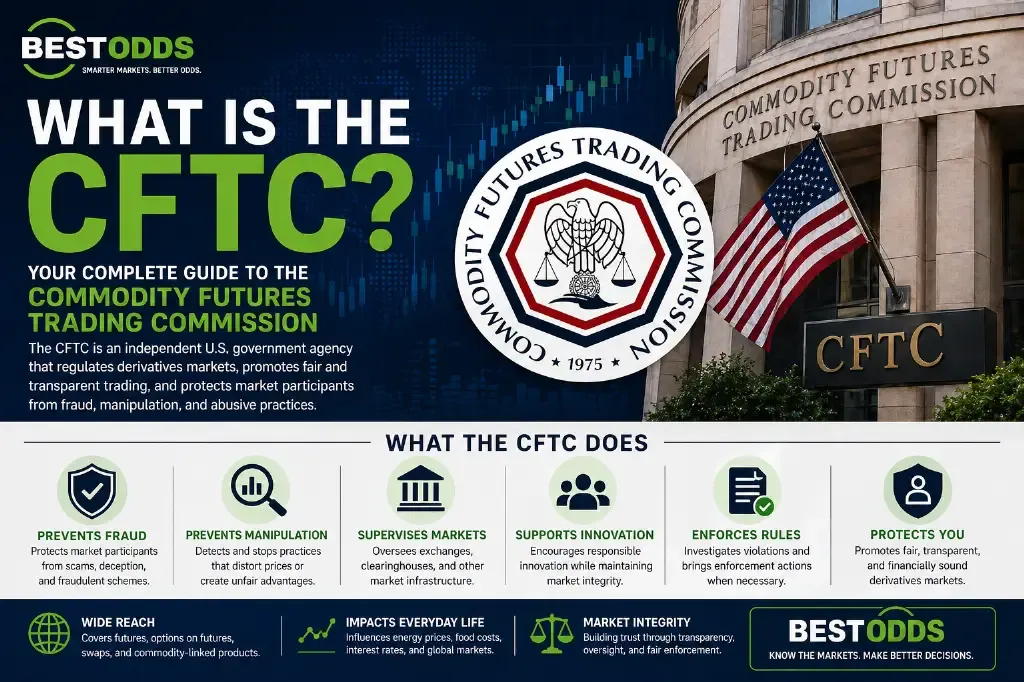
What Is the CFTC?
The Commodity Futures Trading Commission, or CFTC, is a major U.S. financial regulator responsible for overseeing important derivatives markets such as futures, swaps, and certain commodity-linked contracts. Its role centers on promoting fair, transparent, and financially sound markets while helping protect participants from fraud, manipulation, and abusive practices. Although many people rarely interact with these markets directly, the CFTC’s influence can extend into everyday economic life.
Modern commodity and derivatives markets affect far more than agriculture. Energy pricing, metals, interest-rate expectations, currency hedging, and broader market confidence can all connect in some way to sectors supervised through CFTC-related frameworks. Businesses often rely on these markets to manage uncertainty, while investors and institutions watch them for price signals about future supply, demand, inflation, and risk conditions.
The CFTC has also become increasingly relevant in newer areas such as prediction markets, event contracts, and digital asset discussions. As financial innovation evolves, questions about market structure, consumer protection, and lawful participation frequently bring the agency into public focus. Understanding what the CFTC does can help users make better sense of modern markets and the rules shaping them.
How Prediction Markets Work
Prediction markets operate through a structured interaction between contract design, participant incentives, and market liquidity. Unlike fixed-odds systems, prices are not set in advance. They emerge dynamically through trading activity.
Market Structure
Most prediction markets rely on binary contracts, which resolve to either 0 or 100 units depending on whether a specific outcome occurs. For example, a contract titled “Candidate A wins the 2026 Senate election” will resolve to 100 if the outcome is confirmed and 0 otherwise. Participants may buy or sell these contracts at any price between 0 and 100 prior to resolution.
Some platforms support scalar contracts, where settlement values correspond to numerical outcomes within a range, such as voter turnout percentage or inflation rate thresholds. While more expressive, scalar contracts are less common due to increased complexity in settlement and interpretation.
Execution models differ. Centralised platforms typically use order books, allowing participants to place limit orders at specific prices. Orders are matched based on price-time priority, with partial fills occurring when liquidity is fragmented. Decentralised platforms often use automated market makers, where prices adjust algorithmically based on pool balances rather than direct counterparty matching.
Probability Pricing and Information Flow
Contract prices function as implied probabilities. A price of 0.45 reflects a market consensus that the event has a 45% chance of occurring. When new information enters the market—such as polling data, regulatory announcements, or injury reports—participants update positions, causing prices to adjust accordingly.
Price movement reflects not only belief changes but also liquidity imbalance. In thin markets, a small trade can cause disproportionate movement, reducing signal reliability. In deep markets, prices adjust more smoothly, reflecting aggregated information rather than individual influence.
Liquidity, Spreads, and Execution Quality
Liquidity determines the reliability of prediction markets. Narrow bid-ask spreads indicate active participation and efficient price discovery. Wide spreads increase execution cost and distort implied probabilities, particularly for short-term analysis.
Slippage occurs when large orders move the market before execution completes. Platforms with deeper liquidity reduce slippage risk, improving the informational quality of prices. For analytical purposes, markets with sustained trading volume and stable spreads offer the most reliable forecasts.
Resolution Process
Each contract specifies a resolution source, such as an official government announcement or league authority confirmation. Settlement occurs only after outcome verification, often following a defined dispute window. Clear resolution criteria are essential for market credibility, as ambiguity undermines trust in the price signal.
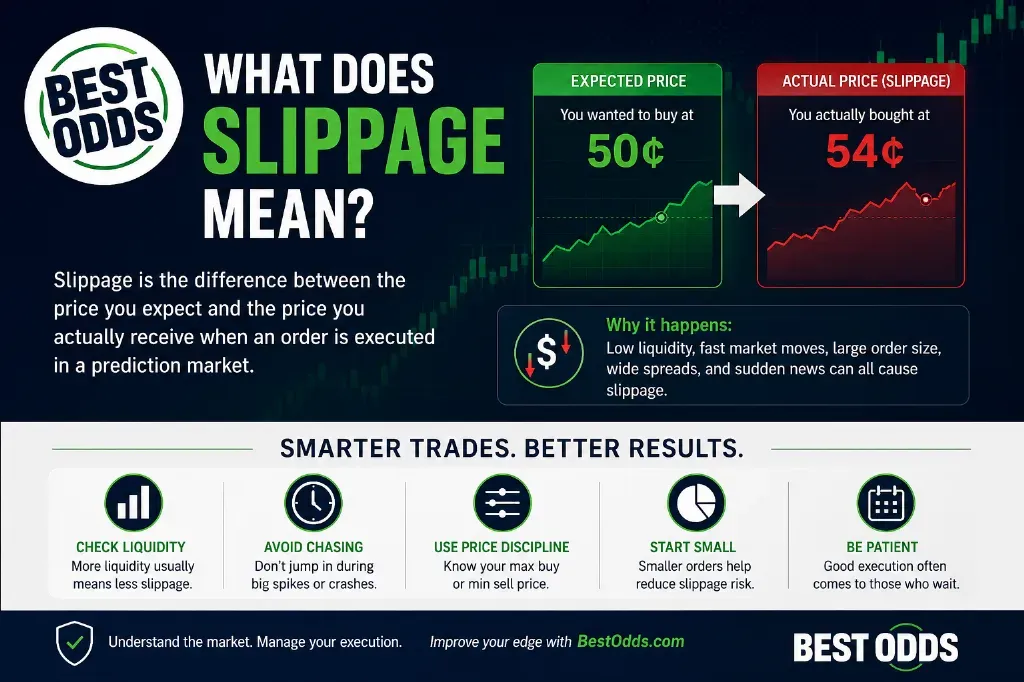
What Does Slippage Mean?
Slippage is the difference between the price a user expects and the price they actually receive when an order is executed in a prediction market. It often happens when markets move quickly, liquidity is limited, or larger orders consume multiple price levels. While beginners may focus only on the headline number shown on screen, execution quality can be just as important as correctly predicting the outcome itself.
Understanding slippage helps users participate more intelligently across prediction market platforms. A contract that looks attractive at first glance may become far less appealing if the average fill price moves significantly during execution. By learning how slippage works, users can better judge timing, market depth, and whether a trade still offers value after real-world pricing conditions are considered.
How to Read Market Prices as Probabilities
Prediction markets use live prices to reflect changing expectations around future outcomes, giving users a different way to interpret sports events, politics, economics, and other measurable developments. Instead of relying on traditional odds formats, many platforms display contracts whose prices move as participants react to new information, sentiment shifts, and market demand. For many users, this makes probabilities easier to understand at a glance.
Learning how to read market prices as probabilities can transform the way users view forecasting and decision-making. A contract trading at 68¢ may suggest the market sees roughly a 68% chance of that outcome occurring, while a lower price signals less confidence. Understanding these movements helps users compare public expectations with their own views and better navigate leading prediction market platforms.

Types of Prediction Markets
Prediction markets are not uniform instruments. Structural differences in oversight, settlement mechanisms, and incentive alignment materially affect their reliability, risk profile, and informational value. Understanding these distinctions is essential before interpreting prices or comparing platforms.
Regulated Event-Contract Markets
Regulated event-contract markets operate under defined legal frameworks that classify contracts as informational instruments rather than gambling products. These markets typically restrict contract scope, position size, and participant exposure to ensure compliance with regulatory standards. Oversight bodies focus on outcome clarity, settlement determinism, and the prevention of market manipulation.
Because of these constraints, regulated markets tend to prioritise political, economic, and institutional events with clearly verifiable outcomes. Liquidity is often concentrated around high-profile events, such as national elections or major policy decisions. While market breadth may be limited, pricing accuracy benefits from reduced settlement ambiguity and clearly documented resolution processes.
Position limits, while sometimes criticised for capping potential exposure, serve an important function in maintaining informational integrity. By limiting the influence of any single participant, these markets reduce the risk of price distortion and preserve the collective signal embedded in contract prices.
Crypto and On-Chain Prediction Markets
Crypto-native prediction markets operate on decentralised infrastructure, with settlement determined by oracle systems that reference external data sources. These markets expand topical coverage to include protocol governance decisions, token supply changes, and ecosystem milestones that fall outside traditional regulatory frameworks.
The primary advantage of on-chain markets lies in their censorship resistance and global accessibility. However, these benefits come with additional risks. Oracle design introduces a dependency on data feeds and governance mechanisms that may be contested during ambiguous outcomes. Settlement disputes can arise if oracle inputs are delayed, inconsistent, or subject to manipulation.
Liquidity in crypto prediction markets is highly variable. Some governance-related events attract substantial participation, while niche markets may remain thinly traded. As a result, implied probabilities in these markets should be interpreted cautiously, particularly where trading volume is limited.
Reputation-Based Forecasting Markets
Reputation-based forecasting markets eliminate monetary settlement entirely, instead ranking participants based on historical accuracy. These systems are often used within research institutions, corporate forecasting teams, and expert communities to aggregate probabilistic estimates without financial exposure.
While these markets lack price-based liquidity signals, they offer valuable insight into expert consensus and long-term forecasting performance. Accuracy scores accumulate over time, allowing participants to build reputational capital rather than financial returns.
Prediction Market Categories
Prediction markets are commonly organised by domain, with each category exhibiting distinct informational dynamics, data sources, and settlement challenges. These category-level distinctions also inform how prices should be interpreted.
Politics Prediction Markets
Politics Prediction Markets aggregate expectations around elections, legislative outcomes, judicial decisions, and geopolitical developments. These markets are particularly sensitive to polling data, fundraising disclosures, debate performance, and institutional signalling.
Unlike opinion polls, political prediction markets incorporate incentives for accuracy rather than representativeness. Participants who correctly assess probability shifts are rewarded through favourable pricing rather than survey completion. As a result, these markets often adjust faster to new information, especially during late-stage election cycles.
Resolution sources are typically official government announcements or certified election results, reducing ambiguity. However, prolonged certification processes can delay settlement, particularly in closely contested races.
Sports Prediction Markets

Sports Prediction Markets focus on match outcomes, tournament progression, and season-long achievements. These markets differ structurally from sportsbooks because pricing is participant-driven rather than operator-set.
Liquidity in sports prediction markets tends to concentrate around major leagues and high-profile events. For widely followed competitions, spreads narrow significantly, allowing prices to function as real-time probability estimates. For lower-tier events, thin liquidity can distort implied probabilities.
Settlement is generally straightforward, relying on official league results. However, postponed matches or rule disputes can introduce edge cases that delay resolution.
Soccer Prediction Markets
Soccer prediction markets continue gaining momentum as platforms such as Polymarket and Kalshi attract traders looking to speculate on major international tournaments and club competitions. These markets function similarly to financial exchanges, with users buying and selling contracts tied to outcomes including match winners, tournament champions, Golden Boot races, and individual player performances.
Prices fluctuate throughout the day based on injuries, roster announcements, betting activity, and market sentiment, creating a constantly shifting trading environment.
World Cup Prediction Markets
Interest surrounding World Cup prediction markets has increased significantly ahead of the 2026 FIFA World Cup, particularly with the expanded tournament field expected to create additional betting opportunities. Active markets already include wagers on the eventual champion, top goal scorer, group-stage advancement, and player awards. High-profile stars such as Kylian Mbappé, Harry Kane, and Lionel Messi remain among the most heavily traded players in Golden Boot prediction markets as traders react to qualification matches, injuries, and shifting tournament expectations.
Crypto Prediction Markets

Crypto Prediction Markets track protocol upgrades, governance votes, regulatory developments, and token-related milestones. These markets often respond rapidly to technical announcements, code commits, and community sentiment.
Because many outcomes depend on decentralised governance processes, resolution criteria must be carefully defined. Ambiguity in outcome verification increases settlement risk, particularly when governance proposals are modified mid-process.
Tech Prediction Markets

Tech Prediction Markets address product launches, adoption thresholds, and technological milestones. These markets frequently reflect asymmetric information, as participants may possess industry-specific knowledge or technical insight.
Settlement definitions must clearly specify measurable criteria, such as release dates or adoption metrics, to prevent interpretive disputes.
Culture and Society Prediction Markets

Culture Prediction Markets cover awards outcomes, media events, and broader social trends. These markets are particularly sensitive to narrative shifts and public sentiment.
Resolution often depends on third-party institutions, such as award committees or industry bodies. Clear sourcing is essential to maintain settlement integrity.
Economy Prediction Markets
Economy Prediction Markets track macroeconomic indicators, policy decisions, and institutional actions. These markets often overlap with regulated event-contract exchanges due to the availability of verifiable data sources.
Prices in economic markets frequently incorporate expectations around central bank behaviour, employment data, and fiscal policy announcements.

Regulation and Legality of Prediction Markets
Prediction markets occupy a complex regulatory landscape shaped by differing interpretations of event contracts, derivatives, and gambling statutes. In the United States, oversight involves both federal agencies and state-level enforcement bodies, resulting in variability across jurisdictions.
At the federal level, regulated event-contract markets operate under explicit permissions that define acceptable contract types and settlement mechanisms. These permissions often limit market scope to events deemed informational rather than speculative entertainment. Regulatory approval does not imply universal availability, as individual states may impose additional restrictions.
Crypto and on-chain prediction markets typically fall outside traditional regulatory frameworks, creating uncertainty regarding enforcement. While decentralized infrastructure complicates jurisdictional oversight, participants may still face access limitations or platform-level restrictions based on location.
Importantly, regulatory status affects market availability rather than forecasting accuracy. A regulated market may offer narrower scope but higher settlement certainty, while unregulated markets may provide broader coverage with increased risk.
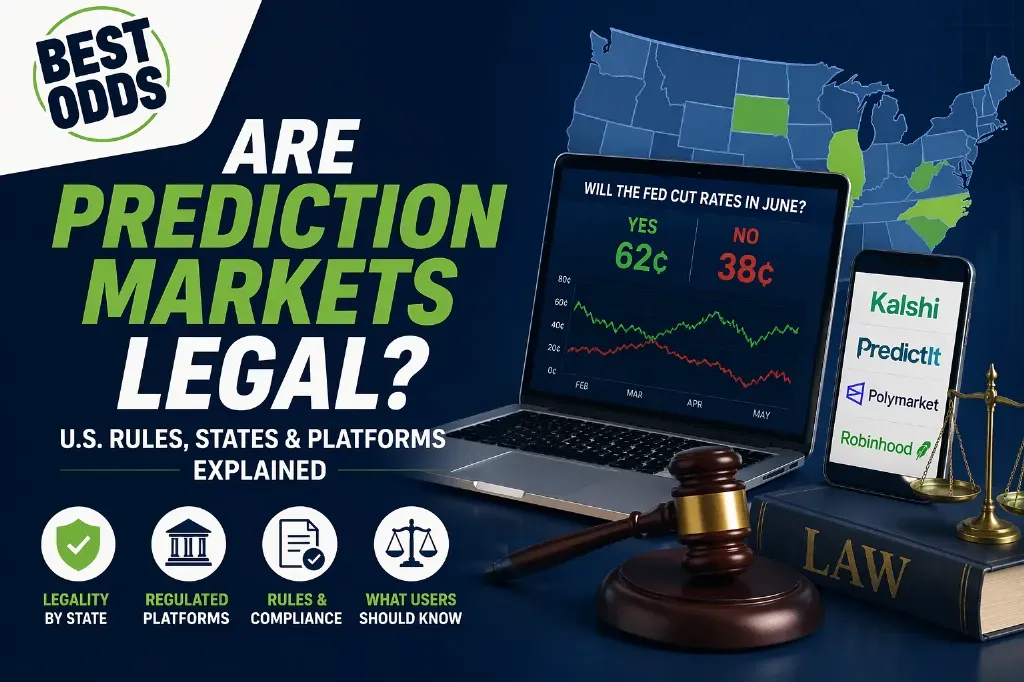
Prediction markets operate in a complex legal environment, more than many users expect. Unlike traditional sportsbooks, some platforms are structured around event contracts or participant-driven markets rather than house-set odds. Because of that, legality often depends on the platform itself, the type of contracts offered, and the jurisdiction where the user is located. A prediction market may be available in one state or country while restricted in another.
For users, the smartest approach is to focus on transparency and access rules rather than assumptions. Platforms such as Kalshi, Robinhood, PredictIt, and other well-known brands all represent different legal or operational models. Before participating, users should check current state availability, identity verification requirements, contract terms, and how outcomes are resolved. In prediction markets, legal clarity is rarely about one universal answer and more about whether a specific platform is lawful and available for that specific user.
Risks of Using Prediction Markets
Prediction markets involve multiple layers of risk beyond simple financial exposure.
Financial Risk
Contract prices can fluctuate rapidly in response to new information. Participants may incur losses if probabilities shift against held positions before resolution.
Market-Structure Risk
Thin liquidity can amplify price movement, reducing reliability. Wide spreads increase execution costs and distort implied probabilities.
Resolution Risk
Ambiguous outcome definitions or delayed verification can postpone settlement. Disputes over resolution sources undermine confidence in market integrity.
Platform and Counterparty Risk
Operational failures, regulatory changes, or governance disputes can affect market continuity. Platform stability and transparency are critical evaluation factors.
Information and Ethical Considerations
Prediction markets aggregate information but do not guarantee correctness. Herd behaviour and overconfidence can distort prices, particularly in emotionally charged markets.
What Is Event Trading?
Event trading is the practice of taking positions on contracts tied to future real-world outcomes such as elections, inflation data, interest-rate decisions, weather events, sports results, or business milestones. Instead of buying a traditional asset, users are trading probabilities that rise and fall as new information enters the market. This makes event trading a fast-growing category that blends forecasting, speculation, and real-time market analysis.
The strongest event trading platforms combine clear contract rules, transparent settlement standards, and user-friendly pricing models. Brands such as Kalshi, Robinhood, PredictIt, Fanatics Markets, and Polymarket are often discussed because each represents a different approach to event-based markets. For many users, the appeal of event trading lies in turning major news stories and upcoming events into live prices that can be analyzed rather than simply followed passively.

Prediction Markets vs Sportsbooks vs Betting Exchanges
Prediction markets, sportsbooks, and betting exchanges all involve outcome-based positioning, but they differ fundamentally in pricing formation, incentive alignment, and informational value. Understanding these distinctions is essential for interpreting probabilities and assessing market reliability when choosing between prediction markets vs. sportsbooks.

Pricing Formation
In prediction markets, prices are generated entirely by participant interaction. Contracts trade based on supply and demand, and the resulting price reflects a consensus probability derived from aggregated information. There is no central price-setter, margin adjustment, or risk-balancing algorithm.
Sportsbooks operate using fixed odds determined by an operator. These odds incorporate margin and risk management considerations, meaning prices reflect both probability assessment and commercial exposure control. As a result, sportsbook odds are not pure probability signals.
Betting exchanges occupy a hybrid position. Prices are participant-driven, but the platform often applies commission to net winnings. While exchange odds may more closely resemble prediction market pricing, exchange markets still operate within a gambling framework and typically include features such as cash-out tools that alter incentive dynamics.
Position Management and Exit Options
Prediction markets allow participants to enter and exit positions by buying or selling contracts prior to resolution. This trading functionality mirrors financial markets more closely than betting products, enabling position management based on evolving information rather than binary win-loss outcomes.
Sportsbooks generally do not permit position exit without penalty, except through cash-out features that are priced at the operator’s discretion. Betting exchanges permit position trading but remain subject to liquidity concentration and commission structures.
Regulatory Classification
Regulators continue to debate whether prediction markets should be categorised as informational instruments, derivatives, or gambling products. This classification affects market scope, participant eligibility, and enforcement posture. Sportsbooks and betting exchanges are universally regulated as gambling operators, whereas prediction markets occupy a narrower and more contested regulatory space.
How to Evaluate a Prediction Market Platform
Evaluating a prediction market platform requires a methodological approach focused on structure rather than promotional features. The following criteria provide a framework for comparative analysis.
Market Depth and Liquidity
Liquidity determines whether prices are meaningful. Deep markets exhibit narrow bid-ask spreads, frequent trade execution, and resistance to single-actor price distortion. Thin markets, by contrast, may display exaggerated volatility and unreliable implied probabilities.
Contract Design and Clarity
Each contract should define outcomes unambiguously, including resolution sources and settlement timelines. Vague or open-ended definitions increase resolution risk and undermine market confidence.
Fee Structure and Friction
Fees affect net outcomes and trading behaviour. Transparent, consistent fee models allow participants to evaluate execution cost accurately. Hidden or variable fees introduce friction that distorts market participation.
Resolution Transparency
Resolution processes should be documented in advance, with clearly identified data sources. Platforms that publish post-resolution audits or dispute procedures provide additional assurance.
Compliance Posture
Regulatory clarity affects platform stability. Platforms operating under defined oversight frameworks typically offer greater continuity, though with reduced market breadth.
User Experience for Trading
Prediction markets function as trading environments rather than wagering interfaces. Order placement, price visibility, and position management tools should support analytical decision-making rather than impulse-driven activity.
Responsible Controls
Platforms should provide balance visibility, position tracking, and optional limits to support disciplined participation. These controls reduce behavioural risk without altering market mechanics.
How to Get Started With Prediction Markets
Participation in prediction markets follows a structured process that mirrors account-based trading environments. The steps below outline the general workflow, illustrated using compliant platforms where applicable.
Step 1: Account Creation
Access to prediction markets begins with account registration on a supported platform. Registration typically requires identity verification and confirmation of eligibility based on jurisdiction.
Step 2: Eligibility and Location Verification
Platforms apply location-based access controls to comply with regulatory requirements. Market availability and contract scope may vary depending on jurisdiction.
Step 3: Funding and Balance Mechanics
Accounts are funded through supported payment methods, resulting in a platform balance used to purchase event contracts. Balances are segregated from contract value until positions are entered.
Step 4: Locating and Interpreting Markets
Markets are listed by category, event, and resolution date. Each contract includes a description, outcome definition, and resolution source. Interpreting this information accurately is essential before entering a position.
Step 5: Placing Orders
Participants may place buy or sell orders at specified prices. Orders execute when matched by counterparties, with partial fills possible in low-liquidity environments.
Step 6: Managing Positions
Open positions fluctuate in value as prices move. Participants may hold positions until resolution or exit by selling contracts prior to settlement.
Step 7: Resolution and Settlement
Following outcome verification, contracts resolve automatically. Settled value is credited to the account balance according to contract terms.
Responsible Use and Risk Management
Prediction markets require disciplined participation due to inherent uncertainty and information asymmetry.
Budget Discipline
Allocating only discretionary capital reduces exposure to adverse outcomes. Prediction markets do not eliminate risk through informational aggregation.
Position Sizing
Concentrated positions increase variance. Diversification across independent events reduces downside volatility.
Avoiding Overconfidence
Markets aggregate collective information, not certainty. High-confidence pricing does not guarantee outcome realisation.
Understanding Uncertainty
Probabilistic outcomes inherently include error margins. Interpreting prices as ranges rather than absolutes supports more accurate analysis.
Guidance on responsible participation is available through our Responsible Gaming page.
Our Methodology for Reviewing Prediction Markets
BestOdds applies a structured evaluation process to all prediction market platforms, documented in the editorial governance framework.
Testing Period
Platforms are observed over extended periods to capture liquidity variation across event cycles.
Liquidity Observation
Trade volume, spread behaviour, and execution frequency are monitored to assess market depth.
Resolution Audits
Completed markets are reviewed for adherence to predefined settlement criteria and timeline consistency.
Fee Verification
Transaction costs are verified against published fee schedules.
User Experience Testing
Order placement, position management, and market navigation are evaluated for analytical usability.
Support Responsiveness
Platform support channels are tested for clarity and response consistency.
Scores are aggregated across these dimensions to produce comparative assessments.
BestOdds: Analytical Coverage of Prediction Markets
BestOdds approaches prediction markets as analytical instruments rather than entertainment products. Coverage prioritises structural integrity, probabilistic interpretation, and verifiable resolution mechanics over short-term engagement metrics. Editorial standards are governed by the documented editorial process, which defines sourcing requirements, testing protocols, and update frequency.
Prediction market analysis is conducted alongside coverage of betting markets to contextualise differences in pricing formation, incentive alignment, and regulatory treatment. This comparative approach ensures that prediction markets are evaluated on their own structural merits rather than framed as substitutes for other wagering formats.
Authors and Editorial Oversight
All prediction market content is produced and reviewed by contributors with demonstrable experience in forecasting, data analysis, market structure evaluation, and regulatory research. Author profiles are published transparently and linked to relevant subject-matter expertise.
Each page undergoes factual verification, resolution-source validation, and compliance review prior to publication. Updates are issued when material changes occur in platform structure, regulatory posture, or market availability.
Main Takeaways
Prediction markets function as information aggregation mechanisms that translate dispersed beliefs into probabilistic prices through tradable event contracts. Their reliability depends on liquidity depth, contract clarity, and settlement integrity rather than promotional incentives or narrative framing.
When evaluated correctly, prediction markets offer insight into collective expectations across politics, sports, technology, economics, and culture. However, they remain subject to financial risk, structural limitations, and regulatory uncertainty.
Key conclusions include:
- Prediction markets express probabilities through participant-driven pricing
- Liquidity is the primary determinant of signal quality
- Contract definitions and resolution sources are critical to integrity
- Regulatory status affects availability, not predictive validity
- Markets aggregate information, not certainty
Frequently Asked Questions
What are prediction markets?Prediction markets are platforms where participants trade contracts tied to future events, with prices representing the market’s implied probability of specific outcomes.
How do prediction markets work?Participants buy and sell event contracts. Contract prices fluctuate based on information flow and liquidity, and settle once outcomes are verified.
Are prediction markets legal in the United States?Legality depends on platform structure, contract design, and jurisdiction. Some operate under defined regulatory frameworks, while others face access restrictions.
How do prediction markets differ from betting?Prediction markets rely on participant-driven pricing rather than operator-set odds and margin models.
What does a contract price represent?The price represents the collective probability assessment of an outcome occurring, not a guaranteed result.
How does settlement occur?Settlement occurs after predefined outcome verification using documented resolution sources, often following a dispute window.
What are the main risks of prediction markets?Risks include financial loss, low liquidity distortion, resolution ambiguity, and platform-level uncertainty.
How can liquidity be evaluated?Liquidity is assessed through trading volume, bid-ask spread width, and execution frequency.
Are prediction markets reliable forecasting tools?When sufficiently liquid and well-defined, prediction markets have demonstrated strong forecasting accuracy, though no market is infallible.
Which platforms offer prediction markets?Platforms such as PredictIt and Underdog provide access to political and sports outcome contracts respectively, subject to eligibility and availability.
Now an experienced iGaming and sports betting writer and editor, Alex has been a keen casino player and sports bettor for many years, having dabbled in both for personal entertainment. He regularly plays slots, and places bets on his favourite sports, including football and NFL as a preference; he’s a big fan of Chelsea and the New York Giants for all his sins.