Sweepstakes Casinos with the Best Rewards Programs
Many sweepstakes casino comparison pages focus heavily on sign-up bonuses, game counts, or surface-level promotions. Those factors matter, but they often overlook one of…


For users who plan to return regularly, the real difference between average and excellent platforms is often what happens after the first visit.
That is where loyalty systems, VIP structures, recurring promotions, daily bonuses, milestone perks, tournaments, cashback-style mechanics, and member recognition become important.
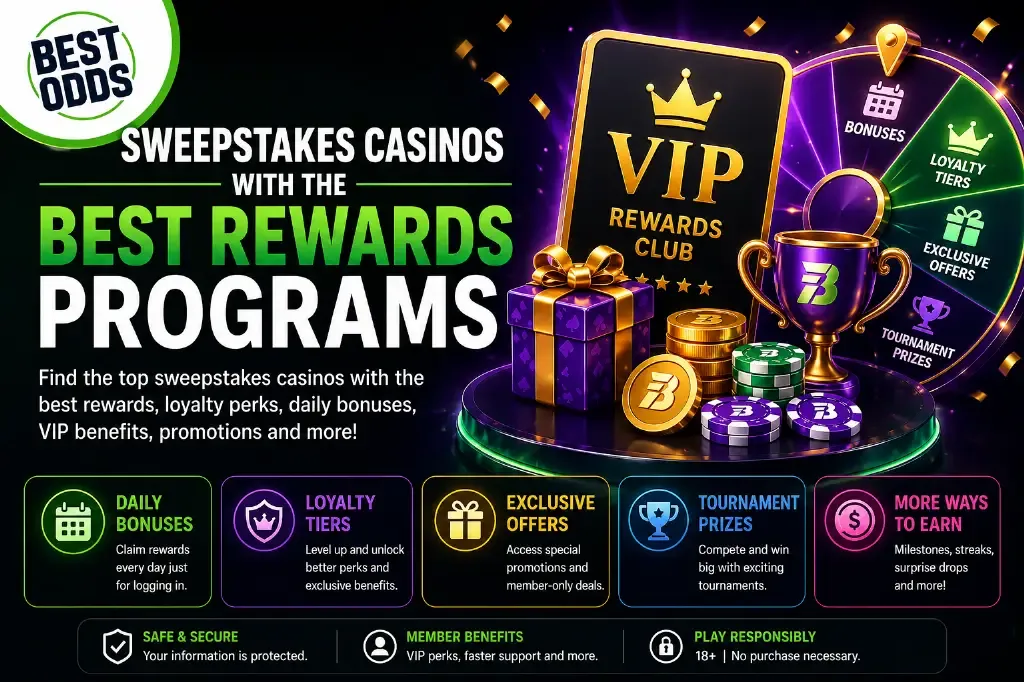
A sweepstakes casino with a weak rewards ecosystem may feel exciting on day one and forgettable by week two.
A platform with a strong rewards program can create momentum, consistency, and reasons to stay engaged over time.
That is why sweepstakes casinos with the best rewards programs deserve their own category.






 Get 200% More Coins on First Purchase – 1.5M CC + 75 SCCLAIM BONUS






 Get up to 750K Gold Coins + 65 SC FREECLAIM BONUS



 Get up to 500K Gold Coins + 105 FREE SC + 1000 VIP pointsCLAIM BONUS


 Exclusive Jackpot Prizes
New Games Added Weekly
0.2 FREE SC Daily Login Bonus
Exclusive Jackpot Prizes
New Games Added Weekly
0.2 FREE SC Daily Login Bonus
 Exclusive Jackpot Prizes
New Games Added Weekly
0.2 FREE SC Daily Login Bonus
120,000 GC + 60 Free SC + a chance to win 500 Free SC!CLAIM BONUS
Exclusive Jackpot Prizes
New Games Added Weekly
0.2 FREE SC Daily Login Bonus
120,000 GC + 60 Free SC + a chance to win 500 Free SC!CLAIM BONUS



 Variety of games
Multiple payment methods
10,000 GC daily reward
Variety of games
Multiple payment methods
10,000 GC daily reward
625K Golden Coins + Up to 125 SC FREE + 1250 VIP PointsCLAIM BONUS
Variety of games
Multiple payment methods
10,000 GC daily reward
Variety of games
Multiple payment methods
10,000 GC daily reward
625K Golden Coins + Up to 125 SC FREE + 1250 VIP PointsCLAIM BONUS

 150% First Purchase Offer: Up to 600K Gold Coins + 303 SC FREECLAIM BONUS

 100% More Coins: 80,000 GC + 40 FREE SC + 75 Free SC SpinsCLAIM BONUS





 Get extra 10 SC for FREE!CLAIM BONUS



 120,000 GC + 60 Free SC + a chance to win 500 Free SCCLAIM BONUS

 Get up to 103 SC + 20,500 GC for FREE with Legendz!CLAIM BONUS

 300% Value on Sign up + First Purchase 300,000 GC + 22 FREE SC for $9.99CLAIM BONUS





 200% Extra: 300,000 Gold Coins + 30 SCCLAIM BONUS



 120,000 GC + 60 FREE SC + Chance to Win 500 FREE SCCLAIM BONUS


 Exclusive Offer: 120000 GC + 50 SC FREE + 50 Free SpinsCLAIM BONUS

 25000 Gold Coins and 1 Free Shuffle CashCLAIM BONUS



 Up to 500% Extra on SC – 950,000 GC + 75 SC + 20 Free SpinsCLAIM BONUS

 200% First Purchase: 10,000 Gold Coins + 30 SC FREECLAIM BONUS



 200% Purchase Offer: 10K Gold Coins and 30 FREE SCCLAIM BONUS
 250% MORE Coins: 1,225,000 GC + 88 FREE SCCLAIM BONUS




 200% Extra: 30 SC FREE and 1.75M WOW CoinsCLAIM BONUS


 100% Matched Offer: 40 SC FREE + 80,000 Gold CoinsCLAIM BONUS


 200% First Purchase Offer: Up to 4.5M Gold Coins + 300 SC FREECLAIM BONUS


 Get 300,000 GC + 30 SC FREE!CLAIM BONUS

 350% Extra: 1 Million GC + 60 SCCLAIM BONUS

 200% EXTRA FREE: 1,005,000 GC + 77.3 SC FREE + 50 Free SpinsCLAIM BONUS


 40 SC FREE + 40K Gold Coins + 40 Gift SpinsCLAIM BONUS
 Get up to 4.4M Gold Coins + 200 SC FREE!CLAIM BONUS



 300% Extra: 2M GC + 100 SC FREECLAIM BONUS
 100% Bonus: 20,000 GC + 20 SC FREECLAIM BONUS

 150% Bonus: 6000 GC + 50 SC FREE and 1 KeyCLAIM BONUS
 100% Extra: 850000 GC + 50 SCCLAIM BONUS

 100% More Coins: 750k GC + FREE 40 SCCLAIM BONUS

 6000 SC FREE and 1.35 Million Gold CoinsCLAIM BONUS

 3000 SC + 250K Tao Coins FREECLAIM BONUS

 60 FC FREE and 850K Gold CoinsCLAIM BONUS

 170,000 GC + 7 SCCLAIM BONUS

 100% up to $100CLAIM BONUS
 Get 200% Extra BRACCO coinsCLAIM BONUS
Why Rewards Programs Matter
Many new users underestimate how much value can come from recurring benefits compared to one-time promotions.
A welcome package may last a short period. A quality rewards system can continue delivering benefits for months.
Strong rewards programs often include:
- Daily login bonuses
- Streak rewards
- Loyalty points
- VIP tiers
- Milestone gifts
- Tournament prizes
- Birthday rewards
- Cashback-style offers
- Seasonal campaigns
- Exclusive promotions
- Faster support access
- Higher redemption opportunities where applicable
This creates a better long-term experience for regular users.
Instead of constantly chasing new sign-up offers across different sites, many players prefer choosing one strong platform with ongoing benefits.
That can be smarter, simpler, and often more rewarding over time.
What Makes a Rewards Program Actually Good
Not all rewards systems deserve praise.
Some platforms advertise loyalty clubs that give little real value. Others create confusing point systems designed more for marketing than genuine benefit.
The best rewards programs usually share several traits:
Clear Progression
Users should understand how rewards are earned and what milestones unlock.
Consistency
Benefits should arrive regularly rather than unpredictably.
Meaningful Value
Rewards should feel worth claiming, not symbolic.
Simplicity
If a user needs to decode five menus to understand perks, the system is weak.
Variety
Different users value different things: coins, tournaments, exclusives, recognition, gifts, convenience.
Motivation Without Pressure
Good systems encourage engagement without creating unhealthy urgency.
Best Sweepstakes Casinos with the Best Rewards Programs in September 2026
The platforms below were selected because each offers a strong but different style of rewards ecosystem.
Some excel through tiered loyalty depth. Others through simplicity, daily consistency, or frequent practical bonuses.
1. Stake.US – Best Overall Rewards Program
 Worldwide Brand
Crash & Mining Games
1 FREE SC Daily Login Bonus
25 SC and 250K GC signup bonusCLAIM BONUS
Worldwide Brand
Crash & Mining Games
1 FREE SC Daily Login Bonus
25 SC and 250K GC signup bonusCLAIM BONUS

Stake.US stands out because its ecosystem feels broad, structured, and capable of rewarding long-term users rather than only new sign-ups.
Many users begin casually, then gradually engage with promotions, recurring benefits, special events, and broader platform mechanics over time.
That matters because a strong rewards system should grow with the user.
Rather than feeling exhausted after the first week, Stake.US often gives returning users reasons to continue exploring.
The platform is especially strong for users who enjoy depth, progression, and a sense that loyalty matters.
Why it ranks highly:
- Broad long-term ecosystem
- Strong recurring engagement structure
- Good for regular users
- Rewards that can scale with usage
- Suitable for users wanting one main platform
For Chumba Casino fans, this is noted to offer games like Chumba within its collection with even more rewarding bonus options.
2. Crown Coins – Best for Straightforward Rewards
Some users do not want a complicated VIP ladder.
They want clear recurring value without needing spreadsheets or deep platform study.
Crown Coins performs strongly here because it often feels easier to understand than more layered competitors.
Users can typically grasp what benefits exist, where to claim them, and how regular participation helps.
That simplicity is underrated.
Many platforms lose users because the reward system feels hidden or confusing.
Crown Coins often benefits from clearer usability.
Why it ranks highly:
- Beginner-friendly reward structure
- Easy-to-follow promotions
- Lower confusion factor
- Strong for casual repeat users
- Good balance between value and clarity

3. Pulsz – Best for Frequent Promotional Energy
200% EXTRA FREE: 1,005,000 GC + 77.3 SC FREE + 50 Free SpinsCLAIM BONUS
Pulsz often appeals to users who enjoy an active promotional environment.
Some users like checking in often, seeing fresh offers, new campaigns, rotating bonuses, and regular reasons to engage.
That style is not for everyone, but for promotion-oriented players it can feel dynamic and rewarding.
The key here is energy.
Users who enjoy movement, variety, and recurring offers may find Pulsz especially attractive.
Why it ranks highly:
- Frequent promotional cadence
- Good for users who like fresh offers
- Strong recurring engagement appeal
- More dynamic than static loyalty systems
- Suitable for active users

4. Chumba Casino – Best Legacy Rewards Experience
Chumba Casino remains one of the most recognized names in the category and often appeals to users who value familiarity, established routines, and long-running promotional structures.
For many users, trust and consistency are part of the reward experience itself.
Some players prefer platforms that feel established rather than experimental.
Chumba often performs well with users who appreciate dependable recurring value and a familiar ecosystem.
Why it ranks highly:
- Recognized long-term brand
- Familiar reward environment
- Consistent returning-user appeal
- Strong mainstream comfort factor
- Good for traditional users

5. LuckyLand Slots – Best for Daily Routine Rewards
LuckyLand suits users who enjoy lighter but regular habits.
Some rewards systems work best not through giant milestones but through daily rhythm.
Login rewards, recurring check-ins, and casual ongoing value can be highly effective for users who prefer smaller, steady benefits rather than chasing elite VIP tiers.
That makes LuckyLand appealing for users who enjoy routine engagement.
Why it ranks highly:
- Good daily-use experience
- Strong casual loyalty appeal
- Lower-pressure reward style
- Suitable for routine players
- Comfortable recurring ecosystem
Why These Five Were Shortlisted
- Stake.US was chosen for overall depth and long-term structure.
- Crown Coins was selected for clarity and ease of use.
- Pulsz stands out for active promotional energy.
- Chumba remains relevant for legacy trust and consistency.
- LuckyLand performs well for routine daily rewards and casual repeat engagement.
A proper rewards ranking should reflect different user personalities rather than pretending one system suits everyone.

How Rewards Programs Actually Shape the User Experience
Many users treat rewards programs as a side feature, something pleasant to have but not especially important. In practice, they often determine whether a platform feels worth returning to after the first few visits. The difference between a site that users abandon quickly and one they continue enjoying for months is frequently not the homepage design or opening promotion. It is whether the platform creates a sense of ongoing value.
That ongoing value can take many forms. Sometimes it is practical, such as recurring coin bonuses, smoother progression, or useful loyalty perks. Sometimes it is psychological. Users enjoy feeling that regular participation is recognized rather than taken for granted. A site that rewards consistency can feel warmer, more engaging, and more satisfying than one that treats every visit as interchangeable.
This matters because sweepstakes casinos are not judged only on first impressions. A polished homepage may attract attention, but long-term satisfaction comes from the repeated experience of using the product. If the second week feels worse than the first, the platform often loses momentum quickly.
By contrast, a thoughtful rewards ecosystem can make the product feel better with familiarity. Users understand where benefits are located, how routines work, and what progress looks like. Confidence rises instead of declining. That is one of the strongest signs of a quality platform.
The Different Types of Rewards That Matter Most
Many comparison pages reduce rewards to one number or one sign-up offer. Real rewards ecosystems are usually more layered than that. The strongest platforms combine several types of value rather than relying on a single headline promotion.
Daily bonuses remain important because they reward consistency in a simple, visible way. Even modest recurring value can create a strong habit loop when it is reliable and easy to claim. Users often prefer steady rewards they can count on over occasional flashy offers that appear unpredictably.
Tier systems and loyalty progression appeal to a different type of user. Some people enjoy seeing movement over time. Unlocking improved benefits, special access, or enhanced offers can make regular use feel more meaningful. The key is whether progression feels realistic and worthwhile rather than symbolic.
Seasonal promotions and limited campaigns can also add energy when used intelligently. These work best when they complement a stable core rewards system rather than replacing it. If a platform relies entirely on short-lived campaigns, users may enjoy bursts of excitement but feel little reason to stay engaged between them.
Then there are softer forms of rewards that many reviews ignore. Smooth customer support, faster responses for loyal users, better usability, cleaner interfaces, and feeling respected by the product all contribute to long-term retention. Not every reward comes in the form of coins or prizes.
Why Simplicity Often Beats Complexity
A common mistake in this category is assuming that a complicated rewards system must be better because it looks more advanced. In reality, complexity often destroys value if users cannot easily understand how the system works.
When users need to decipher tiers, points, timers, rotating conditions, hidden requirements, and scattered menus, the experience becomes work rather than reward. Many simply disengage. Even generous benefits lose impact when the path to them feels confusing or irritating.
That is why simpler systems frequently outperform elaborate ones. If users know exactly where to claim rewards, what regular habits are worthwhile, and what progress looks like, they are far more likely to participate consistently. Clear systems create momentum.
This is especially true for beginners. New users are already learning game categories, navigation, balances, and promotional terminology. A rewards system should reduce friction, not add another layer of uncertainty.
The best platforms understand this balance. They may still offer depth for advanced users, but the visible experience remains intuitive. Someone can benefit immediately without needing to study the platform first.
Why Long-Term Users Should Think Differently
New users often compare sites through the lens of opening offers. That is understandable, because sign-up promotions are visible and heavily marketed. Yet users who expect to stay active for weeks or months should think differently.
The better question is not “What do I get today?” but “How will this platform feel after twenty visits?”
Some sites peak early. They make a strong first impression, then gradually feel repetitive, stingy, or frustrating. Rewards become harder to locate, progression feels stagnant, and novelty fades faster than expected.
Other platforms improve with time. Users learn routines, discover recurring perks, become more efficient navigating the site, and feel that continued use creates better outcomes. These are usually the strongest long-term choices.
That is why rewards programs matter so much. They often decide whether a product becomes part of someone’s regular entertainment routine or just another short-lived sign-up memory.Signs a Rewards Program Is Genuinely Good
Some rewards programs sound impressive in marketing copy but feel underwhelming in practice. The strongest systems usually reveal their quality through small everyday details rather than dramatic claims. One of the clearest signs is visibility. Users should not need to search through multiple menus to understand what benefits are available. If rewards are meaningful, the platform should be confident enough to present them clearly.
Another strong indicator is consistency. A platform that delivers modest but reliable recurring value often creates a better experience than one that occasionally launches loud promotions and then disappears into silence. Predictability matters because it allows users to build habits and expectations. People enjoy knowing that returning to the platform has practical value.
Ease of use is equally important. Claiming rewards should feel smooth, intuitive, and quick. If a user repeatedly encounters friction, confusing steps, or unnecessary delays, the emotional impact of the reward weakens. Something that should feel positive instead feels administrative.
Progression is another sign of quality. Users should feel that time spent on the platform gradually improves their standing or access in some meaningful way. That does not require extravagant gifts. It simply means loyalty should feel recognized. When month three feels identical to day one, many users begin to disengage.
Finally, good rewards systems enhance enjoyment rather than dominate it. They support the entertainment experience instead of turning every session into a constant chase for offers, timers, or obligations.
Warning Signs Most Users Ignore
Weak rewards ecosystems often reveal themselves early, but users sometimes overlook the signals because headline promotions are distracting. One common red flag is overcomplication. If a platform needs lengthy explanations to justify how rewards work, there is often less real value than first appears.
Another warning sign is hidden benefits. When users repeatedly hear that rewards exist but struggle to locate them, the system may be designed more for promotional language than practical use. Genuine value should be accessible, not buried.
Constant urgency can also indicate weakness. If every reward seems tied to countdown timers, expiring notices, aggressive prompts, or pressure tactics, the platform may be compensating for a lack of stable recurring value. Strong ecosystems do not need to create panic every day.
Stagnation is another issue. Some sites feel rewarding for the first week but never evolve afterward. The same offers repeat, progression stalls, and nothing feels meaningfully better with familiarity. Users often mistake this for normality when it is usually a design limitation.
Poor communication is equally damaging. If users cannot easily understand terms, timelines, or what actions create benefits, trust erodes quickly. Confusion is expensive in retention terms.
How Different Users Should Choose
Not every user wants the same type of rewards environment. Casual players often benefit most from straightforward systems with visible recurring bonuses and minimal effort. They may value simplicity more than depth, making cleaner platforms more appealing than heavily layered VIP ecosystems.
Regular users who expect to spend significant time on one platform often benefit from progression-based environments. They may appreciate loyalty tiers, recurring promotions, and systems that become more rewarding over time. For these users, long-term structure matters more than day-one simplicity.
Some users are motivated by variety and energy. They enjoy checking in regularly to see new offers, rotating campaigns, and fresh incentives. Promotional momentum matters to them more than calm predictability. Dynamic platforms often suit this profile.
Others prefer familiarity and routine. They want a site that feels dependable, recognizable, and stable. They may value trust and comfort more than novelty. Established brands often appeal strongly here.
The smartest approach is honest self-assessment. Users often chase what sounds exciting rather than what matches their actual habits. A quieter platform with a better-fit rewards style can create far more satisfaction than a louder one that looks stronger on paper.
Why the Best Rewards Programs Increase Confidence
There is a psychological side to rewards systems that many reviews ignore. Good programs do more than distribute benefits. They reduce uncertainty and increase confidence. Users know what to expect, where to go, and how the platform works. That comfort improves the entire experience.
When a user feels lost, even generous promotions can feel stressful. When a user feels oriented and respected, smaller recurring benefits often feel more valuable than they objectively are. Experience quality magnifies reward value.
This is why strong platforms often feel easier and more enjoyable after repeated use. Familiarity combines with visible systems, and the product begins working with the user rather than against them.
That is the real benchmark. A rewards program should make each future visit feel more comfortable, more worthwhile, and more enjoyable than the last.Signs a Rewards Program Is Genuinely Good
Some rewards programs sound impressive in marketing copy but feel underwhelming in practice. The strongest systems usually reveal their quality through small everyday details rather than dramatic claims. One of the clearest signs is visibility. Users should not need to search through multiple menus to understand what benefits are available. If rewards are meaningful, the platform should be confident enough to present them clearly.
Another strong indicator is consistency. A platform that delivers modest but reliable recurring value often creates a better experience than one that occasionally launches loud promotions and then disappears into silence. Predictability matters because it allows users to build habits and expectations. People enjoy knowing that returning to the platform has practical value.
Ease of use is equally important. Claiming rewards should feel smooth, intuitive, and quick. If a user repeatedly encounters friction, confusing steps, or unnecessary delays, the emotional impact of the reward weakens. Something that should feel positive instead feels administrative.
Progression is another sign of quality. Users should feel that time spent on the platform gradually improves their standing or access in some meaningful way. That does not require extravagant gifts. It simply means loyalty should feel recognized. When month three feels identical to day one, many users begin to disengage.
Finally, good rewards systems enhance enjoyment rather than dominate it. They support the entertainment experience instead of turning every session into a constant chase for offers, timers, or obligations.
Warning Signs Most Users Ignore
Weak rewards ecosystems often reveal themselves early, but users sometimes overlook the signals because headline promotions are distracting. One common red flag is overcomplication. If a platform needs lengthy explanations to justify how rewards work, there is often less real value than first appears.
Another warning sign is hidden benefits. When users repeatedly hear that rewards exist but struggle to locate them, the system may be designed more for promotional language than practical use. Genuine value should be accessible, not buried.
Constant urgency can also indicate weakness. If every reward seems tied to countdown timers, expiring notices, aggressive prompts, or pressure tactics, the platform may be compensating for a lack of stable recurring value. Strong ecosystems do not need to create panic every day.
Stagnation is another issue. Some sites feel rewarding for the first week but never evolve afterward. The same offers repeat, progression stalls, and nothing feels meaningfully better with familiarity. Users often mistake this for normality when it is usually a design limitation.
Poor communication is equally damaging. If users cannot easily understand terms, timelines, or what actions create benefits, trust erodes quickly. Confusion is expensive in retention terms.
How Different Users Should Choose
Not every user wants the same type of rewards environment. Casual players often benefit most from straightforward systems with visible recurring bonuses and minimal effort. They may value simplicity more than depth, making cleaner platforms more appealing than heavily layered VIP ecosystems.
Regular users who expect to spend significant time on one platform often benefit from progression-based environments. They may appreciate loyalty tiers, recurring promotions, and systems that become more rewarding over time. For these users, long-term structure matters more than day-one simplicity.
Some users are motivated by variety and energy. They enjoy checking in regularly to see new offers, rotating campaigns, and fresh incentives. Promotional momentum matters to them more than calm predictability. Dynamic platforms often suit this profile.
Others prefer familiarity and routine. They want a site that feels dependable, recognizable, and stable. They may value trust and comfort more than novelty. Established brands often appeal strongly here.
The smartest approach is honest self-assessment. Users often chase what sounds exciting rather than what matches their actual habits. A quieter platform with a better-fit rewards style can create far more satisfaction than a louder one that looks stronger on paper.
Why the Best Rewards Programs Increase Confidence
There is a psychological side to rewards systems that many reviews ignore. Good programs do more than distribute benefits. They reduce uncertainty and increase confidence. Users know what to expect, where to go, and how the platform works. That comfort improves the entire experience.
When a user feels lost, even generous promotions can feel stressful. When a user feels oriented and respected, smaller recurring benefits often feel more valuable than they objectively are. Experience quality magnifies reward value.
This is why strong platforms often feel easier and more enjoyable after repeated use. Familiarity combines with visible systems, and the product begins working with the user rather than against them.
That is the real benchmark. A rewards program should make each future visit feel more comfortable, more worthwhile, and more enjoyable than the last.
How We Evaluate Rewards Programs Over Time
Many rankings judge rewards programs too quickly. They look at a homepage promotion, a visible VIP badge, or a short-term campaign and assume the platform is generous. Real evaluation requires more patience. A rewards system should be judged across repeated sessions, not a single visit.
The first stage is the opening experience. Are benefits easy to understand from the beginning, or does the user immediately face clutter and vague terminology? Strong platforms make it obvious what recurring value exists without forcing users to decode the system.
The second stage is consistency after the novelty wears off. This is where weaker platforms often struggle. The first few days may feel active, but by week two users discover that rewards are repetitive, difficult to claim, or less meaningful than expected. Initial excitement fades quickly when there is little substance underneath it.
The third stage is progression. Does the user feel that continued activity improves the experience over time, or does everything remain static? The strongest rewards ecosystems create a sense of movement. Even small improvements matter because they signal that loyalty is noticed.
The final stage is emotional response. Does returning to the platform feel worthwhile and comfortable, or does it feel like work? This is often the most honest metric. Users instinctively know when a rewards system is enhancing enjoyment and when it is simply creating noise. For a more detailed breakdown, refer to Our Methodology page.
Why Some Platforms Feel Generous Then Disappoint
This pattern is common across many online products. A platform may look highly rewarding at first because it concentrates visible offers into the early experience. New users see banners, promotions, sign-up packages, countdowns, and active messaging. It can feel energetic and generous.
Then real usage begins.
Users start noticing that recurring benefits are smaller than expected, promotions are hard to access, terms are restrictive, or the same offers repeat endlessly with different packaging. What looked rich at first turns out to be shallow.
This happens because some platforms optimize acquisition more than retention. Their systems are designed to attract attention rather than sustain satisfaction. That can work in the short term, but regular users eventually notice the gap.
By contrast, stronger platforms sometimes appear more modest initially. They may not overwhelm users with promotional noise. Instead, they reveal value gradually through reliability, progression, and smoother everyday use. These are often the sites that age better with familiarity.
That is why users should be careful not to confuse intensity with generosity. Loud marketing and real long-term value are not the same thing.
The Best First-Month Strategy for Maximizing Rewards
Many beginners make the mistake of joining several platforms at once and chasing every visible offer. This often creates confusion rather than value. Different systems blur together, users miss claims, and no platform is understood properly.
A stronger first-month strategy is slower and more selective.
During the first week, focus on one platform only. Learn where rewards are located, how recurring bonuses work, and whether the platform feels comfortable to navigate. This creates a baseline understanding.
During the second week, assess consistency. Are rewards still visible and useful, or was most of the value concentrated in the opening days? This stage reveals whether the system has depth.
During the third week, explore progression. Review whether there are tiers, milestones, or benefits that make continued use worthwhile. A quality platform should begin feeling easier and more rewarding now than it did initially.
During the fourth week, only then consider trying a second platform for comparison. By that point, the user has context. Comparisons become practical rather than hypothetical.
This patient approach usually leads to better decisions than impulsive sign-ups across multiple sites.
Common Mistakes Users Make with Rewards Programs
One of the biggest mistakes is choosing purely by the largest advertised number. Headline offers attract attention, but they often say little about long-term value. A smaller opening package on a better platform can produce a stronger overall experience.
Another common mistake is ignoring friction. Users focus on what is technically offered while ignoring how annoying it is to access. If rewards require repeated searching, confusing steps, or constant monitoring, many users stop benefiting from them.
Some users also overvalue prestige language such as VIP, elite, or exclusive. These labels sound attractive, but what matters is the practical experience attached to them. Branding alone has no value.
Trying too many platforms too quickly is another frequent error. It becomes harder to judge quality when several systems overlap at once. Users often remember excitement but forget which platform actually delivered consistent value.
Finally, many users fail to reassess after the honeymoon phase. They stay loyal to a site that impressed them early even when it no longer feels rewarding in daily use.
When It Makes Sense to Switch Platforms
Changing platforms can be rational rather than impulsive. If a rewards system consistently feels irritating, stagnant, or unclear after repeated use, another site may simply fit better.
If benefits are difficult to locate, if progression feels meaningless, or if the platform relies too heavily on pressure tactics, those are legitimate reasons to reconsider.
Sometimes the issue is not poor quality but poor fit. A casual user may realize they do not want a complex tier system. A regular user may discover they have outgrown a basic daily-bonus model and now want deeper progression.
The best outcomes often come when users adapt once their own preferences become clearer. Platform choice should be flexible, not emotional loyalty.
Responsible Play and Perspective
Rewards programs should always be viewed as enhancements to entertainment, not reasons to overextend time, money, or emotional energy. A strong loyalty system can make a platform more enjoyable, but no promotion or recurring perk is important enough to override healthy boundaries.
Users benefit from deciding limits before sessions begin rather than in the middle of excitement. Time boundaries, spending discipline where optional purchases are involved, and regular breaks all help keep the experience balanced. If a platform’s rewards system creates pressure rather than enjoyment, stepping back is usually the right move.
The healthiest relationship with rewards programs is practical rather than emotional. Appreciate useful benefits, ignore manipulative urgency, and remember that long-term control matters more than any short-term offer.
Conclusion
The best sweepstakes casinos with rewards programs are rarely the ones making the loudest promises. They are the platforms that consistently make returning feel worthwhile, easy, and enjoyable over time.
Stake.US remains one of the strongest all-around choices for users who want depth, progression, and a rewards ecosystem that can grow with continued use. Crown Coins stands out for clarity and straightforward recurring value. Pulsz appeals to users who enjoy active promotional energy and frequent fresh offers. Chumba Casino remains relevant for users who value familiarity, stability, and established routines. LuckyLand Slots performs strongly for users who prefer casual recurring rewards and low-pressure consistency.
The smartest way to judge any rewards program is not by the first day, but by the fourth week. If the platform feels clearer, more rewarding, and more comfortable with time, it is likely doing something right.
In the long run, the best reward is not always the biggest offer. It is a platform that respects the user enough to create steady value without unnecessary friction.
Quick Summary
Best Overall Rewards Program: Stake.USBest for Simplicity: Crown CoinsBest for Frequent Promotions: PulszBest for Familiarity: Chumba CasinoBest for Casual Daily Rewards: LuckyLand Slots
Most Common Mistake: Choosing only by headline offersMost Important Factor: Ongoing value after sign-upBest Strategy: Use one platform long enough to judge consistencyBest Long-Term Metric: Whether the experience improves with familiaritySmartest Mindset: Patient, selective, realistic
Frequently Asked Questions
What is the best sweepstakes casino for rewards programs?
For many users, Stake.US is one of the strongest overall options because it combines recurring value, progression, and a broader long-term ecosystem. Users wanting simpler rewards may prefer Crown Coins.
Are rewards programs more important than welcome bonuses?
For regular users, often yes. Welcome bonuses are temporary, while quality rewards systems can continue delivering value over time.
What types of sweepstakes casino rewards are most common?
Common formats include daily bonuses, streak rewards, loyalty tiers, milestone gifts, seasonal promotions, tournaments, and recurring member offers.
How do I know if a rewards program is actually good?
Look for clarity, consistency, ease of claiming, realistic progression, and benefits that genuinely improve the experience over repeated use.
Should beginners focus on rewards programs?
Beginners should usually prioritize usability first, but a clear and beginner-friendly rewards system can significantly improve the early experience.
Can I switch platforms if rewards feel weak?
Yes. If the system feels stagnant, confusing, or not suited to your habits, comparing alternatives can be a sensible decision.
iGaming Writer - Patrick is a long-time casino enthusiast and sports betting analyst who has spent the last decade diving deep into the world of online gaming. Whether it’s breaking down the nuances of live dealer strategies, reviewing slot tournaments, or comparing crypto payment methods across top UK casinos, Patrick brings a bettor’s mindset to every article.