What Does Slippage Mean?
Slippage is one of the most important concepts for anyone using prediction markets, yet it is also one of the least understood by beginners. Many new users focus only on…


Slippage refers to the difference between the price a user expects and the price they actually receive when an order is executed.
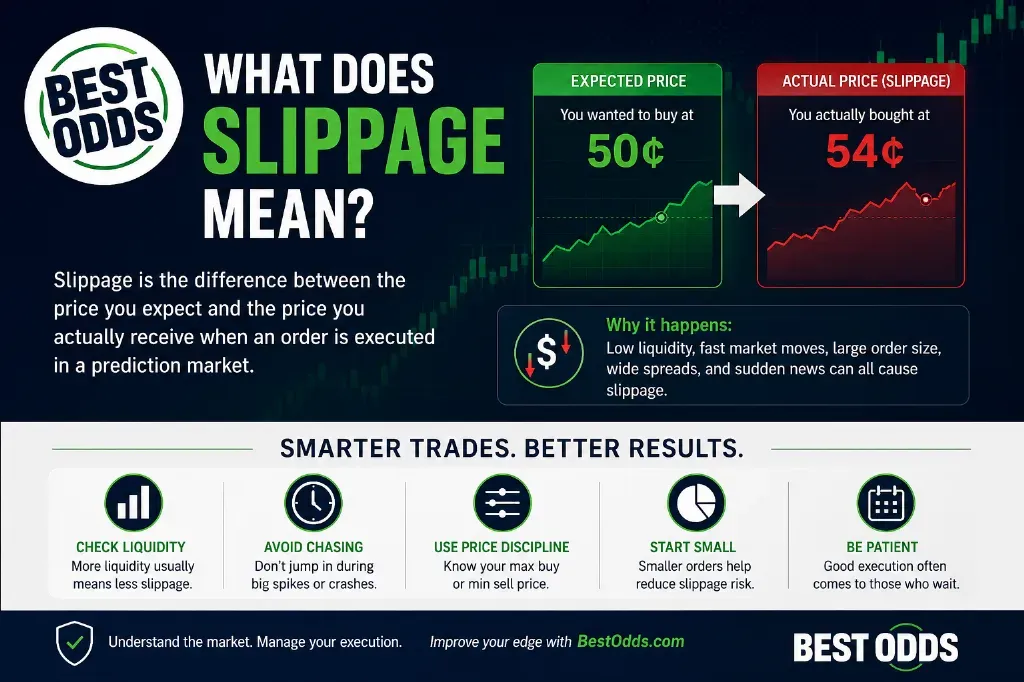
This can happen in prediction markets because prices are shaped by live supply and demand. If available liquidity at the displayed price is limited, a larger order may consume that level and begin filling at worse prices. The result is that the average execution price ends up higher than expected when buying or lower than expected when selling.
For users who only think about direction, slippage can be surprising. They may correctly predict an outcome yet still receive a weaker entry or exit because of market mechanics.
Understanding slippage helps users participate more intelligently, especially on platforms where contracts are bought and sold dynamically rather than simply accepted at fixed odds.
This guide explains slippage in plain language, including why it happens, how it affects profitability, how to reduce it, and how users should think about slippage on leading prediction market brands such as Kalshi, Robinhood, PredictIt, Fanatics Markets, and Polymarket.
Best Prediction Markets for September 2026
As prediction markets continue to grow in popularity, users are increasingly looking for platforms that match their interests, experience level, and preferred market style. Some users want mainstream accessibility and simple interfaces. Others care more about political outcomes, sports-event relevance, economic contracts, or high-profile current events. The best prediction market is rarely the same for everyone.
Strong platforms typically combine recognizable branding, active user interest, intuitive navigation, clear market categories, and consistent relevance during major news cycles. The brands below remain among the most visible names currently associated with prediction markets and each may suit a different type of user.
Kalshi – Best Overall Prediction Market
Kalshi remains one of the most prominent names in the U.S. prediction market category and is often the first brand many users think of when event contracts are discussed.
Its relevance extends across politics, economics, weather, and broader real-world developments, making it one of the most balanced all-around platforms.
Why it stands out:
- Strong U.S. recognition
- Broad market relevance
- Clear mainstream-facing presentation
- Frequent media visibility
Best for:
- General users
- Beginners seeking a recognizable brand
- Users wanting broad event coverage




Robinhood – Best for Mainstream Beginners
Robinhood’s importance comes from familiarity. Many users already know the brand through investing, which can make event-market participation feel less intimidating.
Its mobile-first style also appeals to users who value simplicity and mainstream trust.
Why it stands out:
- Household-name recognition
- Familiar app ecosystem
- Strong crossover from finance audiences
- Mobile-friendly reputation
Best for:
- First-time users
- Mainstream audiences
- Users who prefer familiar brands

PredictIt – Best for Political Outcomes
PredictIt has long been associated with election cycles, polling shifts, debates, and public-policy forecasting.
For politically engaged users, it remains one of the most recognizable names in this niche.
Why it stands out:
- Strong political identity
- Historical election relevance
- Recognized forecasting community
Best for:
- Politics followers
- Election-watch users
- Public-policy enthusiasts
Fanatics Markets – Best for Sports Fans
Fanatics Markets benefits from one of the strongest sports-commerce brands in America. That sports recognition gives it natural relevance for users who are sports-first and prediction-market curious.
Why it stands out:
- Powerful sports branding
- Mainstream fan familiarity
- Natural crossover from sports audiences
Best for:
- Sports fans
- Casual mainstream users
- Users exploring sports-linked event markets

Polymarket – Best for High-Profile Current Events

 Deposit $10 get a $50 Trading BonusCLAIM BONUS


Polymarket is one of the most publicly visible names whenever prediction markets trend online. It often becomes highly relevant during elections, geopolitical developments, and major news moments.
Why it stands out:
- Strong public visibility
- Social-media relevance
- Broad current-event appeal
Best for:
- News followers
- Users interested in headline-driven markets
- Highly engaged event watchers

How to Choose the Right Prediction Market
The smartest approach is to choose based on what you follow most closely.
Users interested in economics and broad real-world outcomes may lean toward Kalshi. Mainstream beginners may prefer Robinhood. Political followers may gravitate toward PredictIt. Sports fans may find Fanatics Markets more intuitive. Users focused on fast-moving public narratives may prefer Polymarket.
The best platform is usually the one that aligns with your interests, comfort level, and preferred style of market participation rather than whichever brand is most talked about.
The Simplest Definition of Slippage
Slippage is the gap between:
- the price you hoped to receive
- and the price you actually received
Examples:
- You wanted to buy at 50¢ but your average fill was 53¢
- You wanted to sell at 61¢ but your average fill was 58¢
- You saw a price on screen, clicked quickly, and execution happened elsewhere
That difference is slippage.
It can be small and barely noticeable, or large enough to materially affect results.
Why Slippage Happens
Slippage usually comes from one or more of five causes:
Limited Liquidity
There may not be enough contracts available at the best displayed price.
Fast Market Movement
Prices may change rapidly while your order is being submitted.
Large Order Size
A bigger order may need multiple price levels to complete.
Wide Spreads
The gap between buyers and sellers may already be meaningful.
Sudden News
Breaking information can cause repricing before execution completes.
These forces are common in live markets and are not unique to prediction markets.
A Basic Example
Imagine a contract is shown at:
- Sellers available at 52¢ for 100 contracts
- Sellers available at 54¢ for 200 contracts
- Sellers available at 57¢ beyond that
You try to buy 250 contracts immediately.
Your order may fill:
- 100 at 52¢
- 150 at 54¢
Your average price becomes worse than the first displayed number.
That is slippage created by depth limitations.
Why Beginners Misunderstand Slippage
Many beginners assume the visible price equals unlimited availability.
But displayed pricing often reflects the best currently available level, not infinite size.
This is similar to seeing one item on sale in a store window. It does not mean the whole inventory is available at that price.
Understanding this one concept prevents many frustrations.
Slippage When Buying
Buying slippage usually means paying more than expected.
You wanted:
- 47¢
You received:
- 49.6¢ average
This matters because you now need a better future move or final settlement outcome to achieve the same return.
Slippage When Selling
Selling slippage usually means receiving less than expected.
You wanted:
- 68¢
You received:
- 65.8¢ average
That difference may reduce gains or increase losses.
Why Slippage Matters So Much
Many users focus on prediction accuracy while ignoring execution quality.
But two users with the same directional opinion can achieve very different results depending on price discipline.
User A buys efficiently.
User B chases and accepts slippage repeatedly.
Over time, User A may outperform despite identical forecasting skill.
Execution matters.
Slippage vs Fees
These concepts are related but different.
Fees
Explicit platform charges.
Slippage
Implicit cost caused by market execution.
A market with low fees but terrible slippage can still be expensive.
A market with modest fees but strong liquidity can sometimes be cheaper overall.
Smart users compare total cost.
Slippage vs Spread
Spread is the gap between the best buyer and best seller.
Example:
- Best buyer: 49¢
- Best seller: 52¢
That 3¢ gap is spread.
Slippage is what happens when your order moves through available prices or executes away from expectation.
Wide spreads often increase slippage risk.
How Slippage Appears in Prediction Markets
Because prediction markets revolve around contracts tied to future outcomes, many users focus only on whether they believe the event happens.
But even if your probability view is strong, poor execution can weaken returns.
Example:
You think true probability is 65%.
Buying at 52¢ may be attractive.
Buying at 61¢ after slippage may be far less attractive.
The underlying opinion did not change. Execution changed everything.
Slippage in High-Profile Markets
Large public markets often have stronger participation.
Examples:
- Elections
- Championship winners
- Rate decisions
- Major headline events
These markets may have tighter pricing and lower slippage risk because more users are active.
Slippage in Niche Markets
Smaller markets may carry higher slippage risk.
Examples:
- Obscure local outcomes
- Narrow technical milestones
- Thinly followed categories
With fewer participants, one order can move price more dramatically.
Kalshi and Slippage Awareness
Trade $25 Get $25CLAIM BONUS





Kalshi’s visibility has introduced many users to event contracts who may not come from trading backgrounds.
That means understanding order execution is especially important for newer mainstream users.
Even a clean interface does not eliminate liquidity realities.

Robinhood and Mainstream Expectations
Users coming from simple mobile-finance experiences may expect smooth one-click fills. Robinhood provides a good example.
But when event contracts depend on live pricing, users still need to understand depth and execution mechanics.
PredictIt and Thin Market Lessons
Political markets can become active during major cycles but thinner at quieter times.
This teaches users that interest level often affects execution quality.
Fanatics Markets and Sports Demand
Sports-linked markets, such as PredictIt, may attract surges of interest around major games, playoffs, or championships.
That can improve liquidity—or create rapid repricing under heavy demand.
Polymarket and Fast Narrative Markets
Deposit $10 get a $50 Trading BonusCLAIM BONUS
Headline-driven markets the likes of Polymarket can move quickly when public attention spikes.
Fast movement can increase slippage risk if users chase emotional momentum.

Why Slippage Is Often Worse During Breaking News
Suppose a major announcement drops.
Users rush to buy or sell simultaneously.
Displayed prices may lag briefly while available contracts disappear.
By the time slower participants act, fills may occur far away from the original number.
This is classic slippage behavior.
Why Emotional Users Suffer More Slippage
Users driven by fear or excitement often:
- click impulsively
- accept any price
- chase spikes
- panic sell into drops
Calmer users tend to place more deliberate orders and avoid paying unnecessary costs.
Market Orders vs Controlled Orders
Some systems prioritize immediate execution. Others allow more price control.
Immediate execution may increase slippage if the market is thin.
Price-controlled methods may reduce slippage but risk non-execution.
This tradeoff is central to market participation.
Why Small Slippage Still Matters
Users dismiss tiny differences like 1¢ or 2¢.
But repeated many times, small edges compound.
Over dozens or hundreds of trades, constant poor fills can materially erode outcomes.
Professional users know that pennies matter.
Example of Long-Term Impact
Imagine 100 trades with average unnecessary slippage of 2¢.
That hidden cost can become substantial depending on size.
This is why disciplined execution often separates serious participants from casual ones.
How Slippage Changes Risk and Reward
Slippage does not only reduce efficiency. It can change the entire risk-reward profile of a position.
Suppose you believe an outcome has a true probability of 62%.
If you can buy at 51¢, the gap between your estimate and market price may look attractive.
If slippage moves your average fill to 58¢, that edge becomes much smaller.
If slippage moves you to 63¢, your original advantage may disappear entirely.
The same idea applies when selling. A good exit level can become mediocre if execution deteriorates.
This is why sophisticated users do not ask only, “Am I right about the event?” They also ask, “Can I enter at a price that still makes sense after execution?”
Positive Slippage vs Negative Slippage
Most people use the term slippage negatively, but not all slippage is harmful.
Negative Slippage
You receive a worse price than expected.
Examples:
- Buying higher than intended
- Selling lower than intended
Positive Slippage
You receive a better price than expected.
Examples:
- Buying lower than expected
- Selling higher than expected
Positive slippage can happen when markets move favorably during execution or when pricing improves unexpectedly.
However, users should not rely on positive slippage as a strategy. It is better viewed as occasional upside rather than a dependable plan.
Why Thin Markets Create Bigger Problems
Thin markets often have:
- fewer resting orders
- wider spreads
- more abrupt jumps between price levels
- slower replenishment of liquidity
That means a modest order can move price more than users expect.
Imagine a highly active contract where thousands of contracts sit near the current price. Slippage may be minor.
Now imagine a niche contract where only small amounts exist at each level. Even medium-sized participation can materially shift the average fill.
This is why users should judge not only the headline market topic, but also the actual trading depth.
Slippage in Fast-Moving Political Markets
Political markets often become especially active during:
- debates
- election nights
- court rulings
- candidate withdrawals
- major endorsements
- polling shocks
During these moments, prices may move rapidly.
Users trying to react after seeing a headline may discover that faster participants already repriced the market.
The result can be chasing stale visible numbers and receiving worse fills.
Slippage in Sports Markets
Sports-related prediction markets may see slippage around:
- injury news
- lineup announcements
- late scratches
- weather updates
- in-game turning points
- playoff bracket shifts
A user who hesitates even briefly after major news may still be directionally correct yet receive much weaker execution.
Slippage in Economic Markets
Economic contracts tied to inflation, rates, employment, or GDP can react sharply when official data is released.
Because releases often occur at known times, many participants prepare in advance.
This can create intense bursts of repricing immediately after publication.
Users who enter during those first seconds may face significant slippage risk.
How to Reduce Slippage
While slippage can never be eliminated entirely, it can often be reduced.
Use Smaller Order Sizes
Breaking one large action into smaller parts may reduce market impact.
Avoid Emotional Chasing
Entering after a dramatic move often means paying worse prices.
Watch Liquidity First
Look at market depth and participation before acting.
Use Price Discipline
Know the highest price you will buy or lowest price you will sell before clicking.
Avoid Peak Chaos Moments
Sometimes waiting for initial overreaction to settle improves execution.
Focus on Stronger Markets
Heavily followed contracts often offer better fills than obscure ones.
Why Patience Can Be an Edge
Many users believe speed alone wins.
Sometimes speed matters. But impatience often creates poor execution.
A patient user may:
- let spreads tighten
- wait for emotional spikes to cool
- enter gradually
- avoid panic participation
This can improve average pricing substantially over time.
Slippage and Probability Thinking
Suppose you believe an event is worth buying at anything below 55¢.
If the visible price is 53¢ but your average fill becomes 56¢, you may have crossed your own threshold without realizing it.
This is where slippage and probability intersect.
Execution determines whether the implied probability you paid still aligns with your view.
A user who ignores this may unknowingly abandon their own discipline.
Why Screenshots Can Mislead
People often share screenshots of favorable prices.
But screenshots do not always show:
- how much size was available
- whether the price still existed seconds later
- what average fill was actually achieved
- whether the market was stable or chaotic
Visible price and executable reality are not always the same.
Slippage as a Hidden Tax
One useful mental model is to treat slippage as a hidden tax on poor execution.
Unlike an explicit fee, it may not feel obvious in the moment.
But repeated hidden costs can erode long-term outcomes more than users realize.
This is why many serious participants obsess over execution details that casual users ignore.
How Beginners Accidentally Cause Their Own Slippage
Users often create unnecessary slippage through habits such as:
- entering oversized orders in thin markets
- chasing viral headlines late
- clicking repeatedly during rapid movement
- refusing to check liquidity
- reacting emotionally to fear of missing out
The market is not always “doing something” to them. Sometimes their own process is the issue.
Why Slippage Can Reverse Good Forecasting
Imagine two users both believe an outcome is undervalued.
User A enters calmly at 47¢.
User B panics in after momentum and averages 55¢.
Even if both are directionally right, User A may produce far better results.
Forecasting skill without execution discipline can underperform.
When Slippage Matters Less
There are situations where slippage may be less important.
Examples:
- very long-term high-conviction views with large edge
- extremely liquid contracts with minimal movement
- tiny position sizes relative to depth
- informational use only (not participating financially)
Still, even then, understanding slippage remains valuable.
When Slippage Matters Most
Slippage becomes especially important when:
- your perceived edge is small
- you trade frequently
- markets are thin
- timing is urgent
- volatility is high
- size is meaningful relative to liquidity
These are the moments where execution can determine success or failure.
Kalshi, Robinhood, PredictIt, Fanatics Markets, and Polymarket: Why Execution Still Matters
Different platforms may vary in interface, audience, and market mix, but one principle remains constant:
Price displayed is not the only thing that matters.
Users on Kalshi, Robinhood, PredictIt, Fanatics Markets, and Polymarket all benefit from understanding how real execution can differ from expectation.
Brand familiarity does not override market mechanics.
A Smarter Habit Before Every Order
Before acting, ask:
- How much size is likely available here?
- Is the market calm or chaotic?
- Am I reacting emotionally?
- What average price would still make sense?
- If I miss this move, is that acceptable?
These questions often prevent impulsive mistakes.
Why Missing a Trade Is Better Than Forced Slippage
Many users fear missing an opportunity more than paying too much.
This is often backwards.
Missing one move can be harmless.
Repeatedly forcing bad entries through slippage can steadily damage outcomes.
Discipline sometimes means doing nothing.
Slippage and Long-Term Survival
Prediction markets can attract users focused on being “right.”
Long-term survival often depends more on:
- price discipline
- execution quality
- emotional control
- realistic sizing
- patience
Being right occasionally with bad process is weaker than being moderately right with strong process.
How Slippage Affects Different User Types
Not every participant experiences slippage the same way. Its impact depends heavily on goals, behavior, and frequency of activity.
Casual Users
Casual users who participate occasionally may notice slippage less often, especially if they use small size in active markets. However, they are also more likely to misunderstand it when it happens and assume the platform is malfunctioning rather than recognizing normal market mechanics.
Frequent Users
Frequent users feel slippage more clearly because repeated small execution costs accumulate over time. A one-cent disadvantage once may feel irrelevant. Across many actions, it can become meaningful.
Large Users
Users participating with larger size relative to market depth are often the most sensitive to slippage. Their own activity can move pricing levels.
Information-Only Users
Some people watch prediction markets purely as signals. They do not participate directly. For them, slippage matters less operationally, but understanding it still helps them judge whether a visible price reflects robust activity or shallow conditions.
Slippage and Emotional Psychology
Slippage is partly mechanical, but it also has a psychological side.
Many users experience frustration because they mentally “anchor” to the first visible price.
Example:
- They see 51¢
- They fill at 54¢
- They feel cheated
But if only tiny size existed at 51¢, the visible number may never have been realistically available for the amount they wanted.
Anchoring to the first number creates emotional disappointment.
A healthier mindset is to think in ranges rather than single prices.
Instead of “I must get 51¢,” think:
- 51¢ ideal
- 52–53¢ acceptable
- above 54¢ unattractive
This reduces emotional reactions and improves discipline.
Why Chasing Often Leads to Worse Slippage
Markets that are suddenly rising create fear of missing out.
Users think:
- “I need to get in now.”
- “It’s running away.”
- “If I wait, I’ll miss everything.”
This emotional urgency often causes poor execution.
By the time slower participants chase, faster participants may already be exiting into them.
The same dynamic happens in reverse during panic selling.
Slippage and False Precision
Some beginners become obsessed with tiny price differences while ignoring bigger strategic mistakes.
Example:
They worry about 1¢ slippage but ignore that they entered a contract with no real edge.
Execution matters, but it does not replace sound judgment.
The strongest users combine:
- sensible market selection
- realistic probability estimates
- disciplined execution
Not one without the others.
Reading Order Depth Mentally
Even if a platform does not show deep professional-style market ladders, users can still think about depth conceptually.
Ask:
- Is this a headline market likely to have many participants?
- Has price been stable or jumpy?
- Does small activity seem to move it a lot?
- Is public attention high right now?
- Is this niche and thin?
These clues help estimate slippage risk.
Why Slippage Is Often Worst at Extremes
Very high-confidence or very low-confidence markets can sometimes behave awkwardly.
Examples:
- 94¢ contracts may have little incentive for sellers
- 6¢ contracts may have little serious two-way activity
That can create thinner conditions than users expect.
Mid-range highly contested markets sometimes attract healthier participation because both sides see plausible opportunity.
Slippage Around Deadlines
As market resolution approaches, behavior can change sharply.
Some users want immediate exposure before cutoff. Others rush to exit. Some wait until the final moment.
This can create bursts of slippage near deadlines.
Late participation is not automatically bad, but urgency tends to reduce price quality.
Why “Good News” Can Still Produce Bad Fills
Users often assume that if they react to genuinely positive news, any price is acceptable.
Not true.
Good news can already be massively repriced within moments. Entering late after the crowd has moved can mean paying inflated probabilities.
Being correct about the news direction does not guarantee good execution.
Slippage and Overconfidence in Speed
Many users imagine they can always outclick the crowd.
In liquid digital markets, countless others may be watching the same event.
Believing you will consistently beat everyone to major headlines is usually unrealistic.
Sometimes the better edge is patience, not reflexes.
Using Limits and Boundaries Mentally
Even where interfaces vary, a strong internal rule helps:
- Maximum buy price
- Minimum sell price
- Maximum acceptable spread
- Maximum size in thin markets
These boundaries prevent emotional drift.
Without boundaries, users rationalize worse and worse fills in the heat of the moment.
Slippage in Quiet Markets vs Loud Markets
Quiet Markets
Can be thin, stable, and less reactive—but also harder to exit efficiently.
Loud Markets
Can have more participants and better depth—but also emotional spikes and sudden repricing.
Neither environment is automatically superior.
The key is understanding the tradeoff.
Why Some Users Blame Platforms Incorrectly
Not every disappointing fill means unfair behavior.
Sometimes:
- the market moved genuinely
- available size was limited
- public demand surged
- the user acted impulsively
This does not mean every platform is flawless. It means users should first understand mechanics before assuming misconduct.
Why Some Users Underestimate Platform Differences
Different brands may attract different audiences, topics, and activity patterns.
Kalshi, Robinhood, PredictIt, Fanatics Markets, and Polymarket may each have different market mixes, user behavior, and liquidity characteristics depending on contract type and public attention.
That means slippage risk may vary by topic and timing, not just by brand name.
Practical Checklist Before Entering a Position
Ask yourself:
- Is this market active enough for my size?
- Has price just moved dramatically?
- Am I acting from fear of missing out?
- What fill range still leaves value?
- If I wait five minutes, might conditions improve?
- If I cannot get my price, should I skip it?
Skipping weak execution is often underrated wisdom.
Slippage and Long-Term Edge
Many users hunt dramatic predictions.
Long-term edge is often quieter:
- entering patiently
- avoiding poor fills
- respecting liquidity
- not forcing trades
- letting weaker opportunities pass
This may feel less exciting, but it is often more sustainable.
The Mature View of Slippage
Beginners see slippage as annoying.
Intermediate users see it as a cost to minimize.
Advanced users see it as a normal market reality to incorporate into planning.
That final mindset is strongest.
Instead of reacting emotionally afterward, they price it in beforehand.
Final Takeaway
Slippage is not a side issue. It is part of the real price you pay.
Anyone using prediction markets seriously should move beyond visible numbers on a screen and think in terms of executable reality. A displayed edge that disappears through poor execution was never truly an edge.
Users who understand slippage become calmer, more selective, and more efficient. Those habits often matter more than chasing the next headline or trying to predict every event correctly.
Frequently Asked Questions
What does slippage mean in prediction markets?
Slippage is the difference between the price you expected to receive and the price you actually received when an order was executed. It can happen when markets move quickly or when available liquidity at the displayed price is limited.
Is slippage good or bad?
Slippage is usually discussed as a negative because users often receive a worse price than expected. However, positive slippage can also occur if execution happens at a better price than anticipated.
Why does slippage happen?
Common causes include low liquidity, rapid price movement, large order size, wide spreads, sudden news, and heavy demand entering the market at once.
Does slippage only happen in prediction markets?
No. Slippage can happen in many market-based environments where prices move dynamically, including financial markets and other trading products. It is not unique to prediction markets.
How does slippage affect profits?
Slippage can reduce value by raising your entry price when buying or lowering your exit price when selling. Over time, repeated poor execution can materially impact overall results.
Can slippage turn a good trade into a bad one?
Yes. If your perceived edge was small, unfavorable slippage can remove that advantage entirely by pushing execution to a less attractive price.
What is the difference between slippage and fees?
Fees are explicit charges imposed by a platform. Slippage is an implicit execution cost caused by market conditions. Both can affect total participation cost.
What is the difference between slippage and spread?
Spread is the gap between the best available buyer price and seller price. Slippage is the difference between the price you expected and the price you actually received.
Is slippage worse in low-liquidity markets?
Often yes. Thin markets may have fewer available contracts at each price level, wider spreads, and sharper price jumps, which can increase slippage risk.
Does slippage happen more during breaking news?
Yes. Major headlines, data releases, injuries, polling changes, or late announcements can cause rapid repricing, making slippage more likely.
How can I reduce slippage?
Users often reduce slippage by using smaller order sizes, avoiding emotional chasing, participating in stronger markets, using price discipline, and avoiding chaotic moments when possible.
Is slippage always the platform’s fault?
Not necessarily. Slippage is often a normal result of live market mechanics, changing prices, or limited liquidity rather than platform malfunction.
Why did I see one price but get another?
The displayed price may have reflected only limited available size, or the market may have moved before your order fully executed.
Does slippage matter for small users?
Even small users can be affected, especially during volatile moments. While single instances may seem minor, repeated small disadvantages can add up over time.
Which markets usually have lower slippage?
Highly followed markets with strong participation and deeper liquidity often have lower slippage than niche or quiet markets.
Should beginners worry about slippage?
Beginners should understand it, but not obsess over it. Slippage is one part of market participation alongside probability judgment, discipline, and risk management.
Can positive slippage happen?
Yes. Occasionally users receive a better price than expected if the market moves favorably during execution or pricing improves unexpectedly.
What is the smartest mindset toward slippage?
Treat slippage as part of the real cost of participation. Strong users plan for it in advance rather than reacting emotionally after it happens.
Now an experienced iGaming and sports betting writer and editor, Alex has been a keen casino player and sports bettor for many years, having dabbled in both for personal entertainment. He regularly plays slots, and places bets on his favourite sports, including football and NFL as a preference; he’s a big fan of Chelsea and the New York Giants for all his sins.