


PredictIt Review

Safety Rating (SR)
by BestOdds.com90%
User Rating
User ReviewsPayment Methods
Checklist
Overview
What PredictIt Is – And What It Is Not
Bonuses


Pros & Cons
- Trade shares on unique and niche markets
- Has many political markets
- Available to American customers
- No welcome bonus or rewards scheme
- No mobile app
- Legal status in question
- High fees are attached to profits and withdrawals
- Limited banking options
21+ to wager. Please Gamble Responsibly. Gambling problem? Call or Text 1-800-GAMBLER, 877-8-HOPENY or text HOPENY (467369) (NY), 800-327-5050 (MA), 800-NEXT-STEP (AZ), 800-522-4700 (KS, NV), 800-BETS-OFF (IA), 800-270-7117(MI), 877-718-5543 (NC).


[provider-bonusbox operator=”3785″ section=”sport”]
This page contains references to products from one of our advertisers. We may receive compensation when you click on links to those products. Terms apply to the offers listed on this page. For an explanation of our Affiliate Policy, visit this page.
PredictIt occupies a very specific and often misunderstood position in the broader landscape of betting, trading, and forecasting platforms. It is not a sportsbook, it is not a traditional exchange, and it is not a financial derivatives platform in the way most people understand those terms. Instead, PredictIt functions as an event-based marketplace designed to aggregate expectations about political and policy outcomes through price discovery.
At its core, PredictIt allows users to buy and sell contracts tied to clearly defined political events. These events can range from election outcomes and congressional control to legislative actions and institutional decisions. Each contract resolves at a fixed value depending on whether the specified outcome occurs. The simplicity of this structure is intentional, but it often masks a level of complexity that only becomes apparent once users begin interacting with live markets.
What makes PredictIt especially notable is that it operates within the United States under a constrained regulatory framework. This has shaped everything from how markets are designed to how much capital can flow into a single outcome. As a result, PredictIt markets behave very differently from sportsbooks and from crypto-based prediction platforms, even when they appear to be addressing similar questions.
This review is not written to encourage participation or to suggest that PredictIt is a superior forecasting tool. Instead, the goal is to explain how the platform works, why it works the way it does, and how to interpret the information it produces responsibly. Understanding PredictIt requires understanding its incentives, constraints, and limitations just as much as its mechanics.

What PredictIt Is – And What It Is Not
PredictIt is best described as a centralized political prediction market operating under a regulatory carve-out rather than as a betting site. Unlike sportsbooks, PredictIt does not set odds, manage exposure, or act as a counterparty to users. Prices emerge entirely from participant activity, with users trading contracts with one another rather than against the platform itself.
Each contract represents a specific outcome and is priced between one cent and ninety-nine cents. If the outcome occurs, the contract pays out one dollar. If it does not, the contract expires worthless. This binary resolution is fundamental to how PredictIt works and is a key reason it is often compared to financial options or futures, even though the legal and economic structures are very different.
It is equally important to understand what PredictIt is not. It is not designed to offer entertainment-focused betting experiences, parlays, or live wagering. It does not provide betting advice, projections, or market-making liquidity. There are no boosted odds, no promotional mechanics tied to specific outcomes, and no attempt to guide users toward particular positions.
PredictIt is also not a comprehensive forecasting engine. The prices displayed on the platform reflect the expectations of a specific group of participants operating under capital and participation limits. These prices can be informative, but they are not authoritative, complete, or immune to bias. Treating them as predictions rather than signals is a common mistake.
The Intellectual Purpose of PredictIt
PredictIt was originally created with a research-oriented purpose rather than as a commercial gambling product. That origin still shapes how the platform functions today. The idea behind prediction markets is that prices can aggregate dispersed information more efficiently than polls or expert commentary alone, particularly when participants have incentives to be accurate rather than persuasive.
In practice, PredictIt serves as a live, continuously updating record of how a segment of politically engaged participants interprets new information. When polling data is released, when a candidate makes a major announcement, or when legislative negotiations shift, prices often adjust within minutes or hours. This responsiveness is one of the platform’s defining characteristics.
However, responsiveness should not be confused with correctness. Political outcomes are influenced by complex, multi-layered factors, including institutional rules, legal processes, voter behavior, and unforeseen events. Markets can react quickly to new information while still mispricing its ultimate impact.
The value of PredictIt lies less in any single price and more in observing how prices move over time, how uncertainty compresses as events approach resolution, and how narratives influence collective expectations. Used properly, it can provide context rather than conclusions.
How PredictIt Markets Are Structured
Every PredictIt market begins with a clearly worded question and a set of predefined outcomes. These questions are deliberately narrow. Instead of asking broad or ambiguous questions, PredictIt markets typically focus on outcomes that can be resolved using official, verifiable sources.
For example, an election market may specify not only the race and office but also the authority responsible for certifying the result. A legislative market may define passage based on a signed bill or a recorded vote in a specific chamber. These details matter because they determine when and how contracts resolve.
Once a market is live, participants can buy or sell contracts at prevailing prices or place limit orders to transact at specific levels. Prices move based on supply and demand rather than bookmaker adjustments. This means that even relatively small trades can move prices in low-liquidity markets, while highly active markets may absorb large volumes with minimal impact.
Markets remain open until the event occurs or until PredictIt suspends trading due to extraordinary circumstances. After resolution, winning contracts are settled automatically, and balances are updated accordingly. This entire lifecycle is designed to be transparent, though it requires users to read and understand market rules carefully.
Understanding Contract Pricing and Implied Probability
One of the most common ways people interpret PredictIt prices is as implied probabilities. A contract priced at sixty cents is often described as implying a sixty percent chance of the outcome occurring. While this shorthand is useful, it should be treated cautiously.
Prices on PredictIt reflect what participants are willing to pay under specific constraints, including position limits, fees, and capital availability. They do not represent objective probabilities derived from statistical models. Instead, they are consensus prices formed through trading activity.
These prices are influenced by who is participating, what information they prioritize, and how confident they are. During high-profile election cycles, markets may include a wide range of participants and viewpoints. During quieter periods, prices may reflect the views of a much smaller and more homogeneous group.
For this reason, implied probabilities should be understood as signals of expectation rather than predictions. They can highlight shifts in sentiment, emerging narratives, or growing uncertainty, but they are not guarantees or forecasts.
Why PredictIt Behaves Differently From Sportsbooks
Although PredictIt is sometimes grouped with betting platforms, its behavior differs in several fundamental ways. Sportsbooks set odds with built-in margins and adjust those odds to manage risk. PredictIt does neither. It does not profit from individual outcomes and does not attempt to balance exposure.
Instead, PredictIt profits through transaction and withdrawal fees, regardless of which outcomes resolve. This creates a different incentive structure. The platform benefits from participation and engagement rather than from users losing money on specific events.
This also means that PredictIt does not intervene to correct prices it considers “wrong.” If a market appears mispriced, it remains mispriced until participants trade against it. In thin markets, this can persist for extended periods, which is why market depth and liquidity matter so much when interpreting prices.
The Regulatory Framework That Defines PredictIt
PredictIt does not operate in a regulatory vacuum, and its design cannot be understood without acknowledging the legal structure under which it exists. Unlike sportsbooks, which are licensed at the state level, PredictIt operates under a federal regulatory exception that allows it to function as an event-contract exchange for academic and research purposes.
This framework is not merely a background detail. It directly determines how much money can flow into markets, how many participants can engage with a single contract, and how markets must be structured to remain compliant. The platform’s well-known limits on position size and trader participation exist because PredictIt is required to demonstrate that its markets are not functioning as unrestricted gambling venues.
As a result, PredictIt markets are intentionally constrained. Individual traders are limited in how many contracts they can hold in a given outcome, and markets themselves are capped in terms of total participation. These restrictions reduce the risk of any single actor dominating a market, but they also limit liquidity and price efficiency.
This regulatory posture prioritizes oversight and academic legitimacy over market completeness. PredictIt is designed to exist in a narrow lane, and every aspect of the user experience reflects that choice.
Position Limits and Trader Caps Explained
One of the most distinctive features of PredictIt is the presence of strict position limits. Each user can hold only a fixed number of contracts per outcome, regardless of conviction or capital. This cap is applied uniformly and cannot be bypassed through higher deposits or special status.
In theory, position limits serve a protective function. They reduce the risk that a well-funded participant can distort prices simply by overwhelming a market. They also prevent the platform from becoming a vehicle for large-scale political wagering, which would raise immediate regulatory concerns.
In practice, these limits introduce trade-offs. When highly informed participants reach their maximum positions, they can no longer correct mispricings, even if they believe prices are materially wrong. This can lead to persistent inefficiencies, particularly in niche or low-attention markets.
Trader caps function similarly at the market level. Once a market reaches its maximum number of participants, no new traders can enter. While this preserves compliance, it can freeze markets into reflecting the views of early participants rather than the broader public. Understanding this dynamic is critical when interpreting prices, especially in long-running markets.
How Fees Influence Market Behavior
PredictIt’s fee structure is another defining characteristic that shapes participant behavior in subtle but important ways. The platform charges transaction fees on profitable trades and additional fees on withdrawals. These fees are not trivial, particularly for short-term trading strategies.
Because fees are applied to profits rather than to every trade, participants are incentivized to be selective. Frequent small trades can quickly become uneconomical once fees are accounted for. This discourages high-frequency activity and reinforces longer holding periods.
Withdrawal fees also matter. They create friction that can lead users to keep funds on the platform longer than they otherwise might. This can influence liquidity dynamics, particularly near major event resolutions, when many participants are attempting to exit positions simultaneously.
These frictions mean that PredictIt prices are not purely theoretical probabilities. They are shaped by the cost of participation, the timing of exits, and the strategic behavior of users responding to those costs.
Liquidity: Why Some Markets Work Better Than Others
Liquidity is the single most important factor in determining how informative a PredictIt market is. High-liquidity markets, typically tied to national elections or widely covered political events, tend to exhibit smoother price movements and narrower spreads between buy and sell prices.
In these markets, prices respond more reliably to new information because there are enough participants on both sides to absorb trades without extreme volatility. Mispricings are more likely to be corrected, and implied probabilities tend to stabilize as events approach resolution.
Low-liquidity markets behave very differently. In markets with limited participation, even small trades can cause large price swings. Prices may reflect the views of only a handful of traders, making them highly sensitive to individual bias or overconfidence.
For this reason, comparing prices across markets without considering liquidity can be misleading. A sixty-cent contract in a heavily traded presidential market does not carry the same informational weight as a sixty-cent contract in an obscure policy market with minimal volume.
Market Resolution and Why Precision Matters
Resolution rules are not a formality on PredictIt; they are foundational. Every market includes a detailed description of how and when contracts will resolve, and these definitions matter more than many users initially realize.
Political outcomes often involve ambiguity. Elections can be contested, legislation can be partially enacted, and officials can resign under disputed circumstances. PredictIt markets attempt to eliminate ambiguity by tying resolution to specific, authoritative sources and actions.
Even with these safeguards, edge cases arise. Delays in certification, court challenges, or unexpected procedural outcomes can create periods of uncertainty where markets remain unresolved longer than participants expect. During these periods, prices may behave erratically as traders reassess risk.
Understanding resolution criteria is essential for interpreting both prices and outcomes. Markets are not resolved based on perceived reality or public opinion, but on the exact conditions defined at market creation.
The Role of Information and Narrative
PredictIt markets do not exist in isolation. They are deeply embedded in the broader political information environment, which includes polling, media coverage, expert commentary, and social narratives. Prices respond not only to factual developments but also to how those developments are framed and interpreted.
Polling releases often produce immediate price movements, but the magnitude of those movements depends on how polls align with existing expectations. Similarly, media narratives can amplify or dampen reactions, even when underlying facts remain unchanged.
This interaction between information and narrative introduces reflexivity. Market prices influence coverage, and coverage influences prices. Recognizing this feedback loop is critical for responsible interpretation.
Markets may temporarily overreact to dramatic headlines or underreact to incremental but meaningful developments. Over time, prices often revert toward more stable levels as information is digested, but this process is not guaranteed.
User Experience and Interface Design
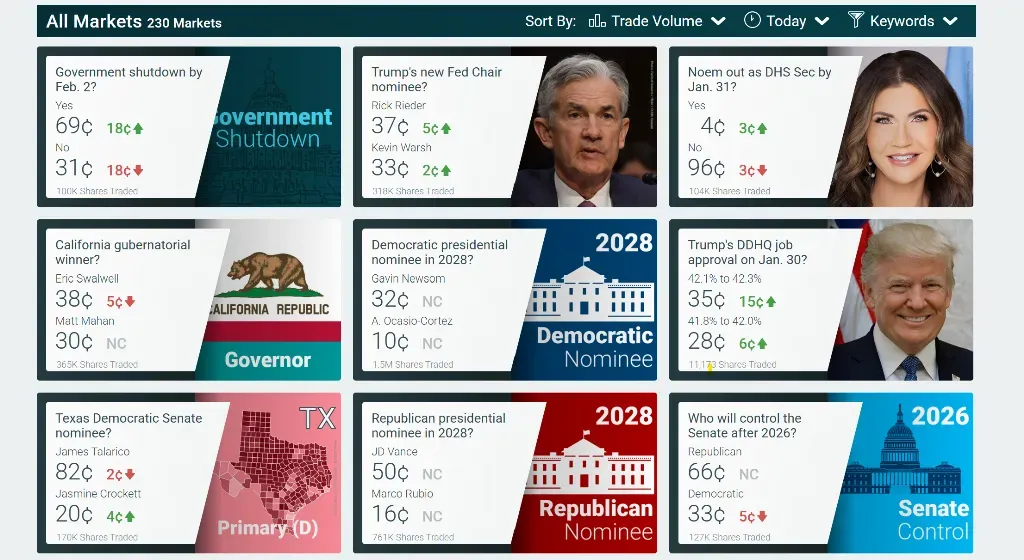
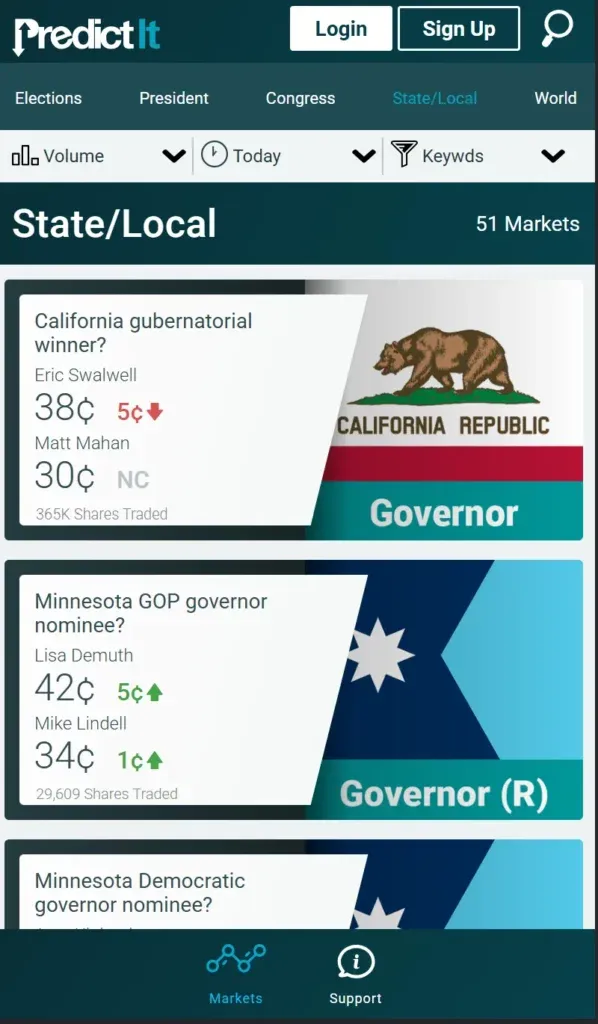
PredictIt’s interface reflects its academic origins more than any commercial betting or trading platform. The layout is functional, restrained, and intentionally utilitarian. There are no animations, promotional banners, or algorithmic recommendations pushing users toward specific markets. Instead, the platform presents a structured list of markets grouped by topic, each displaying current prices, available contracts, and basic volume indicators.
This design choice reduces cognitive overload but places more responsibility on the user. Navigation assumes a willingness to read market descriptions carefully and understand what is being traded. For users accustomed to sportsbook interfaces that prioritize speed and simplicity, PredictIt can initially feel sparse or even dated. Over time, however, the absence of visual noise becomes an advantage for users focused on analysis rather than entertainment.
Market pages themselves are information-dense. Each outcome is listed with buy and sell prices, current volume, and contract limits. The resolution rules are always accessible and clearly written, though they often require careful reading. PredictIt does not simplify complex political processes for the sake of accessibility, which reinforces its analytical positioning but can challenge casual users.
Order placement is straightforward. Buying and selling contracts is done through simple price selection rather than complex order types. This lowers the barrier to entry while still allowing users to express nuanced expectations through price choice. The tradeoff is reduced flexibility compared to financial exchanges, but this limitation aligns with the platform’s regulatory constraints.
Market Commentary and Community Influence
One of PredictIt’s most distinctive features is the presence of market-specific comment sections. These discussion threads function as informal forums where users debate interpretations, share sources, and critique prevailing narratives. In many cases, these discussions are as informative as the prices themselves.
Experienced participants often reference polling data, legal filings, or procedural details that are not immediately obvious from headlines. This can provide valuable context, particularly for complex markets tied to legislative processes or administrative actions. However, the quality of commentary varies widely.
Because participation is open, comment sections can also amplify bias, speculation, or selective interpretation of information. Some users use commentary to justify positions they already hold rather than to objectively assess new evidence. This dynamic reinforces the importance of separating price signals from narrative persuasion.
For attentive readers, comment sections offer insight into how expectations are formed and contested. They reveal which arguments are driving price movements and where disagreement remains unresolved. Used carefully, they enhance understanding; used uncritically, they can mislead.
Who Uses PredictIt
PredictIt’s participant base is unusually diverse compared to traditional betting platforms. It includes politically engaged individuals, data analysts, academics, journalists, and casual observers interested in forecasting. This diversity contributes to the richness of market dynamics but also introduces competing motivations.
Some participants approach markets as analytical tools, using prices to test hypotheses or compare competing interpretations of political events. Others treat participation as a form of expressive engagement, aligning positions with ideological beliefs or personal convictions. A smaller subset approaches PredictIt tactically, seeking short-term price movements rather than long-term outcome accuracy.
These differing motivations coexist within the same markets. As a result, prices reflect a blend of analysis, belief, and reaction to news. This does not invalidate market signals, but it does complicate them. Understanding who is likely driving a price move is often as important as understanding the move itself.
Participation also fluctuates significantly over time. During major election cycles, PredictIt experiences surges in activity that increase liquidity and stabilize prices. Outside these periods, participation declines, and markets can become thinner and more volatile.
Common Misunderstandings About PredictIt Markets
A frequent misconception is that PredictIt prices represent definitive probabilities. In reality, prices reflect the collective expectations of a specific group of participants operating under constraints. They are estimates, not forecasts guaranteed to converge on truth.
Another misunderstanding involves the assumption that markets always incorporate all available information. In practice, information diffusion is uneven. Some developments are absorbed quickly, while others take time to influence prices, particularly if they are complex or counterintuitive.
There is also a tendency to interpret price movement as confirmation of correctness. A rising price does not necessarily indicate increasing likelihood; it may reflect shifting sentiment, narrative dominance, or temporary liquidity imbalances.
Recognizing these limitations is essential for responsible use. PredictIt is most valuable when treated as one signal among many rather than as an oracle.
Why PredictIt Prices Diverge From Outcomes
Price divergence is an inherent feature of prediction markets, not a flaw unique to PredictIt. Divergences occur because markets trade expectations under uncertainty, not outcomes after resolution.
Late-breaking information, legal interventions, procedural irregularities, and strategic behavior can all disrupt convergence. In political contexts, outcomes are often decided through processes that are opaque or subject to interpretation until the final moment.
Additionally, structural limits can prevent markets from fully correcting mispricings. When informed participants hit position caps, their ability to counter prevailing sentiment is curtailed. This can allow incorrect prices to persist longer than they would in unrestricted markets.
Post-event analysis often reveals that markets were not irrational, but rather operating with incomplete or misleading information. Understanding this distinction is crucial for evaluating PredictIt’s performance fairly.
PredictIt in Relation to Other Forecasting Tools
PredictIt occupies a unique position alongside polls, expert forecasts, and statistical models. Polls capture stated preferences at specific moments, while models extrapolate from historical patterns and assumptions. PredictIt aggregates expectations shaped by both data and interpretation.
Each approach has strengths and weaknesses. Polls can be precise but fragile; models can be rigorous but opaque; markets are adaptive but noisy. Used together, they provide a more complete picture than any single method alone.
PredictIt’s value lies in its ability to synthesize diverse inputs into a single, continuously updating signal. That signal must still be interpreted with care, but it offers a perspective that static tools cannot.
PredictIt During Major Election Cycles
PredictIt’s relevance increases dramatically during national election cycles. Presidential elections, congressional control markets, and high-profile primaries attract the highest levels of participation, liquidity, and public attention. During these periods, prices tend to move more frequently and spreads narrow as more participants contribute information, interpretation, and capital.
Election-cycle markets benefit from a steady stream of new data inputs. Poll releases, debate performances, fundraising disclosures, legal rulings, and institutional signals all arrive at a pace that keeps markets active. This constant information flow allows prices to adjust incrementally rather than through abrupt repricing, which improves interpretability.
However, heightened participation also introduces behavioral dynamics. Election cycles amplify narrative momentum, partisan bias, and media-driven reactions. Sharp price movements following debates or breaking news often reflect emotional response rather than durable information. Over time, these moves may partially revert as the initial reaction is reassessed.
PredictIt’s structure moderates some of this volatility through position limits and capped exposure. While this prevents extreme distortions by single actors, it also limits how quickly informed participants can correct prices when sentiment overwhelms fundamentals. As a result, election-cycle markets are both more informative and more psychologically complex than off-cycle markets.
Notable Market Case Patterns
Across multiple election cycles, PredictIt markets have demonstrated recurring patterns rather than consistent accuracy. Early-cycle markets often reflect name recognition and media visibility more than organizational strength or institutional support. As campaigns mature, prices tend to respond more to structural factors such as ballot access, delegate math, and party dynamics.
Markets tied to institutional outcomes, such as legislative control or confirmation processes, often show slower convergence. These outcomes depend on procedural steps that are poorly understood by the general public, which creates room for prolonged mispricing. Markets resolve only once formal processes conclude, not when expectations settle.
Judicial and legal markets are among the most difficult to price accurately. Outcomes depend on opaque deliberations and narrow procedural interpretations. Even highly informed participants face genuine uncertainty, which results in wider spreads and persistent disagreement.
These patterns reinforce the importance of understanding what a market is actually measuring. PredictIt does not predict public opinion or institutional behavior in isolation. It aggregates expectations shaped by both.
Structural Strengths of PredictIt
PredictIt’s greatest strength lies in its clarity. Every market includes explicit resolution rules, defined outcomes, and documented settlement sources. This transparency distinguishes it from many alternative platforms where outcomes depend on loosely specified or mutable criteria.
The platform’s regulatory alignment also contributes to trust. Operating under a CFTC no-action framework imposes constraints, but it also enforces discipline. Markets must be narrowly defined, verifiable, and resolvable through public sources.
PredictIt’s pricing mechanism is intuitive. Contract prices map directly to implied probabilities without embedded margins or opaque adjustments. This makes interpretation accessible for users familiar with probabilistic reasoning.
Finally, the platform’s restraint is itself a strength. By avoiding gamification, leverage, or promotional incentives, PredictIt preserves an environment where analysis is foregrounded over engagement mechanics.
Structural Limitations and Tradeoffs
The same constraints that protect PredictIt also limit it. Position caps restrict capital flow, which can delay correction of mispriced markets. Trader caps reduce concentration risk but also reduce market depth.
Liquidity is uneven outside peak political moments. Many markets attract limited participation, making prices sensitive to small trades. In these contexts, prices should be interpreted cautiously.
Market scope is intentionally narrow. PredictIt avoids continuous price markets, subjective outcomes, and ambiguous events. While this improves resolution clarity, it excludes many areas of public interest.
Finally, PredictIt’s interface prioritizes functionality over accessibility. New users must invest time to understand market mechanics, resolution criteria, and price interpretation. This learning curve filters participation toward more engaged users but limits mass adoption.
Who PredictIt Is Best Suited For
PredictIt is best suited for users who value structured uncertainty analysis over entertainment. Analysts, journalists, researchers, and politically engaged individuals seeking probabilistic signals will find it useful.
It is less suitable for users seeking simplicity, rapid engagement, or expressive participation. PredictIt does not reward intuition or allegiance; it rewards patience and interpretation.
Importantly, PredictIt is not designed to replace polling, modeling, or expert analysis. It complements them by offering a dynamic aggregation of expectations rather than definitive answers.
Responsible Interpretation of PredictIt Markets
PredictIt prices should always be read as conditional expectations, not predictions of truth. They reflect what participants believe given available information and constraints at a specific moment.
Prices are shaped by incentives, biases, and participation levels. They respond to narratives as well as data. Treating them as signals rather than conclusions preserves their value.
Responsible use involves comparing market prices with external information, understanding resolution mechanics, and recognizing uncertainty even when prices appear confident.
Conclusion
PredictIt occupies a rare and valuable position in the forecasting ecosystem. It is neither a betting site nor a forecasting authority, but a structured environment where expectations are expressed, challenged, and revised over time.
Its markets offer insight into how informed participants interpret political uncertainty, particularly during high-stakes moments. At the same time, its limitations remind users that no single tool captures reality in full.
When approached with discipline and context, PredictIt provides a powerful lens into collective expectation formation. When approached uncritically, it risks being misunderstood as something it is not.
Used properly, PredictIt is not about predicting outcomes. It is about understanding uncertainty.
Frequently Asked Questions (FAQs)
What is PredictIt?PredictIt is a US-based prediction market platform that allows users to trade outcome-based contracts tied primarily to political and public-policy events. Contract prices reflect aggregated expectations about future outcomes rather than betting odds set by a bookmaker.
How does PredictIt differ from sportsbooks?PredictIt operates as an event-contract exchange rather than a sportsbook. Prices are determined by participant activity instead of house-set margins, and contracts represent implied probabilities rather than odds adjusted for bookmaker profit.
Is PredictIt legal in the United States?PredictIt operates under a no-action letter from the Commodity Futures Trading Commission (CFTC), which permits limited event-contract trading within defined constraints. Availability and participation rules are subject to regulatory conditions.
What do PredictIt contract prices represent?Each contract price represents the market’s implied probability of a specific outcome occurring, expressed as a value between $0.01 and $0.99. A price of $0.65 implies a 65% aggregated expectation at that moment.
How are PredictIt markets resolved?Markets resolve based on predefined criteria listed at contract creation. Settlement relies on publicly verifiable sources such as certified election results, official government announcements, or published institutional decisions.
Why do PredictIt prices change frequently?Prices change as participants react to new information, reinterpret existing data, or respond to shifts in sentiment. Media coverage, polling updates, legal rulings, and institutional signals can all influence repricing.
Does PredictIt predict election outcomes accurately?PredictIt does not guarantee accuracy. It reflects participant expectations, which may be influenced by incomplete information, bias, or limited liquidity. Markets are tools for interpretation, not forecasting guarantees.
Are there limits on trading activity?Yes. PredictIt enforces position limits and trader caps to reduce the risk of market manipulation and maintain regulatory compliance. These limits also constrain liquidity in some markets.
Who typically uses PredictIt?Users often include analysts, journalists, researchers, politically engaged individuals, and data-driven observers interested in understanding collective expectations around public events.
Is PredictIt suitable for casual users?PredictIt is best suited for users willing to understand market mechanics, resolution rules, and probabilistic interpretation. It is less oriented toward casual or entertainment-focused participation.