How to Read Market Prices as Probabilities
Prediction markets can look unfamiliar to first-time users because they do not usually present information in the same format as a sportsbook or a traditional financial…


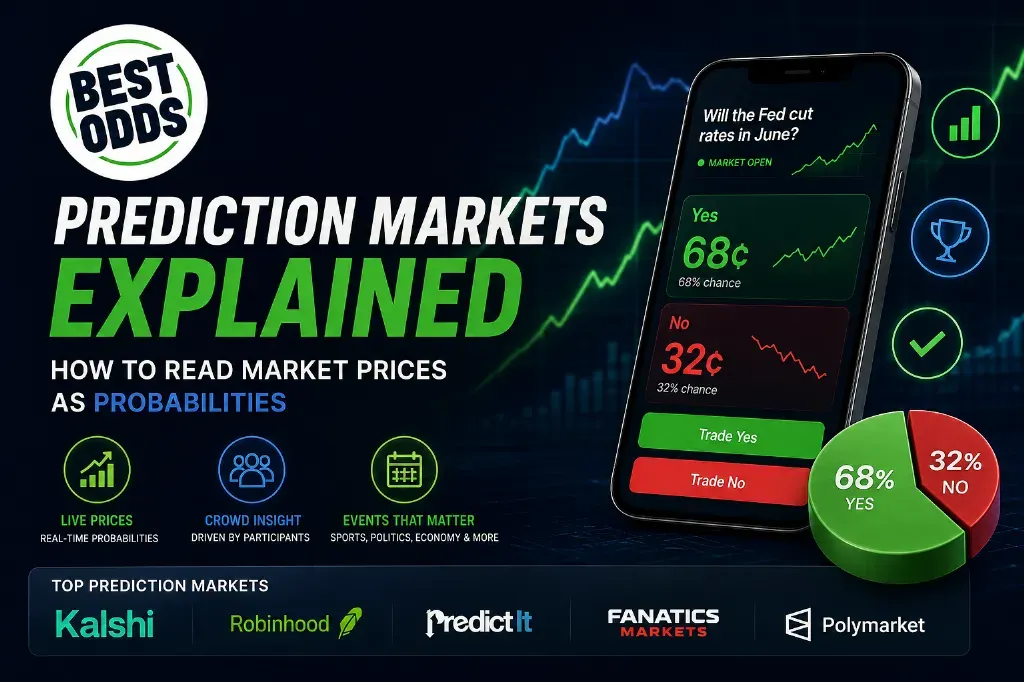
At first glance, a price such as 38¢, 61¢, or 84¢ may seem abstract. In practice, these prices are often interpreted as probability signals.
That means a contract trading at 61¢ may be understood as the market assigning roughly a 61% chance that the stated outcome occurs. A contract at 38¢ may suggest the market currently views that outcome as less likely. A contract at 84¢ may indicate a strong expectation, though not certainty.
This is one of the most important concepts in prediction markets.
Understanding how to read market prices as probabilities helps users move beyond guesswork. It allows them to compare market expectations with their own views, react to changing information more intelligently, and understand why prices move after news, injuries, polling changes, economic releases, or public sentiment shifts.
This guide explains the concept in full detail using plain language. It covers how prices translate into probabilities, why markets move, how to think about value, where users make mistakes, and how leading platforms such as Kalshi, Robinhood, PredictIt, Fanatics Markets, and Polymarket fit into the broader category.
Why Prediction Markets Use Prices Instead of Traditional Odds
Many prediction market apps are built around contracts rather than fixed wagers.
Instead of asking users to place a wager at bookmaker odds, the platform may list a contract tied to an outcome. Users then interact with the price of that contract.
For example:
- Will Team A win the championship?
- Will inflation exceed a stated level this month?
- Will Candidate X win the election?
- Will a company launch Product Y by a given date?
If the contract price rises, it generally means the market sees the outcome as more likely than before. If it falls, the market is signaling lower confidence.
This structure makes prices more intuitive for probability-focused users.
A sportsbook line of -145 requires conversion knowledge. A market price of 59¢ is often more immediately understandable as “about 59%.”
That simplicity is one reason prediction markets have gained attention outside traditional betting audiences.
The Basic Rule: Price Often Resembles Probability
The simplest working model is:
Price in cents ≈ probability in percentage terms
Examples:
- 12¢ ≈ 12%
- 27¢ ≈ 27%
- 50¢ ≈ 50%
- 73¢ ≈ 73%
- 91¢ ≈ 91%
This is not always mathematically perfect in live conditions because spreads, fees, liquidity, and market structure can create distortions. But as a practical first principle, it is highly useful.
If a market asks whether an event happens and the “Yes” side trades at 64¢, many users will interpret that as the crowd collectively assigning roughly a 64% chance that the event happens.
That gives users an immediate language for comparing opinions.
You might personally believe the true chance is closer to 75%. Someone else may believe it is only 52%.
Those disagreements are what create market activity.
Example: Reading a Sports Event Market
Imagine a market asks:
Will Team A win tonight’s game?
If the contract trades at:
- 48¢ early in the day
- 56¢ after lineup news
- 63¢ after confirmation a star player returns
- 58¢ after weather concerns or tactical reports
The market is constantly adjusting its probability estimate.
Rather than reading analyst opinions one by one, users can observe a live aggregated signal.
That does not mean the market is always right. It means the price reflects what active participants collectively believe at that moment.
Example: Reading a Political Outcome Market
Suppose a market asks:
Will Candidate X win State Y?
If the price moves:
- 41¢ after a weak debate
- 49¢ after favorable polling
- 54¢ after fundraising news
- 46¢ after a scandal story
The market is translating incoming information into changing probabilities.
This is why prediction markets are often watched during election cycles. They function as real-time sentiment indicators rather than static snapshots.
Example: Reading an Economic Market
Imagine a market asks:
Will the Federal Reserve cut rates this month?
If the contract moves from 32¢ to 67¢ after new inflation data, users can infer that expectations of a rate cut have increased sharply.
Again, the key value is not certainty. It is updated probability expression.
Why Prices Move
Understanding probability reading also means understanding why prices change.
New Information
Fresh data often drives the fastest moves.
Examples:
- Injury reports
- Polling updates
- Earnings releases
- Weather forecasts
- Official announcements
- Lineup confirmations
- Legal rulings
Changing Sentiment
Sometimes no new hard fact appears, but the crowd reinterprets existing information.
Liquidity and Order Flow
Large buyers or sellers can move thinner markets disproportionately.
Correction of Prior Mispricing
Markets sometimes drift too far emotionally and then reverse.
What a 50¢ Price Means
A 50¢ price is psychologically important because many users interpret it as an even contest.
It suggests the market currently sees the outcome as close to a coin flip.
That does not mean the real probability is exactly 50.0%. It means the market has not strongly favored one side.
When markets hover around 50¢, small pieces of news can trigger sharp moves because sentiment is balanced.
What Very High Prices Mean
Prices like 82¢, 88¢, or 94¢ often indicate strong confidence.
However, users make a common mistake here: they confuse high probability with certainty.
A 90% event still fails around one time in ten over long enough samples.
This matters because users may overpay for heavy favorites if they mentally convert “likely” into “guaranteed.”
Prediction markets reward disciplined probability thinking, not emotional certainty.
What Very Low Prices Mean
Low prices such as 8¢ or 14¢ are often treated dismissively.
But low probability is not zero probability.
Sometimes low-priced contracts rise sharply if new information emerges. That can make long-shot pricing attractive in selected situations.
However, many low-priced contracts remain low for good reason. Users should avoid assuming every cheap contract is hidden value.
Reading Both Sides of a Market
Many binary markets contain two sides:
- Yes
- No
If “Yes” is 63¢, then “No” may trade around the opposite side after accounting for spread and structure.
This helps users understand confidence distribution.
If Yes is high, No is low. If both look oddly priced, fees or liquidity may be influencing the display.
Why Probabilities Matter More Than Headlines
A common beginner mistake is asking only:
“Who will win?”
A stronger question is:
“What probability is already priced in?”
If you think Team A wins tonight, but the market already prices them at 88¢, the real question becomes whether 88% is too high, too low, or fair.
That shift in thinking separates outcome prediction from market evaluation.
Someone can correctly identify the likely winner yet still choose a poor price.
Personal Belief vs Market Belief
Prediction markets become useful when users compare two numbers:
- What the market implies
- What you personally estimate
Example:
- Market price = 57¢
- Your estimate = 68%
You may view the contract as underpriced.
Another user may estimate only 49% and see it as overpriced.
Those differences create trades.
Why the Crowd Is Sometimes Smart
Prediction markets aggregate many participants.
Some may have domain expertise. Others react quickly to news. Others specialize in numbers. Others monitor sentiment.
This can make markets surprisingly informative, especially in liquid, closely watched categories.
Users often underestimate how much dispersed knowledge can be embedded in price.
Why the Crowd Is Sometimes Wrong
Crowds are not infallible.
Markets can misprice due to:
- Emotional overreaction
- Thin liquidity
- Herd behavior
- Narrative obsession
- Slow response to niche information
- Temporary panic or euphoria
This is why prices are signals, not truths.
Kalshi and Probability Reading
Kalshi helped many U.S. users encounter prediction-market pricing in a more mainstream format.
For users new to event contracts, the ability to see an outcome trading at a clear price can feel more intuitive than traditional odds systems.
That simplicity has educational value. Users begin thinking in chances rather than only labels like favorite or underdog.




 Deposit $10 get a $50 Trading BonusCLAIM BONUS


Robinhood and Mainstream Accessibility
When mainstream finance platforms expose the likes of Robinhood users to event-style pricing, more people learn probability-based participation.
For users already familiar with stocks moving on news, prediction market prices can feel conceptually natural.
They respond to information, expectations, and sentiment.

PredictIt and Election Probability Culture
PredictIt played a role in teaching many users to interpret political prices as rough chances rather than partisan narratives.
Instead of arguing endlessly, users could look at live market sentiment.
Even critics of markets often adopted the language of probability because of this influence.
Fanatics Markets and Sports Crossover
Sports-oriented audiences may find event pricing easier to adopt when delivered through a sports-recognized ecosystem, the likes of Fanatics Markets.
That matters because sports fans already think in matchup probabilities, even if informally.

Polymarket and Public Awareness
High-visibility public markets, such as Polymarket, helped normalize the idea that outcomes can be continuously repriced by participants.
This broader cultural familiarity has expanded interest in reading probabilities through markets.
 Deposit $10 get a $50 Trading BonusCLAIM BONUS
Common Beginner Errors
Treating Price as Certainty
A 76¢ contract is not guaranteed.
Ignoring Price and Focusing Only on Narrative
Liking a story is not enough if price already reflects it.
Overreacting to Small Moves
A move from 52¢ to 54¢ is not always profound.
Chasing Momentum Blindly
Prices can overshoot.
Ignoring Liquidity
Thin markets may look informative but be unstable.
A Better Way to Think
Instead of asking:
“Will it happen?”
Ask:
- What chance does the market imply?
- Do I agree?
- Has new information been fully absorbed?
- Is movement driven by facts or emotion?
- Is liquidity strong enough to trust the signal?
How to Convert Market Prices into Practical Probability Thinking
Reading a price as a percentage is only the first step. The more valuable skill is understanding what that percentage actually means in real life.
If a contract trades at 70¢, many users casually say “it will happen.” A more accurate interpretation is:
- In a large sample of similar 70% situations, roughly seven out of ten might occur.
- About three out of ten would still fail.
- A loss in one instance does not automatically mean the market was irrational.
This distinction matters because prediction markets can feel emotionally misleading when users expect single-event certainty from probability-based pricing.
For example:
- A 60¢ contract losing does not prove the market was wrong.
- A 20¢ contract winning does not prove the market was foolish.
- Short-term outcomes and long-term calibration are different concepts.
Users who understand this tend to react more calmly to volatility.
Thinking in Expected Outcomes Instead of Absolutes
Traditional conversations often revolve around absolutes:
- Will they win?
- Will rates be cut?
- Will the bill pass?
- Will the product launch?
Prediction markets encourage a better framework:
- How likely is it?
- Is current pricing too optimistic?
- Is the market underestimating risk?
- Has recent news already been priced in?
That shift can improve reasoning beyond markets themselves. Many users find that probability thinking helps them interpret news, politics, sports commentary, and business claims more intelligently.
Why Market Prices Change Before the Event Happens
Beginners sometimes assume prices should only change once the outcome becomes clearer near the deadline.
In reality, markets move whenever expectations move.
That means prices may react days, weeks, or months before settlement.
Examples:
Sports
A championship contract may rise because:
- A rival team loses a star player
- A favorable playoff path emerges
- Trade deadline improvements occur
- Weather affects a future matchup
Politics
A candidate contract may move because:
- Strong polling trend
- Debate performance
- Major endorsement
- Fundraising surge
- Scandal or legal development
Economics
A rate-cut contract may move because:
- Inflation report surprise
- Labor market weakness
- Central bank commentary
- Global slowdown concerns
The event itself has not happened yet. But expectations about the event have changed.
That is the essence of prediction market pricing.
Why Fast Moves Happen
Sometimes a market jumps sharply in minutes rather than gradually.
This usually reflects one or more of the following:
- Breaking news
- Thin liquidity being overwhelmed
- A large trader acting quickly
- Delayed reaction suddenly catching up
- Public attention flooding into a market
Fast moves are not automatically smarter than slow moves. They are simply faster repricing.
Some sharp moves are justified. Others reverse later.
Reading Price Stability
A stable market can also be informative.
If a contract remains between 58¢ and 62¢ for days despite constant discussion, it may suggest that competing views are balancing out.
This can mean:
- No decisive new information exists
- Participants disagree but in equilibrium
- Existing price feels broadly fair for now
Stability is often underrated as a signal.
Not every important market should be moving wildly.
What Volatility Can Mean
Large price swings can signal:
- Genuine uncertainty
- Emotional trading
- News-sensitive categories
- Poor liquidity
- Polarized expectations
- Fast-changing external conditions
Users should not automatically equate volatility with opportunity.
Sometimes volatility reflects noise rather than value.
The Difference Between Probability and Confidence
A common mistake is treating high probability as emotional confidence.
For example:
A market at 78¢ suggests something like a strong chance. It does not necessarily mean the market is “certain,” “safe,” or “easy.”
Probability is mathematical language.
Confidence is emotional language.
Prediction markets work better when users stay in the first category.
How to Read Underdog Prices Intelligently
Low-priced contracts attract curiosity because they appear cheap.
Examples:
- 11¢
- 17¢
- 23¢
But low price alone means nothing.
The right question is whether the true probability is higher than the market price implies.
An 18¢ contract is attractive only if you believe the real chance is meaningfully above 18%, after considering all costs and risks.
Cheapness is not value.
Why 50¢ Is Often the Most Interesting Zone
Markets around 50¢ can be especially active because the crowd is divided.
Examples:
- 47¢ vs 53¢
- 49¢ vs 51¢
These zones often react strongly to fresh information because there is no dominant consensus.
A small new development can tip sentiment sharply.
This is why many closely contested political or sports markets see intense movement around mid-range prices.
Comparing Market Prices to Polls, Models, and Commentary
Prediction market prices are often discussed alongside other information sources.
These may include:
- Polling averages
- Analyst forecasts
- Sports power ratings
- Economic models
- Media narratives
- Injury reports
- Social sentiment
A market price can differ from all of them.
That does not automatically mean the market is wrong or that the outside source is wrong. It simply means participants are weighting evidence differently.
Strong users compare sources rather than worshipping any single one.
Why Some Users Prefer Markets to Expert Commentary
Experts can be insightful, but commentary is often static, biased, or slow to update.
Prediction markets update continuously when new incentives and information arrive.
That dynamic nature is one reason many users treat them as useful live indicators rather than waiting for tomorrow’s opinion article.
Why Some Users Distrust Markets
Skeptics often raise valid concerns:
- Thin liquidity
- Whale influence
- Narrative herding
- Manipulation attempts
- Regulatory uncertainty
- Overconfidence in market wisdom
These concerns should not be dismissed.
Markets can be informative without being perfect.
The mature stance is neither blind trust nor blind cynicism.
Kalshi, Robinhood, PredictIt, Fanatics Markets, and Polymarket in Context
Each brand helps normalize probability-based thinking in different ways.
Kalshi
Often associated with regulated U.S.-style event contracts and clearer presentation.
 Trade $25 Get $25CLAIM BONUS





Robinhood
Important because mainstream finance users may encounter event-pricing logic through a familiar ecosystem.
PredictIt
Historically important for teaching many users to interpret political prices as live chances.
Fanatics Markets
Potential bridge for sports audiences who already think competitively about outcomes.
Polymarket
Highly visible in public discourse, helping bring event-pricing concepts into mainstream conversation.
Deposit $10 get a $50 Trading BonusCLAIM BONUS
How Professionals Often Think Differently
More disciplined participants usually avoid asking:
“Do I like this outcome?”
They ask:
- Is this price efficient?
- Has news been overreacted to?
- What is consensus missing?
- How strong is liquidity?
- What assumptions are embedded here?
- What would change this price tomorrow?
That mindset shift matters more than any single tactic.
Using Market Prices as Information Only
Some users never participate financially at all. They simply watch prices.
That can still be useful.
Examples:
- Tracking election sentiment
- Monitoring championship expectations
- Gauging policy outlook
- Following macroeconomic expectations
Prediction markets can function as dashboards of collective belief even for observers.
When Not to Trust a Price Too Much
Use extra caution when:
- Market volume appears thin
- Topic is obscure
- Contract wording is messy
- Sudden spikes lack clear news
- Emotional public narratives dominate
- One-sided enthusiasm feels irrational
Prices are signals. Context determines signal quality.
How to Judge Whether a Price Looks High or Low
Many beginners ask whether a contract is “too expensive” or “cheap.” In prediction markets, those words only make sense relative to probability.
A contract at 78¢ may be expensive if the true chance is closer to 65%. The same 78¢ price may be attractive if the true chance is actually 88%.
Likewise, a contract at 19¢ may look cheap because the number is small, but if the real probability is only 8%, it may still be poor value.
This is why advanced users focus less on nominal price and more on implied chance.
The useful framework is:
- What chance does the market imply now?
- What chance do I estimate independently?
- Why does my estimate differ?
- Am I missing something the market knows?
- Is the difference large enough to matter?
Without that framework, “cheap” and “expensive” are mostly emotional labels.
The Importance of Being Humble
Prediction markets can punish overconfidence.
Users often assume they are smarter than the crowd because they follow a topic closely. Sometimes that is true. Often it is not. The market may already contain information the user has not fully considered.
A healthy mindset is humility with conviction.
That means being willing to hold an independent view while also respecting that the crowd may know something.
Strong participants update their beliefs when evidence changes. Weak participants defend ego.
Why Markets Sometimes Look Wrong Before Becoming Right
There are moments when prices appear irrational in the short term.
Examples:
- A candidate falls after seemingly positive news
- A team drops despite a win
- An economic contract barely moves after a headline surprise
This may happen because:
- The news was already expected
- The headline was less meaningful than it looked
- Traders were positioned in advance
- Other hidden negatives offset the positive
- Liquidity timing delayed the true reaction
Markets often price expectations, not headlines.
That distinction explains many confusing moves.
Why Markets Sometimes Look Right Before Becoming Wrong
The opposite also happens.
A market may look intelligent and stable right until new information breaks.
Examples:
- Late injury news
- Legal ruling
- Unexpected resignation
- Data revision
- Severe weather shift
- Last-minute lineup changes
Prediction markets are adaptive, not prophetic.
They process what is known now. They do not eliminate uncertainty later.
Reading Probabilities During Live Sports Contexts
When sports-related markets move during a live event or close to game time, prices can change rapidly.
Examples:
- A favorite falls behind early
- A quarterback exits
- A red card changes a soccer match
- Weather intensifies
- A star player is confirmed active minutes before start
These moves can be dramatic because the remaining path to victory changes immediately.
Users should remember that rapid live movement often includes emotional reactions as well as rational ones.
Not every sharp move is perfectly efficient.
Long-Term Markets vs Short-Term Markets
Not all probabilities behave the same.
Short-Term Markets
Examples:
- Tonight’s game winner
- Tomorrow’s inflation release
- This weekend’s event
These markets may react intensely to immediate news and final-hour developments.
Long-Term Markets
Examples:
- Championship winners
- Election winners months away
- Year-end policy outcomes
These markets involve more uncertainty, more narrative swings, and more time for reversals.
A 70¢ price six months before settlement means something very different from a 70¢ price one hour before resolution.
Time horizon matters enormously.
Why Time Changes Price Meaning
As deadlines approach, uncertainty often compresses.
With less time remaining:
- Fewer unknowns remain
- More information is available
- Probabilities can become sharper
That means a late-stage 80¢ price may be more informative than an early-stage 80¢ price in the same topic.
Early confidence can be fragile. Late confidence may be more evidence-based.
How News Gets “Priced In”
Users often ask why a positive headline did not move a contract higher.
A common reason is that the market already expected it.
If traders widely anticipated a central bank cut, an actual cut may move price only slightly. The expectation was already embedded.
This concept—priced in—is crucial.
Markets react most strongly to surprises, not obvious developments.
Emotional Narratives vs Numerical Reality
Humans naturally love stories.
- “Momentum is unstoppable.”
- “Everyone knows they will win.”
- “The comeback is inevitable.”
- “This changes everything.”
Markets can sometimes resist dramatic narratives because participants reduce stories into percentages.
A dramatic story may still only justify moving from 42¢ to 49¢, not to 80¢.
This is one reason markets can feel cold compared with media coverage.
Using Probabilities to Improve General Decision-Making
One hidden benefit of learning prediction markets is better thinking outside markets.
Probability language can improve how users assess:
- Career opportunities
- Business launches
- Political claims
- Relationship outcomes
- Fitness goals
- Financial risk
Instead of thinking “certain” or “impossible,” users learn to think:
- likely
- plausible
- uncertain
- low chance
- improving odds
- deteriorating odds
This mindset is often more realistic and calmer.
Why Smart Users Keep a Range, Not a Single Number
Experienced users may think in ranges rather than exact precision.
Instead of saying:
“This is 63% exactly.”
They may think:
“This looks somewhere around 58–66%.”
That humility reflects reality. Many events cannot be estimated with perfect precision.
Markets display one price, but intelligent users often think in confidence bands.
Common Misreadings of Market Prices
Mistaking Momentum for Truth
A rising price may simply reflect excitement.
Mistaking Consensus for Accuracy
Many people agreeing can still be wrong.
Mistaking Cheapness for Value
Low prices are not automatically opportunities.
Mistaking High Price for Safety
Heavy favorites still lose.
Mistaking One Result for Long-Term Edge
A correct single outcome proves little.
How to Become Better at Reading Probabilities
The most effective path is observation.
Watch markets around major events and ask:
- What was priced yesterday?
- What changed today?
- What information triggered movement?
- Was the reaction too large?
- Did the final result match the highest-confidence period?
Over time, users begin seeing patterns in crowd behavior, overreaction, complacency, and timing.
Why Prediction Markets Continue Growing
Prediction markets appeal to modern users because they combine:
- Real-time information
- Interactive pricing
- Collective intelligence
- Clear probability language
- Cross-topic relevance beyond sports
Brands such as Kalshi, Robinhood, PredictIt, Fanatics Markets, and Polymarket have helped normalize the category in different ways.
As more users become comfortable thinking in probabilities, the appeal may continue to widen.
Best Prediction Markets in September 2026
The prediction market category continues to expand as more users look for real-time ways to interpret future outcomes through live pricing. Unlike traditional sportsbooks, prediction market platforms typically center around event contracts whose values move as expectations change. This creates a different user experience built around probabilities, sentiment shifts, and evolving information rather than fixed odds alone.
The best prediction markets are not always the ones with the most headlines. Strong platforms usually combine clear market design, recognizable branding, accessible interfaces, reliable execution, and categories that users actually care about. Some appeal more to mainstream beginners, while others attract highly engaged users who follow politics, economics, sports events, or fast-moving news cycles.
The brands below remain among the most recognized names currently associated with prediction markets.
Kalshi – Best Overall U.S. Prediction Market Brand
Kalshi is one of the most prominent names in the American prediction market space and is frequently the first brand many U.S. users mention when discussing event contracts. Its rise has helped bring prediction markets into broader public awareness.
The platform is often associated with contracts tied to economics, politics, weather, and headline-driven developments, while interest in sports-related event markets has also increased.
Why Kalshi stands out:
- Strong U.S. brand recognition
- Clean mainstream-facing presentation
- Broad category relevance beyond sports
- Frequently referenced in media discussions
Who it may suit:
- Users seeking a U.S.-focused prediction market platform
- Beginners wanting a recognizable brand
- Users interested in economics, politics, and current events
Robinhood – Best for Mainstream Accessibility
Robinhood is known primarily as a retail investing platform, but its connection to event-contract participation has made it an important gateway brand for mainstream users entering the category.
Many users already understand Robinhood’s mobile-first interface and app design, which can reduce friction when encountering prediction-market style products for the first time.
Why Robinhood stands out:
- Massive mainstream name recognition
- Familiar app experience for many users
- Strong crossover between finance users and event-market curiosity
- Mobile-first usability reputation
Who it may suit:
- Users already familiar with Robinhood
- Newcomers preferring household-name brands
- Users comfortable with market-style interfaces
PredictIt – Best for Political Outcome Markets
PredictIt has long been associated with political forecasting and election-cycle participation. For many users, it was their first exposure to markets that translate political developments into live prices.
Polling shifts, debates, campaign momentum, fundraising, and breaking political news have historically made PredictIt especially relevant during election seasons.
Why PredictIt stands out:
- Strong political identity
- Longstanding category relevance
- Recognized forecasting community
- Familiarity during election cycles
Who it may suit:
- Users focused on political outcomes
- Election watchers
- Users interested in public-policy forecasting
Fanatics Markets – Best for Sports Brand Crossover
Fanatics Markets benefits from one of the strongest sports-commerce brand names in the United States. That recognition gives it immediate relevance whenever sports-linked prediction markets are discussed.
For users who primarily identify as sports fans rather than finance-style traders, this type of brand familiarity can be valuable.
Why Fanatics Markets stands out:
- Powerful sports-brand recognition
- Natural connection with sports audiences
- Strong mainstream consumer awareness
- Broad crossover potential
Who it may suit:
- Sports-first users exploring prediction markets
- Casual mainstream users
- Fans already familiar with the Fanatics ecosystem
Polymarket – Best for Public Visibility
Polymarket has achieved significant public visibility through online discussion, media coverage, and fast-moving headline markets. It is often one of the most talked-about names whenever prediction markets trend socially.
Its relevance often increases during elections, geopolitical developments, and major news cycles.
Why Polymarket stands out:
- High public profile
- Strong social-media visibility
- Broad event-topic relevance
- Frequently discussed during major news cycles
Who it may suit:
- Users interested in current events
- Highly engaged news followers
- Users who like fast-moving public markets
How to Choose the Right Prediction Market
The best platform depends on what type of outcomes the user follows most closely.
Users interested in economics, weather, and broad real-world events may lean toward Kalshi. Those wanting familiar mainstream interfaces may prefer Robinhood. Political followers may naturally gravitate toward PredictIt. Sports audiences may appreciate Fanatics Markets. Users focused on high-profile public narratives may find Polymarket most relevant.
The smartest choice is usually the platform that best matches the user’s interests, interface preferences, and style of market engagement rather than whichever brand is simply most talked about.
Conclusion
Learning to read market prices as probabilities transforms how users understand prediction markets.
Instead of seeing random numbers on a screen, users begin seeing live estimates of collective belief. A 34¢ price suggests skepticism. A 52¢ price suggests uncertainty. An 81¢ price suggests strong confidence without certainty.
That framework is valuable whether someone participates directly or simply observes.
The most important lesson is that prices are not promises. They are evolving probability signals shaped by information, sentiment, liquidity, and disagreement.
Users who understand that distinction usually make better decisions, react more calmly, and think more clearly than those chasing headlines or certainty.
Frequently Asked Questions
What is a prediction market?
A prediction market is a platform where users buy, sell, and trade contracts tied to future outcomes. These outcomes can involve sports events, political results, economic data releases, entertainment awards, weather developments, and other measurable real-world events.
How do prediction markets work?
Most prediction market platforms display prices that move as participant expectations change. If confidence in an outcome rises, the contract price may increase. If confidence falls, the price may decline. Many users interpret these prices as rough probability signals.
Are prediction markets the same as sportsbooks?
No. Sportsbooks usually offer wagers at odds set by an operator. Prediction markets generally revolve around tradable event contracts whose prices are shaped by participant activity and market demand.
How do you read market prices as probabilities?
A common rule of thumb is that a price in cents often resembles a probability percentage. For example, a contract trading at 63¢ may be interpreted as the market assigning roughly a 63% chance of that outcome occurring, subject to liquidity and market conditions.
Are prediction markets legal in the United States?
Availability depends on the platform, product type, user location, and applicable regulatory framework. Users should always review platform eligibility rules, location restrictions, and current legal requirements before participating.
What can prediction markets cover?
Prediction markets may cover sports events, elections, economic releases, central bank decisions, weather outcomes, entertainment awards, technology milestones, and other measurable events depending on the platform.
Which prediction market is best for beginners?
Many newer users prefer recognizable brands with cleaner interfaces and simpler market presentation. The best beginner option usually depends on personal preferences, product availability, and the type of outcomes the user wants to follow.
Which prediction market is best for politics?
Platforms historically associated with election cycles and public-policy forecasting are often most relevant for political-outcome users.
Which prediction market is best for sports events?
Users focused mainly on sports may prefer brands with stronger sports recognition or platforms that prominently feature sports-event contracts where available.
Can you sell before an event ends?
Many prediction market structures allow users to buy and sell contracts before final settlement, depending on platform mechanics and available counterparties. This is one of the major differences from traditional fixed-ticket wagering.
Do prediction markets have fees?
Fee structures vary by platform. Costs may include spreads, trading fees, settlement charges, or withdrawal fees depending on the operator. Users should review the specific platform terms.
Are prediction markets accurate?
Prediction markets can be informative because they aggregate participant expectations in real time, but they are not perfect. Prices can be influenced by thin liquidity, emotional reactions, crowd behavior, and incomplete information.
Why do prediction market prices move so quickly?
Prices may react to breaking news, data releases, injuries, polling changes, legal decisions, or shifts in sentiment. High-profile markets can move rapidly when new information emerges.
Are prediction markets better than sportsbooks?
Neither category is universally better. Sportsbooks often suit traditional sports fans seeking props, parlays, and familiar betting formats. Prediction markets may appeal more to users who prefer probabilities, trading dynamics, and broader event categories.
Can beginners use prediction markets just for information?
Yes. Many users watch prediction market prices simply as live indicators of sentiment or probability without treating them purely as participation products.
What is the smartest way to choose a prediction market?
Choose the platform that best matches the events you care about, your preferred interface style, product availability in your location, and whether you prefer sports-focused or broader real-world markets.