Prediction Markets vs Sportsbooks
Prediction markets and sportsbooks are frequently compared because each involves taking a position on something that will happen in the future. On the surface, both can…


A sportsbook typically lets users wager at prices posted by the operator. Those odds are created internally and may then move in response to risk exposure, customer demand, injuries, news, and pricing at competing books. The user ultimately decides whether the available price is worth accepting.
A prediction market generally relies more directly on interaction among participants. Users can buy, sell, and trade event contracts connected to future results. Contract prices change as traders respond to fresh information, shifting expectations, and the availability of counterparties. The quoted price can often resemble a live probability estimate more closely than a conventional sportsbook line, although spreads and liquidity remain important.

That difference provides the starting point for this comparison.
For many mainstream sports fans, sportsbooks are still the more recognizable and straightforward option. Users who prefer thinking in probabilities, following price movement, and managing positions may find prediction market sites more intuitive.
This guide examines the major differences in detail, covering mechanics, legality, pricing, risk, liquidity, market types, tax considerations, mobile experience, and the brands that are currently among the best-known names in each category.
What Is a Prediction Market?
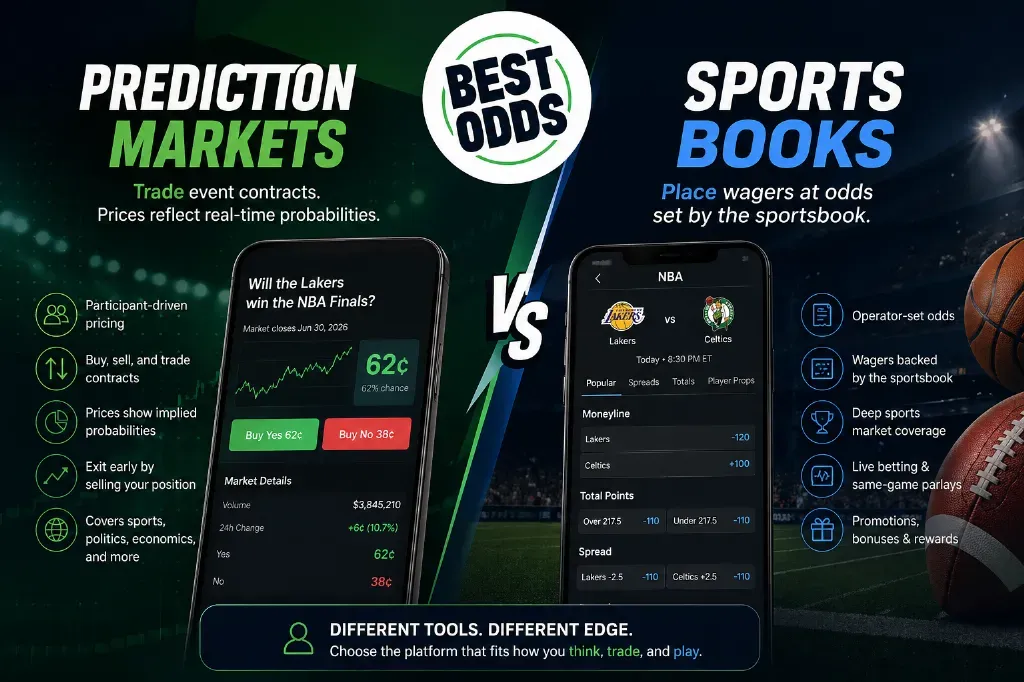
A prediction market is a platform that allows users to trade contracts based on whether a future event will or will not occur. Those events can involve sports, politics, economic reports, entertainment awards, weather developments, or business milestones.
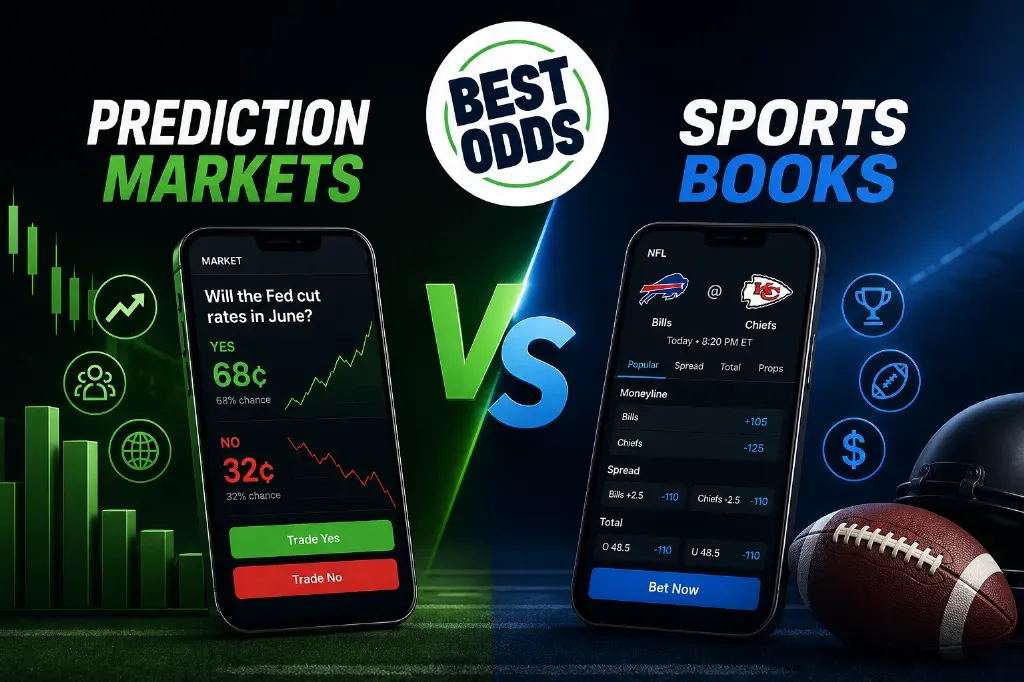
Rather than traditional odds such as +150 or -110, users commonly see a contract price. A contract trading for 62 cents, for example, may indicate that the market is assigning roughly a 62% probability to the outcome, although liquidity and pricing distortions can affect that signal.
When sentiment shifts because of an injury, polling information, an economic release, or breaking news, the contract price can move higher or lower.
As a result, prediction market users are often deciding not just what outcome they believe in, but also what price represents value.
For instance:
- A user who buys at 38 cents and later sells at 54 cents may realize a gain without holding the contract through final settlement.
- Purchasing at 72 cents may make sense only when the user believes the actual probability is greater than the price suggests.
- Exiting early can limit exposure before an uncertain outcome is resolved.
This ability to trade positions represents one of the clearest differences from sportsbooks.
What Is a Sportsbook?
A sportsbook is a platform that lets users wager on sporting events using odds posted by the operator.
Common markets include:
- Moneyline (which side wins)
- Point spread
- Totals (over/under)
- Player props
- Parlays
- Same-game parlays
- Futures
- Live betting
Sportsbooks remain the dominant sports-focused option in the United States because they are built specifically around sports entertainment and generally provide deeper game menus than prediction market apps.
They also commonly offer:
- Promotions
- Bonus bets
- Odds boosts
- Loyalty rewards
- Fast in-play menus
- Team and league hubs
- Detailed bet slips
- Broad state-by-state availability where licensed
For users who simply want to wager on a team, select a player prop, or put together a parlay during a live game, sportsbooks generally provide the more familiar experience.
The Core Structural Difference
The most direct way to understand the distinction is this:
With a sportsbook, the decision is whether to accept the odds posted by the operator.
With a prediction market, the decision is whether to buy or sell a contract at the price currently available.
That structural difference can substantially change user behavior.
Sportsbook users commonly concentrate on line shopping, promotional offers, odds boosts, and matchup analysis.
Prediction market users are more likely to focus on:
- Price entry points
- Implied probability
- Market overreaction
- Liquidity depth
- Exit timing
- Spread between buy and sell prices
- News reaction speed
Both formats can reward informed decisions, but the type of thinking they reward is different.
Why This Comparison Matters Now
Prediction markets have attracted much broader attention in the United States in recent years. Contracts involving economic results, elections, and sporting events have increasingly entered mainstream conversation.
At the same time, sportsbooks continue to represent a huge regulated industry backed by familiar brands, substantial marketing budgets, and well-established customer habits.
That has led many users to ask:
- Are prediction markets better than sportsbooks?
- Which has lower friction?
- Which offers better pricing?
- Which is easier for beginners?
- Which is more useful for sports specifically?
- Which is safer or more regulated?
- Which has more upside for skilled users?
Those are the questions addressed throughout this guide.
Most Recognized Prediction Market Brands
The following brands are among the names most frequently referenced in US prediction market coverage.
Kalshi



 Trade $25 Get $25CLAIM BONUS





Kalshi is one of the most recognized regulated prediction market brands in the United States. It has become a major reference point whenever Americans discuss event-contract trading.
Its markets have historically covered areas such as economics, politics, weather, and broader real-world events, while sports-related discussions have also increased.
Why users know it:
- Strong US visibility
- Clear mainstream brand identity
- Structured contract presentation
- Often cited in media discussions about prediction markets
Who it may suit:
- Users wanting a US-focused prediction market app
- Users interested in broader real-world outcomes beyond sports
- Users who value clearer platform presentation

Robinhood
Robinhood is widely known as a retail investing platform first, but its association with event contracts has brought prediction-market visibility to a much broader mainstream audience.
Its importance is less about being a legacy prediction-market specialist and more about distribution power. Many users already know the Robinhood interface and brand.
Why users know it:
- Massive mainstream recognition
- Familiar mobile-first user base
- Strong crossover between finance users and event-market curiosity
Who it may suit:
- Users who prefer familiar mainstream brands
- Users already comfortable with trading-style interfaces

PredictIt
PredictIt is historically associated with political outcome markets and election-cycle participation. For many users, it was their first exposure to participant-driven forecasting.
It developed a reputation as a place where polling shifts, debates, fundraising, and campaign developments translated into live prices.
Why users know it:
- Strong political identity
- Longstanding public awareness
- Recognized forecasting community
Who it may suit:
- Users interested in political outcomes
- Users who follow election cycles closely
Fanatics Markets
Fanatics Markets benefits from a powerful sports-commerce parent brand. That association gives it immediate relevance whenever sports-linked event trading is discussed.
Its long-term significance depends on execution, but brand recognition alone makes it notable.
Why users know it:
- Strong sports identity
- Large existing customer ecosystem
- Natural crossover into sports outcomes
Who it may suit:
- Sports-first users exploring event contracts
- Users familiar with Fanatics as a broader brand

Polymarket
 Deposit $10 get a $50 Trading BonusCLAIM BONUS


Polymarket has attracted strong public attention globally, especially around headline-driven topics and social media discussion.
Its visibility often comes from being culturally present during major news cycles.
Why users know it:
- High public profile
- Broad market interest themes
- Strong online discussion presence
Who it may suit:
- Users interested in wide-ranging current-event markets
- Users who follow fast-moving public narratives

Why These Prediction Market Brands Were Included
This shortlist reflects public visibility, relevance to the category, consumer awareness, and repeated inclusion in US prediction market discussions rather than promotional claims.
Kalshi is frequently central to conversations about regulated US event contracts. Robinhood matters because mainstream distribution can accelerate category adoption. PredictIt remains historically relevant for political outcomes. Fanatics Markets is notable because of sports-brand crossover potential. Polymarket is highly visible in broader public discourse.
Collectively, these names represent several different models:
- Regulated US-style event contracts
- Finance-platform crossover access
- Political forecasting communities
- Sports-brand ecosystem entry
- High-visibility public market participation
This makes them useful reference points for users researching the category.
Most Reliable Sportsbooks
The sportsbooks listed below rank among the largest and most widely used licensed operators in the United States.
FanDuel Sportsbook
FanDuel is one of the largest sportsbook brands in the United States and remains a reference point for mainstream sports betting adoption. Its brand scale, frequent advertising presence, and broad state footprint have made it familiar even to casual sports fans.
Users often associate FanDuel with:
- Strong app usability
- Extensive same-game parlay menus
- Frequent promotions
- Broad NFL, NBA, MLB, NHL, and college coverage
- Fast live betting menu updates
Who it may suit:
- Mainstream sports users
- Mobile-first bettors
- Users who like broad market menus

DraftKings Sportsbook
DraftKings is another market leader with strong recognition across fantasy sports and sportsbook audiences. It is particularly visible among users who enjoy features, prop depth, and promotional variety.
Users often associate DraftKings with:
- Large market menu depth
- Strong player prop selection
- Fantasy sports crossover familiarity
- Frequent feature launches
- Broad promotional ecosystem
Who it may suit:
- Prop-focused users
- Feature-driven bettors
- Users already familiar with DFS products

BetMGM Sportsbook
BetMGM combines sportsbook scale with one of the most recognizable gaming brands in North America. It often appeals to users who value an established land-based casino association alongside online access.
Users often associate BetMGM with:
- Recognizable brand trust
- Broad state presence
- Casino and sportsbook crossover rewards
- Traditional operator feel
Who it may suit:
- Users who value established gaming brands
- Multi-product users interested in sportsbook plus casino ecosystems
Caesars Sportsbook
Caesars carries one of the most recognizable names in US gaming and hospitality. Many users know it through physical casino presence long before they interact with the app.
Users often associate Caesars with:
- Loyalty ecosystem recognition
- Large national presence
- Sportsbook backed by a major hospitality brand
- Frequent mainstream partnerships
Who it may suit:
- Rewards-conscious users
- Users who already know Caesars as a legacy brand

bet365
bet365 entered the US market with long-established global recognition. It is widely known internationally for sports depth, pricing reputation, and broad event menus.
Users often associate bet365 with:
- Strong global sports coverage
- Broad soccer and international markets
- Familiarity among experienced bettors
- Live betting depth
Who it may suit:
- Users following international sports
- Bettors already familiar with global sportsbook brands
Why These Sportsbooks Were Included
These operators were chosen based on US market share, state availability, and overall consumer recognition.
Together, they reflect several common user priorities:
- Large market-share leaders
- Feature-heavy modern apps
- Legacy gaming brands
- International pricing specialists
- Sports-retail crossover brands
This provides readers with a practical cross-section of the US sportsbook market without requiring comparisons among dozens of operators.
Pricing: Prediction Markets vs Sportsbooks
Pricing is one area where the two categories differ substantially.
Sportsbooks
Sportsbooks publish odds that may be adjusted according to:
- Risk exposure
- User demand
- Competitor movement
- Injuries
- Weather
- Lineup news
- Internal models
Sportsbook odds also contain an operator margin, commonly called vig or juice.
That means sportsbook prices do not represent pure probability signals because business considerations are also built into them.
Prediction Markets
Prediction market pricing is generally driven by participants, with contracts moving higher or lower according to buying and selling pressure.
This can allow prices to reflect collective expectations more directly, although thin liquidity or emotional sentiment can still create distortions.
Practical Takeaway
For users seeking a straightforward wager at clearly displayed odds, sportsbooks are generally simpler.
For users interested in trading changing probabilities, prediction markets may be the more appealing format.
Liquidity and Market Depth
Liquidity describes how easily a user can enter or leave a position without causing a significant change in price.
Sportsbooks
Sportsbooks can generally take a wager directly through the operator and do not always require another customer to hold the opposite position.
That can make major markets easier to access immediately.
Prediction Markets
Prediction markets can rely more heavily on active counterparties and order flow. When liquidity is limited, users may encounter:
- Wider spreads
- Slower fills
- Volatile pricing
- Less reliable implied probabilities
High-profile markets generally offer better conditions than more niche markets.
Ease of Use for Beginners
Sportsbooks
For many Americans, sportsbooks are easier to understand from the start:
- Pick a team
- Choose odds
- Submit wager
That familiarity can be important.
Prediction Markets
Prediction markets can require users to understand:
- Buy vs sell
- Contract price
- Exit before settlement
- Spread costs
- Probability thinking
This can produce a steeper learning curve for some users.
Promotions and Bonuses
Sportsbooks generally spend more heavily on customer-acquisition promotions.
Common offers include:
- Bonus bets
- Odds boosts
- Parlay insurance
- Referral offers
- Loyalty rewards
Prediction market platforms often emphasize product functionality more than aggressive promotional offers.
For users primarily interested in bonuses, sportsbooks generally hold the advantage.
Position Management: Holding, Selling, and Cash-Out
Sportsbooks and prediction markets approach position management in different ways.
On many prediction market apps, users may buy, sell, and trade event contracts before final settlement. This means the user is not always forced to wait until the outcome is confirmed. If the market price moves favorably, the user may be able to sell the position earlier. If the market moves against them, they may be able to reduce exposure before final resolution.
This makes prediction markets feel closer to trading environments. Timing matters. Exit strategy matters. Liquidity matters. The price available later may be just as important as the price paid originally.
Sportsbooks usually work differently. A user places a wager at set odds and waits for settlement. Some sportsbooks offer cash-out features, but those prices are generally calculated by the operator and may include additional margin. Cash-out can be useful, but it is not the same as open market selling.
The practical difference is simple: prediction markets may give users more market-based position flexibility, while sportsbooks give users a more familiar fixed-ticket experience.
How Settlement Works
Settlement is an important consideration in both categories.
At a sportsbook, settlement usually depends on official league or event results. If the wager is on an NFL game, the sportsbook settles based on the final score and its house rules. If the wager is on a player prop, settlement depends on official stat providers and league data.
At a prediction market site, settlement depends on the contract’s written resolution rules. A good contract should explain exactly what source will be used and what condition must be met. For example, an economic market may use an official government data release. A political market may use certified results. A sports market may use official league confirmation.
This is why contract clarity matters so much. A vague prediction market can create disputes if the outcome is not defined precisely. A clear market reduces uncertainty because users know what evidence determines resolution.
In both categories, users should read rules before entering. The difference is that sportsbook rules are often standardized by market type, while prediction market contracts can vary more from event to event.
Regulation and Availability
Regulation is among the more complicated aspects of this comparison.
Sportsbooks in the United States are regulated at state level. A user generally must be physically located in a state where the sportsbook is licensed and where online sports betting is legal. Availability can vary by operator, even among legal states.
Prediction markets have a different regulatory landscape. Some event-contract platforms operate under federal frameworks, while others use different legal or operational models. Availability can depend on contract type, location, platform structure, and current regulatory interpretation.
That means users should not assume that a prediction market app is available everywhere simply because it is accessible online. They should also not assume that sports-event contracts are treated exactly the same as sportsbook markets.
The safest practical rule is to check platform availability, identity verification requirements, location restrictions, and product terms before participating.
Sportsbooks vs Prediction Markets for Sports Events
Sportsbooks generally remain the stronger option for users seeking traditional sports betting depth. They typically provide more leagues, a wider range of props, deeper in-game markets, more parlay tools, and broader promotional options.
Prediction markets may be more attractive to users looking for a different way to participate in sports-event markets. A market for a sports event can allow the user to think in contract prices, probability changes, and buy-sell timing rather than only fixed odds.
For example, a sportsbook user might take a team at +120 before kickoff. A prediction market user might buy a contract tied to the same team at 45 cents, watch it move to 63 cents after injury news or early game developments, then decide whether to sell or hold.
Both participants are making decisions based on an outcome, but the underlying mechanics differ.
Sportsbooks vs Prediction Markets for Non-Sports Outcomes
This is an area where prediction markets have a more obvious structural advantage.
Sportsbooks primarily concentrate on sports and sports-related wagering. Prediction markets can extend into domains where sportsbooks usually do not operate, including:
- Politics
- Economics
- Weather
- Technology
- Entertainment awards
- Public policy
- Business milestones
- Crypto-related events, depending on platform
A user who wants to analyze inflation releases, election outcomes, or whether a technology product launches by a specific date will usually find prediction markets more relevant than sportsbooks.
This broader category coverage is one reason prediction markets are often described as information markets rather than only sports products.
Risk Differences
Both categories carry risk, although the nature of that risk is not identical.
Sportsbooks carry traditional wagering risk. A user accepts odds, the event resolves, and the ticket either settles successfully or does not. The main risks are poor price selection, variance, emotional decision-making, overuse of parlays, and misunderstanding promotion terms.
Prediction markets include those same outcome risks plus additional market-structure risks. Thin liquidity can make entry and exit less efficient. Wide spreads can reduce value. Contract wording can create settlement uncertainty. Price movement before resolution can tempt users into overtrading.
A prediction market price also should not be treated as certainty. It reflects current market conditions, not a guaranteed forecast. Even a contract priced very high can resolve the other way.
Fees, Margin, and Cost of Participation
Sportsbooks make money through margin built into odds. For example, both sides of a spread may be priced at -110, meaning the operator has a built-in hold.
Prediction market sites may charge fees differently. Some may include fees on trades, withdrawals, or settlement. Others may rely on spread dynamics or platform-specific pricing structures.
The key point is that users should evaluate the total cost of participation rather than focusing only on the headline price.
For sportsbooks, that means understanding vig, alternate-line pricing, and parlay margin.
For prediction markets, that means understanding trading fees, bid-ask spreads, withdrawal charges, and liquidity impact.
A market that initially appears attractive can look less efficient once every cost is taken into account.
Mobile Experience and App Quality
For many US users, the real battleground between prediction markets and sportsbooks is mobile usability. Most participation now happens on phones rather than desktops, which means speed, clarity, and app design can matter as much as pricing.
Sportsbooks have spent years optimizing mobile apps. Major operators typically offer fast bet slips, live-score integration, push notifications, one-tap deposits, same-game parlay builders, watchlists, and detailed league hubs. The leading apps are designed for quick in-game use, where seconds can matter.
Prediction market apps often prioritize a different experience. Instead of team pages and bet slips, they may emphasize charts, price movement, contract order screens, watchlists, and market discovery across many event categories. Users who enjoy finance-style interfaces may find this natural. Traditional sports bettors may find it less intuitive at first.
For beginners, sportsbook apps often feel easier because the user journey is familiar: choose event, choose market, place ticket. Prediction market apps may require users to understand contract pricing, spreads, and order mechanics before the interface fully makes sense.
The better mobile option often depends on what a user wants from the product rather than on one category being objectively superior.
Which Is Easier for Beginners?
This is among the questions users ask most often.
For most mainstream US users, sportsbooks are easier initially. The core concept is straightforward: choose an outcome at listed odds. Most sports fans already understand teams, scores, favorites, underdogs, and basic props.
Prediction markets can be highly accessible, but they often introduce extra layers:
- Contract pricing instead of odds
- Buy vs sell decisions
- Entry price vs current price
- Whether to hold or exit early
- Bid-ask spreads
- Liquidity considerations
That additional learning curve is not necessarily a drawback. Some users actually prefer the added complexity because the experience feels more analytical. But for someone who wants instant familiarity on day one, sportsbooks usually have the advantage.
Which Is Better for Skilled Users?
Skill takes different forms in each category.
At sportsbooks, skill may involve:
- Line shopping
- Beating stale numbers
- Modeling props
- Understanding injuries and matchup edges
- Avoiding poor parlay math
- Bankroll discipline
At prediction markets, skill may involve:
- Estimating true probabilities
- Recognizing overreactions
- Entering at efficient prices
- Managing exits
- Understanding crowd psychology
- Interpreting news faster than the market
Some users who struggle at sportsbooks may do better in prediction markets because their strength is probabilistic thinking rather than classic sports handicapping. Others may prefer sportsbooks because they specialize in player props or niche sports where they believe they have an edge.
There is no single answer because each category rewards a different set of strengths.
Which Is Better for Casual Entertainment?
Sportsbooks generally have the advantage when the primary goal is entertainment.
The reasons are straightforward:
- Familiar sports focus
- Instant bet placement
- Same-game parlays
- Live betting excitement
- Promo-heavy onboarding
- Broad event schedules every day
Prediction markets can also be engaging, especially around elections, awards, or headline events, but they often feel more measured than a sportsbook during a packed NFL Sunday or March Madness slate.
Users seeking game-day engagement and fast interactive menus often prefer sportsbooks.
Which Is Better for Information and Forecasting?
Prediction markets often have an advantage in this area.
Because users are trading on outcomes rather than only placing fixed wagers, prices can become useful signals of collective expectations. Many observers use prediction markets to gauge sentiment around elections, policy outcomes, economic releases, or championship races.
That does not mean markets are always correct. They can be emotional, thinly traded, or temporarily distorted. But they often serve as living probability indicators in a way that sportsbooks are not always designed to do.
Sportsbooks are entertainment-first products. Prediction markets can function partly as information markets.
Taxes and Record Keeping
Users should take record keeping seriously in both categories.
Sportsbook participation may create taxable outcomes depending on jurisdiction, and users often need records of deposits, withdrawals, wins, losses, and statements where available.
Prediction market trading may create even more complex tracking because users can enter and exit multiple times rather than simply placing one ticket and waiting for settlement.
For either category, users benefit from keeping accurate records and consulting qualified tax professionals regarding local obligations.
In practical terms, prediction markets may demand more disciplined record keeping because activity can resemble trading instead of simple wager settlement.
Common Mistakes Users Make
Sportsbook Mistakes
Many users chase parlays because they are exciting, overreact emotionally during live betting, or ignore pricing differences between books. Others place wagers mainly because a game is on rather than because value exists.
Prediction Market Mistakes
Many users buy contracts purely because they like the outcome rather than because the price is attractive. Others ignore spreads, chase fast-moving headlines, or overtrade every small fluctuation.
Shared Mistakes
Across both categories, common errors include:
- Poor bankroll management
- Emotional decision-making
- Acting without understanding rules
- Confusing confidence with certainty
- Chasing losses
The products may differ, but many of the mistakes users make are similar.
How to Choose Between Prediction Markets and Sportsbooks
A simple framework can make the choice easier.
Choose sportsbooks if you mainly want:
- Traditional sports betting
- Parlays and props
- Broad game menus
- Fast entertainment value
- Promotions and bonuses
- Familiar app experiences
Choose prediction markets if you mainly want:
- Trading-style participation
- Probability-based thinking
- Event coverage beyond sports
- Entry and exit flexibility
- Following political or economic outcomes
- Market sentiment signals
Some users participate in both categories because each serves a different purpose.
Which Category Is Likely to Grow More?
Sportsbooks remain far larger in the United States in terms of scale, revenue, and mainstream customer familiarity. They are deeply embedded in sports media, leagues, and fan culture.
Prediction markets, however, have significant growth potential because they extend beyond sports and appeal to finance-minded users, news followers, and people interested in forecasting.
Coexistence is a more realistic outlook than one category replacing the other. Sportsbooks are unlikely to disappear because prediction markets grow. Prediction markets are unlikely to vanish because sportsbooks dominate sports betting.
They address different user needs.
Responsible Participation
Whether using sportsbooks or prediction market platforms, users should approach both categories responsibly.
Set limits in advance. Avoid using either product to recover losses. Do not confuse market movement with certainty. Step away when decisions become emotional rather than rational.
Participation should remain controlled entertainment or measured speculation, not a source of financial pressure. Licensed sportsbooks provide responsible gambling tools including deposit limits, session timers, cooling-off periods, and self-exclusion, and these are most effective when configured proactively.
For confidential support, the National Council on Problem Gambling operates a helpline 24 hours a day, seven days a week at 1-800-GAMBLER. Additional resources are available through the National Council on Problem Gambling.
Conclusion
Prediction markets and sportsbooks can appear similar at first glance, but they are fundamentally different products.
Sportsbooks are usually stronger for users who want traditional sports wagering, promotions, props, parlays, and fast game-day entertainment. Prediction markets often appeal more to users who prefer probabilities, pricing movement, event trading, and broader categories such as politics or economics.
Neither category is automatically better. Each favors different habits, abilities, and expectations.
For many users, sportsbooks remain the default choice for sports. For analytical users who think in probabilities and price movement, prediction markets can offer a compelling alternative.
The most useful question is not which category is best in the abstract. It is which one best matches how you naturally think and what kind of experience you actually want.
Frequently Asked Questions
What is the difference between prediction markets and sportsbooks?
A sportsbook generally allows users to place wagers at odds offered by an operator. A prediction market usually allows users to buy, sell, and trade contracts tied to future outcomes, with prices moving according to participant demand and changing expectations.
Are prediction markets the same as sports betting?
Not exactly. Prediction markets and sportsbooks can both involve sports outcomes, but the mechanics are different. Sportsbooks focus on wagers at listed odds, while prediction market platforms often use tradable contracts with market-based pricing.
Are prediction markets legal in the United States?
Availability depends on the platform, product type, state location, and applicable regulatory framework. Users should always check current eligibility, platform terms, and jurisdiction-specific restrictions before participating.
Are sportsbooks legal in the United States?
Sportsbook legality depends on state law. Some states allow online sports betting, some allow retail-only betting, and others do not permit it. Availability also varies by operator.
Which is better for beginners: prediction markets or sportsbooks?
For many beginners, sportsbooks are easier to understand because the format is more familiar. Users choose an event and place a wager at listed odds. Prediction markets may require learning contract pricing, buy and sell mechanics, and probability-based thinking.
Which is better for experienced users?
That depends on the user’s strengths. Experienced sportsbook users may prefer odds analysis, props, and line shopping. Experienced prediction market users may prefer pricing inefficiencies, contract trading, and sentiment shifts.
Can you make money with prediction markets?
As with any speculative activity, outcomes vary and losses are possible. Some users may profit through disciplined decision-making, but there is no guarantee of success. Prices can move quickly and markets can be wrong.
Can you make money with sportsbooks?
Some users attempt to profit through research, line shopping, bankroll management, and disciplined wagering, but losses are common and no profit is guaranteed.
Do prediction markets offer sports markets?
Some prediction market platforms may offer markets tied to sports outcomes, such as game winners, championships, or season milestones, depending on platform scope and availability.
Do sportsbooks offer political or economic markets?
Traditional sportsbooks mainly focus on sports and sports-adjacent markets. Prediction markets are generally more associated with politics, economics, and broader real-world outcomes.
Which has better promotions: prediction markets or sportsbooks?
Sportsbooks usually offer more aggressive promotional ecosystems, including bonus bets, odds boosts, and loyalty offers. Prediction market platforms often focus more on trading functionality than promotions.
Which has lower fees?
Sportsbooks typically build margin into odds. Prediction markets may involve spreads, trading fees, or other platform costs depending on structure. Users should compare total cost rather than just headline pricing.
Can you cash out early on both?
Many sportsbooks offer cash-out features, while some prediction markets allow users to sell positions before settlement if there is sufficient market activity. The mechanics are different.
Which is better for sports fans?
Sportsbooks are usually the stronger fit for users focused mainly on sports because they offer deeper game menus, player props, live betting, and same-game parlays.
Which is better for politics or economic forecasting?
Prediction markets are generally more relevant for users interested in political outcomes, macroeconomic releases, or broader forecasting markets.
Do prediction markets replace sportsbooks?
No. They are better viewed as a parallel category serving different user preferences. Sportsbooks remain dominant for sports wagering, while prediction markets appeal to users interested in tradable outcome contracts.
Are mobile apps better for sportsbooks or prediction markets?
Sportsbook apps often feel more intuitive for mainstream users. Prediction market apps may appeal more to users comfortable with finance-style interfaces and live pricing screens.
What is the smartest way to choose between them?
Choose sportsbooks if you want traditional sports betting entertainment. Choose prediction markets if you prefer probabilities, market pricing, and event-contract trading. Some users engage with both for different reasons.
iGaming Writer - Patrick is a long-time casino enthusiast and sports betting analyst who has spent the last decade diving deep into the world of online gaming. Whether it’s breaking down the nuances of live dealer strategies, reviewing slot tournaments, or comparing crypto payment methods across top UK casinos, Patrick brings a bettor’s mindset to every article.