Are Prediction Markets Legal? Platforms, Rules, and What Users Need to Know
Prediction markets sit in a more complex legal category than many users assume. They are often discussed alongside sports betting, financial derivatives, and forecasting…

That is why legality is one of the most important topics in the sector.
Some prediction market platforms operate under formal regulatory frameworks. Others rely on offshore structures, crypto infrastructure, or limited exemptions. Certain platforms may be available in one state or country but restricted in another. A market can be permitted in principle, but unavailable to a specific user based on location, residency, or platform policy.
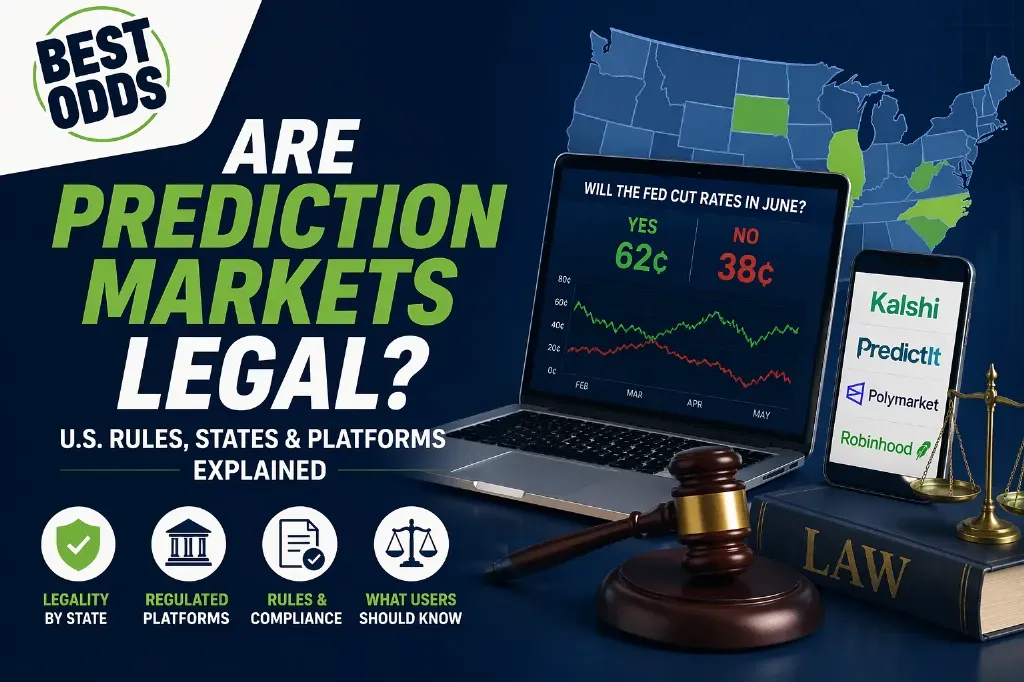
This means the question “Are prediction markets legal?” rarely has a one-word answer.
Instead, legality usually depends on five core factors:
- Jurisdiction
- Platform licensing or regulatory status
- Type of contract offered
- Payment and settlement model
- User eligibility rules
The strongest approach for users is to treat prediction markets as a regulated access product, not an open internet free-for-all.
This guide explains how legality works, which platforms operate under clearer frameworks, where uncertainty still exists, and what users should check before trading.
Are Prediction Markets Legal in the United States?
Yes, some prediction markets are legal in the United States, but only certain platforms and certain contract structures operate with clearer regulatory standing.
In the U.S., prediction markets may fall under oversight connected to derivatives, event contracts, or other regulated financial products rather than standard gambling frameworks. That distinction matters.
Unlike sportsbooks, which are regulated state by state as gambling operators, some prediction market platforms position themselves as exchanges or contract venues tied to measurable future events.
That can include markets linked to:
- Elections
- Inflation data
- Interest rate decisions
- Weather events
- Economic indicators
- Policy outcomes
- Select sports or entertainment outcomes (depending on framework)
However, legality does not mean universal availability. Even where a platform is permitted, access can still vary by state, identity verification status, age restrictions, or changing regulatory interpretation.
The practical answer is simple:
Some platforms are legal for some users in some states under specific rules.
Best Legal Prediction Market Platforms in the U.S. – September 2026
The platforms below were selected because they are commonly referenced in U.S. prediction market discussions and represent different legal or structural approaches. Availability may change by jurisdiction.
1. Kalshi – Best Known Regulated Prediction Market Exchange



Kalshi occupies a unique place in the U.S. market because it is widely recognized for operating under a regulated event-contract framework.
The platform focuses heavily on measurable real-world events such as inflation releases, weather outcomes, Federal Reserve decisions, politics, and other clearly defined contracts. Markets typically include formal resolution criteria tied to official sources.
That structured model gives Kalshi stronger legal clarity than many alternative platforms, although market availability and contract scope can still evolve.
Why it stands out: Clearer U.S. regulatory positioning and precise contract design.

2. Crypto.com – Highly Reputable Brand

 Trade contracts, not fixed-odds bets
Operates on regulated trading infrastructure
Easy access with fiat and crypto funding
Trade contracts, not fixed-odds bets
Operates on regulated trading infrastructure
Easy access with fiat and crypto funding
 Trade contracts, not fixed-odds bets
Operates on regulated trading infrastructure
Easy access with fiat and crypto funding
Trade contracts, not fixed-odds bets
Operates on regulated trading infrastructure
Easy access with fiat and crypto funding
 Earn up to $300 in CROCLAIM BONUS





Crypto.com occupies a distinctive position within the broader prediction market ecosystem because it combines event-style contracts with the infrastructure, liquidity networks, and user base of a large-scale cryptocurrency exchange. Unlike smaller standalone prediction platforms, Crypto.com benefits from an existing global audience already accustomed to market-based speculation, rapid information flow, and digital asset trading. This creates an environment where event contracts can attract participation from users who actively monitor macroeconomic developments, cryptocurrency volatility, geopolitical developments, and major sporting events. The platform’s integration within a broader financial ecosystem also allows prediction-style products to sit alongside spot trading, derivatives, and market analytics, creating a structurally different experience from traditional sportsbook environments. For users already familiar with digital asset platforms, this familiarity can reduce friction when interacting with event-based contracts tied to real-world outcomes.

3. PredictIt – Best Known Political Market Brand
PredictIt has historically been one of the most recognized names in U.S. political prediction markets.
It became especially visible during election cycles, where users used markets to express views on candidates, parties, and public outcomes.
Its legal position has long been more nuanced than a fully open national exchange model, which makes it important historically and structurally even when access conditions shift.
Why it stands out: Strong brand recognition in politics-focused prediction markets.
4. Fanatics Markets – Best Emerging Consumer Brand
Fanatics Markets represents a consumer-facing attempt to bring event-style markets into a sports-adjacent ecosystem.
Its relevance lies less in legacy depth and more in the possibility that prediction products become integrated into broader mainstream sports ecosystems.
Why it stands out: Potential bridge between sports fans and prediction-style markets.

5. Polymarket – Best Known Crypto Prediction Brand
 Deposit $10 get a $50 Trading BonusCLAIM BONUS

Polymarket is globally prominent in crypto-native prediction markets, though its regulatory position differs sharply from regulated U.S. exchanges.
It is frequently discussed because it covers a wide range of political, crypto, and cultural topics, often reacting quickly to breaking news.
Users should understand that visibility and popularity are not the same as domestic regulatory clarity.
Why it stands out: High-profile crypto-native market brand with broad topic coverage.

6. Robinhood – Best Mainstream Retail Entry Point
Robinhood’s involvement in event contracts has helped introduce prediction-style markets to a wider retail audience.
Rather than functioning as a traditional prediction exchange, Robinhood integrates certain event-based products into a broader investing platform. This mainstream wrapper can make access feel more familiar to ordinary users.
Availability tends to be selective, and product rollout can vary.
Why it stands out: Large mainstream audience and familiar brokerage environment.

Why Prediction Market Legality Is Complicated
Prediction markets combine features from multiple sectors at once.
They can resemble:
- Trading platforms
- Forecasting tools
- Event derivatives
- Speculation markets
- Gaming products
- Information markets
Because of that, regulators may view similar-looking products differently depending on structure.
For example:
A sports bet with operator-priced markets is one legal category.
A participant-driven event contract on a regulated exchange may be another.
A token-settled crypto market may fall into a different category again.
This is why two platforms that look similar on the surface may face completely different legal treatment.
Federal vs State Rules in the U.S.
Users often assume one national answer exists. In reality, U.S. legality can involve multiple layers.
Federal Layer
Certain products may be reviewed through national regulatory frameworks depending on contract type and platform structure.
State Layer
Even where a platform has stronger federal standing, access may still vary by state law, consumer rules, or platform policy.
Platform Layer
Some companies voluntarily restrict states or users to reduce legal risk.
That means users should always check:
- Current state availability
- Age requirements
- Identity verification rules
- Funding methods
- Product limitations
Are Prediction Markets Gambling?
One of the most common legal misunderstandings is the assumption that all prediction markets are simply gambling products under a different name. That is not how the category is always treated in law or in regulation.
Some prediction markets are structured as event contracts or trading instruments rather than sportsbook-style wagering products. The distinction matters because pricing, participation, and market design work differently. In a sportsbook, odds are generally set by an operator that incorporates margin and exposure management. In a prediction market, prices may emerge through participant interaction, often reflecting a tradable probability signal rather than a house-set line. That structural difference is one of the reasons prediction markets are often discussed separately from conventional betting products.
That said, legal classification is not determined by marketing language alone. Regulators may look at how a market functions, how it settles, whether participants are trading against one another or against a house framework, what the contract references, and what formal approval or exemption the platform operates under. Two products can look similar from a consumer perspective while receiving very different legal treatment. This is one of the central reasons users should not assume that “prediction market” automatically means legal, nor that “looks like betting” automatically means illegal.
It is more accurate to say that prediction markets sit in a contested space between informational trading, event contracts, speculative positioning, and gambling-adjacent behavior. In some cases they are treated as regulated event markets. In others they face restriction, challenge, or jurisdictional uncertainty. The safest approach for users is to evaluate the platform’s actual structure rather than relying on broad labels.
Are Sports Prediction Markets Legal?
Sports-related prediction markets sit in an especially sensitive category because they invite immediate comparison with sportsbooks, betting exchanges, and fantasy-style products. That comparison is understandable, but it can also blur important legal distinctions.
A sports outcome market may be presented as a contract tied to a measurable event rather than as a traditional wager. Even so, legality depends heavily on platform design, regulatory treatment, and jurisdiction. Some products are built within clearer exchange-like or state-licensed frameworks, while others rely on models that are newer, narrower, or still developing. The parent page’s shortlisted platforms reflect this structural diversity, from event-style markets to fantasy-style products to state-licensed sports outcome models.
This means users should not treat “sports prediction markets” as one unified legal class. A sports contract inside a regulated or licensed product environment may be available to one user and unavailable to another based on location, eligibility, or platform policy. Some platforms may allow only a narrow catalog of events. Others may concentrate on player performance or peer-driven structures instead of broad open market pricing. The legal answer is therefore not whether sports prediction markets are legal in the abstract, but whether a specific platform’s sports contracts are permitted and available for that specific user.
Crypto Prediction Markets and Legal Uncertainty
Crypto-native prediction markets are among the most visible parts of the category, but they are also among the least straightforward from a legal standpoint. They often operate through on-chain systems, token settlement, and oracle-based resolution methods rather than through conventional U.S. exchange infrastructure.
That architecture gives them broader topical flexibility. It also introduces additional regulatory and operational questions. The parent page notes that crypto-native markets expand coverage into politics, crypto governance, culture, and protocol-level events, but it also points out that settlement outcomes may depend on oracle design and governance processes rather than on a regulated institutional framework. That makes legal and interpretive caution especially important.
For users, the practical takeaway is simple. Popularity does not equal clarity. A widely discussed platform can still carry substantial uncertainty around access, enforceability, settlement assumptions, and jurisdictional treatment. Crypto prediction markets may be relevant for understanding the category, but they should not be assumed to offer the same legal certainty as a regulated U.S. event-contract venue. Any user considering such a platform should pay close attention to access restrictions, local rules, and platform-level limitations before taking any position.
Why Unregulated Access Creates More Risk
Legal ambiguity is not only a theoretical issue. It changes the real risk profile of participation.
When a platform operates under a clearer framework, users at least have a stronger basis for understanding market rules, contract definitions, settlement standards, and continuity expectations. When a platform sits in a more uncertain category, additional risks emerge. Market access may change abruptly. Certain jurisdictions may be restricted without much notice. Resolution mechanisms may depend on processes unfamiliar to mainstream users. Support and recourse options may also be weaker.
This matters because prediction markets are often used as information tools as much as speculative instruments. If legality, continuity, or settlement standards are unclear, even a seemingly active market can become harder to interpret. The problem is not only possible financial loss. It is also that the signal itself may be harder to trust if the platform environment is unstable.
Users therefore need to evaluate not just whether a topic is available, but whether the venue itself inspires confidence. Regulatory posture, contract clarity, and settlement transparency are not side details. They are core parts of platform quality. That is a recurring theme throughout the parent page’s methodology and platform comparisons.
How to Check If a Prediction Market Platform Is Legal for You
The safest approach is not to ask whether prediction markets are legal in general, but whether a particular platform is legal and available for a particular user in a particular jurisdiction.
Start with the platform’s access rules. Check whether the site explicitly lists supported states or countries. Look at identity verification requirements, age restrictions, and funding limitations. If the platform is unclear about who may participate, that is already a warning sign.
Next, look at how the product is described. Is it framed as an event-contract exchange, a fantasy-style product, a brokerage-linked market, or a crypto-native protocol? Those differences matter because they often correspond to different legal postures and different levels of regulatory clarity.
Then review contract definitions and settlement language. Clear resolution criteria usually indicate a more serious market structure. If a platform is vague about how outcomes are determined or where official data comes from, users should be cautious.
Finally, users should remember that legality is dynamic. Product offerings, platform policy, and regulatory interpretation can all change. What matters is current access, current restrictions, and current eligibility, not only general market reputation.
Responsible Use and Legal Awareness
Users sometimes treat legal availability as the only question that matters. It is not. Even where a platform is accessible, responsible participation still matters because prediction markets involve uncertainty, changing prices, and event-driven volatility.
The parent page emphasizes that prediction markets aggregate information but do not produce certainty. A contract price represents a probabilistic market signal, not a guarantee of outcome. That means users should approach these markets analytically rather than emotionally. Budget discipline, position sizing, and a realistic understanding of uncertainty remain essential.
Legal awareness is part of that discipline. A user who understands platform structure, jurisdictional limits, and contract mechanics is better positioned than one who simply follows headlines or social media attention. Responsible use in prediction markets therefore includes both financial caution and legal caution.
Main Takeaways
Prediction markets can be legal in the United States, but legality depends on structure, jurisdiction, and platform-level rules rather than on a universal yes-or-no answer.
Some platforms operate under clearer regulatory or licensed frameworks. Others remain harder to classify and carry greater uncertainty, especially in crypto-native environments.
Users should not assume that prediction markets are automatically the same as gambling products, but they should also not assume that being called a prediction market makes a platform permitted everywhere.
The safest approach is to verify location eligibility, understand contract design, review settlement rules, and use platforms that are transparent about how they operate.
Frequently Asked Questions
Are prediction markets legal in the United States?
Some are. Legality depends on platform structure, jurisdiction, and the regulatory framework or permissions under which the platform operates.
Are prediction markets the same as gambling?
Not always. Some are structured as event contracts or informational trading markets rather than as traditional gambling products, though legal classification can still be contested.
Are sports prediction markets legal?
Some sports-related products may be available through permitted or licensed frameworks, but availability depends heavily on platform design and jurisdiction.
Are crypto prediction markets legal?
They can carry more uncertainty. Visibility and market activity do not automatically mean strong regulatory clarity for U.S. users.
How can users check whether a prediction market platform is legal for them?
They should review supported jurisdictions, identity requirements, platform terms, contract structure, and access restrictions before trading.
Why does legality vary so much?
Prediction markets sit between several categories, including event contracts, speculative instruments, and gambling-adjacent products. That makes regulatory treatment more complex than in standard sportsbook models.
UK iGaming Writer - With 10+ years in tech, crypto, igaming, and finance, Ali has written across many platforms covering crypto, tech, and gambling news, reviews, and guides. He specialises in content on igaming, sports betting, and crypto trends in emerging markets. Outside of work, Ali enjoys cricket and travelling.