World Cup Predictions 2026 | Odds, Forecasts & Tournament Analysis
FIFA World Cup predictions are probability estimates, not guarantees. That distinction…


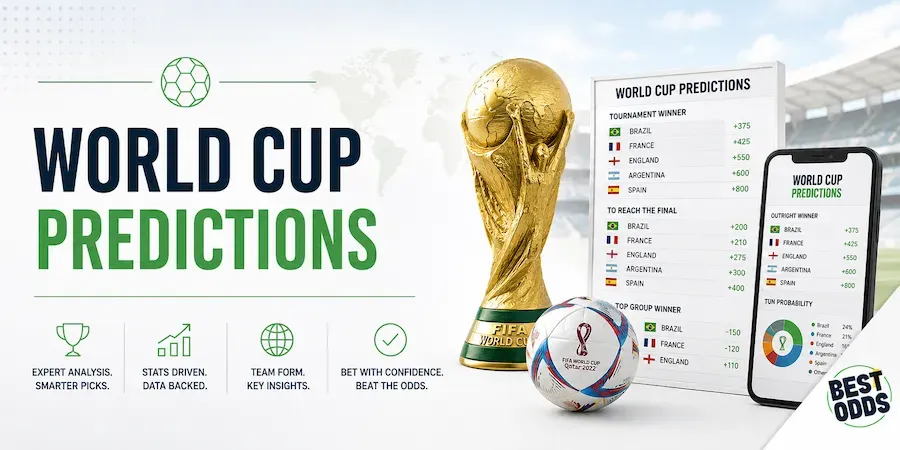
A team priced at -200 for a group-stage match is expected to win roughly 66% of the time. That means the same team loses or draws one in every three matches at that price. Across a 48-team tournament with single-elimination knockout rounds and penalty shootout variance built into every bracket stage, even the most analytically sound predictions carry substantial uncertainty.
Soccer’s low-scoring structure is the primary driver of this soccer betting and prediction difficulty. A sport in which the average match produces between two and three goals creates an environment where variance is enormous relative to the true quality gap between sides.
A 0-0 match is not necessarily a mismatch; it may be a match in which one team generated 2.4 expected goals and the other generated 0.8, with the scoreline producing no goals purely through finishing variance. The raw result communicates far less information about underlying team quality than the equivalent outcome in a high-scoring sport.
The World Cup introduces additional structural complexity. Group-stage incentives, tactical rotation, squad depth management, neutral venues, compressed scheduling, tournament pressure psychology, and rapidly moving futures markets all interact with basic team quality in ways that make prediction accuracy harder to achieve and harder to evaluate. A prediction framework that ignores these structural layers is not an analytical prediction at all.
This page explains how World Cup predictions are formed structurally and analytically: how odds markets encode implied probability, why tournament variance makes even strong favorites unreliable, how tactical matchup analysis shapes outcome probability, what statistical indicators carry real forecasting weight, and how to interpret market movement as a prediction signal. For current World Cup odds and market pricing, see the main odds guide.
Best Sportsbooks for World Cup Betting and Predictions
Following prediction analysis is most useful when bettors have access to competitive market pricing across match odds, futures, and live betting. The comparison below reflects each book’s World Cup offering across the dimensions most relevant to prediction-focused bettors.
| Sportsbook | Match Odds | Futures Markets | Live Betting | Promotions | Best For |
|---|---|---|---|---|---|
| DraftKings | ★★★★★ | ★★★★★ | ★★★★★ | ★★★★☆ | Best Overall |
| FanDuel | ★★★★☆ | ★★★★☆ | ★★★★☆ | ★★★★☆ | Casual Bettors |
| BetMGM | ★★★★★ | ★★★★★ | ★★★★☆ | ★★★★☆ | Broad Markets |
| Caesars | ★★★☆☆ | ★★★☆☆ | ★★★☆☆ | ★★★★☆ | Beginners |
| bet365 | ★★★★★ | ★★★★★ | ★★★★★ | ★★★☆☆ | Live Betting |
| Hard Rock Bet | ★★★☆☆ | ★★★☆☆ | ★★★☆☆ | ★★★☆☆ | Simplicity |
DraftKings: Best Overall for World Cup Market Depth

DraftKings offers the most comprehensive World Cup betting environment among US-licensed operators, making it the most useful platform for bettors who want to act on predictions across multiple market formats.
Match odds on every group-stage and knockout fixture are priced competitively, futures betting markets extend from tournament winner through group winners and exact finalists, and player prop availability covers anytime scorer, goal scorer assists, shots on target, and tournament specials.
Live betting during group-stage multi-fixture windows is reliably accessible and fast-repricing, with in-play markets that update quickly after goals and red cards. World Cup promotions include odds boosts and profit boost tokens tied to specific match and futures outcomes during the knockout rounds.
For bettors who want to translate prediction analysis into bets across match odds, futures, and player markets, DraftKings provides the broadest single-platform coverage available.
Key strengths: deepest overall market range, competitive match and futures pricing, fast live betting, player prop integration, tournament promotions.
FanDuel: Best for Casual World Cup Bettors

FanDuel’s World Cup interface is well-designed for bettors approaching tournament prediction markets for the first time or for those who want streamlined access to match result and popular futures markets. Navigation to group-stage match odds, tournament winner prices, and same-game parlay options is direct and clear, without requiring navigation through complex submenus.
The same game parlay builder allows casual bettors to combine match result predictions with player performance legs in a single wager, which is the format most commonly associated with casual World Cup engagement.
Cash out functionality on futures and SGP positions is among the more reliable in the market, useful for bettors who want to act on live prediction updates during the tournament. See World Cup betting sites for a full operator comparison.
Key strengths: clean navigation, SGP integration, accessible futures, cash out availability, user-friendly interface.
BetMGM: Best for Broad Tournament Markets

BetMGM’s international soccer depth translates into the widest range of World Cup prediction markets among US-licensed books. Group winner odds for all twelve groups, nation specials, confederation winner markets, and advanced futures formats that most US operators do not offer make BetMGM the strongest secondary book for bettors building prediction-based positions across a range of outright formats.
Existing customer promotions during World Cup knockout windows appear more consistently at BetMGM than at most competitors, with profit boost tokens and odds boosts tied to specific prediction markets available for registered accounts.
For bettors whose prediction analysis extends beyond tournament winner and match result into bracket-specific and nation-specific outcomes, BetMGM is the most comprehensive option.
Key strengths: broadest market range, group winner depth, nation specials, advanced futures formats, existing customer promotions.
Caesars: Best for Beginner Bettors

Caesars provides a simplified World Cup prediction betting experience that suits bettors placing their first tournament wagers. Match odds, tournament winner, and Golden Boot markets are prominently displayed and simple to navigate. The welcome offer structure at Caesars makes it a practical entry point for new accounts: first-bet insurance gives bettors a structured way to act on a prediction at reduced effective risk.
The onboarding process at Caesars is among the most streamlined of the major US operators, which matters for bettors who decide to act on World Cup predictions close to kickoff and need to register, verify, and fund quickly.
Key strengths: simple navigation, clear odds display, easy onboarding, welcome offer applicable to match and futures predictions.
bet365: Best for Live World Cup Betting

bet365 is the strongest platform for bettors who want to act on in-play predictions during World Cup matches. Live odds on match result, next goal, correct score, and player-specific markets update continuously during fixtures, with in-play market coverage that exceeds every competing US-licensed operator in speed and breadth.
The in-play interface at bet365 displays live match statistics alongside odds, providing the contextual data needed to evaluate whether a live prediction is supported by the underlying match data.
Live futures updates on tournament winner and group winner odds are also faster at bet365 than at most competitors, making it the most useful platform for bettors whose prediction approach involves acting on live market information. A full guide to in-play prediction and betting is available in the World Cup live betting page.
Key strengths: fastest live odds, comprehensive in-play markets, live statistics integration, live futures updates, cash out availability.
Hard Rock Bet: Best for Simplicity

Hard Rock Bet offers core World Cup match odds, tournament winner futures, and basic player markets in a clean, straightforward interface.
Market depth is narrower than the leading operators, but for bettors who want to act on a match result or outright prediction without navigating a complex betting environment, Hard Rock Bet provides uncomplicated access to the essential markets.
Key strengths: clean interface, simple market navigation, straightforward bet placement, beginner-accessible experience.
World Cup Predictions: Final Results
Spain were crowned world champions for the second time after defeating Argentina 1-0 in extra time at MetLife Stadium in New Jersey, with substitute Ferran Torres scoring the decisive goal in the 106th minute.
The result overturned the quarterfinal market consensus, where France had been installed as the +175 favorite and Spain were a 19 percent implied-probability third choice at +425. France’s semifinal exit against Spain proved the tournament’s defining upset, removing the consensus favorite and clearing the path for La Roja to complete one of the more dominant championship runs in recent World Cup history.
Argentina reached the final on the back of Lionel Messi’s eight-goal campaign but were unable to convert their chances in 120 minutes and were reduced to ten men late in extra time when Enzo Fernández was sent off.
| Finish | Nation | Final Odds | Result |
|---|---|---|---|
| Champion | Spain | +425 | Beat Argentina 1-0 AET, Torres 106′ |
| Runner-up | Argentina | +325 | Lost final, Fernández sent off late |
| Third Place | England | +500 | Beat France 4-6 in thriller |
| Fourth Place | France | +175 | Lost semifinal to Spain, QF favorite |
| QF Exit | Belgium | +750 | Eliminated in quarterfinals |
| QF Exit | Norway | +900 | Eliminated in quarterfinals |
| QF Exit | Morocco | +2000 | Eliminated in quarterfinals |
| QF Exit | Switzerland | +2500 | Eliminated in quarterfinals |
The biggest betting lesson of the tournament was the gap between France’s pre-quarterfinal dominance and their inability to reach the final. Spain’s patient, possession-based structure dismantled France in the semifinal and ultimately proved the most sustainable model across the full knockout bracket.
Rodri won the Golden Ball as the tournament’s best overall player, and 19-year-old Pau Cubarsi was named Best Young Player, rounding out a historic sweep of the major individual and team honors for the world champions.

What Are World Cup Predictions?
World Cup predictions are probability-based expectations about future match or tournament outcomes. They are estimates of likelihood, not statements of certainty, and their quality is determined by how accurately they estimate the true probability of an outcome relative to what the market is already pricing.
A match prediction that says “France will beat Australia” is not a useful analytical statement without a probability attached. France may be 85% likely to win that match at true probability. A market pricing France at -500 implies 83.3% probability. If the true probability is 85%, the market price is close to fair value and no meaningful edge exists.
If the true probability is 90%, the market is underpricing France and a bet has positive expected value. The prediction is only actionable when the probability estimate diverges meaningfully from the market’s implied probability.
Predictions for World Cup matches are influenced by a combination of variables that must be evaluated simultaneously:
Team quality as measured by squad strength, recent international form, and squad depth across all playing positions. Quality differentials between nations vary substantially at the World Cup, from near-even matchups between top-10 ranked nations to significant mismatches in group-stage fixtures involving lower-ranked qualifiers.
Tactical matchups between specific playing systems. The interaction between a high-pressing team and a deep-block defensive system, or between a possession-dominant team and a high-transition counterattacking team, produces outcome distributions that pure team-quality measures do not fully capture.
Squad depth and rotation across a tournament that demands peak performance in potentially eight matches over four weeks. Nations with limited squad depth face compounding fatigue and injury risk through the knockout rounds that affects their probability of advancing relative to equally strong nations with deeper squads.
Injuries and suspensions to key players, which can shift match probability by 5 to 15 percentage points depending on the player’s centrality to the team’s tactical system.
Market pricing and movement, which aggregates the collective assessment of the betting market and contains information about sharp-money views that no individual analyst has access to independently.
Tournament structural factors, including group-stage qualifying scenarios, knockout bracket paths, rest day differentials, and venue conditions.
How Odds Influence World Cup Predictions
Odds markets are not simply a mechanism for placing bets. They are aggregated probability assessments that incorporate an enormous volume of information: team quality metrics, injury news, tactical analysis, sharp money positions, public betting behavior, and historical statistical patterns. Understanding the relationship between market odds and prediction probability is fundamental to any analytical approach.
Implied probability converts any odds price into a percentage representing the market’s estimate of that outcome’s likelihood.
For positive American odds: 100 / (Odds + 100)
For negative American odds: |Odds| / (|Odds| + 100)
A France match price of -180 implies 180 / (180 + 100) = 64.3% probability. A tournament winner price of +550 implies 100 / (550 + 100) = 15.4% probability.
These are not the sportsbook’s actual internal probability estimates; they are the offered prices after the sportsbook’s margin has been applied. To approximate the true market probability, the margin must be removed by normalizing the implied probabilities across all outcomes in the market.
Why the market price matters for prediction:
A prediction that simply identifies the most likely outcome is not analytically useful if that outcome is already fully reflected in the price. The World Cup market for any given match is one of the most liquid soccer betting markets in the world.
Prices aggregate information from thousands of sharp bettors, statistical models, and professional traders. Any prediction that contradicts the market’s assessment without a specific, identifiable reason is more likely to be wrong than the market.
The productive approach is not to fight the market but to identify specific, measurable factors that the market has not fully priced. Lineup announcements not yet reflected in posted odds, injury news not yet confirmed publicly, tactical information from press conferences, and bracket implications not yet fully priced after a draw are all examples of information asymmetry that can produce genuine prediction edges.
Why favorites are not guaranteed:
At any given price, a favorite’s implied probability is always below 100%. A match favorite at -300 (implied 75%) loses one in four times at true probability. A tournament winner at -150 after reaching the semifinal loses roughly four in ten times at true probability. Treating any odds price as a guarantee is a category error. The market is pricing probability, not certainty.
Why underdogs win regularly:
Group-stage upsets are a structural feature of the World Cup, not statistical anomalies. Saudi Arabia defeating Argentina in 2022 and Japan defeating Germany in the same tournament were both results in a range that any reasonable pre-match probability model would assign non-negligible probability to.
At odds of +700 to +1200 for those upsets, the expected value calculation for backing the underdog was not necessarily unfavorable. Treating short-priced favorites as certain to win systematically undervalues the probability of upset outcomes that the market itself prices explicitly.
How public betting distorts pricing:
Public money concentrates disproportionately on recognizable nations, star players, and media-dominant narratives. This behavioral pattern systematically shortens the odds of popular sides and lengthens the odds of alternatives.
A prediction framework that relies solely on market prices without accounting for this public bias will consistently overestimate the probability of the most-covered nations and underestimate the alternatives.

Why World Cup Predictions Are Difficult
World Cup prediction is structurally harder than prediction in most other major team sports betting contexts, for reasons that are intrinsic to soccer’s scoring structure, tournament format, and competitive dynamics.
Low-scoring variance:
Soccer is a sport in which the typical match produces two to three goals. At this scoring level, the variance around expected outcomes is enormous. An expected goals model that assigns 1.8 xG to one team and 0.7 xG to the other correctly identifies the stronger team.
But the most likely single scoreline in that match might still be 1-0, 1-1, or even 0-0, each of which is plausible despite the clear quality differential. The relationship between quality and results is weaker per match in soccer than in any major North American team sport.
Draw probability:
Group-stage World Cup matches can end in draws, and draws are a meaningful and frequent outcome in competitive fixtures. A market pricing England at -140 against a mid-ranked opponent implies roughly 58% win probability for England. The remaining 42% is split between the draw and an England loss. Prediction frameworks that treat soccer as a binary win-loss market are structurally incomplete.
Penalty shootout variance:
Knockout matches that reach a shootout introduce near-coin-flip variance at the decisive stage. Penalty conversion rates in World Cup shootouts typically run between 70 and 80% per kick, and the difference in expected conversion between the strongest and weakest nations in a shootout is modest.
Nations have been eliminated from the World Cup on shootout outcomes that a pre-match probability model would have assigned only marginally higher probability to one side. Any knockout-stage prediction must account for this terminal variance.
Short tournament format:
The World Cup’s group stage involves only three matches per nation, and the knockout rounds are single-elimination. This format produces extremely small sample sizes.
A nation that is genuinely 20% better in quality terms than their opponent has only a modest probability advantage in any single 90-minute match. Over three group-stage matches and a knockout bracket, even significant quality advantages can fail to manifest in results due to variance alone.
Squad rotation:
World Cup managers rotate squads during the group stage, particularly in the third fixture when qualification has already been secured. This creates a systematic mismatch between the expected quality of a starting lineup and the actual lineup fielded.
A match odds market based on expected first-choice starting elevens may be significantly mispriced once a manager announces a rotated lineup.
Injuries and suspensions:
Injuries to key players are a constant source of prediction disruption. A central midfielder or striker who is instrumental to a team’s offensive structure and is ruled out in a pre-match training session can shift a match’s true probability by 10 percentage points or more depending on the player’s centrality.
The window between injury confirmation and full market adjustment is a documented source of pricing inefficiency.
Tactical conservatism:
World Cup matches at the knockout stage frequently produce tactically conservative, low-scoring encounters in which both teams prioritize defensive solidity over attacking ambition.
This is most pronounced in matches between well-matched sides where both teams manage to a 0-0 or 1-0 outcome rather than an open, high-scoring game. Prediction models built on group-stage offensive output may significantly overestimate expected goals in high-stakes knockout rounds.
Public pressure and psychological factors:
The psychological pressure of representing a nation at the World Cup creates performance patterns that domestic club form does not reliably predict. Some nations historically perform better than their squad quality suggests in tournament environments; others underperform. Quantifying this psychological component is difficult, but ignoring it entirely produces predictions that miss a genuine source of outcome variance.
Predicting Group Stage Matches
Group-stage prediction requires accounting for factors that are absent from standard domestic match prediction: three-game round-robin incentives, goal difference management, deliberate draw strategies, and rotation decisions.
Tactical incentives and game state management:
A nation entering the final group-stage match needing only a draw to qualify will approach that match with a fundamentally different tactical setup than a nation that must win. The incentive to manage a 0-0 draw rather than press for a win compresses the expected goal output for the match and flattens the result distribution toward the draw.
Prediction models that do not account for this incentive structure will overestimate goals and underestimate draw probability in final-round group matches where one side has nothing to gain from winning.
Goal difference and its tactical effects:
Nations that need to improve their goal difference to advance may adopt unusually aggressive attacking approaches even in matches where a defeat would be dangerous. This creates asymmetric tactical setups within a single match that standard match-quality metrics do not capture.
A nation pressing frantically for goals while their opponent manages a lead creates a very different in-match probability structure than a neutral contest.
Qualification scenarios and information:
When both teams in the final group-stage fixture have already qualified with their standings locked, both may field rotated squads.
The quality of the fielded lineup in these circumstances can differ significantly from the expected lineup, producing match odds that diverge from the true probability once actual squads are announced. The expanded 48-team format adds a further wrinkle, as some of the best third-placed nations advance, which can keep qualification mathematically alive for sides that would have been eliminated under the previous format and alters the incentive to chase goals in a final group match. Monitoring late lineup news before placing group-stage predictions is more important in final-round group matches than in earlier rounds.
Rotation risk in opening fixtures:
Some managers rotate squad members in the first group fixture to manage fatigue and protect key players. Nations with deep squads have more capacity to rotate without meaningful quality loss than nations that are heavily reliant on a first-choice starting eleven.
Identifying which nations are likely to rotate and assessing the quality differential between first and second-choice options is a relevant prediction input for opening group-stage matches.
Predicting Knockout Matches
Knockout match prediction requires a different analytical framework from group-stage prediction because the structural incentives, tactical approaches, and decisive mechanisms all change. The 2026 format also adds a round of 32 ahead of the round of 16, which means the eventual winner must navigate one more single-elimination match than in previous editions, compounding the cumulative knockout variance any title prediction must absorb.
Extra time and its effects:
Knockout matches that remain level after 90 minutes proceed to 30 minutes of extra time. Fatigue accumulates across these additional 30 minutes in ways that disproportionately affect teams with less squad depth or who have played more physically demanding matches earlier in the tournament.
A team arriving at the knockout rounds having played three high-intensity group-stage matches against strong opposition may carry more physical fatigue into extra time than a team that managed relatively comfortable group-stage fixtures.
This fatigue differential is rarely reflected in market prices, which typically price knockout rounds on squad quality rather than accumulated physical cost.
Penalty shootout variance:
As discussed above, penalty shootouts introduce near-coin-flip variance that is largely independent of the quality differential between the two teams.
The historical record shows no reliable correlation between overall team quality and shootout performance. Some nations have notably strong or weak shootout records, but sample sizes are too small to reliably distinguish skill from variance.
Prediction models should treat knockout matches that reach a shootout as near-even probability events regardless of the overall team quality differential.
Conservative tactics in high-stakes matches:
Knockout-round tactical setups differ structurally from group-stage setups. With no opportunity for recovery from defeat, managers frequently prioritize defensive solidity and counter-attacking efficiency over possession-based attacking play.
This conservative shift reduces expected goals and compresses the goal distribution toward 0-0, 1-0, and 1-1 outcomes relative to what group-stage attacking metrics would predict.
Tournament pressure:
The cumulative psychological pressure of a knockout tournament affects player performance in ways that domestic metrics do not capture.
Nations with limited previous deep tournament experience may face greater pressure in late-stage knockout matches than their squad quality suggests.
Conversely, nations with strong historical performance in tournament environments may maintain composure under high-pressure conditions more reliably than their current squad form would predict.
Squad depth and fatigue accumulation:
By the quarterfinal stage, nations have played at least five matches in four weeks under the expanded format. Squads with 20 to 23 high-quality players can absorb injuries and rotation demands without meaningful quality loss.
Squads built around 11 to 14 key players face compounding fatigue and injury risk that increases significantly across the knockout rounds. Predicting the quarterfinal and semifinal stages requires incorporating depth assessment that is largely irrelevant in group-stage prediction.
Tournament Winner Predictions
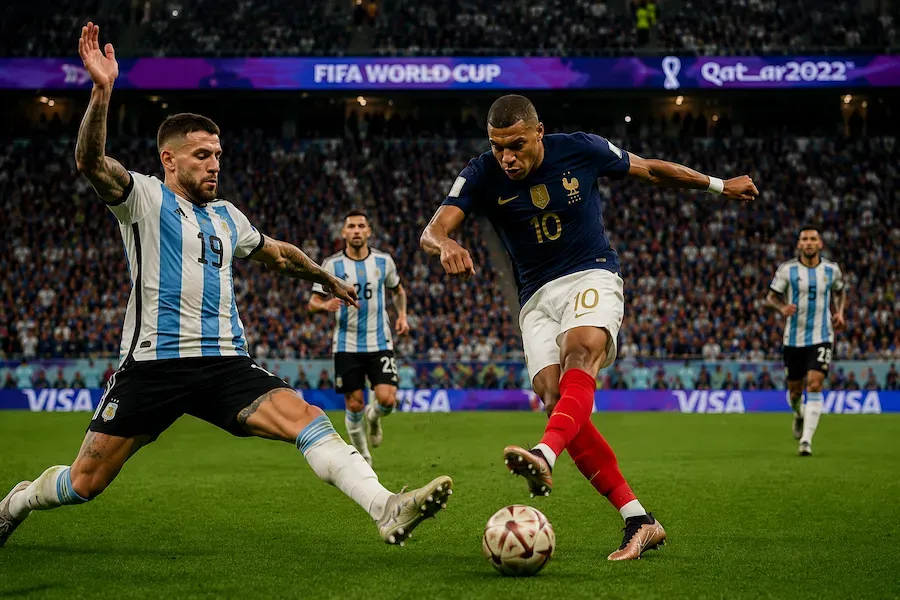
Predicting the World Cup winner requires integrating all the variables that affect individual match prediction with the additional complexity of bracket path probability, multi-round performance consistency, and tournament-specific contextual factors. For more information on this topic, visit the World Cup outright odds guide.
Favorites versus value:
The nations priced shortest to win the World Cup are not necessarily the best value prediction plays. Pre-tournament favorites are systematically compressed by public money, which concentrates on the most globally recognized nations regardless of bracket conditions.
A nation priced at +500 to win the tournament implies 16.7% probability. If the true structural probability accounting for bracket path, squad depth, and knockout variance is 20%, the bet has positive expected value. If the true probability is 12%, the bet is overpriced regardless of how strong the squad looks. The current board, with Spain and France clustered at the top on implied probabilities around 18% and a competitive chasing group of England, Portugal, Brazil, and Argentina, reflects an unusually open field by historical standards, which widens the range of nations for which a value case can be made.
Bracket path analysis:
A nation’s bracket path is the sequence of opponents they would face if both sides win their respective matches through each round. Two nations of identical quality can have dramatically different true probability of reaching the final depending on which side of the bracket they are placed in after the group draw.
A legitimate contender whose bracket half does not include the tournament’s top seed has a materially higher path probability than a comparably strong nation facing the top seed in the quarterfinal. This path differential is one of the most reliable sources of pricing inefficiency in tournament winner markets.
Historical winner profiles:
Every World Cup winner since 1978 has come from a small group of nations: Brazil, Argentina, France, Germany, Italy, and Spain. This historical concentration reflects structural advantages in talent depth, tactical sophistication, tournament experience, and squad quality that are not arbitrary.
Nations outside this historical pool face genuine structural barriers to winning a World Cup that extend beyond the quality of their current squad.
At the same time, the distinction between the historical winners and the second tier of genuine contenders (England, Portugal, Netherlands, Belgium) has narrowed significantly in recent tournaments, and the structural advantages that once created clear separation are now smaller than historical win rates suggest.
Tactical flexibility as a predictor:
World Cup winning squads historically demonstrate tactical flexibility: the ability to play a possession game when ahead, absorb pressure when necessary, and adapt to the specific defensive or attacking tendencies of each successive opponent.
Nations that play rigidly in a single system, however effective, are more predictable and more vulnerable to tactical adjustments than nations that can vary their approach across different phases of a match.
Public betting distortion in winner markets:
Brazil, England, France, and Argentina consistently attract public betting volume that is disproportionate to their statistical probability of winning. This concentration shortens their tournament winner prices and creates corresponding length in the alternatives.
A prediction framework that identifies a second-tier contender with a favorable bracket path and strong defensive metrics will often find that the market is offering better value on that alternative than the price suggests.
Golden Boot and Top Scorer Predictions
Golden Boot predictions follow a different analytical framework from match predictions because they require modeling individual player performance across multiple matches that depend on the team’s tournament progression. A full analytical guide is available at World Cup top scorer odds.
Why team advancement is the primary input:
A player can only score goals in matches their team plays. The range of matches available to any Golden Boot candidate is between three (group-stage exit) and eight (tournament winner under the expanded 48-team format).
A player averaging 0.6 goals per match over eight matches (4.8 expected goals) has a higher expected total than a player averaging 0.8 goals per match over four matches (3.2 expected goals), even though the second player has a higher per-match scoring rate. Predicting the Golden Boot without modeling team tournament probability is analytically incomplete.
Penalty takers and structural scoring floors:
Confirmed penalty takers on nations that reach the knockout rounds have a built-in scoring floor from spot kicks that open-play attackers lack. Historical Golden Boot winners have regularly relied on penalty contributions for a meaningful share of their total goals. Predicting the Golden Boot without confirming penalty-taking duty for each candidate is a fundamental analytical gap.
Group-stage schedule strength:
Nations in favorable groups against weaker opposition generate higher goal output in the opening three matches. A striker on a nation facing two bottom-half qualified nations in the group stage has a materially better scoring environment than a striker in a group involving two top-ten ranked sides. Identifying this schedule advantage before the group draw is one of the most reliable structural inputs in pre-tournament Golden Boot prediction.
Public bias in top scorer predictions:
The most famous attacking players consistently attract public prediction and betting volume that inflates their implied scoring probability above what their structural position warrants. Prediction analyses that simply list the most globally recognizable strikers are reproducing public bias, not adding analytical value.
The most useful Golden Boot prediction analyses identify structural advantages held by less-publicized players: confirmed penalty duty, favorable schedule, deep-running nation, high team attacking output.
For prediction-oriented player analysis, see World Cup player props.
Tactical Matchup Analysis in World Cup Predictions
Tactical analysis is the most qualitative dimension of World Cup prediction and the area where generic prediction content most consistently fails to add value. Understanding how specific system interactions affect outcome probability goes well beyond identifying which team has the better players.
Pressing systems versus defensive blocks:
A nation that plays a high-intensity press, using coordinated forward defensive pressure to win the ball high up the pitch, is structurally effective against possession-based teams that are uncomfortable under pressure but structurally vulnerable to teams that play quickly through the press with long balls into deep forwards.
The prediction implication is that the relative effectiveness of a pressing system is opponent-specific, not absolute. A team that dominated possession against a mid-ranked side in the group stage may find the same pressing approach neutralized by a disciplined defensive block in the knockout rounds.
Transition speed and defensive organization:
Teams that are highly effective on the counter-attack rely on space behind the opposing defensive line. Nations that defend in a deep, organized low block provide less space and fewer transition opportunities than nations that press aggressively.
Predicting matches involving counter-attacking teams requires assessing whether the opposing tactical setup will create the transitions that the counter-attacking team needs.
Possession structure and territory:
Dominant possession teams that control territorial position create high-quality scoring opportunities through patient buildup and positional superiority. The limitation of possession dominance is that it does not guarantee goal output: teams can control 70% possession and still generate low expected goals if the opposing defensive block is well-organized and compact.
Predicting output from possession metrics requires cross-referencing possession share against shot volume and expected goals data, not treating possession as a direct quality proxy.
Set-piece vulnerability:
Set pieces account for roughly 25 to 35% of World Cup goals across recent tournaments. A nation with significant set-piece vulnerability (poor defensive organization at corners, weak marking on near-post deliveries, inconsistent goalkeeper positioning) is at greater risk against nations with proven set-piece attacking efficiency. This tactical dimension is often underweighted in prediction models that focus primarily on open-play metrics.
Squad athleticism in tournament conditions:
The physical demands of a compressed World Cup schedule, often involving multiple matches within three or four days during the knockout rounds, favor squads with high athletic capacity across all positions. Nations with older squads or squads with limited physical capacity may perform well in earlier rounds before fatigue becomes a significant factor in the semifinal and final.
Statistical Indicators Used in World Cup Forecasting
Data-driven World Cup forecasting uses a range of statistical indicators that go beyond win-loss records and goal tallies. Understanding which metrics carry genuine predictive weight distinguishes analytical forecasting from narrative-based commentary.
Expected goals (xG):
Expected goals measures the quality of scoring opportunities created and conceded, independent of whether those opportunities were converted.
A nation that generates 2.1 xG and concedes 0.6 xG per match is performing at a level that will produce wins more consistently over time than a nation that generates 1.4 xG and concedes 1.2 xG, even if the two nations have similar win-loss records in a small match sample. xG is currently the most widely used and analytically validated single-match predictive metric in professional soccer.
Shot volume and shot quality:
Total shots provide a rough proxy for attacking pressure. Shots on target within the penalty area, weighted by location, provide a higher-quality signal. The combination of shot volume and shot quality data (location, angle, assist type, situation) is the foundation of most expected goals models.
Defensive suppression:
Defensive quality is most accurately measured by a team’s ability to reduce the quality and quantity of opponent shots, not simply by goals conceded. A nation that concedes few goals but generates poor expected goals against (because opponents have been generating good shots that simply did not convert) is more vulnerable than their goals-against column suggests.
Possession territory:
Territory, defined as the proportion of match time spent in the attacking third, correlates with attacking output more strongly than raw possession share. A team that controls 55% possession while maintaining territorial dominance is creating structural conditions for offensive output. A team that controls 55% possession while operating primarily in their own half is not.
Transition efficiency:
Transition speed from defense to attack, measured by the quality of chances created within three seconds of a ball recovery, is a distinctive metric for counter-attacking teams. High transition efficiency against a heavy possession team predicts goal-scoring probability that possession and territory metrics alone would underestimate.
Set-piece efficiency:
Set-piece goals (corners, direct free kicks, indirect free kicks, penalties) account for a disproportionate share of World Cup goals. Measuring expected goals from set pieces separately from open play provides a more accurate quality picture than a single combined xG figure, and allows prediction models to weight the specific threat of set-piece-heavy teams more accurately.
Why raw win-loss records can mislead:
A team that has won six consecutive international matches by a single goal, with opponents generating significant expected goals in each match, is less likely to repeat those results than their record suggests.
Conversely, a team that has drawn three consecutive matches while consistently generating 2.0+ xG per game is performing better than their results indicate. Forecasting from results alone, without underlying quality metrics, systematically misidentifies which teams are genuinely performing well.
Public Betting Bias in World Cup Predictions
Public betting bias in World Cup markets is more analytically significant than in domestic league betting, and its effects on prediction discourse are equally distorting. Understanding how public narratives create systematic mispricings is essential for distinguishing analytical prediction from narrative repetition.
How public volume distorts odds:
Recreational bettors concentrate betting volume on the most globally recognizable nations, particularly Brazil, England, Argentina, France, and the USA. This concentration shortens those nations’ odds below their statistical probability and creates corresponding length in the alternatives.
A prediction framework that begins with the list of most-publicized nations and works backward to justify their prices is reproducing public bias, not adding analytical value.
England and the “golden generation” narrative:
England routinely enter major tournaments as the subject of extensive media prediction that overestimates their probability of winning relative to their historical performance in knockout stages. English betting markets disproportionately concentrate on England outright prices, shortening them below statistical probability in the pre-tournament window.
The predictive implication is not that England cannot win, but that their price is typically less favorable relative to their structural probability than the price of comparably strong alternatives.
Brazil and global recognition:
Brazil’s global soccer brand, their historical record of five World Cup wins, and their consistent production of elite attacking talent make them the default favorite in public betting narratives regardless of the specific squad composition or bracket draw for any given tournament. This narrative drives their prices shorter than pure probability models typically support.
France and squad quality:
France frequently enter World Cup tournaments with squad depth that is objectively among the best in the field. The predictive challenge is that this quality is already reflected in their short tournament winner price, and often over-reflected due to public betting concentration on their name.
Predicting France to win is not wrong; predicting France to win at a price that already fully reflects their probability of doing so is not a positive expected value prediction.
USA and host effect:
As a co-host of the 2026 World Cup, the USA attracts significant domestic public betting volume regardless of their statistical tournament winner probability. This concentration systematically shortens USA tournament winner and group winner prices below what pure probability analysis supports, creating a predictable public-money overpay on USA-related markets. The shortening of the USA price from roughly 66-1 before the draw to around +4000 after a favorable Group D draw and a 4-1 opening win over Paraguay illustrates the pattern in real time: a portion of that move reflects a genuinely easier path and a strong result, but a portion reflects anticipated host-nation betting volume.
Where analytical value concentrates:
The systematic underpricing created by public bias concentrates in the mid-to-long range of tournament winner and match odds markets: nations with genuine quality that are not global betting brands, strong squads with favorable bracket paths, and tactically capable sides that statistical models rate more favorably than public narrative does.

Live World Cup Predictions and In-Play Markets
Live prediction during World Cup matches involves updating probability estimates in response to real-time match events and assessing whether the sportsbook’s live repricing accurately reflects the information content of those events. A full in-play betting and prediction guide is available at World Cup live betting.
Match momentum and tactical substitutions:
A tactical substitution that introduces a fresh forward in the 70th minute, with a team pressing for an equalizer, signals increased attacking intent that should compress the trailing team’s probability of not scoring. Live markets do not always immediately reflect the quality implication of a substitution, particularly for less-publicized players whose impact is harder for the market to assess instantly.
Red cards and probability shifts:
A red card for a leading team in the 60th minute creates an immediate, significant shift in match probability that live markets reprice within seconds. The magnitude of the shift depends on the score, time remaining, and the tactical identity of both teams. A team that is well-suited to defending with ten players will not be as severely impacted as a team that relies on high-energy pressing to maintain their advantage.
Fatigue and late-match probability:
As matches progress beyond the 75th minute, fatigue creates asymmetric probability shifts depending on which team is fitter and which tactical approach is more sustainable at reduced intensity.
Teams defending a lead typically maintain their probability advantage through the final minutes if they are organized; teams pressing for an equalizer face diminishing probability as the final whistle approaches unless they have created clear scoring opportunities.
Public overreaction in live markets:
Live markets exhibit systematic public overreaction to visible match events. A goal in an even match that makes the score 1-0 triggers an immediate rush of public money onto the leading team, often compressing their live win probability beyond what the true state of the match (time remaining, xG balance, tactical situation) justifies.
The stabilization of those odds 5 to 10 minutes after the initial repricing frequently provides a more accurate probability estimate than the immediate post-goal price.
bet365, DraftKings, and FanDuel are the three most reliable platforms for live World Cup prediction betting. bet365 leads on speed of repricing and in-play market depth. DraftKings offers the broadest range of live markets including player props. FanDuel provides the most accessible live interface for casual bettors acting on real-time predictions.
World Cup Prediction Models Explained
Systematic World Cup forecasting uses several distinct modeling approaches, each with documented strengths and limitations. Understanding how these models work explains why different prediction sources produce different probability estimates for the same outcomes.
Elo rating systems:
Elo ratings are a mathematical framework for measuring relative team strength based on match results, opponent strength, and result margin. Applied to international soccer, Elo systems assign each nation a rating that updates after every result, with larger updates for surprising outcomes against strongly rated opponents. Club-Elo and World Football Elo are the most widely cited public Elo systems for international soccer prediction.
The strength of Elo systems is their simplicity and their track record of outperforming naive models in large-sample prediction exercises. The limitation is that Elo systems are blind to information that is not encoded in match results: lineup changes, tactical evolution, key injuries, and tournament-specific conditions all affect match probability but are not reflected in Elo ratings until subsequent results update the model.
Expected goals models:
xG-based prediction models replace match result history with shot quality metrics as the primary quality signal. These models have been shown to outperform result-based models in predicting future performance at club level, where large match samples are available. The limitation at international level is data scarcity: national teams play relatively few matches per year compared to club sides, and xG data quality across all World Cup qualifying confederations is uneven.
Monte Carlo simulation:
Monte Carlo simulation uses probability estimates for each match to simulate the full tournament thousands or millions of times, producing win percentages for each nation across every possible outcome path. A model that assigns each team a win probability for each potential match can then simulate whether they advance through the group stage, survive each knockout round, and win the final across all simulated tournaments.
The output of a Monte Carlo simulation is a distribution of probabilities for reaching each stage, which is more informative than a single “predicted” outcome. The limitation is that the simulation’s quality is entirely dependent on the match probability estimates fed into it: garbage-in, garbage-out.
Market-based models:
Market-based forecasting uses sportsbook odds as the primary probability input. The rationale is that betting markets aggregate information from a very large number of informed participants and are therefore more efficient than any single analyst’s model. Market-based models normalize the implied probabilities from sportsbook prices (removing the margin) and feed them into bracket simulation models.
The limitation of market-based models is that they reproduce the public biases embedded in betting markets: famous nations are systematically overpriced relative to statistical probability, and the market-based model will inherit that mispricing.
Hybrid forecasting systems:
The strongest prediction frameworks combine multiple inputs. A hybrid model might use Elo ratings as the base quality signal, adjust for xG over recent qualifying and friendly matches where available, incorporate injury and lineup news as an adjustment factor, and cross-reference the output against market prices to identify divergences. Divergences between a hybrid model and the market price are the most actionable signals for prediction-based betting.
Why Sportsbooks and Prediction Models Differ
Even sophisticated prediction models regularly diverge from sportsbook prices, and understanding the reasons for those divergences is analytically important.
Sportsbook margin reduces offered probability:
Every sportsbook price includes margin built above the true probability. A prediction model that calculates true match probability at 60% will find the sportsbook offering -150 (implied 60%) only if the market is priced at zero margin, which never occurs in practice. More typically, a 60% true probability match will be priced at -180 or beyond, reflecting the margin applied across all outcomes.
Public money affects lines independently of probability:
Sportsbooks manage liability by adjusting lines when public money concentrates heavily on one side. This adjustment can move prices away from the book’s own probability estimate and away from what a statistical model would calculate. A line that has moved significantly toward one side due to public volume may now be priced in the opposite team’s favor relative to true probability.
Models may ignore behavioral pricing factors:
Statistical prediction models do not account for the ways that narrative, national identity, and emotional betting affect market prices. A model that calculates England’s group-stage match probability at 62% and finds the sportsbook offering -165 (implied 62.3%) has identified a near-efficiently priced market. But if the true implied probability before public money compressed the price was -130, the bettor who acts on the model price is paying for public bias, not for probability.
Market movement reflects sharp action:
When a sportsbook line moves significantly against public sentiment (for example, a money favorite whose line drifts longer despite heavy public backing), the movement reflects sharp-money action on the other side. Tracking line movement relative to public betting percentages is a form of market intelligence that supplements prediction models by identifying where professional bettors are diverging from public opinion.

How to Compare World Cup Predictions Properly
Prediction quality is evaluated not by whether a predicted outcome occurred but by whether the probability estimate was accurate and whether the market price was favorable relative to that estimate.
Compare predictions against implied probability:
Any prediction must first convert the relevant market price to implied probability. A prediction of “France to win” against a match price of -280 (implied 73.7%) is only a value prediction if the true probability of France winning is meaningfully above 73.7%. If the true probability is 65%, the prediction is wrong in the sense that matters for betting: the price is not favorable.
Avoid certainty framing:
Predictions expressed as “locks” or “certain outcomes” are analytically dishonest. No soccer match outcome is certain. A match priced at -400 (implied 80%) has a 20% probability of not producing the favored outcome. Framing that eliminates this uncertainty misleads bettors about the nature of risk in sports betting.
Understand variance:
Even a high-quality prediction framework will produce losing bets in 30 to 50% of cases, depending on the odds range. The purpose of disciplined prediction is not to guarantee winners but to identify situations where the offered price is more favorable than the true probability warrants.
Over a large sample of such bets, positive expected value produces positive long-term returns. Over a small sample like a single World Cup, variance will produce significant deviation from expected results in either direction.
Use market movement intelligently:
A line that has moved from -130 to -160 between opening and kickoff reflects net buying pressure on the favorite. Combined with public betting percentage data, line movement can identify whether the movement reflects public money (which may overshoot) or sharp money (which tends to be more accurately calibrated). Line movement in the direction opposite to public money is the most analytically significant signal.
Separate narrative from probability:
Prediction narratives built on historical championships, star player reputation, or national identity are not probability analyses. The most useful World Cup predictions are grounded in measurable variables: xG data, tactical matchup analysis, injury-adjusted quality metrics, squad depth assessments, and bracket path probability. Narratives that reproduce public consensus are unlikely to identify prices where genuine value exists.
Common Mistakes With World Cup Predictions
Treating predictions as guarantees. Even a -400 match favorite loses 20% of the time. Predictions are probability estimates with uncertainty built in at every stage of the tournament.
Betting emotionally on national teams. Fan identity and prediction accuracy are inversely correlated in betting contexts. The psychological compulsion to back a national team overrides analytical assessment and produces systematic overpayment on the emotional choice.
Ignoring variance. A prediction framework that is correct 55% of the time on 50/50 markets is a strong framework. It will still produce losing streaks. Judging a prediction methodology by a short run of results, rather than by the quality of the probability estimates, confuses luck with analysis.
Overreacting to one match. A strong group-stage performance against a weak opponent is weak evidence about knockout-stage probability. A single impressive result updates the probability of future performance only modestly; a pattern of performances across multiple matches against varied opposition is the relevant signal.
Ignoring tactical context. A prediction based solely on squad quality without accounting for how the two teams’ playing systems interact is analytically incomplete. Tactical matchup analysis is the variable most often ignored by generic prediction content and most often responsible for result surprises that look obvious in retrospect.
Ignoring implied probability. Placing a bet based on a prediction without converting the odds to implied probability and comparing it to the true probability estimate is not disciplined prediction betting. The price must be favorable relative to probability, not just the outcome must be predicted correctly.
Not accounting for sportsbook margin. Every market contains margin above 100% implied probability. A bettor who routinely ignores margin is systematically underestimating the cost of every bet placed and overestimating the frequency with which they need to be right to achieve positive expected value.
How BestOdds Evaluates World Cup Prediction Markets and Sportsbooks
BestOdds evaluates World Cup prediction markets and sportsbooks independently, across six criteria applied consistently across all reviewed operators. The methodology is not influenced by commercial relationships with listed sportsbooks.
Market depth reflects the range of prediction markets available per fixture and per tournament stage, including match odds, futures, player props, and in-play markets.
Odds competitiveness measures the pricing of a representative sample of World Cup match and futures markets against the industry average, identifying which books offer consistently better prices to prediction bettors.
Futures coverage covers the breadth of outright prediction markets available, from tournament winner through group winners, knockout-round progression, and player awards.
Live betting usability assesses the speed of in-play repricing, the range of live prediction markets available during matches, and the reliability of app performance during peak simultaneous-fixture windows.
Analytical transparency reflects whether a sportsbook’s market presentation supports informed prediction decision-making, including line movement visibility and historical odds data where available.
Market responsiveness measures how quickly each book adjusts prices in response to injury news, lineup announcements, and post-match results relevant to futures markets.
Responsible Gambling
Prediction content should not create certainty bias. The strongest analytical prediction framework in the world produces losing bets regularly. Even a team priced at -300 loses one in four times. Even the most analytically supported tournament winner prediction fails to win roughly 80 to 85% of the time.
World Cup prediction engagement carries specific behavioral risks. The extended duration of the tournament, combined with daily match availability during the group stage and high-pressure knockout elimination, creates conditions for escalating stakes and loss-chasing behavior that are less common in single-match betting contexts.
Set a total budget for World Cup prediction betting before the tournament begins. Define the maximum stake per bet relative to total bankroll and do not deviate from it regardless of tournament narrative or early results. Do not increase stakes after a losing sequence under the assumption that results are “due” to turn: each match is statistically independent.
All licensed sportsbooks provide responsible gaming tools deposit limits, session loss alerts, cooling-off periods, and self-exclusion tools. These controls are most effective when set proactively, before the pressure of tournament betting is active.
If gambling is affecting finances, relationships, or mental wellbeing, confidential support is available. Call 1-800-GAMBLER.
Conclusion
World Cup predictions are probability estimates built from tactical analysis, statistical indicators, market interpretation, and a rigorous understanding of tournament variance.
The difference between analytical prediction and narrative opinion is the difference between identifying prices that are favorable relative to true probability and simply stating which team is most likely to win.
The most common errors in World Cup prediction discourse are treating low-variance probability estimates as certainties, backing famous nations at prices that already fully reflect their quality, ignoring the tactical context that determines how closely results track underlying quality, and failing to account for the enormous variance that soccer’s low-scoring structure introduces at every stage of a single-elimination tournament.
The tools for better prediction are accessible: implied probability formulas, expected goals data, tactical matchup analysis, line movement interpretation, and a clear-eyed understanding of the structural factors that drive tournament outcomes.
Applied consistently, those tools produce prediction analysis that is more accurate and more actionable than the narrative consensus found in most public prediction content.
| Use Case | Recommended Sportsbook |
|---|---|
| Best Overall | DraftKings |
| Best for Casual Bettors | FanDuel |
| Best Broad Tournament Markets | BetMGM |
| Best for Live Betting | bet365 |
| Best for Beginners | Caesars |
| Best for Simplicity | Hard Rock Bet |
Key Takeaways
- World Cup predictions are probability estimates, not guarantees. A match favorite at -300 loses one in four times at true probability. Tournament winner favorites fail to win roughly 80 to 85% of the time.
- Implied probability is the foundational analytical tool. Every prediction must compare the true estimated probability against the market’s implied probability to determine whether a price has value. Formula for positive odds: 100 / (Odds + 100).
- Soccer’s low-scoring structure creates higher variance than any major North American team sport. A team generating 2.0 xG against an opponent generating 0.6 xG can still draw or lose the match through finishing variance.
- Knockout matches introduce penalty shootout variance that is near-coin-flip regardless of the quality differential between the two teams. The added round of 32 means the winner navigates one more single-elimination match than in past editions.
- Tactical matchup analysis is the most undervalued dimension of World Cup prediction. System interactions between pressing teams and defensive blocks, possession structures and transition-oriented defenses, and set-piece specialists against vulnerable defensive organizations determine outcome probability in ways that squad quality rankings do not capture.
- Expected goals is the strongest single predictive metric for World Cup match analysis, outperforming win-loss records and raw goal tallies in identifying genuine team quality.
- Public betting bias systematically shortens the odds of famous nations below their statistical probability. Brazil, England, France, Argentina, and the USA will be priced shorter than statistical models support throughout the tournament.
- Bracket path is a primary input in tournament winner prediction. Two nations of equal quality in different bracket halves have materially different probabilities of reaching the final, often not reflected in their tournament winner prices.
- Market movement reveals information. Lines moving against public sentiment signal sharp-money action that is historically better calibrated than public opinion. Monitoring movement direction relative to public volume is a practical prediction input.
- Set prediction betting limits before the tournament begins. The compressed schedule, daily match availability, and high-pressure elimination format create conditions for escalating behavior that disciplined pre-commitment controls against effectively.
Frequently Asked Questions
What are World Cup predictions?
World Cup predictions are probability-based expectations about future match or tournament outcomes. They are estimates of likelihood derived from tactical analysis, statistical modeling, and market interpretation, not statements of certainty. A prediction’s value is determined by how accurately it estimates true probability relative to the market’s implied probability.
How accurate are World Cup predictions?
No prediction system can reliably identify specific match winners with high accuracy in soccer. The best forecasting models correctly identify the stronger team in roughly 55 to 65% of matches, depending on the quality differential involved. Accuracy against the spread (whether the prediction correctly identifies positive expected value at the offered price) is the more meaningful metric than raw win rate.
Why are soccer predictions difficult?
Soccer’s low-scoring structure produces high variance around true quality differences. Draw probability is a meaningful outcome in group-stage matches. Penalty shootouts introduce near-coin-flip variance in knockouts. Short tournament samples amplify variance further. Tactical rotation, injuries, and group-stage incentive dynamics add additional layers of complexity absent from domestic league prediction.
How do sportsbooks calculate World Cup odds?
Sportsbooks build World Cup odds from internal probability models based on team quality metrics, historical performance, squad analysis, and tactical assessment. They then add margin to each price so the sum of all implied probabilities exceeds 100%. Lines are subsequently adjusted to manage liability as public and sharp betting money arrives.
What affects World Cup predictions most?
The most significant variables are: team quality relative to specific opposition (not absolute quality ranking), tactical matchup dynamics, injury and availability status for key players, tournament stage incentives (group-stage rotation, qualification scenarios), bracket path for tournament winner predictions, and accumulated fatigue in the knockout rounds.
How important are injuries in tournament predictions?
Injuries to central players are among the most significant single-event probability shifters in tournament prediction. A confirmed absence for a key midfielder or striker can shift match probability by 5 to 15 percentage points and tournament winner probability significantly more. The window between injury confirmation and full market repricing is the most actionable prediction window in the tournament.
What are implied probabilities?
Implied probability converts an odds price into a percentage estimate of outcome likelihood. For positive American odds, the formula is: 100 / (Odds + 100). For negative odds: |Odds| / (|Odds| + 100). The implied probability is the market’s priced estimate of each outcome’s probability, after margin has been applied. Removing the margin by normalizing probabilities across all outcomes produces the closest available estimate of the true market consensus probability.
Why do prediction models differ?
Prediction models use different inputs (Elo ratings, xG data, market prices), different weighting approaches for those inputs, and different treatments of qualitative factors like tactical analysis and tournament-specific context. They also differ in how they handle the public-money bias embedded in market prices. Hybrid models that combine multiple inputs tend to outperform single-variable models but require careful calibration to avoid inheriting market biases.
Can underdogs realistically win the World Cup?
Yes. A tournament that is truly random among the 48 qualified nations would produce the same winner each tournament only about 2.1% of the time. The actual concentration of wins among a small group of nations reflects real quality advantages, but the variance inherent in an eight-match elimination run means that any nation capable of reaching the knockout rounds has a non-negligible probability of winning it.
The 2022 tournament saw Argentina (a genuine contender but not the pre-tournament favorite at every stage) win, and the competitive field makes genuine upsets possible at every stage.
How do knockout matches affect predictions?
Knockout matches concentrate probability mass on fewer outcomes (someone must win, no draws stand) while introducing additional variance through extra time and penalty shootouts. They tend to produce lower-scoring, more defensively structured matches than group-stage fixtures.
Predictions for knockout rounds should account for tactical conservatism, accumulated fatigue, penalty shootout variance, and the compressing effect of elimination pressure on attacking output.
Are World Cup predictions legal betting content in the U.S.?
Yes. World Cup prediction content is legal editorial content in the United States. Acting on predictions by placing bets is legal in states that have authorized sports wagering. Over 35 states plus Washington D.C. currently permit licensed sports betting. Bettors must be physically located in a licensed state and at least 21 years old in most jurisdictions to place legal wagers.
What sportsbook has the best World Cup markets? DraftKings and bet365 consistently offer the most competitive World Cup match and futures odds with the deepest market range. BetMGM leads on advanced outright and nation-specific market formats. For live prediction betting specifically, bet365 has no peer among US-licensed operators. Always compare prices across at least two books before acting on any prediction.
For almost two decades, Sadonna has remained at the forefront of the gambling industry in the US and abroad, covering the latest news and legal updates. Sadonna’s goal is to provide sports bettors and casino players with premium content, including comprehensive details on the US industry.