



World Cup Odds Explained | Futures, Match Odds & Top Scorer
FIFA World Cup odds are structurally different from standard league soccer odds in ways…


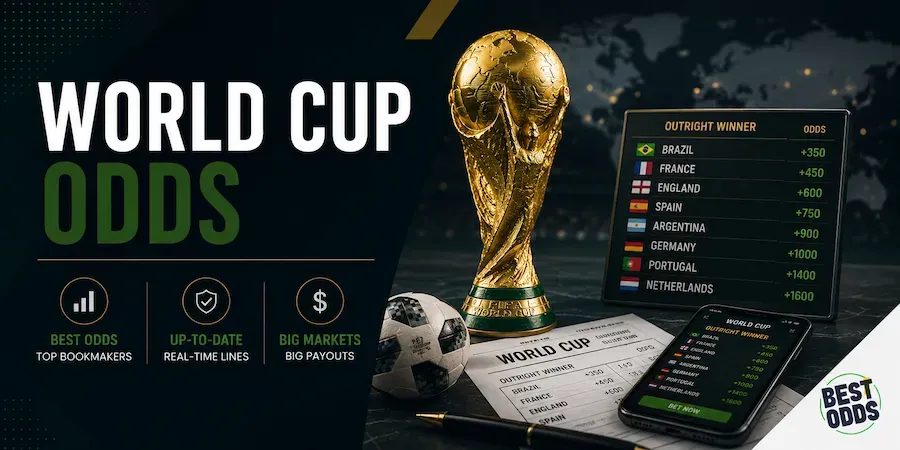
This page explains World Cup soccer odds from a mathematical and structural perspective. It covers American odds, implied probability, sportsbook margin, 1X2 pricing, outright futures, top scorer odds, group and knockout stage odds, live odds movement, and how odds shift across the stages of a tournament.
The goal is to give bettors the tools to read any World Cup odds format accurately and evaluate whether a given price represents genuine value.
Best Sportsbooks for World Cup Soccer Betting
Understanding World Cup odds is the foundation. Choosing the right sportsbook determines what range of markets, prices, and in-play options are available. The comparison below reflects each book’s World Cup offering across match odds quality, futures depth, live pricing, and promotions.
| Sportsbook | World Cup Match Odds | Futures Markets | Live Odds | Promos | Best For |
|---|---|---|---|---|---|
| DraftKings | ★★★★★ | ★★★★★ | ★★★★★ | ★★★★☆ | Best Overall |
| FanDuel | ★★★★☆ | ★★★★☆ | ★★★★☆ | ★★★★☆ | Same Game Parlays |
| BetMGM | ★★★★★ | ★★★★★ | ★★★★☆ | ★★★★☆ | Broad Coverage |
| Caesars | ★★★☆☆ | ★★★☆☆ | ★★★☆☆ | ★★★★☆ | New Bettors |
| bet365 | ★★★★★ | ★★★★★ | ★★★★★ | ★★★☆☆ | Live Odds |
| Hard Rock Bet | ★★★☆☆ | ★★★☆☆ | ★★★☆☆ | ★★★☆☆ | Simplicity |
DraftKings: Best Overall for World Cup Odds
DraftKings offers the most comprehensive World Cup odds menu among US-licensed operators. Match odds are available across every group-stage fixture, with competitive pricing on 1X2 markets, totals, and player props. The futures depth extends well beyond tournament winner into Golden Boot, group winners, exact finalists, and stage-of-elimination markets for every qualified nation.
The goal scorer market at DraftKings covers a broader player pool than most US competitors, including mid-tier attackers from smaller nations that other books ignore. Live odds update quickly after goals, red cards, and lineup changes, and the app navigation handles multiple simultaneous group-stage matches reliably. For bettors who want full World Cup market access in a single interface, DraftKings is the strongest starting point.
Key strengths: competitive match odds, deepest futures menu, strong goal scorer coverage, fast live odds, reliable app performance.
FanDuel: Best for Same Game Parlay Soccer Odds
FanDuel’s World Cup strength lies in its same game parlay (SGP) builder. Combining match result with player prop legs, goal scorer markets, and totals within a single match is straightforward on the FanDuel interface, and the SGP pricing on World Cup fixtures is among the most competitive available. Player prop odds on expected starters are well-priced and easy to find without deep menu navigation.
The mobile interface is clean and optimized for quick bet construction, which suits bettors building multi-leg World Cup parlays during the high-volume group stage. Match result odds are competitive on popular fixtures, though FanDuel’s depth on less-followed nations is thinner than DraftKings or BetMGM.
Key strengths: strong SGP builder, competitive player prop pricing, clean mobile interface, popular fixture match odds.
BetMGM: Best for Broad World Cup Market Coverage
BetMGM’s international soccer infrastructure produces the widest range of World Cup markets among US-licensed operators. Group winner odds are available for all eight groups, nation specials cover dozens of team-specific outcomes, and the World Cup outright odds menu extends to confederation winner and exact group order markets that most US books do not carry.
The futures pricing on mid-tier nations is often more competitive at BetMGM than at DraftKings, making it a valuable comparison point for any outright position.
Existing customers benefit from odds boosts and profit boost tokens that appear regularly during World Cup group-stage and knockout-round windows. For bettors building a comprehensive World Cup betting strategy across multiple markets, BetMGM alongside DraftKings covers the full available market spectrum.
Key strengths: broadest market range, competitive futures pricing, group winner depth, nation specials, existing customer promos.
Caesars: Best for New World Cup Bettors
Caesars presents a streamlined World Cup odds experience that suits bettors approaching the tournament for the first time. The market navigation is simple: match odds, tournament winner futures, and Golden Boot are prominent and accessible without having to work through nested submenus. The odds display is clear and the bet slip intuitive.
The welcome offer structure at Caesars has historically been well-suited to futures bets, with first-bet insurance giving new accounts a practical way to take an outright position at reduced effective risk. For bettors who want a manageable entry point to World Cup betting without the complexity of a deep market environment, Caesars is the most appropriate starting book.
Key strengths: simple navigation, clear odds display, beginner-friendly interface, welcome offer applicable to futures.
bet365: Best for Live World Cup Odds
bet365 is the strongest platform for in-play World Cup betting. Live odds on match result, next goal, total goals, and player-specific markets update continuously throughout each match, with pricing that reflects real-time game state faster than any competing US-licensed operator. The in-play interface displays match statistics alongside live odds, allowing bettors to contextualize price movements against possession, shots, and match tempo data.
Cash out functionality is available on most live World Cup markets and activates at logical intervals, including immediately after goals and during stoppage time. The goal scorer and top scorer futures at bet365 cover a deeper player pool than most US competitors. For bettors prioritizing in-play World Cup betting sites, bet365 has no peer among licensed US operators.
Key strengths: fastest live odds updates, comprehensive in-play markets, in-play statistics integration, cash out availability, deep goal scorer coverage.
Hard Rock Bet: Best for Simplicity
Hard Rock Bet provides clean access to core World Cup odds without the depth or complexity of the leading operators. Match odds, tournament winner, and Golden Boot markets are easy to locate, and the interface is designed for quick, uncomplicated bet placement.
Market range is narrower than DraftKings or bet365, but for bettors who know exactly what they want to bet and value straightforward navigation over market breadth, Hard Rock Bet functions well throughout the tournament.
Key strengths: clean interface, easy market navigation, core World Cup odds accessible, beginner-friendly experience.
How World Cup Odds Work
World Cup odds express the sportsbook’s pricing of all possible outcomes for a given market. Every price implies a probability, and the relationship between that implied probability and the bettor’s own estimate of true probability is the basis of all value assessment in sports betting.
In the United States, World Cup odds are displayed in American format as the default. Positive odds (such as +300) indicate the profit on a $100 stake. Negative odds (such as -150) indicate the amount needed to stake in order to profit $100. Both formats encode the same underlying probability estimate in different numerical forms.
Positive odds express profit on a $100 stake. A +300 price returns $300 profit plus the original $100 stake, for a total return of $400.
Negative odds express the stake required to return $100 profit. A -150 price requires a $150 stake to return $100 profit, for a total return of $250.
Total return on any bet is calculated as: Stake x (1 + (Odds / 100)) for positive odds, or Stake x (1 + (100 / |Odds|)) for negative odds.
Implied probability converts any odds price into a percentage representing the sportsbook’s estimate of that outcome’s likelihood.
Sportsbook margin is the amount by which the sum of all implied probabilities in a market exceeds 100%. It represents the book’s built-in edge across the full market.
Line movement refers to changes in odds prices between the time a market opens and the time a bet is placed. Movements reflect incoming betting volume, sharp action, news, and the book’s own liability management.
American World Cup Odds Explained
American odds are the standard display format at all major US-licensed sportsbooks. Understanding how to convert American odds to implied probability is the most fundamental skill in World Cup betting.
Positive odds examples:
- Brazil +450 to win the World Cup
- France +600 to win the World Cup
- USA +2500 to win the World Cup
A +450 price on Brazil means a $100 bet returns $450 profit, for a total payout of $550. The implied probability is calculated as follows:
Positive odds implied probability formula:
100 / (Odds + 100)
For Brazil at +450: 100 / (450 + 100) = 100 / 550 = 18.2%
For France at +600: 100 / (600 + 100) = 100 / 700 = 14.3%
For USA at +2500: 100 / (2500 + 100) = 100 / 2600 = 3.8%
Negative odds example:
- Argentina -150 to beat a group-stage opponent
A -150 price means a $150 stake is required to return $100 profit. The implied probability is calculated as follows:
Negative odds implied probability formula:
|Odds| / (|Odds| + 100)
For Argentina at -150: 150 / (150 + 100) = 150 / 250 = 60.0%
Any price below -100 implies greater than 50% probability. Any price above +100 implies less than 50% probability. The breakeven point is exactly +100 or -100, both implying 50%.
Decimal and Fractional World Cup Odds
US sportsbooks display American odds by default, but World Cup bettors may encounter decimal or fractional formats, particularly when using internationally-oriented platforms or comparing prices across global soccer markets.
Decimal odds represent the total return per $1 staked, including the original stake. A decimal price of 4.50 on Brazil means a $1 bet returns $4.50 total, of which $3.50 is profit and $1.00 is the returned stake.
Decimal odds are generally considered the clearest format for implied probability calculation because the formula is a simple reciprocal:
Implied probability from decimal odds:
1 / Decimal Odds
For 4.50: 1 / 4.50 = 22.2% For 6.00: 1 / 6.00 = 16.7% For 1.67 (equivalent to -150): 1 / 1.67 = 59.9%
Fractional odds express profit relative to stake. Odds of 9/2 mean $9 profit for every $2 staked, equivalent to 4.50 decimal or +350 American. Fractional odds are the traditional format in UK and Irish betting markets and appear on some international soccer platforms.
Converting between formats:
- American positive to decimal: (Odds / 100) + 1. For +450: (450 / 100) + 1 = 5.50
- American negative to decimal: (100 / |Odds|) + 1. For -150: (100 / 150) + 1 = 1.67
- Decimal to implied probability: 1 / Decimal Odds
For most US bettors, American odds are the native format. The key skill is converting any format to implied probability, since that is the universal comparison unit across all formats and markets.
World Cup 1X2 Odds
World Cup match odds follow the three-way 1X2 structure used across all professional soccer. Unlike American football or basketball, which price only two outcomes per game, soccer prices three: Team A win (1), draw (X), and Team B win (2). The draw is a distinct, priceable outcome because group-stage World Cup matches can end level without any further resolution.
Example 1X2 market:
- England +120
- Draw +240
- USA +260
Converting each to implied probability:
- England: 100 / (120 + 100) = 45.5%
- Draw: 100 / (240 + 100) = 29.4%
- USA: 100 / (260 + 100) = 27.8%
Total implied probability: 45.5 + 29.4 + 27.8 = 102.7%
The 2.7% excess above 100% is the sportsbook margin on this market. The book profits on average by that margin regardless of which outcome occurs, because the prices are set to return less than the true probability warrants across the full market.
Three-way odds differ materially from two-way US moneyline markets. In a standard NFL or NBA market, one side must win and the vig is split across two outcomes.
In a World Cup 1X2 market, the margin is spread across three outcomes, draw probability must be independently assessed, and the total vig is typically slightly higher per dollar wagered due to the additional outcome and the lower liquidity of soccer relative to major US leagues.
Draw pricing in World Cup group-stage matches is particularly important. Group-stage incentives, tactical setups, squad rotation, and tournament context all affect the real probability of a draw in ways that static team-strength models may not fully capture. A nation that has already qualified entering its final group match may have genuine incentive to manage the game toward a low-risk draw, compressing the draw probability above what a neutral match would justify.

World Cup Knockout Odds vs Group Stage Odds
The transition from group stage to knockout rounds fundamentally changes the structure of World Cup odds, and understanding the difference between available market types is essential for accurate interpretation.
Group stage odds price matches that can end in a draw without any further resolution. A draw in a group-stage match is a valid final result that earns one point for each nation. The 1X2 three-way market applies across all group-stage fixtures.
Knockout stage odds require a winner. Matches that are level after 90 minutes proceed to extra time (two 15-minute periods) and, if still level, a penalty shootout. This creates multiple distinct markets, each pricing a different outcome.
The critical distinction for US bettors is between the following market types, which are priced differently and settle on different criteria:
“Team to win in 90 minutes” covers only the regulation result. A match that goes to extra time is not a win under this market, even if the team eventually advances. Odds reflect the probability of a team winning within 90 minutes only.
“Team to qualify” covers advancement to the next round by any means: win in 90 minutes, win in extra time, or win on penalties. These odds are shorter (higher implied probability) than the 90-minute win market because additional paths to progression are included.
“Team to lift the trophy” covers winning every remaining match necessary to be crowned World Cup champion, including the final. This is the tournament winner outright market, which prices the full probability chain of winning every knockout game remaining.
Extra time markets price outcomes within the extra-time period specifically, excluding penalties. These are available as match markets at some sportsbooks and require careful attention to settlement rules before placing.
Penalty shootout markets price outcomes specifically within the shootout, independent of the extra-time result. Sportsbooks vary on whether “draw after extra time” or “penalties” is offered as a distinct market, and settlement definitions differ between operators.
The practical consequence for bettors is that a bettor backing a team “to qualify” at -130 and the same team “to win in 90 minutes” at +180 is placing two structurally different bets on the same match. A team can lose the 90-minute bet and win the qualify bet in the same match.
World Cup Outright Odds
World CUp outright odds price long-term tournament outcomes rather than individual match results. They are the futures layer of World Cup betting, settled at a defined tournament stage rather than at the end of a single 90-minute match.
The primary outright markets available across major US sportsbooks include:
Tournament winner odds price each nation’s probability of lifting the trophy. These are the highest-margin, highest-uncertainty outright markets, open from before the qualifying process ends and closing only when the final is played.
Group winner odds price the probability of each nation finishing top of their group. These markets settle before the knockout stage and are available for all eight groups.
To reach the final prices the probability of a nation making the championship match, regardless of result. This market’s implied probability is roughly double that of the tournament winner market for most nations.
To reach the semifinal prices the probability of a nation making the last four. This market prices bracket path and draw implications more directly than any other outright format.
Nation specials are custom props tied to a specific nation’s performance, tactical milestone, or individual outcome within their tournament run.
Key factors affecting outright odds pricing:
Bracket path effects are the most systematically underpriced factor in outright markets. A nation in a favorable half of the draw has a materially higher path to the final than an equally strong nation on the other side. Odds markets are often slow to fully reflect draw implications, creating a pricing window in the hours after the knockout bracket is confirmed.
Injuries and suspensions cause immediate, significant repricing. A confirmed injury to a primary striker or central midfielder before a knockout match can move tournament winner odds by 100 basis points or more within hours of announcement.
Public betting bias concentrates volume on the most recognizable nations regardless of their bracket path or injury situation. This systematically compresses the odds of popular nations and lengthens the odds of comparably strong but less publicized alternatives.
World Cup Top Scorer Odds
Top scorer odds price each player’s probability of finishing the tournament as the leading goal scorer. These odds operate as a standalone outright market and carry significant structural complexity that purely reputation-based assessments miss.
Penalty takers have a built-in structural advantage in top scorer markets. A designated penalty taker for a nation that reaches the knockout rounds accumulates goals from the spot that pure open-play attackers cannot match. Tournament top scorers frequently include a significant proportion of penalty goals. Confirming penalty-taking responsibility before pricing a top scorer bet is a foundational step in the analysis.
Group-stage matchup strength determines how many goals a striker is likely to accumulate before the more defensively structured knockout rounds begin. Nations with favorable group draws against weaker opposition generate higher goal-scoring output in the opening phase, inflating individual tallies for their primary attackers relative to strikers in stronger groups.
Expected minutes affects top scorer probability directly. A player subject to rotation, suspension risk, or injury concern has a lower expected goal total than their per-90-minute scoring rate would suggest. Tournament top scorers almost always play close to the full available minutes across every match.
Team attacking output matters as much as individual quality. A striker on a team that generates 15 shots per match and scores three or four goals per group-stage game has a structurally higher ceiling than an equally talented striker on a defensively conservative nation scoring one or two goals per game.
Set-piece role extends beyond penalties to free kicks and corner delivery. Nations that score heavily from set pieces generate goal-scoring opportunities for specific attackers that pure open-play models do not capture.
Knockout path determines how many additional matches a top scorer candidate will play. A nation that reaches the final plays seven matches; a nation eliminated in the round of 16 plays four. A top scorer candidate on a deep-running nation has 75% more opportunity than a candidate whose nation exits early.
Rotation risk is highest in the final group-stage match when a nation has already secured qualification. Managers frequently rest first-choice attackers in these matches, reducing their expected goal tally for the group stage.
Famous players attract public betting volume that shortens their top scorer odds below fair probability. This creates a systematic pattern: genuinely well-priced top scorer candidates are almost always found outside the three or four most recognizable names in the tournament.
World Cup Predictions and Odds
World Cup predictions should be built from the same analytical inputs that drive market pricing: odds-implied probability, team strength metrics, matchup-specific data, player availability, tactical context, and market movement patterns.
The relationship between odds and predictions is not one-directional. The odds themselves are data. A market that prices a nation at -180 for a group-stage match is expressing a 64.3% implied probability for that nation’s win.
Any prediction that diverges significantly from that implied probability should be grounded in specific, identifiable reasons: an injury not yet priced in, a tactical mismatch the market has not weighted correctly, or a structural factor (such as rotation incentive) the public-weighted odds do not reflect.
Predictions should not be treated as certainty. Even a match priced at -400 (implied probability 80%) produces the underdog result 20% of the time. World Cup knockout matches at even odds produce the underdog result by definition 50% of the time, because the only long-run advantage comes from identifying systematic mispricings, not from predicting individual match outcomes with more certainty than the market already expresses.
World Cup Futures Odds
Futures odds differ from single-match odds in several structural ways that affect how they should be evaluated and what margin bettors should expect to pay.
Longer time horizon means futures bets remain unsettled for days, weeks, or in the case of pre-tournament winner markets, months. The extended duration increases uncertainty across every dimension: player availability, tactical evolution, weather, bracket luck, and match-by-match variance all compound over a longer timeline.
Higher uncertainty produces wider spreads between true probability and offered odds, which is one reason futures carry higher sportsbook margin than liquid match markets. A tournament winner market pricing 32 nations distributes more margin across more outcomes than a single two-outcome match market.
Injury risk affects futures bets disproportionately relative to single-match bets. A key injury confirmed one hour before a match affects that match’s odds immediately. The same injury announced three weeks before a match affects every futures position open at that moment, with no chance to exit at pre-injury prices.
Squad depth is a futures-specific analytical variable. A nation with strong depth across positions is less sensitive to individual injuries than a nation built around two or three irreplaceable players. This depth factor is frequently underweighted in public futures markets.
Public money concentrates on the most recognizable nations and drives their futures prices below fair value. This is the most reliable source of systematic opportunity in World Cup futures markets.
Higher sportsbook margin applies across futures markets compared to match odds. Tournament winner markets at major US books typically carry 8 to 15% margin, compared to 4 to 6% on liquid group-stage match odds.
Common World Cup futures markets:
- World Cup winner
- Golden Boot (top scorer)
- Group winners (all eight groups)
- Exact finalists
- Confederation winner (e.g., best European nation)
- Player award markets where available

Group Stage Odds
Group-stage odds pricing covers a range of market types that reflect the unique incentive structure of round-robin World Cup competition.
Available group-stage market types:
Match winner (three-way 1X2), draw, group winner, to qualify from the group, group points totals, and exact group finishing order where available. Some sportsbooks also offer player prop markets (goal scorer, assists, cards) at the individual match level during the group stage.
Tactical incentives and their effect on group-stage odds pricing:
A nation that has already secured qualification entering its final group match has a materially different incentive structure from a nation needing a positive result. Rotation is common in this situation, reducing the expected quality of the starting lineup and affecting match odds in the final group round.
Goal difference can drive tactical decision-making at any point in the group stage. A nation in third place that needs to improve its goal difference to overtake a competitor may adopt a more aggressive style in a match it would otherwise manage conservatively. This goal difference pressure affects not only match result odds but also totals pricing.
A team that only needs a draw in a given match may play with deliberate defensive structure rather than pressing for a win. This “draw is enough” dynamic flattens the match result distribution toward the draw outcome and compresses the team’s win probability relative to a neutral match.
Final group-stage matches involving two teams that have already qualified and have their final standings locked may see both squads rested, producing genuinely unpredictable odds driven by squad depth rather than starting-11 quality assessments.
Knockout Stage Odds
Knockout-stage odds are structurally more complex than group-stage odds because every match must produce a winner. The range of available markets and the differences between their settlement criteria require careful understanding before placing.
90-minute result market: Standard 1X2 pricing applies, but the draw outcome now leads to extra time rather than being a valid final result. Sportsbooks still price three-way odds for the 90-minute market, with the draw representing the probability of the match being level at 90 minutes regardless of eventual outcome.
Extra time market: Prices the outcome during the extra-time period specifically, available at some sportsbooks as a standalone market. Settlement is based solely on the extra-time score, with penalties excluded.
Penalty shootout market: Available at selected sportsbooks, pricing the outcome of the shootout if the match reaches that stage. Shootout pricing typically reflects a near-coin-flip due to the near-equal probability of each nation converting under pressure, adjusted for penalty-taking quality and goalkeeper record.
To qualify market: Prices the probability of advancing by any means, combining win in 90 minutes, win in extra time, and win on penalties into a single outcome. These odds are always shorter than the 90-minute win odds because more paths to advancement are included.
Clean sheet markets: Price the probability of a nation not conceding a goal across a specific match or stage. These become particularly relevant when a nation has a strong defensive record and faces a weakened attacking opponent.
Correct score: Available at select sportsbooks for knockout matches, correct score markets price specific final scorelines and carry very high margin due to the large number of outcomes.
The practical distinction bettors must maintain throughout the knockout stage is between “winning the match in 90 minutes” and “qualifying.” A bettor holding a pre-tournament position on a nation in a to-qualify market will still win that bet even if their nation draws after 90 minutes and wins on penalties. A bettor holding a 90-minute match result bet will lose that same bet on a draw, regardless of what happens in extra time.
World Cup Live Odds Movement
In-play World Cup live betting odds move continuously in response to match events, game state, and tournament context. Understanding the mechanics of live odds movement allows bettors to identify when prices are reacting to new information accurately and when public overreaction creates a temporary mispricing.
Goals produce the largest single-event odds movements. A goal for the favorite compresses their win probability further; a goal for the underdog may shift the favorite from -200 to +150 within seconds depending on the match state and time remaining.
Red cards cause significant repricing. A red card for the favorite dramatically reduces their win probability as the match approaches 11-versus-10 dynamics. A red card for the underdog reinforces the favorite’s position.
Penalties awarded cause immediate live market suspension at most sportsbooks while the penalty is taken, followed by rapid repricing reflecting the outcome.
Substitutions affect live odds more during injury time than at standard breaks. A tactical substitution that signals a team shifting to a defensive shape when protecting a lead implies lower expected goal output and compresses live totals pricing.
Injuries to key players during live matches cause repricing similar to pre-match injury announcements, adjusted for the time remaining.
Time remaining amplifies all price movements. An equalizing goal in the 85th minute produces much larger odds movement than the same goal in the 35th minute because the remaining expected goals are far fewer.
Tournament context affects live odds in ways that standard match models do not capture. A nation that needs to win by two goals for group-stage qualification will continue pressing even when managing a one-goal lead, maintaining higher live win probabilities than a purely match-based model would suggest.
Game state combines all live variables into the most accurate available estimate of current match probability. Possession share, shots on target, xG accumulation, and tactical shape all contribute to the underlying model, though sportsbooks vary in how quickly these inputs are reflected in displayed prices.
Team motivation in the final group stage match can affect live odds significantly. A team with nothing to play for that concedes early may not press for an equalizer with the same urgency as a team fighting for qualification, reducing the probability of a comeback relative to what the scoreline alone would suggest.
Sportsbook Margin in World Cup Odds
Every World Cup odds market contains a sportsbook margin built into the prices. Understanding how to calculate and compare margin across sportsbooks is a foundational skill for bettors who want to evaluate the true cost of placing a bet.
Calculating margin on a three-way market:
Consider a group-stage match priced as follows:
- Team A +110
- Draw +240
- Team B +260
Converting each to implied probability:
- Team A: 100 / (110 + 100) = 47.6%
- Draw: 100 / (240 + 100) = 29.4%
- Team B: 100 / (260 + 100) = 27.8%
Total implied probability: 47.6 + 29.4 + 27.8 = 104.8%
The 4.8% excess above 100% is the sportsbook margin. The true probabilities of all three outcomes must sum to exactly 100%, so the 4.8% represents the book’s structural advantage across all possible outcomes of this market.
To convert the margin into a per-outcome probability deduction, divide the excess by the number of outcomes: 4.8% / 3 = 1.6% per outcome. Each outcome is priced roughly 1.6 percentage points below its true probability, on average.
Futures market margin is higher than match market margin. Tournament winner markets typically carry 8 to 15% total margin, spread across 32 or more competing nations. This means the sum of all implied probabilities for a tournament winner market is 108 to 115%, representing a materially higher structural cost per bet than a liquid group-stage match market.
Comparing margin across sportsbooks: Because margin is built directly into the odds price, comparing the same market at two or more sportsbooks identifies the book offering the most favorable return on the same probability estimate. A line of +120 versus +135 on the same outcome at two different books represents a 6.3 percentage point difference in payout on the same underlying bet, which compounds significantly over many wagers.
How World Cup Odds Change Before Kickoff
World Cup odds are not static from the time a market opens. Multiple information inputs cause prices to shift in the hours and days before kickoff, and recognizing which shifts reflect genuine new information versus market noise is important for timing bet placement effectively.
Lineup news produces the most significant pre-match movement. A confirmed first-choice starting XI typically tightens the favorite’s odds; a surprise absence or tactical adjustment in the announced lineup can move prices materially in minutes. World Cup teams are required to submit official lineups before kickoff, and the release of that information is the most reliable signal for the final wave of pre-match price movement.
Injury reports move odds as soon as they become public. A training ground report of a key player not participating in the final pre-match session can shift match odds before any official confirmation, as sharp bettors act on the news immediately.
Public betting on famous nations causes systematic price compression on major soccer nations regardless of underlying probability. England, Brazil, France, and Argentina attract volume that moves their prices below fair value during World Cup windows, even for matches where their advantage is modest.
Sharp action refers to betting by sophisticated, high-volume players whose positions have historically been predictive of outcome. When books observe consistent sharp action on one side of a market, they move the line regardless of the volume involved. Sharp action is most visible in markets that move against public sentiment.
Weather and travel affect World Cup odds less than in domestic leagues due to neutral venues, but significant temperature differences, altitude, or unusual playing surfaces can be reflected in pre-match pricing when they are relevant.
Tactical reports from press conferences, training observations, and historical matchup analysis feed into market pricing through the betting public and through the books’ own pricing models.
Market liquidity increases as kickoff approaches and more information becomes available. Early-week prices on a Saturday match may carry wider spreads and lower certainty than the same market on Friday evening. Bettors seeking the best price on an underdog or a futures-linked outright bet sometimes find better value in early pricing before public volume concentrates.
Line Shopping World Cup Odds
Line shopping is the practice of comparing odds across multiple sportsbooks before placing a bet, in order to identify the most favorable available price on a given outcome. It is the single most reliable way for a recreational bettor to improve their long-term return on World Cup betting.
Example of line shopping value:
- France +120 at Sportsbook A
- France +135 at Sportsbook B
A $100 bet on France at +120 returns $120 profit if France wins. A $100 bet on France at +135 returns $135 profit if France wins.
The difference is $15 per $100 staked on the same outcome with the same underlying probability. Over 50 bets at this differential, that represents $750 in additional return from nothing more than checking a second sportsbook before placing.
Markets where line shopping produces the most significant differences:
Futures and outright odds show the largest price variation across books, particularly for nations outside the top five by betting volume. Differences of +200 to +500 on the same tournament winner or group winner are common. A nation priced at +2000 at one book and +1600 at another represents a 25% difference in payout on the same probability estimate.
Top scorer odds vary widely for players outside the top handful by public interest. Less-followed attackers from smaller nations can differ by +300 to +600 between the deepest and shallowest market operators.
Match odds on less-publicized fixtures show more variation than match odds on England, France, or Brazil group games, where high volume forces prices toward a consensus.
Group winner odds can differ by 40 to 60 points between operators on nations where public interest and betting volume are low enough that books have not been forced to a market consensus.
Bettors should compare prices at a minimum of two sportsbooks for every World Cup bet placed. For outright and futures positions, checking three books is the more thorough approach. The time cost of checking is negligible relative to the compounding value of consistently better prices over a tournament.
Common Mistakes Reading World Cup Odds
Confusing 90-minute result with qualification. In knockout matches, a bet on a team to win in 90 minutes is different from a bet on that team to qualify. A team can advance on penalties while losing the 90-minute result bet. Always confirm which market applies before placing.
Ignoring draw probability. Group-stage World Cup matches can end in a draw, and the draw is a meaningful and frequent outcome in competitive fixtures. Treating soccer match odds as a two-way market misses a real and priceable outcome.
Treating futures odds as predictions. A +500 price on Brazil to win the World Cup reflects implied probability, not certainty. That price implies roughly an 16.7% win probability, meaning Brazil is priced to fail roughly five times out of six. Treating a short futures price as a reliable prediction misunderstands what odds represent.
Betting famous nations at poor prices. Public volume concentrates on the most recognizable soccer nations and compresses their odds below fair value. A bettor who consistently backs England, Brazil, or France at their publicly driven prices is systematically paying above fair probability for each bet.
Ignoring sportsbook margin. Every market contains margin built into the prices. Bettors who do not account for margin when assessing value are comparing their probability estimates against odds that already incorporate a structural disadvantage.
Not comparing odds across sportsbooks. As demonstrated above, failing to line shop leaves meaningful return on the table for every bet placed, regardless of the underlying quality of the selection.
Misreading positive and negative odds. +500 does not mean a 500% probability. -200 does not mean the team will win. These are profit expressions, not probability percentages. Misreading the format leads to incorrect implied probability calculations and faulty value assessments.
Ignoring lineup rotation. World Cup squad rotation is more common than in domestic league play, particularly in dead-rubber final group matches and for nations with a deep squad. A market priced on expected starting-11 quality can change significantly if a manager rotates half the lineup.
How BestOdds Evaluates World Cup Odds and Sportsbooks
BestOdds evaluates World Cup odds and sportsbooks across eight criteria applied consistently across every reviewed operator. The editorial process is independent and not influenced by commercial relationships with any listed sportsbook.
Odds competitiveness measures the margin and pricing on a representative sample of World Cup match, futures, and prop markets compared to the industry average.
Market depth reflects the number of available markets per match and per tournament stage, including the availability of less-common formats such as group winner, exact finalists, and nation specials.
Futures availability covers the range of outright markets available pre-tournament and the speed with which new futures markets are opened as the tournament progresses.
Live odds quality assesses pricing speed, update frequency, and market range during in-play World Cup matches.
App usability reflects the ease of navigating to World Cup odds, constructing multi-leg bets, and placing wagers during peak usage periods.
Line movement transparency covers whether a sportsbook displays opening lines and historical movement, and how clearly pricing changes are communicated.
Promotion relevance assesses whether promotions are genuinely tied to World Cup betting behavior rather than generic welcome offers applied to the tournament.
Withdrawal reliability covers the speed and reliability of payout processing, which affects the practical value of any winnings derived from World Cup betting.
Responsible Gambling
World Cup betting volume rises quickly across a compressed tournament schedule. The combination of daily matches, high-profile fixtures, and public attention creates conditions in which bettors may act more frequently or stake more than their normal pattern.
Set responsible gaming tools like deposit limits and session loss limits before the tournament begins. These tools are available at every licensed sportsbook and should be established in advance, before the first match is played. Adjusting limits downward is always immediately available; requests to increase limits involve a delay period by design.
Avoid chasing losses during the tournament. A bad group-stage betting week does not change the underlying probability of any future match, and increasing stakes to recover losses is the most common behavioral pattern associated with problem gambling.
Treat World Cup betting as entertainment with a defined budget, not as a financial strategy. The sportsbook margin ensures that the expected return on any bet is negative over a long run, regardless of the quality of the selection process.
If betting is affecting finances, relationships, or mental health, support is available. Call 1-800-GAMBLER for confidential assistance.
Conclusion
World Cup odds span a wider range of formats, market types, and structural complexity than almost any other betting context. Reading them accurately requires understanding the difference between American, decimal, and fractional formats; converting any price to implied probability; recognizing the distinction between 90-minute and qualification odds in knockout matches; accounting for sportsbook margin; and comparing prices across books before every bet.
The structural features of the World Cup, including group-stage draw incentives, knockout format complexity, rapid futures repricing, and high public betting volume on famous nations, create both the most visible markets in global sports betting and some of the most systematic opportunities for bettors who approach them analytically rather than emotionally.
| Use Case | Recommended Sportsbook |
|---|---|
| Best Overall | DraftKings |
| Best Same Game Parlays | FanDuel |
| Best Market Coverage | BetMGM |
| Best Live Odds | bet365 |
| Best for Beginners | Caesars |
| Best for Simplicity | Hard Rock Bet |
Key Takeaways
- World Cup odds use the three-way 1X2 format in group-stage matches, pricing win, draw, and loss as separate outcomes. Ignoring draw probability is a foundational error.
- Positive odds express profit on a $100 stake; negative odds express the stake required to profit $100. Both encode implied probability, not certainty.
- Implied probability formula for positive odds: 100 / (Odds + 100). For negative odds: |Odds| / (|Odds| + 100).
- The sum of all implied probabilities in a market exceeds 100%. The excess is the sportsbook margin. Futures markets carry higher margin (8 to 15%) than liquid match markets (4 to 6%).
- 90-minute result odds and qualification odds are different markets that settle differently. A team can lose the 90-minute bet and win the qualification bet in the same match.
- Decimal odds simplify implied probability calculation to a single reciprocal: 1 / Decimal Odds. This is the cleanest format for probability comparison across formats.
- Outright and futures markets carry the highest margin and the most public-money distortion, but also the most opportunity for bettors who identify structural mispricings in bracket path, injury impact, and draw implications.
- Top scorer odds reward structural analysis over name recognition. Penalty takers, favorable group draws, expected minutes, and knockout path matter more than reputation in correctly pricing this market.
- Line shopping produces compounding long-term value. A +15 price difference per $100 bet across 50 bets is $750 in additional return from no increase in risk.
- Live odds move fastest in response to goals, red cards, and time remaining. Public overreaction to these events creates systematic temporary mispricings that stabilize within minutes.
- Set betting limits before the tournament begins. The compressed schedule, high match volume, and public attention of the World Cup create conditions that differ from standard season-long betting and require deliberate bankroll management.
Frequently Asked Questions
What are World Cup odds?
World Cup odds are prices set by sportsbooks on all possible outcomes across World Cup matches, outright futures, top scorer markets, and other tournament-specific betting formats. They express the sportsbook’s estimate of each outcome’s probability in American, decimal, or fractional format, with a margin built in above 100% total implied probability.
How do World Cup odds work?
World Cup odds work by converting outcome probabilities into prices that determine the return on a winning bet. American odds express either the profit on a $100 stake (positive odds) or the stake required to profit $100 (negative odds). The sum of all implied probabilities in any given market exceeds 100%, with the excess representing the sportsbook’s margin.
What does +500 mean in World Cup odds?
A +500 price means a $100 bet returns $500 profit plus the original $100 stake, for a total payout of $600. The implied probability of a +500 price is 100 / (500 + 100) = 16.7%. A bettor placing this bet is estimating the true probability of the outcome is higher than 16.7%.
What is the difference between 90-minute odds and to qualify odds?
90-minute odds cover only the result at the end of regulation time. A draw at 90 minutes is a losing bet under a 90-minute win market. To qualify odds cover advancement by any means: win in 90 minutes, win in extra time, or win on penalties. These odds are always shorter (higher implied probability) than the 90-minute win odds for the same team.
What are World Cup outright odds?
World Cup outright odds are futures prices on long-term tournament outcomes, including tournament winner, group winners, finalists, semi-finalists, and nation specials. They are settled at the end of the tournament or a defined stage rather than at the conclusion of a single match. Outright markets carry higher sportsbook margin than match markets.
What are World Cup top scorer odds?
Top scorer odds price each player’s probability of finishing the tournament as the leading goal scorer. Key analytical factors include whether the player is the designated penalty taker, their nation’s group draw quality, expected playing minutes, team attacking output, and the length of the nation’s tournament run. Famous players are often priced below their true probability due to public betting concentration.
Why do World Cup odds change?
World Cup odds change in response to lineup announcements, injury news, public betting volume, sharp action, and live match events. Pre-match odds move most significantly when official lineups are released. Live odds move fastest in response to goals, red cards, and changes in time remaining.
Which sportsbook has the best World Cup odds?
DraftKings and bet365 consistently offer the most competitive World Cup odds across match markets, futures, and live pricing. BetMGM leads on market breadth and nation specials. For any given bet, comparing prices at two or more books before placing is the most effective way to access the best available price.
Are World Cup odds legal in the U.S.?
Yes, in states that have legalized sports betting. Over 35 states plus Washington D.C. permit licensed sports wagering, and all licensed operators in those states offer World Cup odds markets. Bettors must be physically located in a licensed state at the time of placing a bet and must be at least 21 years old in most jurisdictions.
How do sportsbooks calculate World Cup implied probability?
Sportsbooks set odds based on their own probability models for each outcome, then add margin by lowering each price below what fair probability would warrant. For positive odds, implied probability is calculated as 100 / (Odds + 100). For negative odds, the formula is |Odds| / (|Odds| + 100). For decimal odds, the formula is 1 / Decimal Odds. The sum of all implied probabilities in a market exceeds 100% by the amount of the sportsbook’s margin.
Now an experienced iGaming and sports betting writer and editor, Alex has been a keen casino player and sports bettor for many years, having dabbled in both for personal entertainment. He regularly plays slots, and places bets on his favourite sports, including football and NFL as a preference; he’s a big fan of Chelsea and the New York Giants for all his sins.