


Kalshi Markets on the Death of Iran’s Supreme Leader Spark $54 Million in Wagers but Contracts Remain Unresolved


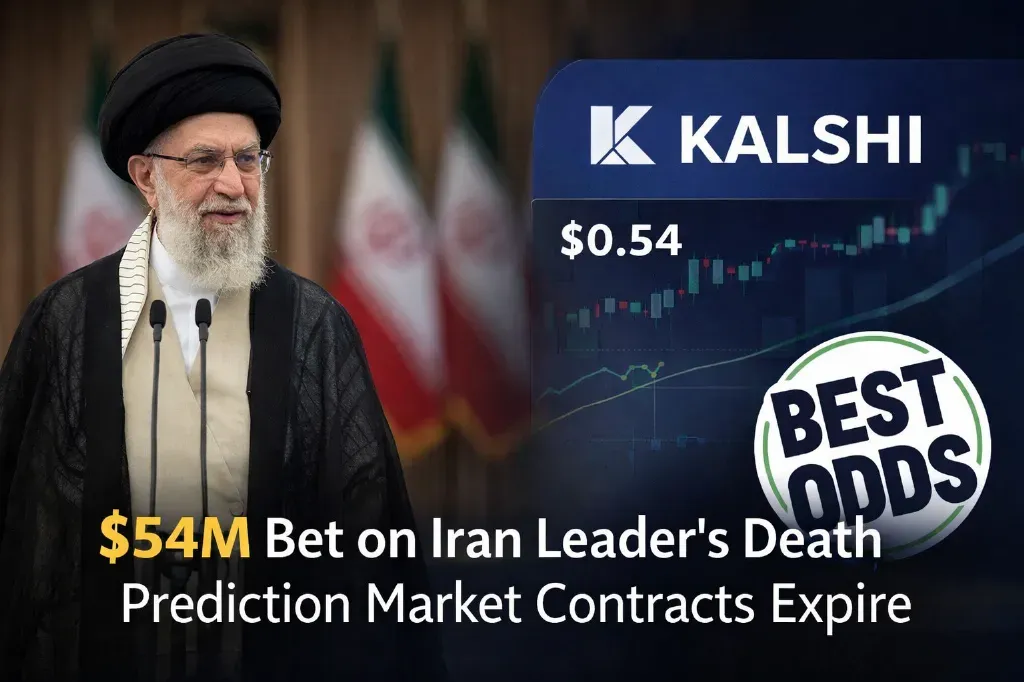
Prediction markets have once again drawn public attention after contracts related to the potential death of Ali Khamenei accumulated tens of millions of dollars in wagers without ultimately paying out to traders. Activity surrounding the contracts reached approximately $54 million before markets closed without resolution, highlighting both the scale of interest in geopolitical prediction markets and the rules governing how such event contracts are settled.
The contracts were hosted on Kalshi, a regulated United States exchange that allows participants to trade event-based contracts tied to measurable outcomes across politics, economics, and public policy. The outcome tied to the Iranian leader’s death did not meet the exchange’s specific resolution criteria within the defined timeframe, meaning that traders who took positions on the event did not receive payouts despite the high level of wagering.
The episode illustrates the growing role of prediction markets as platforms where participants attempt to quantify geopolitical uncertainty in real time.
A High-Profile Event Contract
Prediction markets operate differently from traditional sports betting platforms. Rather than wagering against a bookmaker, traders buy and sell event contracts that resolve based on clearly defined outcomes. Each contract is structured around a binary result, typically settling at either $1 or $0 depending on whether the event occurs within the contract’s specified conditions.
In this case, the contract focused on whether Iran’s Supreme Leader would die within a defined period. As geopolitical tensions in the Middle East intensified and global media attention focused on Iran’s leadership, trading activity on the contract accelerated significantly.
Reports indicated that total volume tied to the contract reached roughly $54 million before expiration. However, because the event itself did not occur within the designated timeframe, the contract resolved as “No,” meaning that traders who purchased positions expecting the event to occur did not receive payouts.
Prediction markets often attract large trading volumes when global political developments create uncertainty around leadership, policy decisions, or geopolitical stability. Platforms such as Kalshi allow participants to express probabilistic expectations about such outcomes by buying or selling event contracts.
A broader explanation of how these systems function can be found in the BestOdds guide to political prediction markets, which examines how traders price political events ranging from elections to leadership changes.
Rules-Based Settlement in Prediction Markets
The resolution of the contract reflects a central principle of regulated prediction exchanges: strict adherence to predetermined settlement rules.
Every event contract on Kalshi must be tied to a measurable outcome defined in advance. The exchange publishes clear criteria describing how an event will be confirmed and which sources will be used to determine the final result. These rules are essential because prediction markets operate as financial instruments rather than informal betting pools.
If the event does not occur within the contract’s timeframe or does not meet the specified criteria, the contract resolves accordingly, regardless of how much money was wagered on the opposite outcome.
In the case of the Iranian leadership contract, the absence of the event meant that all positions expecting the death of the Supreme Leader expired without payout.
Industry observers note that such outcomes are not unusual in event-based markets. Traders who take positions essentially purchase probability estimates. If the predicted event does not occur before the expiration date, the contract settles against that position.
Growing Interest in Geopolitical Event Markets
The scale of trading in the contract reflects the rapid growth of prediction markets as tools for analyzing political and geopolitical developments.
Platforms such as Kalshi allow participants to trade contracts on a wide range of events, including central bank decisions, economic indicators, election results, and major geopolitical developments. Unlike traditional sportsbooks, these exchanges focus on outcomes tied to public information and verifiable events.
This structure allows prediction markets to function as real-time indicators of collective expectations.
For example, traders may buy contracts suggesting a particular outcome is likely, pushing prices higher and signaling market confidence in that scenario. Conversely, selling pressure can indicate that participants believe the probability of an event is declining.
The growing popularity of these markets has led to increased regulatory scrutiny and legal debates over how event contracts should be categorized. One of the most prominent legal developments involving the exchange concerns ongoing litigation between regulators and the platform itself, detailed in the BestOdds coverage of Kalshi and its legal dispute over political event contracts.
Political and Geopolitical Forecasting
Political prediction markets have long attracted attention from economists and policy analysts because they aggregate diverse information sources into a single price.
Research has suggested that such markets can sometimes provide more accurate forecasts than opinion polls or expert commentary because participants risk capital when expressing their views. The price of a contract effectively represents the market’s implied probability of an event occurring.
In the case of the Iranian leadership contract, market prices fluctuated as news developments emerged and geopolitical tensions shifted. Traders adjusted their positions in response to changing information, including public statements from Iranian officials and developments across the broader Middle East.
While the contract ultimately resolved without the predicted outcome occurring, the level of participation demonstrates how traders use these platforms to track political developments that could have global implications.
The Role of Regulated Exchanges
Kalshi occupies a distinctive position in the prediction market sector because it operates as a federally regulated exchange in the United States. The platform is overseen by the Commodity Futures Trading Commission, which treats event contracts as derivatives tied to verifiable outcomes.
This regulatory framework distinguishes Kalshi from many offshore prediction platforms that operate without the same oversight.
Under the exchange’s rules, contracts must be based on publicly verifiable data and must include clear resolution criteria. The exchange also publishes detailed rulebooks describing how disputes are handled and how settlement decisions are made.
Such transparency is considered essential for maintaining market integrity, particularly when contracts involve politically sensitive events.
Market Signals and Public Interest
The substantial volume tied to the Iranian leadership contract reflects broader public interest in geopolitical forecasting. Major political developments can influence global markets, energy prices, and international relations, making them topics of intense attention among traders and analysts.
Prediction markets offer a mechanism for translating that attention into measurable probabilities.
Although the contract concerning Iran’s Supreme Leader did not resolve in favor of traders expecting the event, the episode demonstrates how event markets continue to evolve as tools for analyzing complex political developments.
As participation in these markets grows, trading activity around geopolitical events may continue to expand, providing additional insight into how participants collectively assess global political risk.
References
- Kalshi Exchange. “Event Contracts and Market Rules.” Kalshi Regulatory Documentation.
- Commodity Futures Trading Commission. “Event Contracts and Derivatives Regulation.”
- Financial Times. “Prediction Markets Gain Popularity for Political Forecasting.”
- Bloomberg. “Trading Volumes Rise in Political Event Markets.”
- Reuters. “Prediction Markets and Geopolitical Risk Assessment.”
iGaming Writer - Patrick is a long-time casino enthusiast and sports betting analyst who has spent the last decade diving deep into the world of online gaming. Whether it’s breaking down the nuances of live dealer strategies, reviewing slot tournaments, or comparing crypto payment methods across top UK casinos, Patrick brings a bettor’s mindset to every article.
Related News

 NFL
NFL NBA
NBA NHL
NHLBetting offers


