


After Holding Spain, How Far Can Cape Verde Actually Go? A Group H Projection

Cape Verde’s goalless draw with Spain on Monday was the result of the 2026 World Cup so far, but a single point against a co-favorite raises a more interesting question than the shock itself: what is that point actually worth, and how far can the smallest nation ever to reach a World Cup realistically travel from here? With the group stage now past its opening round and the expanded 48-team bracket rewarding third-place finishers for the first time, the math behind Cape Verde’s tournament has shifted from romantic to genuinely live. The World Cup outright odds still price the Blue Sharks as rank outsiders to lift the trophy, as they should, but the more relevant markets – qualification from the group and survival into the round of 32 – tell a different and far more encouraging story.
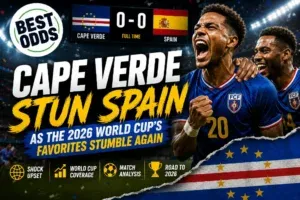
What One Point Is Really Worth in a 48-Team Format
Under the old 32-team structure, a draw in the opening match left a nation like Cape Verde needing to beat at least one of the group’s stronger sides to have any realistic hope of advancing. The 2026 format changes that calculus entirely. With twelve groups of four and the eight best third-placed teams progressing alongside the twelve group winners and twelve runners-up, a third-place finish is now a qualifying position rather than an early flight home. Historically, the threshold for a third-placed team to advance has hovered around four points across three matches, and in many simulations even three points with a respectable goal difference has been enough. That is the prism through which Monday’s point should be read. Cape Verde did not merely deny Spain; they banked a third of the way toward a plausible qualifying tally in the single hardest fixture on their schedule. A draw against the group’s strongest side is worth disproportionately more than a draw against an even opponent, because it is the fixture they were least expected to take anything from. The World Cup predictions that model qualification probability rather than tournament victory moved sharply in Cape Verde’s favor after the final whistle, and with good reason: the team’s hardest assignment is now behind them, and it yielded a point rather than the expected defeat.The Group H Picture After Matchday One
Group H broke about as favorably as Cape Verde could have hoped. While they were holding Spain, Saudi Arabia and Uruguay played out a 1-1 draw of their own in Miami, Abdulelah Al-Amri’s header canceled out by Maxi Araujo’s late equalizer. The result means all four teams in the group sit level after the opening round, with Spain and Uruguay, the two pre-tournament favorites, each dropping two points they were expected to collect. No team has a win, no team has a loss, and Cape Verde, far from being cut adrift, are level with the field on goal difference. This matters because it compresses the margin Cape Verde needs to make up. Rather than chasing two strong sides who had already banked maximum points, they enter matchday two in a flat group where a single victory could lift them into a qualifying position outright. Their remaining fixtures, against Saudi Arabia and Uruguay, are demanding but not the mismatch the Spain game represented on paper. Against a Saudi side that just took a point off Uruguay, and a Uruguayan team carrying its own questions after a flat opening performance, Cape Verde’s defensive organization and the form of goalkeeper Vozinha suddenly look like the foundation of a credible qualifying run rather than a one-off heroic stand.Why the Spain Draw Was Not a Fluke
The temptation with a result like this is to file it as variance, a low-probability event that flatters the underdog and tells us little about what comes next. The underlying numbers argue otherwise. Spain registered 27 attempts but generated barely over one expected goal in the first half, a profile that points to volume without quality – a great deal of territory and possession converted into low-value chances against a disciplined, deep defensive block. That is not a team riding luck. It is a team executing a specific, repeatable plan: concede possession, deny central space, and force a technically superior opponent into half-chances from distance and tight angles. A side that can reproduce that defensive shape can reproduce results, which is precisely why Cape Verde’s qualification price is more interesting than their outright price. Vozinha, at forty, was the standout, but the structure in front of him was the real story, and structure travels from match to match in a way that hot-goalkeeper variance does not. The challenge in their next two fixtures is different: against Saudi Arabia and Uruguay, Cape Verde may need to take the initiative rather than absorb pressure, and whether they can carry a threat going forward, rather than simply frustrate, will determine whether the Spain point becomes the foundation of a knockout run or its high-water mark.The Individual Markets and the Wider Field
Cape Verde’s rise has had knock-on effects beyond their own group. Spain’s failure to win has rippled through the individual markets, including the World Cup Young Player Award, where Lamine Yamal remains the favorite despite starting on the bench as he manages his return from an April hamstring injury. His twenty-minute cameo was Spain’s brightest attacking spell, but the team’s stutter is a reminder that even the strongest individual prices depend on their nation maintaining the deep run that generates visibility. The same logic applies to the World Cup Golden Boot odds, where a forward’s price is inseparable from his team’s projected number of matches – a dynamic that cuts against Spain’s attackers if their slow start continues and, conversely, has nothing to offer a Cape Verde side whose value lies entirely in defensive resilience rather than goalscoring. The broader point is that the opening round has flattened the hierarchy. Spain and France remain co-favorites, but a tournament that has already produced four straight draws on a single matchday, a Cape Verde point against Spain, and a Saudi Arabia point against Uruguay is one in which the gap between the elite and the rest is narrower than any pre-tournament board suggested. For those tracking the event through market pricing, the prediction-market angle has become one of the more reliable reads on a volatile field, and the mechanics of how those contracts price probability in real time are set out in full in the comprehensive Kalshi prediction-markets review, where new users who sign up with the BestOdds referral code can claim $10 in bonus credits after a qualifying trade.The Realistic Projection
Stripped of romance, the projection for Cape Verde is this: a round-of-32 place is now a genuine target rather than a fantasy, but it remains more likely than not that they fall short. Four points from their remaining two fixtures would almost certainly see them through as one of the best third-placed teams, and even three points could be enough depending on goal difference across the other groups. To get there, they need to convert the defensive solidity that frustrated Spain into at least one positive result against opponents they will be expected to match rather than survive. That is a meaningfully easier task than the one they just completed, which is the strongest argument that Monday was a beginning rather than a peak. Beyond the round of 32, realism takes over. A nation of barely half a million people, however well-organized, would be a substantial outsider in any single-elimination tie against a seeded side, and the outright market is correct to keep them at the bottom of the board. But the World Cup’s expansion was designed precisely to give teams like Cape Verde a stage on which a strong group campaign is rewarded with knockout football, and after one match they are closer to seizing that opportunity than almost anyone predicted. The Blue Sharks will not win the 2026 World Cup. Whether they reach its first knockout round is now, remarkably, a question worth asking. About the Author: Ali Raza
UK iGaming Writer - With 10+ years in tech, crypto, igaming, and finance, Ali has written across many platforms covering crypto, tech, and gambling news, reviews, and guides. He specialises in content on igaming, sports betting, and crypto trends in emerging markets. Outside of work, Ali enjoys cricket and travelling.

Share page
OR
Related News

Betting offers


Sportzino is a unique Sweepstakes platform that offers social betting and free casino games.
Sportzino
Unique Sports Prediction Options
Live Sports Action
Over 500 Online Slots
Sportzino is a unique Sweepstakes platform that offers social betting and free casino games.
Sportzino
Unique Sports Prediction Options
Live Sports Action
Over 500 Online Slots


Best Sportsbook
Fliff Sportsbook
High-quality customer support
Users can play for free or real cash prizes
Attainable rewards program
Best Sportsbook
Fliff Sportsbook
High-quality customer support
Users can play for free or real cash prizes
Attainable rewards program


Best Sweepstake
Thrillzz Sportsbook
Daily log-in rewards
Loyalty levels from sports picks
Seamless mobile gaming
Best Sweepstake
Thrillzz Sportsbook
Daily log-in rewards
Loyalty levels from sports picks
Seamless mobile gaming