Kentucky Derby Betting in 2026: The Complete US Guide
Kentucky Derby betting holds a distinctive and historic place in American wagering culture. Unlike the fixed-odds sportsbook model commonly used for NFL or NBA betting,…


Held each year at Churchill Downs in Louisville, Kentucky, the Kentucky Derby serves as the opening leg of the Triple Crown and ranks among the most heavily bet horse races anywhere in the world. Betting handle regularly reaches hundreds of millions of dollars across US and international wagering pools. With a 20-horse field, a one-and-a-quarter-mile distance, and intense pace pressure, the Derby presents bettors with a combination of considerable volatility and opportunity.
US bettors can legally wager on the Kentucky Derby through licensed online racebooks and at racetrack betting windows in jurisdictions where pari-mutuel wagering is permitted. Before considering individual wagers, understanding how the pari-mutuel structure operates is critical.
This guide takes a detailed look at Kentucky Derby betting, covering the calculation of odds, available wager types, advanced handicapping, futures betting, online wagering platforms, bankroll management, and frequently asked questions.

Understanding Pari-Mutuel Betting
Kentucky Derby wagering primarily uses a pari-mutuel system instead of traditional fixed odds. Under this format, every wager placed on a particular bet type goes into the same pool. The racetrack removes a takeout percentage for regulatory fees and operating expenses, with the remaining money distributed among winning tickets.
Because the odds depend on how money is distributed throughout the pool, prices continue changing until wagering closes at post time. The odds displayed when a wager is submitted therefore aren’t necessarily the odds the bettor ultimately receives. A horse showing 8-1 with 10 minutes remaining could close at 6-1 if a significant amount of late money is wagered on that runner.
That system is fundamentally different from traditional sportsbook wagering, where the bettor generally locks in the displayed odds when placing the bet. Pari-mutuel bettors are essentially wagering against everyone else participating in the pool rather than directly against a bookmaker.
The enormous size of Kentucky Derby pools can produce both efficiency and market distortion. Significant liquidity helps prevent some extreme pricing discrepancies, but large amounts of public money placed on popular horses can create more appealing odds on overlooked contenders. That can generate potential value for disciplined handicappers.
Understanding how that process works provides the foundation for evaluating the individual Kentucky Derby wager types.
Core Kentucky Derby Bet Types
Kentucky Derby bettors can choose between traditional straight wagers and more complicated exotic bets. With as many as 20 horses in the Derby field, the number of potential combinations can become particularly significant when constructing exotic tickets.
Win, Place, and Show
A Win wager cashes when the selected horse finishes first. It is the simplest Derby wager and generally provides the largest potential payout of the three traditional straight bets.
A Place wager wins when the selected horse finishes either first or second. Since more tickets can qualify for a payout, the returns on Place bets are normally smaller than those offered by Win wagers.
A Show wager wins when the selected horse finishes first, second, or third. The additional winning possibilities reduce volatility but also substantially decrease the potential return.
With 20 horses potentially competing in the Kentucky Derby, Win wagers can offer attractive prices because betting money is spread across a large number of runners. When significant money flows toward a heavy favorite, however, that horse’s potential Win payout can decline considerably.
Exacta
An Exacta requires the bettor to correctly select the horses finishing first and second in the precise order. The Kentucky Derby’s Exacta pool is one of the largest in US horse racing, and a 20-horse field produces 380 possible finishing combinations.
Bettors can also “box” an Exacta, covering the different finishing orders involving several selected horses. The added coverage also increases the ticket price. A three-horse Exacta box, for example, contains six separate combinations.
Derby Exactas can generate substantial payouts, especially when a longshot manages to finish in either of the first two positions.
Trifecta
A Trifecta requires correctly predicting the first three finishers in their exact order. A full 20-horse Kentucky Derby field produces 6,840 possible Trifecta combinations.
Because covering every possibility isn’t practical, bettors frequently construct partial wheels that key a particular horse into one finishing position while using several other contenders in the remaining positions. Trifecta payouts can become extremely large when heavily backed favorites fail to control the top of the results.
Superfecta
A Superfecta takes the same concept another step, requiring the bettor to correctly identify the first four finishers in exact order. A field of 20 starters produces 116,280 possible Superfecta outcomes.
Minimum stakes for Superfectas can fall to $0.10 in many jurisdictions, but the huge number of potential combinations means careful bankroll management remains important when constructing these tickets.
Kentucky Derby Futures Betting
Kentucky Derby futures are different from the pari-mutuel pools available on race day because the wagers are made well before the race takes place. Depending on the jurisdiction, futures markets may be available through pari-mutuel racebooks as well as fixed-odds sportsbooks.
These wagers can be placed weeks or even months ahead of the Derby, creating additional risk for the bettor. A selected horse could become injured, fail to earn enough qualifying points, or ultimately not enter the Kentucky Derby. Unlike typical race-day bets, futures wagers are generally not refunded simply because the selected horse doesn’t start.
Futures odds also incorporate expectations surrounding qualifying points earned in major prep races, including the Florida Derby, Santa Anita Derby, and Blue Grass Stakes. Bettors may uncover significant early value when a horse that initially receives little attention improves dramatically during the Derby prep schedule.
Liquidity in futures markets is considerably lower than in the enormous race-day pools, however. As a result, futures prices may react more slowly to new information until the Kentucky Derby gets closer.
Advanced Handicapping for the Kentucky Derby
Handicapping the Kentucky Derby involves combining numerous performance factors rather than relying on one statistic or race result. The 1 1/4-mile distance, unusually large field, and potentially aggressive early pace make the Derby considerably different from ordinary allowance and stakes races.
Pace Projection
Kentucky Derby fields frequently feature several speed horses competing aggressively for early position. When those runners produce fractions that are too fast to sustain, the race can experience a pace collapse. Deep-closing horses may significantly outperform public expectations under those circumstances.
Evaluating potential pace requires studying previous running styles, early gate speed, and the tactical tendencies of each horse. Horses breaking from outside posts may also have to use additional energy early in the race to establish a favorable position.
Speed Figures
Measurements such as Beyer Speed Figures provide standardized benchmarks that allow handicappers to compare performances produced at different racetracks and under different conditions. The Kentucky Derby nevertheless introduces variables unique to Churchill Downs, including the racing surface and unusually intense environment surrounding the event.
One outstanding speed figure doesn’t necessarily mean a horse can reproduce that performance over 10 furlongs. A pattern of continued improvement across multiple prep races may provide a more useful indicator than one isolated peak figure.
Pedigree Analysis
The Kentucky Derby’s distance demands more stamina than many horses encounter during their prep campaigns. Evaluating pedigree can provide clues about whether a runner has the ability to maintain its performance over 1 1/4 miles. The performances of sires and dams at classic distances can offer useful evidence regarding stamina.
Horses whose breeding is more heavily geared toward sprint distances may perform well early but struggle to maintain that speed through the final furlong.
Post Position
Post position takes on added significance when as many as 20 horses are loaded into the Kentucky Derby starting gate. Horses drawn toward the inside can encounter significant traffic, while those on the extreme outside may have to expend additional energy early to obtain position. Some post ranges have historically produced more Derby winners than others, although considerable variance remains.
Advanced Exotic Betting Strategy for the Kentucky Derby
A 20-horse Kentucky Derby field dramatically increases the number of possible outcomes when wagering on exotic bets. Because pari-mutuel payouts reward combinations held by fewer winning tickets, thoughtful ticket construction becomes particularly important. Simply covering large numbers of random combinations can rapidly increase costs while reducing expected value.
Keying Strategy
Keying involves placing one horse in a particular finishing position, usually first or second, and then rotating several other contenders through the remaining positions. A bettor who strongly favors one horse, for example, could key that runner to win while using several mid-priced horses underneath in the second and third positions of a Trifecta.
This approach reduces the ticket cost compared with fully boxing all the selected horses while still providing exposure to potentially lucrative outcomes. A key strategy generally makes the most sense when the bettor has considerable confidence that one horse will deliver a consistent performance.
When the expected Derby pace points toward a chaotic finish, another strategy could involve keying a deep closer underneath faster horses. Such an approach provides exposure to a possible pace collapse without requiring the closer to actually win the race.
Partial Wheeling
Partial-wheel wagers allow bettors to use separate groups of horses for different finishing positions. One possible structure could look like this:
- Position 1: Horse A
- Position 2: Horses B, C, D
- Position 3: Horses B, C, D, E, F
The ticket therefore reflects different levels of confidence. Keeping the first-place position more selective reduces the overall number of combinations and makes the wager less expensive.
Because Kentucky Derby results frequently include a longshot in the Trifecta or Superfecta, using more horses in the third and fourth positions can increase the possibility of capturing a larger payout without allowing ticket costs to expand exponentially.
Boxing vs Structured Construction
A box gives every selected horse equal treatment across all available finishing positions. While that approach is simple to understand, it can become expensive and inefficient in a field as large as the Kentucky Derby.
Structured tickets instead emphasize outcomes based on their estimated probability rather than providing equal exposure to every possible finishing order. A four-horse Trifecta box, for example, produces 24 combinations. A more carefully constructed ticket involving those runners might require only 10 or 12 combinations while retaining coverage of the bettor’s primary expected outcomes.
With so much money flowing into Kentucky Derby pools, even relatively small advantages in ticket construction can have a meaningful effect on potential returns.
Track Bias and Surface Considerations at Churchill Downs
Churchill Downs brings several environmental and structural factors into play that can influence how the Kentucky Derby unfolds.
Track Bias
Track bias describes a racing surface that appears to provide an advantage to certain running styles or post positions. Those tendencies can change during the day depending on maintenance, moisture, and weather conditions.
An inside-speed bias could provide an advantage to front-running horses starting from lower-numbered posts. If outside-running closers appear to be performing better, however, horses making wider late moves could hold an advantage.
Watching races earlier on the Kentucky Derby Day card can therefore provide useful information about how the surface is playing. Heavy public wagering late in the day doesn’t necessarily mean that emerging track biases will immediately be reflected in the odds.
Weather Impact
Rain can significantly change the racing surface. Horses that have already demonstrated an ability to handle muddy conditions may have an advantage on a wet track. Pedigree can also influence performance under those circumstances because some bloodlines demonstrate stronger stamina and traction on off tracks.
Wind can also affect the way a race develops. A headwind through the stretch may make it more difficult for late runners to maintain closing speed, while a tailwind can potentially improve finishing fractions.
Weather forecasts can change considerably during Kentucky Derby Week, making final track and weather conditions important considerations before exotic tickets are completed.
Best Kentucky Derby Racebooks in the US
To determine the strongest options for Kentucky Derby wagering, our team evaluated licensed US racebooks offering access to Churchill Downs pari-mutuel pools along with dependable payment processing, competitive promotions, and comprehensive race-day coverage. Platforms were assessed on the depth of their betting menus, ranging from Win, Place, and Show wagers through Superfectas, as well as live streaming, past-performance information, and mobile functionality.
The following racebooks consistently rank among the strongest overall choices for betting on the Kentucky Derby in the United States.
- TwinSpires: Official Churchill Downs racebook featuring a complete Derby wagering menu
- FanDuel Racing (TVG): Best mobile interface for horse racing wagering
- NYRA Bets: Best suited to advanced handicapping tools and racing data
- Caesars Racebook: Rewards integration for bettors within the Caesars ecosystem
- BetMGM Racing: Strong option for sportsbook customers moving into horse racing betting
Why These Racebooks Were Selected
Kentucky Derby betting operates differently from conventional sportsbook wagering because bets are combined into official pari-mutuel pools. Since not every sportsbook offers access to those pools, these racebooks were chosen specifically because of their horse racing infrastructure and Kentucky Derby coverage.
TwinSpires distinguishes itself through its connection to Churchill Downs Incorporated, the company that operates the Kentucky Derby. That relationship provides direct integration with Derby wagering pools and access to an extensive betting menu. Available wagers range from traditional straight bets to Exactas, Trifectas, Superfectas, Pick 4s, and Pick 6s, along with detailed past-performance information for Kentucky Derby contenders.
FanDuel Racing, formerly known as TVG, offers one of the more polished mobile horse racing experiences available to US bettors. Live streaming from hundreds of tracks is combined with an intuitive betting interface, a particularly useful combination on Derby Day when bettors may be following several races and wagering pools.

NYRA Bets is particularly appealing to more experienced handicappers. Its platform includes detailed racing analytics, speed figures, and performance information that can help bettors evaluate Kentucky Derby hopefuls as they progress through prep races such as the Florida Derby, Blue Grass Stakes, and Santa Anita Derby.
Caesars Racebook and BetMGM Racing bring horse racing into larger sportsbook ecosystems. Bettors already using these operators for sports such as the NFL or NBA can therefore transition into Kentucky Derby wagering while also taking advantage of loyalty programs connected to Caesars Rewards and MGM Rewards.

Taken together, these platforms offer some of the most comprehensive and dependable options for legally wagering on the Kentucky Derby online in the US, including official pari-mutuel pool access, secure payment options, and horse racing-specific betting tools.
Step-by-Step Guide to Placing a Kentucky Derby Bet Online
Step 1: Register with a Licensed Racebook
Choose a pari-mutuel wagering platform authorized in your state. Registration requires bettors to provide information such as their legal name, address, date of birth, and Social Security information for identity verification.
Step 2: Verify Location
Geolocation technology is used to confirm that the bettor is physically located within a jurisdiction where online horse racing wagering is permitted.
Step 3: Deposit Funds
Available deposit methods can include ACH bank transfers, debit cards, PayPal, and other approved payment methods depending on the jurisdiction and racebook.
Step 4: Access the Kentucky Derby Race Card
On Derby Day, locate Churchill Downs within the racebook and select the Kentucky Derby from the available race card.
Step 5: Select Bet Type and Construct Ticket
Choose the wager you want to place, such as a Win bet, Exacta, or Trifecta. Enter the appropriate horse numbers into the required finishing positions and review the stake before submitting the ticket.
Because Kentucky Derby odds are pari-mutuel, the final payout isn’t established until wagering has closed at post time.
Step 6: Monitor Results and Withdraw
After the race results become official, winnings are automatically added to the bettor’s account. Withdrawal requests can then be submitted through the platform’s cashier section.
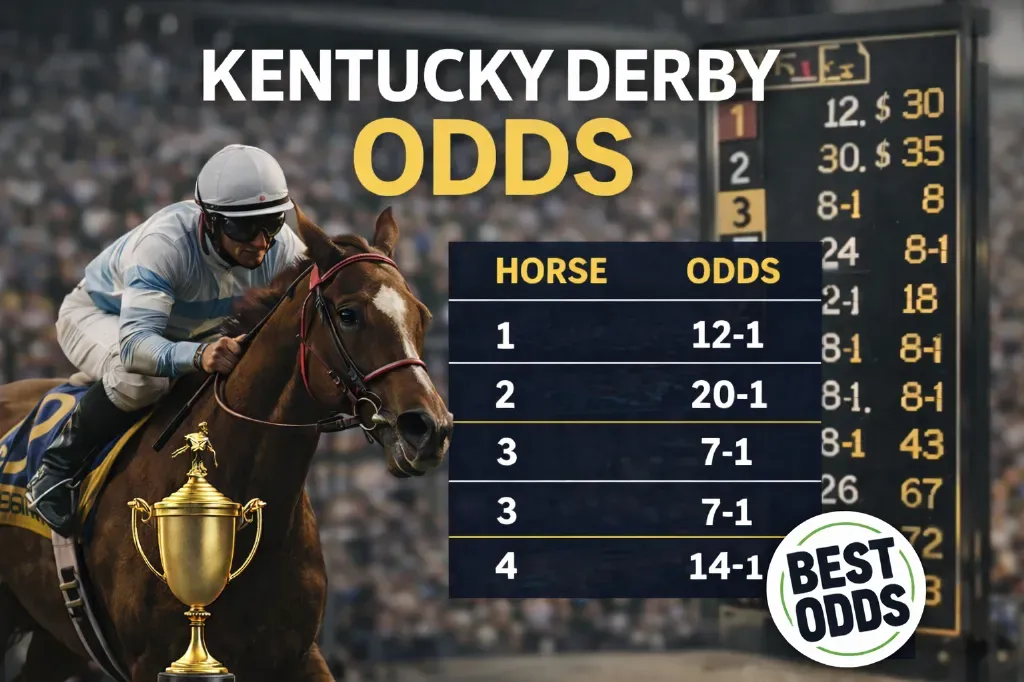
Understanding Kentucky Derby Odds
Kentucky Derby odds operate differently from the fixed prices commonly associated with US sportsbook betting. Instead of a sportsbook setting a price that becomes locked when the wager is submitted, most Derby odds are generated through pari-mutuel wagering. Bets of the same type are combined into one pool, and the final odds depend on the amount wagered on each horse compared with the size of the entire pool. The racetrack removes its takeout before the remainder is distributed to winning tickets. Consequently, the odds displayed before post time are estimates that can move substantially as additional money enters the pool.
The Kentucky Derby’s enormous wagering volume can produce particularly significant movement during the final minutes before the race. A runner showing odds of 12-1 earlier in the afternoon could close at 8-1 following a wave of wagering from the public or large betting groups. An early favorite could also drift to a higher price if bettors move toward competing horses after considering late handicapping information, trainer developments, or changing track conditions.
The Kentucky Derby’s 20-horse field also plays an important role in determining odds. Since the field is considerably larger than those found in most races during the year, wagering money is distributed among many different contenders. Even highly regarded runners can therefore start at comparatively attractive odds. That dynamic contributes to the Derby’s potential for large payouts, especially when longshots or mid-priced horses occupy the leading finishing positions.
For bettors, following the movement of odds throughout the wagering period can become an important part of Derby strategy. Tracking changes in the pools, evaluating how public money is distributed, and identifying horses whose prices have moved beyond a bettor’s estimated probability can reveal potential value. Predicting the winner of a race involving 20 horses remains extremely difficult, but disciplined market analysis can help identify situations where public sentiment may be overvaluing or undervaluing a particular contender.
Bankroll Management for Kentucky Derby Day
The spectacle surrounding the Kentucky Derby can encourage bettors to wager more aggressively than planned. Establishing a structured bankroll beforehand can reduce the temptation to take on impulsive additional exposure.
Set aside a predetermined portion of the overall bankroll specifically for Kentucky Derby Day. That amount can then be divided between straight wagers and exotic tickets according to the bettor’s individual tolerance for risk.
Traditional Win bets generally produce less variance than wagers such as Superfectas. Exotic tickets should be constructed around a defined strategy rather than emotionally adding large numbers of longshots in pursuit of an enormous payoff.
The Kentucky Derby remains a single racing event with considerable inherent randomness. For that reason, one wager shouldn’t account for a disproportionate percentage of the total bankroll.
Responsible Gambling
Kentucky Derby Day presents a wagering environment with its own particular risks. The scale of the event, social setting, and concentration of significant betting activity into a single afternoon can make it easier to exceed predetermined wagering levels. Exotic bets can intensify that risk because adding more combinations to a ticket can gradually increase the total stake.
Establishing a firm Derby Day budget before wagering begins and treating that limit as final is one of the most practical safeguards. Licensed racebooks provide responsible gambling features within their account settings, which may include deposit limits, wagering limits, session controls, and self-exclusion. These tools are generally most useful when established before betting begins rather than after losses or wins have already influenced decision-making.
Confidential problem-gambling assistance is also available through established responsible-gambling support resources.
Final Perspective on Kentucky Derby Betting
Kentucky Derby betting creates one of the most complicated and dynamic wagering environments in American sports. Its pari-mutuel structure means bettors compete for shares of wagering pools rather than simply wagering against prices established by a bookmaker. With as many as 20 horses competing, the number of possible outcomes increases dramatically for exotic wagers, making disciplined ticket construction more valuable than indiscriminately covering combinations.
Effective Derby handicapping involves bringing together pace projections, speed figures, pedigree and stamina considerations, post-position analysis, and assessments of track bias. Large wagering pools are also heavily influenced by public sentiment, and the presence of longshots in exotic finishing positions can produce particularly substantial payouts.
Within the regulated US wagering system, licensed racebooks provide secure access to official pari-mutuel pools as well as responsible gambling protections. Sustainable Kentucky Derby wagering ultimately depends less on the spectacle surrounding the race and more on structured probability analysis, thoughtful ticket construction, and disciplined bankroll management.
Frequently Asked Questions About Kentucky Derby Betting
Is Kentucky Derby betting legal in all states?
Kentucky Derby betting is legal in states that permit pari-mutuel wagering through authorized platforms.
Are Kentucky Derby winnings taxable?
Yes. Kentucky Derby gambling winnings may be subject to federal taxation as well as applicable state taxes.
What is the difference between pari-mutuel and fixed-odds betting?
Pari-mutuel odds continue changing according to how wagering money is distributed throughout the pool. Fixed-odds wagers lock in the available price when the wager is placed.
How many horses run in the Kentucky Derby?
The Kentucky Derby field generally includes as many as 20 starters.
What is the minimum wager amount?
Minimum stakes depend on the platform and wager type, but certain exotic bets can have minimums as low as $0.10.
For almost two decades, Sadonna has remained at the forefront of the gambling industry in the US and abroad, covering the latest news and legal updates. Sadonna’s goal is to provide sports bettors and casino players with premium content, including comprehensive details on the US industry.