Kentucky Derby Odds Explained: The Complete US Guide
Traditional North American sports, like NFL and College Football, MLB, or NBA games, typically last at least two hours and often last longer than three. Watching and…


Horse racing offers a completely different thrill, with the average Kentucky Derby race lasting just over two minutes.
Kentucky Derby odds operate under a fundamentally different system than traditional sportsbook betting. Unlike fixed-odds markets in NFL, NBA, or UFC wagering, the Kentucky Derby uses a pari-mutuel pool structure. This distinction is critical. In a pari-mutuel system, bettors do not wager against a bookmaker; instead, they wager against one another.
All money bet on a particular wager type—Win, Exacta, Trifecta, and so on—is combined into a common pool. The racetrack deducts a percentage known as the takeout. The racetrack distributes the remaining funds proportionally among winning tickets.
Because payouts depend on pool distribution rather than fixed pricing, Kentucky Derby odds are dynamic until betting closes at post time. Understanding how these odds form, fluctuate, and how to interpret value in this structure is essential before placing any wager.
This guide explains Kentucky Derby odds in depth, including morning lines, final odds, pool math, takeout impact, exotic payout calculation, futures pricing, and advanced pool analysis.
Best Sportsbooks for Kentucky Derby Odds
DraftKings Sportsbook

DraftKings is one of the leading options for Kentucky Derby betting, offering a broad range of horse racing markets during the Triple Crown season. Bettors can wager on outright winners, exactas, trifectas, superfectas, and other popular race outcomes through a streamlined betting interface.
The sportsbook typically provides competitive Kentucky Derby odds along with detailed horse profiles, morning-line information, and race-day updates. Mobile wagering makes it easy to follow odds movements and place bets as post time approaches.
DraftKings also frequently offers racing promotions and odds boosts around major horse racing events. Combined with extensive sports betting markets, it gives Kentucky Derby fans a comprehensive wagering experience.
FanDuel Sportsbook

FanDuel is a popular destination for Kentucky Derby betting thanks to its user-friendly platform and extensive horse racing coverage. The operator offers wagering options on the Derby field as well as key prep races leading into the Run for the Roses.
Bettors can access traditional win, place, and show wagers alongside exotic betting options. FanDuel Racing integrates horse racing and sportsbook features, allowing users to manage multiple types of wagers from a single account.
The platform is known for competitive odds, live updates, and race analysis that can help bettors make informed decisions. Kentucky Derby wagering is often supported by special promotions during Triple Crown season.
BetMGM Sportsbook
BetMGM offers comprehensive Kentucky Derby betting markets with a focus on major horse racing events throughout the year. The sportsbook regularly posts Derby futures and race-day odds well in advance of the event.
Bettors can choose from a variety of wagering formats, including outright winners and exotic bets. The platform provides useful racing information, helping users evaluate contenders and compare odds before placing wagers.
Kentucky Derby betting at BetMGM is supported by a strong mobile experience and frequent promotional offers. The sportsbook’s combination of horse racing and traditional sports betting makes it a popular choice among racing fans.
Caesars Sportsbook

Caesars Sportsbook brings a long history of racing and sportsbook operations to Kentucky Derby betting. The operator offers odds on the Derby field along with numerous wagering options for one of horse racing’s biggest events.
The platform provides access to futures betting, race-day markets, and popular exotic wagers. Bettors can follow odds changes and monitor race information through Caesars’ mobile app and desktop platform.
Caesars Rewards integration adds value for many players, allowing bettors to earn rewards while wagering on the Kentucky Derby. The sportsbook often features promotions tied to Triple Crown racing events.
bet365 Sportsbook
Bet365 is known for offering extensive betting markets, and Kentucky Derby wagering is no exception. The sportsbook typically posts a wide selection of horse racing odds, giving bettors multiple ways to engage with the race.
In addition to outright winner markets, bet365 frequently offers a variety of specialty and exotic betting options. The platform’s reputation for deep market coverage can be especially appealing during major horse racing events.
Race information, form data, and live updates help bettors stay informed throughout Derby week. Combined with its global horse racing expertise, bet365 remains a strong option for Kentucky Derby betting.
BetRivers Sportsbook

BetRivers offers Kentucky Derby betting through an easy-to-use platform that caters to both new and experienced bettors. The operator typically features odds on the Derby field and key races leading up to the event.
Bettors can access a range of wagering opportunities, from traditional win bets to more advanced exotic wagers. The sportsbook also provides useful race information and betting resources throughout the Triple Crown season.
BetRivers frequently promotes major sporting events, including horse racing’s biggest races. Its combination of competitive odds and a straightforward betting experience makes it a solid choice for Derby wagering.
Hard Rock Bet

Hard Rock Bet has expanded its presence in the online sports betting market and offers Kentucky Derby wagering for horse racing fans. The sportsbook provides access to odds on Derby contenders and major Triple Crown events.
The platform allows bettors to explore multiple wagering options while tracking developments leading up to race day. Kentucky Derby futures and race-specific markets often become available as the field takes shape.
Hard Rock Bet combines horse racing opportunities with a full sportsbook experience, giving users access to a wide variety of betting markets. Promotional offers and a streamlined mobile platform add to its appeal during Derby season.
Morning Line Odds vs Final Odds
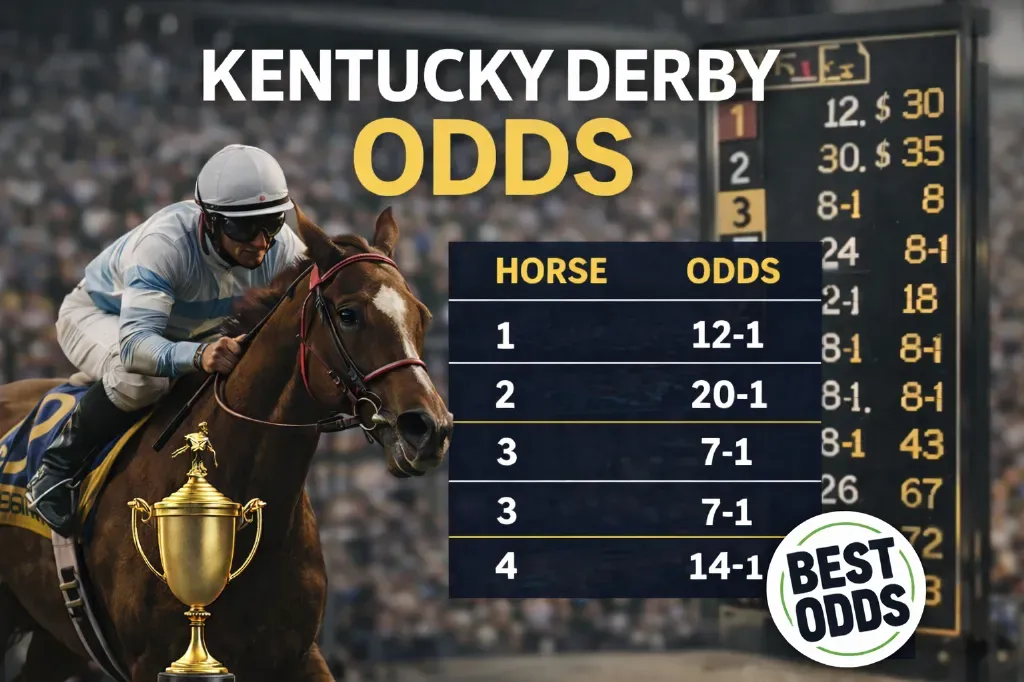
The first odds posted for the Kentucky Derby are known as the morning line. These are not actual betting odds but rather projections made by the track’s oddsmaker. The purpose of the morning line is to estimate how the betting public will distribute money across the field.
Morning line odds are based on:
• Recent performance in prep races• Speed figures• Pedigree• Trainer and jockey reputation• Anticipated public sentiment
However, once live wagering begins, the morning line becomes irrelevant. Final odds are determined entirely by actual money placed in the pool.
It is common for heavily hyped horses to close at significantly lower odds than their morning line projection due to public betting volume. Conversely, less-publicized horses may drift upward, creating potential value opportunities.
Morning line discrepancies do not represent mispricing by the track; they reflect differences between projected and actual public sentiment.
How Pari-Mutuel Odds Are Calculated
Understanding payout calculation requires examining the structure of the pool.
Assume the following:
Total Win Pool: $200,000Track Takeout: 16%
First, remove takeout:
$200,000 × 0.16 = $32,000 (track share)Remaining Pool = $168,000
If Horse A receives $28,000 of total wagers:
Payout Pool ÷ Amount Bet on Horse A = 168,000 ÷ 28,000 = 6.00
This means Horse A will pay approximately 5-1 odds (because decimal payout includes stake).
Final payout per $2 wager:
$2 × 6.00 = $12.00 total return$10 profit per $2 wager
This calculation occurs automatically within the tote system, but understanding it clarifies why odds fluctuate based purely on pool distribution.
Takeout and Its Impact on True Odds
Takeout represents the house edge embedded within pari-mutuel betting. Kentucky Derby takeout rates vary by wager type but often fall between 14% and 22%.
Because takeout reduces the total distributable pool, true probability must be adjusted.
If raw implied probability across all horses sums to 100%, takeout inflates the effective probability beyond 100%, creating embedded margin.
Unlike sportsbook vig, which is built directly into pricing spreads, pari-mutuel takeout applies uniformly to the pool. However, effective margin can vary depending on public concentration.
Large Derby pools reduce variance in margin distribution but do not eliminate the takeout disadvantage.
Implied Probability in Horse Racing Odds
To convert final Derby odds into implied probability:
Probability = 1 ÷ (Decimal Odds)
Example:
Horse at 6.00 decimal (5-1 fractional):
1 ÷ 6.00 = 0.1667Implied Probability = 16.67%
However, because of takeout, summed probabilities across all horses will exceed 100%. This excess represents the effective takeout margin.
Understanding implied probability allows bettors to compare personal handicapping estimates against final tote pricing.
Fixed Odds vs Pari-Mutuel Derby Odds
In recent years, some jurisdictions have introduced fixed-odds horse racing through sportsbooks. This differs from traditional pari-mutuel pools.
Fixed odds:
• Price is locked at placement• Payout does not change regardless of late money• Sportsbook assumes risk
Pari-mutuel:
• Odds fluctuate until betting closes• Final payout determined by total pool• Bettors compete against one another
In large pools like the Kentucky Derby, late money can dramatically shift final odds in the final minutes before post time. This phenomenon is often referred to as “late steam.”
Because final odds are not locked at ticket purchase, bettors must anticipate likely late money patterns.
Exotic Wager Odds Structure
Exotic wagers function under separate pools.
Each of the following has its own pool:
• Exacta• Trifecta• Superfecta• Daily Double• Pick 3, Pick 4, Pick 6
Each pool has its own takeout rate and payout distribution.
Exacta Pool Example
Assume:
Total Exacta Pool: $1,000,000Takeout: 20%Remaining Pool: $800,000
If the winning combination was bet for $50,000 total:
800,000 ÷ 50,000 = 16.00
Each $1 bet returns $16.
Because Derby pools are large, even modest longshot inclusion in exacta combinations can produce substantial payouts.
Why Derby Odds Move Dramatically Late
The Kentucky Derby attracts massive national and international wagering volume. A significant portion of handle arrives in the final 5–10 minutes before post time.
Large institutional wagers, syndicates, and last-minute public money frequently cause:
• Favorites to shorten• Mid-tier horses to drift upward• Longshots to fluctuate dramatically
Because the pool is so large, even six-figure late wagers can shift odds meaningfully.
Understanding likely public bias—such as heavy backing of popular trainers or media narratives—can help anticipate late pricing compression.
Overlay and Underlay: Identifying Value in Derby Odds
In pari-mutuel wagering, value is determined by comparing a bettor’s assessed probability of a horse winning against the implied probability derived from final tote odds.
An overlay occurs when the public underestimates a horse’s true probability of winning. An underlay occurs when the public overestimates it.
Example:
If a bettor estimates Horse A has a 20% chance of winning, fair odds would be 4-1 (decimal 5.00).If the tote board shows 6-1 (decimal 7.00), the implied probability is approximately 14.3%.
Because the bettor’s estimate (20%) exceeds the market’s implied probability (14.3%), Horse A represents an overlay.
Conversely, if the horse closes at 3-1 (decimal 4.00), implied probability is 25%. That would represent an underlay relative to the bettor’s 20% projection.
The Derby’s immense public attention often produces underlays on highly publicized contenders. Casual money tends to concentrate on:
• Undefeated horses• Horses trained by elite trainers• Horses winning major prep races• Media favorites
This concentration can inflate pool share beyond statistical expectation, creating overlays among less-hyped entrants.
Because the Derby pool is so large, minor percentage distortions translate into significant dollar amounts. Identifying overlays requires disciplined probabilistic modeling rather than narrative momentum.
Public Bias in Kentucky Derby Odds
Public wagering behavior in the Kentucky Derby is not evenly distributed. Certain patterns recur consistently.
Trainer and Jockey Bias
High-profile trainers and jockeys attract disproportionate money. When a well-known jockey is listed aboard a mid-tier horse, betting volume often exceeds what underlying speed figures justify.
Recency Bias
Horses that win major prep races in visually impressive fashion frequently experience pricing compression. The public tends to overweight the most recent performance even when earlier form is less consistent.
Post Position Narratives
Extreme inside or outside post positions generate media discussion. In some years, public fear of “bad posts” may cause excessive drift in odds despite statistical evidence that post impact varies by pace scenario.
These biases do not guarantee mispricing, but awareness of public concentration patterns is critical when evaluating value.
Historical Kentucky Derby Odds Patterns
The Kentucky Derby frequently produces at least one longshot finishing in the top three positions. While favorites win with measurable frequency, the 20-horse field introduces elevated variance relative to smaller stakes races.
Historically:
• Favorites win approximately 30–35% of recent Derby runnings.• Double-digit odds winners are common.• Exacta and trifecta payouts often exceed expectations when pace collapses occur.
Because exotic pools magnify combinatorial complexity, a single 20-1 horse finishing second or third can increase payouts exponentially.
Understanding this historical variance profile informs appropriate risk allocation across straight and exotic wagers.
Futures Odds vs Race-Day Odds
Kentucky Derby futures markets operate months before race day. These may be offered either through pari-mutuel future pools or fixed-odds sportsbook markets depending on jurisdiction.
Futures odds incorporate:
• Qualification uncertainty• Injury risk• Development trajectory from prep races• Public anticipation
Because many futures tickets are written before full qualification fields are determined, pricing reflects elevated uncertainty.
On race day, pari-mutuel odds reflect fully confirmed entrants and final public distribution. Futures bettors benefit when early developmental projections exceed public expectations at post time.
However, futures carry significant risk. If a horse fails to start, the wager is typically forfeited.
Race-day odds are more information-efficient but subject to public bias and late money.
Oaks-Derby Double Odds Mechanics
The Kentucky Oaks-Derby Daily Double allows bettors to select the winner of both races. This wager operates through a separate pool distinct from individual race pools.
Because Oaks and Derby pools are linked through the double structure, payout calculation depends on combined pool distribution across all winning combinations.
If heavy favorites win both races, double payouts compress dramatically. However, inclusion of a mid-priced or longshot winner in either leg inflates payout significantly.
Understanding how double pool money is distributed between combinations can reveal structural inefficiencies, particularly when one race features overwhelming favorite concentration.
Advanced Pool Behavior: Late Money and “Steam”
Late money in the Kentucky Derby frequently originates from:
• Computer-assisted wagering teams• Professional syndicates• Institutional bettors placing large wagers close to post time
Because odds are dynamic until wagering closes, visible tote board prices minutes before the race may not reflect final payouts.
Late money often targets horses perceived as overlays by professional models. This results in:
• Odds compression on certain mid-priced horses• Drift on others due to pool redistribution
Understanding that the final odds may differ materially from displayed prices when placing a wager is essential in pari-mutuel environments.
Kentucky Derby Odds vs Other Triple Crown Races
The Kentucky Derby differs from the Preakness Stakes and Belmont Stakes due to:
• Larger field size (20 vs typically 8–12)• Greater public betting volume• Elevated media exposure
The Derby’s size increases variance and exotic payout potential relative to subsequent Triple Crown races.
Takeout rates and pool sizes differ across tracks, influencing effective margin and volatility.
Conclusion: Understanding Kentucky Derby Odds as a Market System
Kentucky Derby odds reflect a dynamic, crowd-driven market rather than bookmaker-set pricing. The pari-mutuel system redistributes risk among participants while embedding a fixed takeout percentage.
Understanding morning line projections, pool distribution, implied probability, public bias, takeout mechanics, and late money patterns transforms Derby betting from spectacle-driven participation into structured probability evaluation.
Because the Derby pool is among the largest in global racing, inefficiencies tend to be subtle rather than extreme. However, public concentration and narrative bias can still produce overlay opportunities for disciplined handicappers.
Long-term viability in Kentucky Derby wagering depends on:
• Accurate probability modeling• Overlay identification• Structured exotic ticket construction• Awareness of late money shifts• Controlled bankroll exposure
The Kentucky Derby remains both a historic sporting event and a complex wagering ecosystem. Mastery of its odds structure begins with understanding how the pool functions beneath the surface.
Frequently Asked Questions About Kentucky Derby Odds
How are Kentucky Derby odds determined?
Kentucky Derby odds are determined through pari-mutuel wagering pools. All money bet on a particular wager type is combined. After takeout is removed, remaining funds are distributed among winning tickets based on total pool share.
Why do Kentucky Derby odds change before the race starts?
Odds fluctuate continuously as bettors place wagers. Because payouts depend on pool distribution, any significant bet alters the implied probability and final payout.
What is the takeout rate for Kentucky Derby betting?
Takeout varies by wager type but typically ranges between approximately 14% and 22%. Exact rates depend on the specific pool and track policy.
What is the difference between morning line and final odds?
Morning line odds are projections made by the track oddsmaker. Final odds are determined by actual betting pool distribution at post time.
Can Kentucky Derby odds drop significantly at the last minute?
Yes. Large late wagers can materially shift odds in the final minutes before betting closes.
Are fixed-odds Derby bets available in the United States?
In select jurisdictions, sportsbooks may offer fixed-odds horse racing. In fixed odds, price is locked at placement rather than determined by pool distribution.
Why are exotic payouts sometimes extremely high?
Exotic wagers such as trifectas and superfectas involve multiple finishing positions in exact order. With a 20-horse field, combinatorial complexity creates large payout potential when longshots finish in top positions.
Is it better to bet early or wait until post time?
Because odds fluctuate until betting closes, waiting allows more complete information but also exposes bettors to late money compression. Strategic timing depends on anticipated public behavior.
How do I calculate implied probability from Derby odds?
Convert fractional or decimal odds to implied probability using:
Probability = 1 ÷ Decimal Odds
This provides the sportsbook’s or pool’s implied chance of winning.
Are Kentucky Derby winnings taxable?
Yes. Gambling winnings are subject to federal taxation and potentially state taxation depending on jurisdiction.
For almost two decades, Sadonna has remained at the forefront of the gambling industry in the US and abroad, covering the latest news and legal updates. Sadonna’s goal is to provide sports bettors and casino players with premium content, including comprehensive details on the US industry.