2026 NFL Offensive Rookie of the Year
Every NFL draft class produces one player who rewrites expectations before the season is two months old, and the 2025 class found its standard-bearer in a wide receiver…


When the Carolina Panthers selected Tetairoa McMillan eighth overall in the 2025 NFL Draft, the questions were as loud as the praise. Carolina was a team coming off a 5-12 season. Bryce Young was entering his third year at quarterback having yet to fully deliver on the promise that made him the first overall pick. The NFC South was competitive. And McMillan, for all his size and talent at 6-foot-5, would be asked to produce as a clear No. 1 receiver from Day 1 at 22 years old.
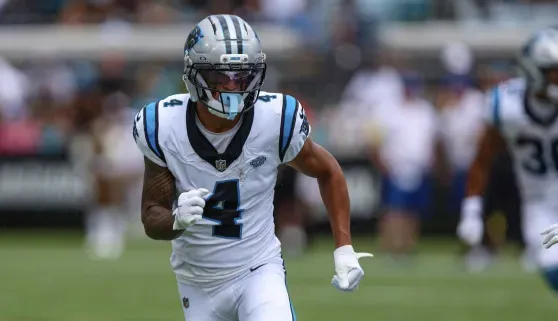
He answered every question, usually before halftime. McMillan started all 17 games, led every NFL rookie in receiving yards with 1,014 and in receiving touchdowns with seven, and became Bryce Young’s most trusted target on a Panthers offense that surprised the entire league by winning the NFC South with an 8-9 record and ending a seven-year playoff drought.
His 70 receptions on 122 targets yielded an average of 14.5 yards per catch, and 27 of those catches went for 16 or more yards, the most explosive receptions of any rookie in the league. When AP voters gathered in San Francisco for NFL Honors on February 5, 2026, McMillan earned 41 of 50 first-place votes and ran away with the award, making him just the second Carolina Panther to win Offensive Rookie of the Year after Cam Newton in 2011.
The preseason odds board told a different story. McMillan was listed at +1300 entering the year, well behind Ashton Jeanty (+250) and Cam Ward (+250), two players who were expected to dominate the market. Jeanty ended the season with 266 carries on a 3-14 Las Vegas Raiders team that finished last in the conference.
Ward went 3-14 in Tennessee after head coach Brian Callahan was fired six games into the year. The actual race was won by a player most books had as a distant afterthought, which is one of the defining features of this betting market: the OROTY board is volatile, unpredictable, and almost always produces a result that looks obvious in hindsight but was not obvious entering the year.
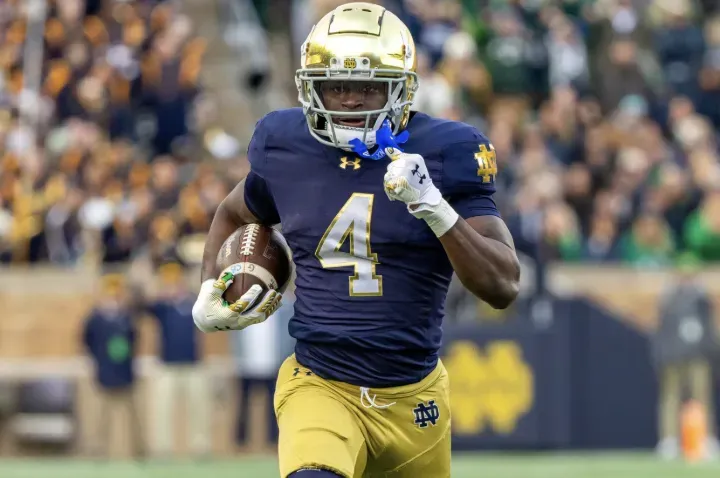
The 2026 season presents a fascinating new set of questions. A draft class unusually light on quarterback talent has pushed a running back and a wide receiver to the top of the odds board for the first time in recent years. Jeremiyah Love, selected third overall by the Arizona Cardinals from Notre Dame, opens as the early favorite.
Carnell Tate, the fourth overall pick out of Ohio State who lands in Tennessee alongside second-year quarterback Cam Ward, is the primary competition. Fernando Mendoza, the Heisman winner and No. 1 overall pick headed to Las Vegas, rounds out the top three, though questions about how quickly the Raiders plan to hand him the full reins make his candidacy more complicated than his draft position suggests.
Best Sportsbooks for NFL Offensive Rookie of the Year Betting
NFL Offensive Rookie of the Year betting has become one of the most popular NFL futures markets, allowing bettors to back standout first-year players before and during the season. Quarterbacks often dominate the award conversation, but running backs and wide receivers can also emerge as strong contenders with productive seasons and favorable situations.
The best sportsbooks for Offensive Rookie of the Year betting offer competitive odds, early futures markets following the NFL Draft, and a variety of player props that help bettors evaluate rookie performance throughout the season. Below are some of the top operators for NFL Offensive Rookie of the Year wagering.
DraftKings

DraftKings is typically among the first sportsbooks to post NFL Offensive Rookie of the Year odds following the NFL Draft. The operator regularly updates futures markets throughout the preseason and offers a wide selection of player props that can help bettors track potential award candidates.
As the season progresses, DraftKings provides detailed statistics, alternate futures markets, and live betting opportunities tied to rookie performances. Bettors can often find value on emerging candidates before the broader market adjusts.
Key Features
- Early NFL Draft futures markets
- Competitive Offensive Rookie of the Year odds
- Extensive player prop offerings
- User-friendly futures betting interface
FanDuel

FanDuel is known for offering one of the most comprehensive NFL futures menus in the industry. Offensive Rookie of the Year odds are prominently featured throughout the offseason and regularly updated as player performances impact the market.
The sportsbook’s clean interface makes it easy to compare candidates, track line movement, and identify value opportunities. FanDuel also frequently boosts odds on popular rookie players during the season.
Key Features
- Robust NFL futures markets
- Frequent odds boosts
- Easy-to-navigate mobile app
- Strong selection of rookie-related props
BetMGM
BetMGM consistently offers deep futures markets and competitive pricing on NFL awards. Bettors can often find strong value on longshot candidates thanks to BetMGM’s extensive player listings.
The sportsbook complements its award markets with weekly player props, season-long statistical projections, and numerous NFL betting promotions throughout the year.
Key Features
- Wide range of rookie candidates listed
- Competitive futures pricing
- Season-long NFL prop markets
- Frequent NFL promotions
Caesars

Caesars Sportsbook provides a straightforward and easy-to-use platform for NFL futures bettors. Offensive Rookie of the Year odds are available well before the season and receive regular updates based on player performance and injuries.
The operator also offers a variety of NFL promotions and reward opportunities that can provide additional value for futures bettors throughout the season.
Key Features
- Early award futures availability
- User-friendly sportsbook interface
- Competitive NFL futures markets
- Caesars Rewards integration
Bet365
Bet365 is well known for offering detailed futures markets and deep player selections. NFL Offensive Rookie of the Year betting is typically available year-round, allowing bettors to monitor changing odds throughout the season.
The sportsbook’s extensive statistical information and broad market coverage make it a strong option for those researching rookie candidates before placing wagers.
Key Features
- Extensive futures menu
- Large selection of rookie candidates
- Detailed statistical resources
- Consistent market updates
BetRivers

BetRivers offers a solid combination of competitive odds and an intuitive betting experience. The sportsbook frequently updates its NFL futures markets and provides numerous ways to wager on rookie players beyond award betting.
In addition to Offensive Rookie of the Year odds, bettors can find season-long props and weekly player performance markets that can help identify emerging contenders.
Key Features
- Competitive award odds
- Season-long rookie props
- Regular futures updates
- Easy-to-use platform
Hard Rock Bet
Hard Rock Bet continues expanding its NFL betting offerings and has become a strong option for futures bettors. Offensive Rookie of the Year markets are typically available shortly after the draft and remain active throughout the season.
The operator provides a streamlined mobile experience and offers a growing selection of NFL player props and futures markets that appeal to award bettors.
Key Features
- Early rookie futures markets
- Strong mobile betting experience
- Growing NFL betting menu
- Competitive futures pricing
How the NFL Offensive Rookie of the Year Award Is Decided
The award is voted on by a panel of 50 sportswriters and broadcasters who cover the NFL for the Associated Press. Unlike the MVP, which uses a weighted point system, OROTY voting is a simple plurality. Each voter casts one ballot, and the player with the most votes wins. That means a candidate does not need to be the consensus choice across the full panel, just the most compelling option for a plurality of voters who spent the season watching him play.
The award has never gone to an offensive lineman. No tight end has ever won it. It is almost exclusively the domain of quarterbacks, running backs, and wide receivers, with quarterbacks claiming the honor most often over the past decade.
Critically, unlike the Offensive Player of the Year award, OROTY does not require team success. Several of the most famous winners played on losing teams. Saquon Barkley won in 2018 for a 5-11 Giants team. Garrett Wilson won in 2022 for a 7-10 Jets squad. Justin Herbert won in 2020 for a 7-9 Chargers group. Individual production on its own can be enough.
2025 OROTY Voting Results
| Rank | Player | Team | Position | 1st-Place Votes | Points |
|---|---|---|---|---|---|
| 1 | Tetairoa McMillan | CAR | WR | 41 | 445 |
| 2 | Tyler Shough | NOR | QB | 5 | 168 |
| 3 | TreVeyon Henderson | NWE | RB | 1 | 111 |
| 4 | Jaxson Dart | NYG | QB | 1 | 88 |
| 5 | Emeka Egbuka | TAM | WR | 0 | 66 |
McMillan’s 41 first-place votes out of 50 was a landslide by any measure. The margin between him and second-place Tyler Shough, who led the Saints to a surprising late-season run on the back of a strong stretch of games after replacing the injured Taysom Hill, was larger than nearly any OROTY vote in recent memory.
TreVeyon Henderson, who contributed significantly to New England’s Super Bowl run out of the backfield in the Patriots’ system, finished third. Jaxson Dart, who impressed many observers with the Giants but was limited by New York’s overall record and context, finished fourth. Emeka Egbuka, the Buccaneers receiver who had been considered a co-favorite with Dart through most of the season, managed zero first-place votes in the final balloting.
The race had looked very different through the first eight weeks of the season. Dart was even money at the midpoint, with Egbuka close behind. McMillan was +1500. The Panthers’ 8-9 finish and the consistency of McMillan’s production down the stretch shifted the conversation dramatically in the final months of the year.
2025 Offensive Rookie of the Year Finalist Stats
| Player | Team | Pos | Key Stat | TDs |
|---|---|---|---|---|
| Tetairoa McMillan | CAR | WR | 70 rec, 1,014 yds (14.5 avg) | 7 |
| Tyler Shough | NOR | QB | 3,011 pass yds (full season), 23 TD | 23 pass |
| TreVeyon Henderson | NWE | RB | Featured back on Super Bowl team | 8 rush |
| Jaxson Dart | NYG | QB | Over 2,400 pass yds, competitive | 16 pass |
| Emeka Egbuka | TAM | WR | Strong first half, hamstring injury | 6 |
McMillan was the only rookie in the league to reach 1,000 receiving yards, and he did it on a Panthers offense that ranked in the bottom half of the NFL in passing volume for most of the season. His 14.5 yards per catch underscored that he was not simply an underneath target accumulating volume, but a true field-stretching receiver who created explosive plays on a weekly basis. His 27 catches of 16 or more yards led all NFL rookies, and his Panthers rookie receiving record of 1,014 yards shattered the previous franchise mark.
Past NFL Offensive Rookie of the Year Winners
| Season | Player | Position | Team |
|---|---|---|---|
| 2025 | Tetairoa McMillan | WR | Carolina Panthers |
| 2024 | Jayden Daniels | QB | Washington Commanders |
| 2023 | C.J. Stroud | QB | Houston Texans |
| 2022 | Garrett Wilson | WR | New York Jets |
| 2021 | Ja’Marr Chase | WR | Cincinnati Bengals |
| 2020 | Justin Herbert | QB | Los Angeles Chargers |
| 2019 | Kyler Murray | QB | Arizona Cardinals |
| 2018 | Saquon Barkley | RB | New York Giants |
| 2017 | Alvin Kamara | RB | New Orleans Saints |
| 2016 | Dak Prescott | QB | Dallas Cowboys |
| 2015 | Todd Gurley | RB | St. Louis Rams |
Looking at the last decade, a clear pattern emerges. Quarterbacks have won five of the last ten times. Wide receivers have won three times, including three of the last four years. Running backs have won twice. No tight end has won since Mike Ditka in 1961, and the position has never produced a modern-era winner. The award consistently rewards volume production that the media can easily track and discuss each week.
One of the most instructive patterns for bettors is the quarterback dominance of this award, combined with the notable exceptions. When the rookie quarterback class is weak or those quarterbacks are not starter-ready from Week 1, non-quarterback candidates suddenly become much more viable. The 2026 class fits that description almost perfectly. Only one quarterback, Fernando Mendoza, is expected to start regularly, and even that timeline is uncertain given Kirk Cousins’ presence on the roster.
2026 NFL Offensive Rookie of the Year Odds
| Player | Team | Position | Draft Pick | Odds |
|---|---|---|---|---|
| Jeremiyah Love | ARI | RB | No. 3 overall | +250 |
| Fernando Mendoza | LVR | QB | No. 1 overall | +350 |
| Carnell Tate | TEN | WR | No. 4 overall | +500 |
| Jordyn Tyson | NOR | WR | No. 8 overall | +600 |
| Jadarian Price | SEA | RB | No. 32 overall | +750 |
| Makai Lemon | PHI | WR | No. 20 overall | +950 |
| Carson Beck | ARI | QB | Late round | +1500 |
| Omar Cooper Jr. | NYJ | WR | No. 30 overall | +1800 |
Odds are approximate early-market figures from DraftKings and FanDuel as of late May 2026. Lines will shift considerably once training camp opens and the starting lineup picture becomes clearer in August.
The Favorites
Jeremiyah Love (ARI) +250
Love is the most decorated college running back to enter the NFL since Saquon Barkley was taken second overall in 2018. The Notre Dame product averaged 6.9 yards per carry in each of his final two college seasons, totaling 18 rushing touchdowns in 2025 on only 226 touches, an extraordinary efficiency rate that suggests his workload was managed carefully before a first-round projection rather than run into the ground. He also averaged over 10 yards per reception on 27 catches with three more scores, demonstrating a receiving ability that most modern backs cannot match.
Arizona’s selection of Love at No. 3 overall, the highest running back taken in eight years, sends a clear organizational message that he will be the centerpiece of their offense from Week 1. He signed a four-year rookie contract worth roughly $53.9 million fully guaranteed, the largest rookie deal ever signed by a running back, which creates accountability in the other direction: the Cardinals will maximize his touches to justify that investment.
The counterargument is the Cardinals’ offensive line, which ranked 27th in the NFL in yards before contact in 2025, meaning Love may face stacked boxes and poor blocking more often than his talent deserves. The OROTY award has historically been earned on volume and counting statistics, and if Love is averaging 3.8 yards per carry behind a shaky line while playing on a team that could win four or five games, voters may look elsewhere.
The comparison to Ashton Jeanty’s 2025 season is instructive. Jeanty was one of the two preseason co-favorites and finished with 266 carries on a 3-14 Raiders team without generating serious award buzz. Love’s receiving ability and raw talent are superior, but the team environment gives bettors legitimate reason to shop for better odds elsewhere.
Fernando Mendoza (LVR) +350
Mendoza arrived in Las Vegas after one of the most dominant college quarterback seasons in recent history. The Indiana Heisman winner threw 41 touchdown passes in 2025 against just six interceptions, led the Hoosiers to a national championship, and earned near-unanimous acclaim as the best quarterback prospect in the 2026 class before being taken first overall by the Raiders.
The uncertainty that makes Mendoza’s OROTY candidacy complicated is not his ability. It is the Raiders’ stated intention of starting veteran Kirk Cousins in Week 1 while Mendoza learns the system from the bench. That plan has been described by Las Vegas coaching staff as a deliberate attempt to protect a young quarterback from an unnecessary early-season burden. If it holds through the first month of the year, Mendoza loses significant statistical runway and gives other candidates time to build leads that become difficult to overcome.
The historical pattern is unambiguous: rookie quarterbacks who start from Week 1 win this award far more often than those who come in mid-season. Justin Herbert, C.J. Stroud, Jayden Daniels, and Kyler Murray all started from the beginning. If Mendoza begins the year as a backup and inherits the starting job by Week 5 or 6, the odds of him producing enough in the remaining 11 or 12 games to overwhelm competitors with a full season of data are significantly reduced. At +350, the price feels too short given that structural uncertainty.
Carnell Tate (TEN) +500
Tate was the fourth overall pick, a surprise selection by the Titans that generated as much debate as any choice in the entire draft. Tennessee used the pick to give second-year quarterback Cam Ward his most dangerous receiving weapon, and the fit is immediately obvious. Tate is a polished route runner from Ohio State with the kind of hands, size, and contested-catch ability that translates to NFL production from the first snap. He can create separation underneath, win on intermediate routes, and attack the deep ball, which aligns directly with Ward’s ability to push the ball vertically.
Ward’s 2025 season was undermined by the combination of a 1-11 start, a coaching change with Callahan’s midseason firing, and a roster stripped to the bones. With Robert Saleh now as head coach, Brian Daboll as offensive coordinator, and Tate as a genuine No. 1 weapon, Tennessee’s offense has the architecture to be significantly more functional in 2026. If the Titans make the kind of improvement their win total suggests (their line sits at 8.5, reflecting genuine optimism about Saleh’s system) and Tate becomes Ward’s primary target, the counting statistics will accumulate fast.
The risk is Ward himself. His first year was difficult enough to raise questions about his NFL-level readiness, and Tate’s production ceiling is directly tied to how Ward develops. But at +500, the price reflects enough uncertainty to provide value for bettors who believe the Tennessee offense is ready to take a step forward.
In the Mix
Jordyn Tyson (NOR) +600
The New Orleans Saints made clear their post-draft priority with the eighth overall selection of Tyson from Arizona State. Tyler Shough, who finished second in OROTY voting in 2025, is now the established starter for a Saints organization committed to building around him. Tyson had 18 touchdown catches over his final two college seasons, combining a large catch radius with reliable hands on contested balls that should translate immediately to an NFL role.
The Saints have the second-easiest schedule in the NFL in 2026, a critical detail for bettors evaluating OROTY candidates. More wins, more passing volume in competitive game situations, and a receiver with Tyson’s draft capital starting alongside an experienced quarterback creates a setup few teams can match. At +600, Tyson may represent the best value on the board relative to his situation, with a strong bet case built on team context, quarterback quality, and schedule.
Jadarian Price (SEA) +750
Seattle’s 32nd overall pick is the second Notre Dame running back from the 2026 class, though a very different profile from Love. Price never started during his three seasons in South Bend, serving primarily as the complement to Love.
But his 280 carries for 1,692 yards and 21 touchdowns over that span, including three kickoff return touchdowns, speak to a player with legitimate explosiveness and big-play ability. He is entering a Seahawks offense that won the Super Bowl with Sam Darnold and Jaxon Smith-Njigba as the primary engines, and the departure of Kenneth Walker III creates an opening at running back on a winning team.
Playing behind an offensive line that was among the best in the Super Bowl run, on a team expected to win 10 or more games, Price could produce efficient rushing numbers that put him in late-season OROTY conversations at attractive odds. His situation is arguably better than Love’s despite the vast difference in their draft positions.
Makai Lemon (PHI) +950
Philadelphia selected Lemon 20th overall from USC, pairing him with quarterback Jalen Hurts and an offensive line that remains among the best in the league. Lemon had the quickest get-off time in pre-draft testing among wide receivers, and his ability to separate early in routes makes him an ideal match for a quick-passing system.
The Eagles used the pick to begin reloading their receiver room following the A.J. Brown trade to New England, and Lemon is expected to be a starter from Week 1. At +950, the situational case is compelling.
Key Trends for OROTY Betting
Understanding how this award has been won over the past decade provides meaningful guidance for bettors placing early wagers.
Quarterbacks dominate when they start from Day 1. The past four quarterback winners (Herbert, Murray, Stroud, Daniels) all started opening day and produced substantial numbers over a full 17-game sample. When a rookie quarterback is held back or injured, the award defaults to a skill position player. The 2026 class may be the weakest rookie quarterback group in five years in terms of ready-to-start talent, which is one reason Love, Tate, and Tyson are drawing the most early attention.
Draft capital creates production volume. Every winner in the last decade was selected in the top ten rounds (most in the first round). The guarantee of significant playing time and a defined role is a prerequisite. Players drafted outside the first two rounds almost never accumulate the statistical footprint needed to compete for this award.
The award does not require team success, but it helps. While losing-team winners like Barkley and Wilson have occurred, having a team that wins 8 or more games typically means more touches in competitive situations and more national attention each week. Tyson’s Saints and Price’s Seahawks both project for winning records.
Wide receivers on bad teams can still win with volume. McMillan’s 2025 season on an 8-9 team showed that a receiver commanding a massive target share from a reliable quarterback can produce numbers compelling enough to overcome the team record factor. The lesson for 2026 is to look for receivers with a clear path to 100-plus targets on teams that will throw the ball, regardless of whether the team is expected to win a division.
Week 8 Mid-Season Odds Tracker
The following table reflects how odds shifted across the 2025 season, providing historical context for the movement bettors can expect in 2026:
| Player | Preseason | Week 4 | Week 6 | Week 8 | Final |
|---|---|---|---|---|---|
| Jaxson Dart (NYG) | +2500 | +650 | +185 | +100 | 4th |
| Emeka Egbuka (TAM) | +4000 | +360 | +120 | +175 | 5th |
| Tyler Warren (IND) | +3500 | +600 | +1400 | +650 | Did not win |
| Quinshon Judkins (CLE) | +2000 | +1000 | +1800 | +1300 | Did not win |
| Tetairoa McMillan (CAR) | +1300 | +850 | +1200 | +1500 | WON |
| Ashton Jeanty (LVR) | +250 | +1000 | +1000 | +2000 | Did not win |
| Cam Ward (TEN) | +250 | +700 | +3000 | +8000 | Did not win |
The table above is a masterclass in how wrong preseason OROTY odds can be. The two co-favorites entering the year (Jeanty and Ward) both finished nowhere near the award. The winner was a player who drifted to +1500 by Week 8. Bettors who monitored the mid-season market and backed McMillan at +1500 in Week 8 found outstanding value on a player who went on to win 41 of 50 first-place votes.
In 2026, the lesson is to avoid overreacting to preseason narratives. Love and Mendoza are the favorites because of their draft positions and pre-camp projections. What happens in August training camps and the first three weeks of the regular season will determine whether either player is delivering on that promise or fading from the conversation.
How to Bet on the NFL Offensive Rookie of the Year
- Log in to your preferred sportsbook and navigate to the NFL section.
- Select Futures or Player Awards from the menu.
- Find the Offensive Rookie of the Year market.
- Compare the available odds across multiple sportsbooks.
- Add your selection to the bet slip and confirm your wager amount.
The best value in this market historically comes from identifying skill position players on winning teams who are receiving high target or touch share from an established quarterback. Place your early bets before training camp reveals health and depth chart information that the market has not yet priced in. Return to the market after Week 4 and Week 8, when the actual season data begins to diverge from preseason assumptions and odds frequently become mispriced. Always shop across sportsbooks for the best available number before placing any bet.