Best NFL Running Backs in 2026
For all the hoopla behind the star quarterback and the flashy wide receiver, the running back remains one of football’s most essential and most entertaining…


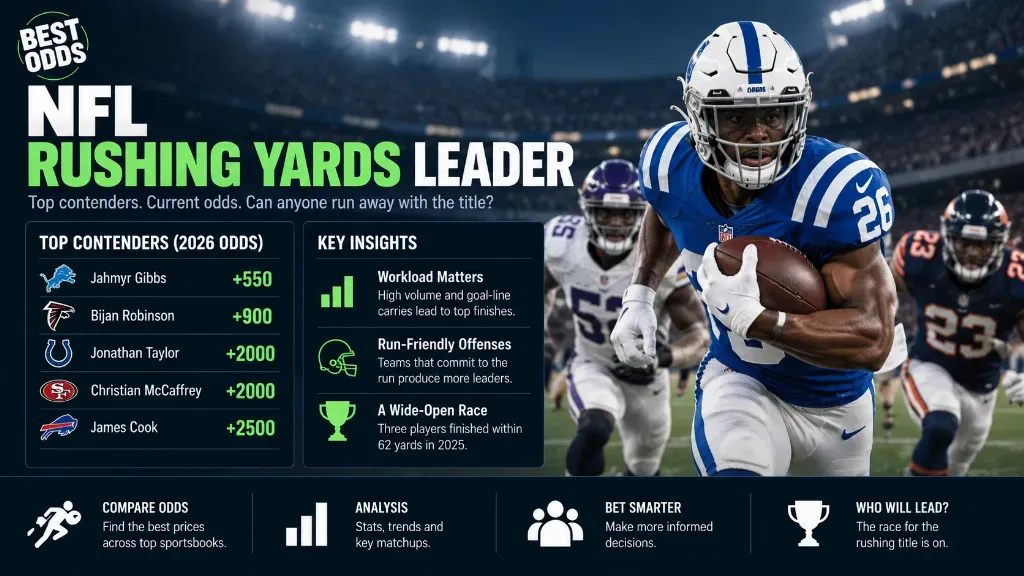
The 2025 NFL season produced one of the deepest and most entertaining running back races in recent memory, with the league’s rushing title decided by the slimmest of margins. James Cook of the Buffalo Bills crossed the finish line first with 1,621 rushing yards, edging Baltimore’s Derrick Henry by just 26 yards and Indianapolis’s Jonathan Taylor by 36 in the closest three-way battle for the rushing crown the league has seen in decades.
The gap between the top three was smaller than the spread between first and third in any year since 2017. That narrow margin tells its own story about the depth at the position right now. Cook, Henry, and Taylor are three completely different backs in terms of age, style, and team context, yet they produced nearly identical volume over 17 games.
Behind them, a generation of elite young runners including Jahmyr Gibbs, Bijan Robinson, De’Von Achane, and Kyren Williams is pushing the position toward a level of talent density it has not seen since the early 2000s.
Jonathan Taylor led the league in rushing touchdowns with 18 and rushing attempts with 323, and was the undisputed MVP of the position through the first half of the season before a quarterbacks injury in Indianapolis derailed the Colts down the stretch.
Derrick Henry, now 32 years old, continued to defy the conventional wisdom about running back aging curves by posting his second consecutive 1,500-yard season in Baltimore. And Gibbs finished the year as arguably the most complete back in the league, combining 1,223 rushing yards and 616 receiving yards for 1,839 total yards from scrimmage and 18 touchdowns, while setting a career high in catches with 77.
Heading into 2026, the conversation at the position is genuinely wide open. Gibbs enters as the betting favorite to win Offensive Player of the Year after David Montgomery was traded to Houston, essentially handing Gibbs the full backfield and a workload that could push into historic territory. Robinson, who led the NFL in scrimmage yards in 2025, is right behind him.
McCaffrey, always a threat when healthy, returns to San Francisco. And the veterans Henry, Taylor, and Cook each have compelling cases for continued elite production.
Best Sportsbooks for Running Back Betting
DraftKings Sportsbook

DraftKings offers a wide range of NFL running back betting markets throughout the season. Bettors can wager on rushing yards, rushing touchdowns, receiving yards, receptions, and numerous game-day player props. The sportsbook also features futures markets on rushing leaders and major statistical categories.
Running back betting remains one of the most popular NFL wagering options because elite backs contribute both as runners and receivers. DraftKings updates odds throughout the season as workloads, injuries, and offensive trends impact player production.
Key Features:
- Extensive running back prop betting markets
- Rushing yards and touchdown leader futures
- Same-game parlays featuring player props
- Weekly and season-long betting options
FanDuel Sportsbook

FanDuel features NFL running back betting across a broad selection of futures and player props. Bettors can wager on rushing attempts, rushing yards, touchdowns, receptions, and total scrimmage yards throughout the season.
Running back odds are adjusted regularly based on player usage, health, and matchup considerations. FanDuel also offers alternate lines that provide additional flexibility for player prop bettors.
Key Features:
- Competitive running back prop odds
- User-friendly betting platform
- Broad NFL futures menu
- Frequent football odds boosts
BetMGM Sportsbook

BetMGM offers NFL running back betting through player props, futures, and statistical leader markets. Bettors can back players to lead the league in rushing yards, rushing touchdowns, or other major categories.
The sportsbook provides both season-long betting opportunities and weekly player performance markets. Odds are updated throughout the year as running backs compete for league-leading statistics.
Key Features:
- Extensive running back futures markets
- Rushing leader betting options
- Regular promotional offers
- Wide variety of player props
Caesars Sportsbook

Caesars Sportsbook provides NFL running back betting as part of its comprehensive football betting lineup. Bettors can wager on rushing leaders, touchdown leaders, and weekly rushing props throughout the regular season and playoffs.
The platform offers betting opportunities on many of the NFL’s top backs while also supporting a broad range of season-long futures. Markets are updated frequently to reflect player performance.
Key Features:
- NFL running back futures and props
- Caesars Rewards integration
- Multiple rushing category markets
- Comprehensive NFL betting coverage
bet365 Sportsbook

Bet365 features NFL running back betting alongside one of the deepest football betting menus available. Bettors can access extensive rushing props, receiving props, and statistical leader futures throughout the season.
The sportsbook is particularly strong for bettors who enjoy alternative lines and live betting opportunities. Running back markets remain active throughout the regular season and playoffs.
Key Features:
- Extensive running back prop offerings
- Strong live betting functionality
- Deep NFL futures markets
- Numerous alternate betting lines
BetRivers Sportsbook

BetRivers offers NFL running back betting through a variety of futures and player prop markets. Bettors can wager on rushing yards, touchdowns, receptions, and season-long statistical leader categories.
The sportsbook emphasizes straightforward navigation while still providing a broad range of running back betting options. Markets are updated regularly to reflect changing trends and player performance.
Key Features:
- Competitive running back betting odds
- Easy-to-use sportsbook interface
- Strong selection of player props
- Multiple season-long futures markets
Hard Rock Bet

Hard Rock Bet features NFL running back betting as part of its growing football portfolio. Bettors can place wagers on rushing leaders, touchdown leaders, and weekly player performance props throughout the NFL season.
The sportsbook updates odds regularly as players compete for league-leading rushing statistics and major awards. Running back betting remains one of the most active player-focused NFL wagering categories.
Key Features:
- NFL running back futures markets
- Competitive player prop betting
- Clean and intuitive user experience
- Broad football betting coverage

Betting On NFL Running Backs
2025 NFL Rushing Statistics Leaders
| Player | Team | Rush Yds | Carries | Rush TDs | Yds/Carry |
|---|---|---|---|---|---|
| James Cook | BUF | 1,621 | 309 | 12 | 5.2 |
| Derrick Henry | BAL | 1,595 | 298 | 16 | 5.3 |
| Jonathan Taylor | IND | 1,585 | 323 | 18 | 4.9 |
| Bijan Robinson | ATL | 1,478 | 281 | 13 | 5.3 |
| De’Von Achane | MIA | 1,350 | 220 | 7 | 6.1 |
| Kyren Williams | LAR | 1,252 | 259 | 12 | 4.8 |
| Jahmyr Gibbs | DET | 1,223 | 243 | 13 | 5.0 |
| Christian McCaffrey | SFO | 1,202 | 287 | 10 | 4.2 |
| Javonte Williams | DAL | 1,201 | 252 | 11 | 4.8 |
| Saquon Barkley | PHI | 1,140 | 280 | 9 | 4.1 |
The 2025 table above is remarkable for two reasons. First, the sheer number of backs who cracked 1,000 yards, with 17 doing so across the regular season, a reflection of how run-friendly the modern NFL has become as offensive coordinators look for any advantage to keep pass rushers honest. Second, the concentration of talent at the top. The top three rushers were separated by 36 yards, the closest such finish in nearly a decade.
Seventeen running backs surpassing 1,000 rushing yards in the same season is an extraordinary marker of positional depth. The top ten alone represents a range of styles, team contexts, and age profiles that makes ranking them as difficult as it has been in years.

The Best Running Backs Heading Into 2026
Jahmyr Gibbs (DET)
Gibbs enters 2026 as the consensus choice for the most complete back in football, and his situation has never been better. At just 24, he enters the statistical sweet spot for running backs, a window between ages 23 and 27 where the combination of athleticism, experience, and durability tends to peak. He has posted back-to-back 1,000-yard rushing seasons in just his first three NFL years, which alone makes him exceptional. But the real story is what happens when you factor in his receiving production.
In 2025, Gibbs set career highs in receptions (77), receiving yards (616), and targets (94), becoming one of the few backs in the league capable of functioning as a legitimate passing option on third down, not merely a checkdown safety valve. He totaled 1,839 yards from scrimmage and 18 touchdowns across 17 starts, and finished fifth in the league in PFF overall grade at the position.
The offseason shift is substantial. Detroit traded David Montgomery to Houston, removing the most significant check on Gibbs’ workload that he has faced in his career. Montgomery handled 37 percent of the Lions’ offensive snaps last year.
A meaningful portion of those snaps are now going to Gibbs. He remains the favorite to win Offensive Player of the Year for 2026, with BetMGM listing him at +550 as of September 2. Analysts across the fantasy and betting communities have also pointed to him as one of the strongest candidates to post a 2,000-yard scrimmage season.
The counterargument is that Detroit’s offensive line took a step back in 2025, and a heavier workload could accelerate wear on a back who has never carried more than 250 times in a single season. But the talent is undeniable, and the setup in Detroit may be as good as it has ever been.
Bijan Robinson (ATL)
Robinson finished fourth in OPOY voting in 2025 despite leading the entire NFL in scrimmage yards with 2,298. That number bears repeating. He touched the ball more productively in terms of total yards than anyone in the league, yet the Seahawks’ Jaxon Smith-Njigba took the award on the back of a record-setting receiving season.
The injustice is a useful reminder of how awards voting works, and it also suggests Robinson enters 2026 on something of a chip.
At 23, Robinson is one year younger than Gibbs, and the two have been virtually identical in overall production across their first few seasons. Robinson carries the ball with power that belies his athleticism, and his receiving ability out of the backfield has developed into a genuine weapon in Atlanta’s offense. The Falcons traded Tyler Allgeier, Robinson’s primary backup, clearing the way for Robinson to take on a larger role in 2026.
The question for Robinson bettors is whether Atlanta’s offense can be consistently good enough to fuel the kind of season that earns OPOY recognition. The Falcons finished 8-9 in 2025, which is not typically the profile of an award winner. Running backs need wins, and lots of them, to generate the kind of national attention the award demands.
Jonathan Taylor (IND)
Taylor put together one of the most compelling first halves of a season the position has seen in years. Through 10 games, he had 1,139 rushing yards, 17 touchdowns, and was averaging six yards per carry, pace that had him in serious MVP conversation and positioned him as the overwhelming OPOY favorite.
Then the Colts lost quarterback Daniel Jones to an Achilles injury, and everything changed. Over the final seven games without Jones, Taylor managed just 446 yards and three touchdowns, averaging 3.3 yards per carry.
The binary nature of that split tells two stories simultaneously. On one hand, Taylor remains one of the most explosive and productive running backs in football when the supporting cast holds up, and his 18 rushing touchdowns led the entire league. He also led the NFL in carries (323) and yards after contact (787). On the other hand, his production is highly dependent on having a functional quarterback beside him, and Indianapolis’s situation at that position heading into 2026 remains uncertain.
Taylor turns 27 in January, which is entering the age range where running backs traditionally begin to show the first signs of decline. However, his physical style and burst remain elite, and he is one of only four players in NFL history to record multiple career games with 240 or more rushing yards and two rushing touchdowns, joining Derrick Henry, Barry Sanders, Jim Brown, and LaDainian Tomlinson. The floor is high. The ceiling, given a healthy environment, is enormous.

James Cook (BUF)
Cook became the first Bills player to win the rushing title since O.J. Simpson in 1976 when he crossed the finish line with 1,621 yards, and the significance of that fact is not lost on a franchise and fanbase that has waited 49 years for the achievement. But the more relevant question for 2026 is whether Cook, who averaged 5.2 yards per carry and registered nine 100-yard games, can replicate or exceed that production now entering his fourth professional season at age 26.
The Bills signed Cook to a contract extension heading into 2025, and the results validated that investment. He formed one of the best quarterback-running back pairings in the AFC alongside Josh Allen, and his presence as a rushing threat directly opened up passing lanes for Allen throughout the year. With the addition of D.J. Moore at wide receiver, the Bills’ offense has the potential to be even more dangerous in 2026, which should continue to benefit Cook.
The knock is that Cook’s success is intertwined with the Bills’ overall offensive efficiency. When Buffalo plays from ahead, Cook thrives. When Allen takes over a game through the air, Cook’s touches naturally decrease. He is a top-tier running back, but his ceiling in terms of pure rushing production may be somewhat capped by the Bills’ identity as a pass-first team.
Derrick Henry (BAL)
Any analysis of Henry in 2026 has to begin with the same question that has followed him since he left Tennessee: how much does he have left? He turned 32 in January, which makes what he has done over the past two seasons in Baltimore almost without historical precedent. Running backs simply do not put up back-to-back 1,500-yard seasons at 31 and 32, and Henry has done it while posting efficiency numbers that many backs half his age cannot match.
His 16 rushing touchdowns in 2025 were second only to Taylor’s 18 league-wide, and his 5.3 yards per carry was one of the best among high-volume backs in the league. He remains a physical nightmare for defenses who try to tackle him with angles because he simply runs through them, and Baltimore’s offensive line has given him the kind of wide, clean running lanes that turned an already special player into a historically great one.
The honest concern is that the statistical record of running backs aging past 32 is grim, and Henry is not an exception to biology regardless of how dominant his production has been. Baltimore lost head coach John Harbaugh in the offseason, and how new coordinator relationships develop around Henry will matter. At long odds, Henry is a legitimate dart throw. At short odds, the age discount applies.
De’Von Achane (MIA)
Achane’s 2025 season was genuinely fascinating from an analytical perspective. He finished fifth in rushing yards with 1,350 and recorded a league-best 6.1 yards per carry among backs with at least 200 attempts. But his receiving production was the real story. He led all running backs with 78 receptions, 592 receiving yards, and six receiving touchdowns, essentially functioning as a slot receiver who also ran the ball 220 times.
The combination of that explosive rushing efficiency and elite receiving production gives Achane a profile that is genuinely rare in the modern NFL. He is 23 years old, just signed a four-year extension that makes him the highest-paid running back in contractual value, and is operating in a Miami offense that has increasingly been built around his versatility.
The durability question is real. Achane has missed games in each of his first three seasons, and his slight build means the workload he absorbed in 2025 is more physically demanding than it would be for a larger back. If he can stay healthy across 17 games, his ceiling in 2026 is among the highest at the position.

Christian McCaffrey (SFO)
McCaffrey won the NFL’s Comeback Player of the Year award for the 2025 season after returning from the bilateral Achilles tendinitis that wiped out most of 2024 and delivering 1,202 rushing yards, 806 receiving yards, and 10 touchdowns across the full season.
At 29 heading into 2026, he remains one of the most complete offensive weapons in the sport when healthy, with a rare combination of receiving ability, route-running, and rushing versatility that no other back in football can fully match.
The straightforward concern is that McCaffrey has now dealt with significant injuries in three of the past four seasons, and his 4.2 yards per carry in 2025 was the lowest of any full season in his career since his rookie year. The evidence that his explosiveness has diminished at least somewhat is real, even if his overall production remained elite.
San Francisco remains a top offensive environment and Kyle Shanahan’s system is among the most running back-friendly in football. If McCaffrey can stay on the field for all 17 games in 2026, he is a legitimate OPOY candidate. The uncertainty around his health simply cannot be ignored when evaluating him as a betting investment.
Saquon Barkley (PHI)
Barkley’s 2025 season played out as something close to a worst-case scenario for the Eagles and for his fantasy and betting investors, and yet he still totaled 1,140 rushing yards and nine touchdowns. When the best version of a player’s difficult year still produces those numbers, it underscores how good the player actually is.
The 2025 difficulties in Philadelphia were largely systemic rather than Barkley-specific. The Eagles traded A.J. Brown to New England in the offseason, which fundamentally changed the character of the offense. Jalen Hurts dealt with inconsistency, the offensive line was not as dominant as it had been in 2024, and the scheme did not always put Barkley in positions to create explosive plays. His 4.1 yards per carry was well below his 5.8 from the 2024 Super Bowl run.
For 2026, Barkley will be 29 years old, signed to a two-year extension. The Eagles appear to be rebuilding their passing attack around new options in the wake of the Brown trade, which could either restore more run-game balance or further complicate things depending on how quickly the new pieces gel. When the conditions are right, Barkley is still capable of a dominant season. The question for bettors is whether those conditions will align in 2026.
2026 NFL Offensive Player of the Year Odds (Running Backs)
| Player | Team | BetMGM OPOY Odds |
|---|---|---|
| Jahmyr Gibbs | DET | +550 |
| Bijan Robinson | ATL | +900 |
| Christian McCaffrey | SF | +2000 |
| Saquon Barkley | PHI | +2000 |
| Jonathan Taylor | IND | +2000 |
| James Cook | BUF | +2500 |
| Derrick Henry | BAL | +2500 |
| Omarion Hampton | LAC | +2500 |
| De’Von Achane | MIA | +5000 |
| Ashton Jeanty | LV | +5000 |
BetMGM Offensive Player of the Year odds checked September 2, 2026. Futures prices are subject to change, so always verify the live number before wagering.
Among running backs, Gibbs has clear separation at the top of the current OPOY market at +550, with Robinson next at +900. McCaffrey, Barkley, and Taylor form the next tier at +2000, followed by Cook, Henry, and Omarion Hampton at +2500. Achane and Ashton Jeanty are longer shots at +5000. Team success, workload, health, and total scrimmage production remain the key factors for bettors evaluating this market.
Rising Backs Worth Watching in 2026
Kyren Williams (LAR)
Williams finished sixth in rushing yards with 1,252 and played a critical role in the Rams’ offensive efficiency that helped carry Matthew Stafford to the MVP award. He is a remarkably refined runner for a player in his third season, with excellent vision and patience behind the line that consistently allow him to find the correct cutback lane. With Myles Garrett now joining the Rams’ defense and the team projecting as a Super Bowl contender, Williams should continue to benefit from favorable game scripts and a first-class offensive line.
The trade of Jared Verse to Cleveland effectively shifts defensive resources toward supporting the Rams’ offense in 2026, and Williams is likely to see another 250-plus carry workload.
Ashton Jeanty (LV)
Jeanty came in as the fifth overall pick of the 2025 draft and finished his rookie season with 266 carries, one of the higher rookie workloads of recent years. He was not a statistical revelation in his first year, but the tools are obvious. His contact balance and yards after contact were exceptional for a rookie, and Las Vegas has committed to building their offense around him heading into 2026. At 21, he is one of the youngest featured backs in the league and has the kind of physical profile that projects as a long-term franchise cornerstone.
Javonte Williams (DAL)
Williams was one of the quiet stories of the 2025 season, finishing ninth in rushing yards with 1,201 at 4.8 yards per carry while operating behind Dak Prescott and one of the most prolific offenses in the AFC. Dallas’s defense was the worst in the league in 2025, which ironically created more passing situations and actually limited Williams’ rushing opportunities. If the Cowboys can improve defensively in 2026 and run the ball more frequently from positions of strength, Williams has the talent and situation to push into the top five in the position.

What Betting Markets Exist for Running Backs?
The most widely available running back betting market is Offensive Player of the Year, a season-long futures bet that is available before the season and updated throughout the regular season. The award is voted on by 50 media members at the conclusion of the regular season, and as noted above, has gone to a non-quarterback in every year since 2018.
Beyond OPOY, most major sportsbooks also offer rushing yards leader futures, rushing touchdowns leader futures, and individual player season prop bets covering over/under totals for carries, yards, and touchdowns. These markets open during the offseason and continue to move as injuries, depth-chart changes, and early-season performance reshape player expectations.
When betting running backs, the critical variables to track are offensive line health, quarterback efficiency (which directly affects whether the team leads games and therefore runs the ball), and injury history. Running backs are among the most injury-prone players in the sport, and the most talented back on paper is not always the most reliable investment.
How to Bet on NFL Running Backs
- Log in to your preferred sportsbook and navigate to the NFL section.
- Select Futures or Player Awards from the menu.
- Find Offensive Player of the Year, Rushing Yards Leader, or individual player prop markets.
- Compare available odds across multiple sportsbooks before placing any wager.
- Add your selection to the bet slip and confirm your wager.
The best value in running back betting typically comes from identifying players whose situations have changed meaningfully in the offseason, as sportsbooks are slower to update odds based on depth chart and offensive line changes than they are to react to big-name narrative shifts.
The combination of Gibbs’ expanded role in Detroit and his existing elite production at just 24 years old represents exactly the kind of situation-plus-talent combination that tends to produce outsized returns in positional betting markets.
As always, shop across multiple books for every bet. A three-hundred-point difference in odds on the same player between DraftKings and FanDuel is a real difference in what you take home, and it costs nothing to check.