Odds Hub
The sports betting world is getting bigger by the second, especially in the United States.


Sports odds are the language of sports betting. Once you understand what the numbers mean, you can compare prices across sportsbooks, spot value, and build your own strategies instead of guessing.
This guide breaks down how odds work across major leagues – NFL, NBA, MLB, NHL, and Wimbledon/tennis, golf, soccer, as well as NCAA sports – while also covering formats, line movement, and key betting markets.

Best Sportsbooks for Sports Betting Odds
DraftKings
DraftKings provides real-time sports betting odds across a wide range of leagues, including the NFL, NBA, MLB, NHL, college sports, soccer, golf, tennis, and more. Bettors can access moneylines, point spreads, totals, player props, futures, and live betting odds through an easy-to-navigate platform.
The sportsbook is also known for offering alternate lines, same-game parlays, and regularly updated odds boosts that can create additional betting opportunities. DraftKings’ extensive market coverage makes it a popular destination for bettors looking to compare odds across multiple sports.
FanDuel

FanDuel offers competitive sports betting odds on major U.S. and international sporting events throughout the year. The platform features markets on game outcomes, player props, futures, and live betting, with odds updating continuously as events unfold.
Many bettors use FanDuel for its same-game parlay options and broad selection of betting markets across professional and collegiate sports. The sportsbook also frequently features enhanced odds promotions tied to high-profile events and championship games.
BetMGM

BetMGM provides sports betting odds on thousands of events annually, covering everything from major professional leagues to international competitions. Bettors can find traditional betting markets as well as player props, futures, live wagering, and specialty bets.
The sportsbook regularly updates odds throughout the day and offers a variety of alternate lines and same-game parlay options. BetMGM’s broad market selection makes it a strong choice for bettors seeking odds across multiple sports and betting categories.
Caesars

Caesars Sportsbook offers sports betting odds on major U.S. sports, international events, and championship markets throughout the calendar year. Bettors can access moneylines, spreads, totals, player props, futures, and live betting opportunities from a single platform.
The sportsbook frequently introduces odds boosts and promotional offers tied to marquee events, giving bettors additional ways to engage with the betting markets. Caesars Rewards integration also provides added value for eligible users placing sports wagers.
Bet365
Bet365 is widely recognized for its extensive odds offerings and large selection of betting markets across global sports. The platform provides pregame and live odds on football, basketball, baseball, hockey, soccer, tennis, golf, and many other events.
Live betting is a key strength of Bet365, with odds adjusting in real time as games progress. The sportsbook also features numerous alternate lines, player props, futures, and specialty markets that appeal to a wide range of bettors.
BetRivers

BetRivers offers sports betting odds on major professional and collegiate sports, including NFL, NBA, MLB, NHL, soccer, golf, and more. Bettors can access traditional wagering markets alongside player props, futures, live betting, and same-game parlays.
The sportsbook regularly updates its odds and often features promotions tied to major sporting events and championship contests. BetRivers’ user-friendly interface and comprehensive market coverage make it a solid option for comparing sports betting odds throughout the year.
What Are Sports Odds?
Sports odds tell you two things:
- How much you can win from a bet.
- How likely the sportsbook thinks that outcome is.
In the U.S., most books use American odds, shown with a plus (+) or minus (–) sign.
- Favorites have a minus sign (e.g., –150).
- Underdogs have a plus sign (e.g., +130).
Odds are not pure predictions. They blend true probability, bookmaker margin (vig) and market pressure from public and sharp bettors.
Odds Formats: American, Decimal, Fractional
You’ll mainly see American odds in U.S. markets, but understanding all formats is useful.
American Odds
- Negative odds (favorite): Amount you must risk to win $100.
- Example: –150 → wager $150 to profit $100.
- Positive odds (underdog): Profit on a $100 wager.
- Example: +180 → wager $100 to profit $180.
Implied probability:
- For favorites:
Prob = Odds / (Odds + 100)Example: –150 → 150 / (150 + 100) = 60% - For underdogs:
Prob = 100 / (Odds + 100)Example: +180 → 100 / (180 + 100) ≈ 35.7%
Decimal Odds
Used widely in Europe & online:
- Show total return (stake + profit).
- Example: 1.80 → risk $100, total return $180 ($80 profit).
Convert:
- From American –150 → Decimal = 1 + (100 / 150) ≈ 1.67
- From American +180 → Decimal = 1 + (180 / 100) = 2.80
Fractional Odds
Common in UK racing and tennis:
- Example: 5/2 (“five to two”) → risk $2 to profit $5.
- Implied probability:
Denominator / (Numerator + Denominator)- 5/2 → 2 / (5 + 2) ≈ 28.6%
Regardless of format, the probability is the same – only the display changes.
Core Betting Markets
Although each sport has unique wrinkles, most odds fall into a few main categories.
Moneyline
Pick who wins the game or match, regardless of score.
- NBA: Lakers –140 vs. Suns +120
- NFL: Eagles –175 vs. Giants +150
- Tennis/Wimbledon: Alcaraz –220 vs. Sinner +190
Great for beginners and low-scoring or volatile sports (MLB, NHL, tennis).
Spread, Run Line & Puck Line
Handicap markets designed to balance mismatched teams.
- NFL Point Spread: Chiefs –6.5 vs. Bears +6.5
- NBA Spread: Celtics –8.5 vs. Raptors +8.5
- MLB Run Line: Yankees –1.5 (+120) vs. Red Sox +1.5 (–140)
- NHL Puck Line: Rangers –1.5 (+150) vs. Devils +1.5 (–170)
Favorites must “cover” the number; underdogs can win outright or lose by less than the spread.
Totals (Over/Under)
Bet on the combined score rather than who wins.
- NFL total 47.5
- NBA total 228.5
- MLB total 8.5 runs
- NHL total 6.5 goals
- Wimbledon total 40.5 games or 3.5 sets
You choose Over or Under the posted line, usually at or around –110 aside.
Props (Proposition Bets)
Micro-events inside the game:
- Player stats: points, rebounds, strikeouts, shots on goal, passing yards.
- Team stats: total threes made, total corners, team totals.
- Game events: first team to score, race to 10 points/games.
Props rely heavily on player roles, matchups and pace, and often offer softer pricing than main markets.
Futures
Season- or tournament-long markets:
- Super Bowl winner, NBA champion, World Series winner, Stanley Cup winner.
- Wimbledon men’s or women’s singles champion.
- MVP, Rookie of the Year, Cy Young, Hart Trophy, etc.
The trade-off: better odds, but money is tied up until the market settles.
Parlays, Same-Game Parlays & Teasers
- Parlay: Combine 2+ bets; all must win, payout multiplies.
- Same-Game Parlay (SGP): Multiple legs from one game (e.g., player points + game total + spread).
- Teaser (mainly NFL/NBA): Adjust spreads/totals in your favor in exchange for reduced payout.
These are high-risk, high-reward and should be used sparingly.
Live / In-Play Odds
Odds that update in real time as the game or match is being played:
- NBA totals shifting every run.
- MLB moneylines flipping on a late-inning rally.
- Wimbledon set handicaps after a first-set tiebreak.
Live odds reward fast decision-making and a strong read on momentum – but can also encourage impulsive betting if you do not have a plan.
Why Odds Move: Line Movement & Closing Line
Odds are not static. They change due to:
- Injury news & lineup changes
- Weather (especially NFL & MLB totals)
- Rest & travel spots (back-to-back games, long road trips)
- Sharp money (large wagers from respected bettors)
- Public action (heavy one-sided betting on popular teams)
The final number right before the event starts is the Closing Line. Consistently beating this number (getting a better price earlier) is one of the strongest indicators that you’re placing +EV (positive expected value) bets.
Understanding Vig, Hold & True Odds
Sportsbooks build profit into markets via vig (juice):
- Standard side odds of –110 on both teams mean you risk $110 to win $100 each way.
- The implied probabilities sum to more than 100%, creating a margin.
Example: Two equal teams should each be +100 (50% implied). If both are –110 instead, the book keeps a small edge.
For multi-outcome markets (like futures or outrights), the hold can be much higher. That’s why line shopping across multiple sportsbooks matters – shaving a few percentage points of vig makes a difference across hundreds of bets.
Kentucky Derby Odds
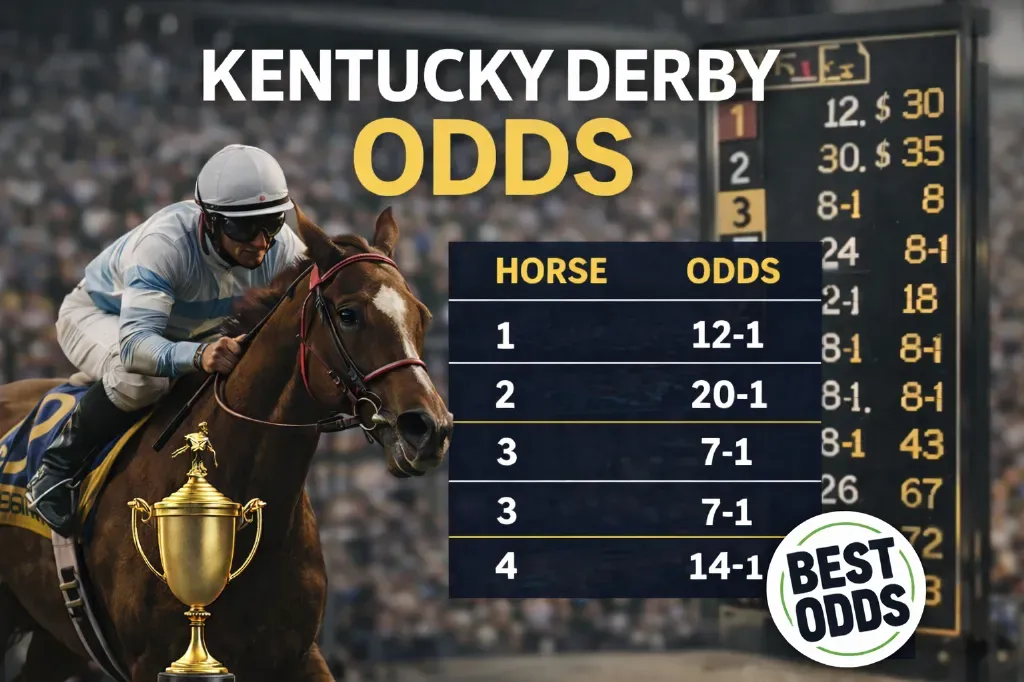
Kentucky Derby odds reflect the dynamic nature of pari-mutuel betting, where prices shift continuously as wagers enter the pool before post time. With a field of up to 20 horses and massive betting volume, the Derby often produces significant odds movement and attractive payouts. Understanding how these odds are formed helps bettors identify value opportunities and approach one of horse racing’s most exciting wagering events more strategically.
MLB Odds
Baseball odds are heavily influenced by:
- Starting pitching matchups and projected innings.
- Bullpen strength and usage from prior games.
- Ballpark factors (dimensions, altitude, weather, wind).
- Lineups vs. L/R pitching splits.
Key markets:
- Moneyline (very popular due to low-scoring, high variance).
- Run line (usually –1.5 / +1.5).
- Totals, often linked to wind and temperature.
- Pitcher props: strikeouts, outs recorded, earned runs.
- Hitting props: total bases, hits, HRs, RBIs.
Because MLB plays daily for six months, there’s a huge sample size for modeling and finding mispriced spots.
Make sure to check our MLB Betting Odds to fully familiarize yourself with how they work.
MMA Odds
MMA odds represent the probability sportsbooks assign to each fighter winning a bout, typically displayed in American odds format. These odds reflect a range of factors including fighters’ records, recent performances, fighting styles, and matchup dynamics. Because mixed martial arts combines striking, grappling, and submission techniques, odds can shift significantly depending on how analysts believe one fighter’s strengths match up against another’s weaknesses.
Sportsbooks usually offer several MMA betting markets beyond simply picking the fight winner. Bettors can wager on outcomes such as method of victory (knockout, submission, or decision), the round in which the fight ends, or whether the bout goes the distance. For major promotions like the UFC, odds are often released weeks before fight night and may change as betting activity increases or new information emerges about training camps, injuries, or weight cuts.
Understanding how MMA odds move can help bettors identify potential value opportunities. Public betting patterns, late injury news, and stylistic matchup analysis can all influence how sportsbooks adjust prices before an event. As fight night approaches, monitoring odds changes across multiple sportsbooks can provide insights into where money is being placed and which fighters may be gaining momentum in the betting market.
NBA Odds
How NBA Odds Are Priced
NBA odds react quickly to:
- Injury & rest news (load management, back-to-backs).
- Pace (fast teams push totals higher).
- Efficiency trends (offensive/defensive rating, three-point variance).
- Public demand on big-market teams (Lakers, Celtics, Warriors).
Markets include:
- Game odds: spread, moneyline, total.
- Team totals and halves/quarters markets.
- Player props: points, rebounds, assists, PRA, threes, double-doubles.
- Futures: Championship, Conference winners, win totals, awards.
Live NBA odds are particularly volatile, with totals and spreads re-calculated after almost every possession.
NFL Odds
NFL betting is built around spreads, totals and moneylines but also features:
- Key numbers like 3, 7, 10 (due to touchdown/field-goal scoring).
- Huge public handle, especially on prime-time and playoff games.
- Deep futures markets on conferences, divisions, season wins, and awards.
Because NFL has a short schedule and massive volume, lines are extremely efficient on sides and totals. Edges often come from:
- Player props,
- Niche markets (first halves, alt spreads),
- Exploiting stale numbers after injury or weather news.
Make sure to check out comprehensive guide explaining how NFL Betting Odds work.
NHL Odds
NHL odds are driven by:
- Goaltender quality and confirmation.
- Five-on-five metrics (expected goals, shot attempts, high-danger chances).
- Special teams (power-play and penalty-kill).
- Schedule spots (back-to-backs, travel).
Markets include:
- Moneyline (most common).
- Puck line (–1.5 / +1.5).
- Totals (usually 5.5–7 goals).
- Player props: shots on goal, points, goals, assists, power-play points.
- Futures: Stanley Cup, conferences, divisions, awards.
NHL is naturally high-variance, which means underdogs cash often – and pricing edges tend to appear in props and derivative markets rather than main sides.

Wimbledon Odds
Wimbledon, as the most iconic grass-court event in tennis, has its own betting dynamics.
Key Wimbledon Markets
- Match Moneyline – who wins the match.
- Set Betting – correct score (3–0, 3–1, etc. in best-of-five; 2–0, 2–1 in best-of-three).
- Handicap Games/Sets – favorite must win by a certain margin in games or sets.
- Totals – number of games or sets (Over/Under).
- Outrights – tournament winner, to reach the final, quarter/section winners.
- Props – tie-break played, most aces, player over/under aces or double faults.
How Wimbledon Odds Are Set
Wimbledon Odds reflect:
- Surface-specific form: grass rewards big servers, flat hitters, and aggressive first-strike tennis.
- Serve/return profiles: strong servers tend to produce tighter spreads and higher totals.
- Best-of-five vs. best-of-three: men’s singles (best of five) allow more time for favorites to assert themselves, reducing upset probability compared to best-of-three.
- Draw structure: seeding, path difficulty, potential early clashes.
- Weather conditions: roof open vs. roof closed; ball speed; slip risk.
Because Wimbledon is relatively short and high-profile, lines move quickly after draw release, early round results, and any sign of injury or fatigue.
Golf Odds
Golf odds work a little differently from most team sports because large fields, multi-round formats, and stroke play create a wide range of betting markets and long-shot prices. Understanding how books price tournaments, rounds, and players will help you avoid overreacting to narratives and focus on where numbers are truly off.
Core Golf Markets
Outright Winner (Tournament Odds)The most popular golf bet is the outright winner – picking who will lift the trophy on Sunday.
- Odds are usually fractional or big plus-money prices in American format (e.g., +900, +2500, +8000), because you’re betting against an entire field of 100+ players.
- Short prices (favorites) are often in the +600 to +1400 range for elite players in regular events, and a bit longer in majors where fields are stronger.
- Because the hold is high on outrights, serious bettors:
- Build small outright portfolios (3–8 players instead of one all-in pick).
- Add each-way bets at books that pay places (e.g., top 5, top 8, top 10) so a player who contends but doesn’t win can still return a profit.
Each-Way BetsEach-way betting splits your stake in two:
- Half goes on the player to win.
- Half goes on the player to place (e.g., top 5, top 8, top 10), paid at a fraction of the outright odds (commonly 1/4 or 1/5).
Example:Scottie Scheffler 10/1 (each-way, 1/5 odds, top 8)
- $10 EW = $5 on win, $5 on place.
- If he wins: you cash both halves.
- If he finishes 3rd: you lose the win part but get paid on the place leg at 10/1 ÷ 5 = 2/1.
Each-way is crucial in golf because variance is huge, and many “good bets” still don’t actually win.
Top Finishes (Top 5/10/20/40)Instead of picking one winner, you can back:
- Top 5 finish
- Top 10 finish
- Top 20 or Top 40 finish
These odds are shorter but much higher probability and tend to be more stable. Top-20 markets, in particular, are popular among sharp bettors because:
- They’re more sensitive to course fit and recent form than name value.
- There’s often mispricing on accurate but non-flashy players who contend regularly without winning.
Head-to-Head & Group MatchupsMatchups price one golfer against another (or small groups) over a round or full tournament.
- Example: Rory McIlroy –125 vs. Xander Schauffele +105 (72-hole matchup).
- You’re only concerned with who scores lower, not where they finish in the overall event.
- Books also offer 3-ball matchups (3 players grouped together for a round) and “to beat” markets within featured groups.
Matchups are attractive because they strip out some randomness of the entire field and focus on relative performance, which models handle well.
Golf Prop & Niche Markets
Beyond outright and matchups, golf books offer:
- Round leader (First-round leader, Second-round leader, etc.).
- Hole-in-one props (Yes/No for tournament or specific rounds).
- To make/miss cut (binary markets with relatively low variance).
- Nationality markets (Top American, Top European, Top Rest-of-World).
- Winning margin (playoff vs. 1 stroke vs. 2+ strokes).
These props are often softer, especially in smaller events or where weather and course difficulty are misjudged.
Live & In-Play Golf Odds
Golf is particularly well suited for live betting because:
- The tournament lasts four days, with dozens of holes and groups in play.
- Conditions can change throughout the day (morning vs. afternoon wave, wind, rain, greens firming up).
In-play angles include:
- Backing strong ball-strikers who are underperforming their putting early – if the underlying approach game is good, regression can swing things their way over 72 holes.
- Weather-draw edges – if one wave played in brutal wind and the other catches calmer conditions, live odds may still underrate wave-adjusted performance.
- Round-by-round matchups after seeing how players handle particular greens, rough, and green speeds.
Books will adjust in real time with every birdie, bogey, and weather update, so it’s critical to anchor your decisions to strokes gained data and tee-time context rather than just the leaderboard.
How Golf Odds Are Shaped
Golf pricing blends:
- Course fit: distance vs. precision, approach difficulty, green type (Bentgrass, Poa, Bermuda), and around-the-green requirements.
- Recent form: strokes gained off the tee, approach, around the green, and putting over last 8–24 rounds.
- Event history: some courses reward repeat success (e.g., Augusta, certain links tracks); others are too volatile for “horses for courses” to matter much.
- Field strength: majors and elevated events compress odds at the top because more elite players are present.
- Weather models: wind, temperature, and rain forecasts impact scoring and wave splits.
Because each market is interconnected, sharp golf bettors:
- Build projections for each golfer (true win %, top-20 %, etc.).
- Translate those into fair odds and compare across multiple sportsbooks.
- Attack mispriced derivatives (matchups, top nationalities, live markets) instead of only chasing outright long-shots.

Soccer Odds
Soccer odds represent the probabilities sportsbooks assign to the possible outcomes of a match and determine the potential payout for each wager. Because soccer allows for three main results — a home win, a draw, or an away win — most markets are structured as three-way betting lines rather than the traditional two-outcome moneyline used in many American sports. These odds are influenced by factors such as team form, injuries, head-to-head history, and betting market activity.
In addition to match result odds, sportsbooks typically offer a wide variety of soccer betting markets. Bettors can wager on goal totals, both teams to score, halftime results, player props such as anytime goalscorer, and more complex markets like Asian handicaps or correct score predictions. Major leagues and tournaments often feature hundreds of betting options, especially for high-profile matches.
Because soccer odds move in response to betting volume and new information, monitoring how the market shifts before kickoff can provide valuable insights. Lineup announcements, tactical changes, and late injury updates can all influence odds adjustments. Comparing prices across multiple sportsbooks can also help bettors identify better value when placing wagers on their preferred outcomes.
World Cup Golden Boot Odds

Every goal a player scores between the opening whistle of the group stage and the final counts toward the Golden Boot, which is why the market draws some of the heaviest individual-award volume of the entire tournament. The 2026 board took shape with two names well clear of the field: Kylian Mbappé, the 2022 winner, as the French favorite, and Harry Kane, England’s all-time leading scorer, a short step behind, with the remaining elite forwards strung out behind them according to how far their nations are expected to travel rather than how clinical they are in front of goal.
The arithmetic of the award is driven almost entirely by matches played, since a forward eliminated in the round of 32 simply runs out of fixtures, and that is the reason the trophy has stayed with quarterfinalists and deeper sides in all but one edition since 1994. The new 48-team bracket hands finalists an eighth game, nudging the likely winning tally toward seven or eight and pulling more squads into contention, while the penalty takers on the favored nations enjoy a scoring floor that pure open-play strikers cannot match. The complete contender board, the tiebreaker rules, the host-nation reads, and the operators with the sharpest goalscorer pricing are laid out in the full guide to World Cup Golden Boot odds.
World Cup Golden Glove Odds

FIFA’s Technical Study Group hands the Golden Glove to the goalkeeper it judges the standout of the tournament, and the market rewards careful pre-tournament study because the inputs that sway the vote are visible long before a ball is kicked. The 2026 race opened as the most tightly bunched award on the entire board, with reigning winner Emiliano Martínez of Argentina holding a slender lead over Spain’s Unai Simón and Brazil’s Alisson Becker, a top three that mirrors the expectation that the trophy lands with a keeper whose side runs at least as far as the semifinals.
What the panel rewards above all is clean sheets, and since those can only be banked in games a nation actually plays, projected progression is the most telling number attached to any keeper, which is how six of the eight winners since 1994 came from finalists. The expanded format’s extra knockout fixture gives a deep-running goalkeeper one more shutout opportunity and could lift the winning total past the three-to-five range seen in recent editions. The contender-by-contender analysis, the defensive-structure framework that separates the live candidates from the names, the record of past winners, and the books pricing goalkeeper futures most keenly are covered in the full guide to World Cup Golden Glove odds.
World Cup Outright Odds

Pricing each nation to lift the trophy, the outright market is the anchor the rest of the World Cup board hangs from, because almost every individual-award line is downstream of a team’s expected run. Spain and France emerged at the head of the 2026 market, with England and Portugal next and the South American pair of Brazil and Argentina close behind, while the 48-team field and its brand-new round of 32 stretched the route to the final by inserting an extra knockout tie for the sides that go the distance.
Reading the outright board first is the soundest way into the goalscorer, goalkeeper, and young-player markets, since a striker, keeper, or emerging talent attached to a finalist carries a far higher ceiling than an equally gifted player whose nation is tipped for an early exit. How the numbers have drifted since the draw, where the host-nation group-winner value sits, and which operators price tournament futures most competitively are set out in full in the guide to World Cup outright odds.
World Cup Prediction Market Odds

Prediction markets approach the World Cup from a different direction than a sportsbook, with CFTC-regulated venues letting participants buy and sell event contracts that trade somewhere between a single cent and a full dollar, the price itself standing in for the market’s estimate of how likely an outcome is. A contract changing hands at sixty-five cents maps to roughly a sixty-five percent probability, and because a position can be sold back before the result is known, a trader can lock in a move as the picture shifts rather than waiting on a settled bet.
Through the opening of the 2026 tournament, contract prices have stayed in lockstep with the sportsbook board across the winner and individual-award markets, with the leading contracts echoing the same consensus seen at licensed books, which makes the two systems a useful check on one another. A full walk through how those prices translate into probabilities, where they diverge from a traditional sportsbook, and how the major World Cup contracts are currently trading is available in the guide to World Cup predictions.
World Cup Young Player Award Odds

Reserved for the tournament’s outstanding performer aged twenty-one or under, meaning anyone born on or after January 1, 2005, the Young Player Award is settled by FIFA’s Technical Study Group on the strength of a player’s full body of work across the competition. Spain’s Lamine Yamal headed the 2026 market by a comfortable distance, with France’s Désiré Doué alone in second, followed by Warren Zaïre-Emery and a cluster of contenders taking in Arda Güler, Nico O’Reilly, and Pau Cubarsí, an honor that carries no official runner-up places and is announced on the same day as the final.
Game time is the threshold every candidate has to clear first, because a high-profile substitute has almost no route to the prize, and that is precisely the doubt hanging over the French contenders given the competition for minutes ahead of them. The award has also leaned heavily toward attackers from nations reaching the quarterfinals or beyond, which explains why a center-back as accomplished as Cubarsí trades at a long price despite a likely starting role for the favorites. The full breakdown of contenders, the eligibility cut-off, the rotation risk shaping the market, and the books pricing it most sharply are set out in the guide to World Cup Young Player Award odds.
NCAA Betting Odds
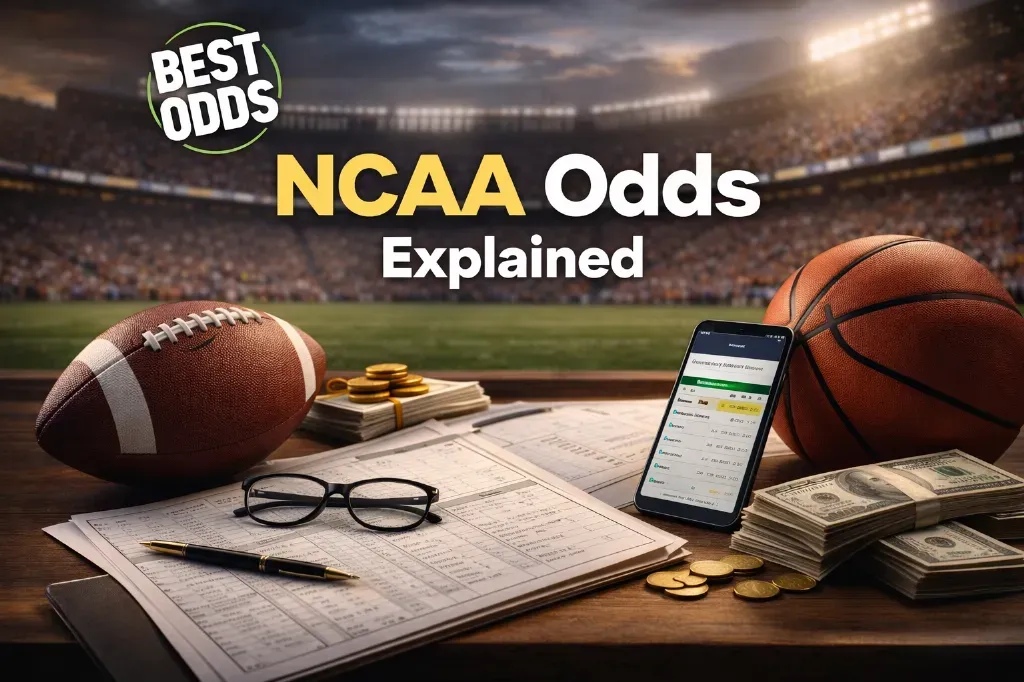
NCAA betting odds form the foundation of all wagering activity across college sports, translating game dynamics, team strength, and market sentiment into actionable numbers. Whether you are betting on football Saturdays or navigating the intensity of March tournaments, odds are the mechanism through which sportsbooks express probability and manage risk.
At their core, NCAA odds are designed to balance action on both sides of a wager while incorporating a margin for the sportsbook. However, unlike professional sports, college athletics introduce a layer of variability that makes these odds more fluid and, in many cases, less efficient. Differences in player development, coaching systems, travel schedules, and even emotional momentum can all influence how lines are set and adjusted.
Understanding NCAA odds requires more than simply reading spreads or moneylines. It involves interpreting how those numbers were derived, why they move, and how they differ between sports. College football and college basketball, while both operating under the NCAA umbrella, present distinct betting environments with their own pricing tendencies and strategic considerations.
For bettors, this creates both complexity and opportunity. Those who take the time to understand how odds function across different NCAA sports are better positioned to identify value, avoid common mistakes, and make more informed decisions over the long term.
College Basketball Odds
College basketball odds are shaped by a fast-paced and highly variable environment, where tempo, shooting efficiency, and matchup dynamics play a central role in determining outcomes. With over 350 Division I teams and thousands of games each season, sportsbooks must price a vast number of events, often with uneven levels of information.
Point spreads in college basketball tend to reflect significant differences in team quality, particularly in non-conference play. It is not uncommon to see double-digit spreads, especially when elite programs face mid-major or lower-tier opponents. Totals are heavily influenced by pace, with faster teams driving higher scoring expectations and slower, defensive teams pulling numbers down.
What makes college basketball odds particularly interesting is the influence of tempo and efficiency metrics. Advanced statistics such as adjusted pace and offensive efficiency can reveal discrepancies between how a game is priced and how it is likely to unfold. This is especially relevant in tournament settings, where teams with contrasting styles meet in high-stakes environments.
Line movement in college basketball is also more sensitive to late-breaking information. Injuries, lineup changes, and even coaching decisions can lead to rapid adjustments, particularly in smaller conferences where market attention is lower. This creates opportunities for bettors who follow specific teams or conferences closely.
During postseason play, especially in the NCAA Tournament, odds become even more dynamic. Public betting increases significantly, often driving prices toward well-known programs regardless of underlying metrics. This shift in market behavior can create value on less popular teams that are analytically strong but receive less attention.
College Football Odds
College football odds operate within a different structural framework, driven by weekly schedules, larger team rosters, and a smaller number of games compared to basketball. Each matchup carries greater weight, and as a result, lines are often shaped by a combination of statistical analysis and public perception.
Point spreads in college football can be wider than in most other sports, reflecting the significant disparity between top programs and lower-tier teams. It is not unusual to see spreads exceeding 20 or even 30 points, particularly in early-season matchups. These large numbers require careful interpretation, as they introduce additional variance and strategic considerations.
Totals in college football are influenced by offensive schemes, tempo, and defensive capabilities. High-tempo offenses can drive totals upward, while teams with strong defensive identities or slower pacing tend to produce lower scoring expectations. Weather conditions and game location also play a more significant role than in indoor sports, adding another layer of complexity to odds evaluation.
One of the defining characteristics of college football odds is the impact of public betting. High-profile programs with strong national followings often attract disproportionate attention, which can influence line movement. This creates scenarios where odds are shaped not only by probability but also by market demand.
In major events such as bowl games and playoff matchups, odds become even more sensitive to narrative and perception. Team motivation, coaching changes, and player availability can all influence how lines are set and adjusted. Bettors who understand these contextual factors are better equipped to interpret odds beyond their surface value.
Best Sportsbooks For Sports Odds (U.S.)
Brand availability varies by state. Always check local regulations.
DraftKings
DraftKings features:
- Deep markets across NFL, NBA, MLB, NHL and tennis, plus extensive props.
- Competitive pricing on player props and same-game parlays.
- Regular odds boosts and SGP-specific promotions.
- Strong live betting interface with fast updates and plenty of alternate lines.
FanDuel
FanDuel features:
- Industry-leading mobile UX and easy navigation across all leagues.
- Known for Same-Game Parlays, especially for NFL and NBA.
- Robust live betting, including updated player props and team-specific markets.
- Frequent promos tied to national TV games and big events like the Super Bowl, NBA Finals and Wimbledon.

BetMGM
BetMGM Sportsbook features:
- Wide variety of in-play markets and the ability to edit or cash out certain bets.
- Solid futures catalog across championships and player awards.
- Popular in states with retail partners, making depositing & withdrawals easier.
- Often competitive on moneylines and totals for major events.

Caesars Sportsbook
Caesars Sportsbook features:
- Strong on futures and outright markets, including tennis Grand Slams.
- Regular odds boosts across multiple leagues.
- Clear breakdown of alternate spreads and totals.
- Reward system ties into Caesars Rewards, which appeals to frequent bettors.
bet365
bet365 Sportsbook features:
- Long-established international operator with sharp, early lines.
- Excellent coverage for tennis, including Wimbledon qualifiers, doubles and live markets.
- Deep menu of derivative markets and alternate lines for all major U.S. sports.
- Live streaming for many events where permitted.

Hard Rock Bet & Other Regional Books
Hard Rock Bet features:
- Simple layout designed for newer bettors.
- Competitive promos to attract players in newly launched states.
- Often strong local-team markets and odds boosts.
Whatever sportsbooks you use, line shopping is non-negotiable. Checking prices at two or three books before betting is the easiest way to improve long-term ROI.

Using Odds Comparison & Tools
Odds comparison tools save time by:
- Showing moneylines, spreads, totals, props and futures from multiple books side-by-side.
- Highlighting best prices automatically.
- Surfacing line movement so you can see where the market is going.
- Helping you track closing line value across your bets.
Combine this with:
- Stat databases (NBA, NFL, MLB, NHL, ATP/WTA).
- Injury trackers and projected lineups.
- Model outputs or projections (if you build your own).
The more you integrate odds and data, the easier it becomes to tell whether a price is fair or out of line.
General Strategy For Betting Sports Odds
Bankroll Management
- Set a dedicated bankroll.
- Risk 1–2% per bet; rarely more than 3–4% on extreme conviction plays.
- Accept variance: hot streaks and cold stretches are normal.
Focus On Markets You Understand
- Specialize in one league first (e.g., NFL sides, NBA player props, Wimbledon outrights).
- Learn the schedule, injury patterns, and how markets react.
- Add more sports only once you’re consistently beating numbers in your primary niche.
Hunt For Mispricing
- Look for models vs. market disagreements – where your projected line differs from the posted odds.
- Target soft spots: smaller markets, alt lines, props, early futures.
- Avoid chasing “locks” or reacting emotionally to short-term swings.
Leverage Bonuses & Promos
- Use welcome bonuses, odds boosts, risk-free/bonus bets when terms are reasonable.
- Treat bonuses as extra bankroll, not a reason to make careless bets.
- Always read rollover and minimum odds requirements.
Record & Review
- Log every bet: stake, odds, closing line, result and notes.
- After a meaningful sample, review:
- Which sports and markets you profit from.
- Whether you regularly beat the closing line.
- Where leaks appear (e.g., parlays, long-shot futures).
Responsible Sports Betting
Understanding odds is only useful when combined with control:
- Bet only money you can afford to lose.
- Set deposit, loss and time limits in your sportsbook account.
- Avoid betting when tired, upset or intoxicated.
- Step away or use time-outs/self-exclusion if you feel compulsive urges.
Sports betting should enhance your experience of the game, not create financial or emotional stress.
FAQ: Sports Odds
What are sports odds in simple terms?They are numbers that show how much you can win and how likely an outcome is. A minus sign (–) marks favorites; a plus sign (+) marks underdogs in American odds.
Why do odds change before a game starts?Because sportsbooks adjust to injuries, weather, lineup changes and betting action. Heavy money on one side or sharp bets can force a line move.
What’s the difference between –110 and +100?–110 includes vig; you risk $110 to win $100. +100 (“even money”) means risk $100 to win $100. Over many bets, hitting +100 prices instead of –110 on the same outcomes dramatically improves ROI.
Are props or main lines better for beginners?Main markets (moneyline, spread, total) are simpler, but props can offer softer pricing if you know player roles well. Start small, track results, and expand as you gain comfort.
Why are Wimbledon odds different from regular tennis events?Wimbledon is grass-only, favors big servers and aggressive styles, and uses best-of-five in men’s singles. Books adjust odds based on surface history, draw difficulty and tournament format.
Is it better to bet early or late?It depends. If you’re good at reading news and modeling games, early betting can grab soft openers. If you rely on consensus and confirmed lineups, later betting lets you avoid surprises. Long-term, aim to beat the closing line.
How many sportsbooks should I use?At least two or three so you can line-shop. Even a small price difference (e.g., +115 vs. +105) adds up over hundreds of bets.
For almost two decades, Sadonna has remained at the forefront of the gambling industry in the US and abroad, covering the latest news and legal updates. Sadonna’s goal is to provide sports bettors and casino players with premium content, including comprehensive details on the US industry.