Complete Guide to the Commodity Futures Trading Commission
The Commodity Futures Trading Commission, commonly known as the CFTC, is one of the most important financial regulators in the United States. It plays a…


In recent years, the CFTC has also entered mainstream discussion because of its relevance to event contracts, prediction markets, digital assets, commodities, futures trading, and broader questions about how modern markets should be supervised.
For users researching prediction markets, event trading, or U.S. market regulation, understanding the CFTC is essential.
This guide explains what the CFTC is, why it exists, what it regulates, how it affects consumers, how it relates to prediction markets, how it differs from other agencies, and why it matters far beyond Wall Street.
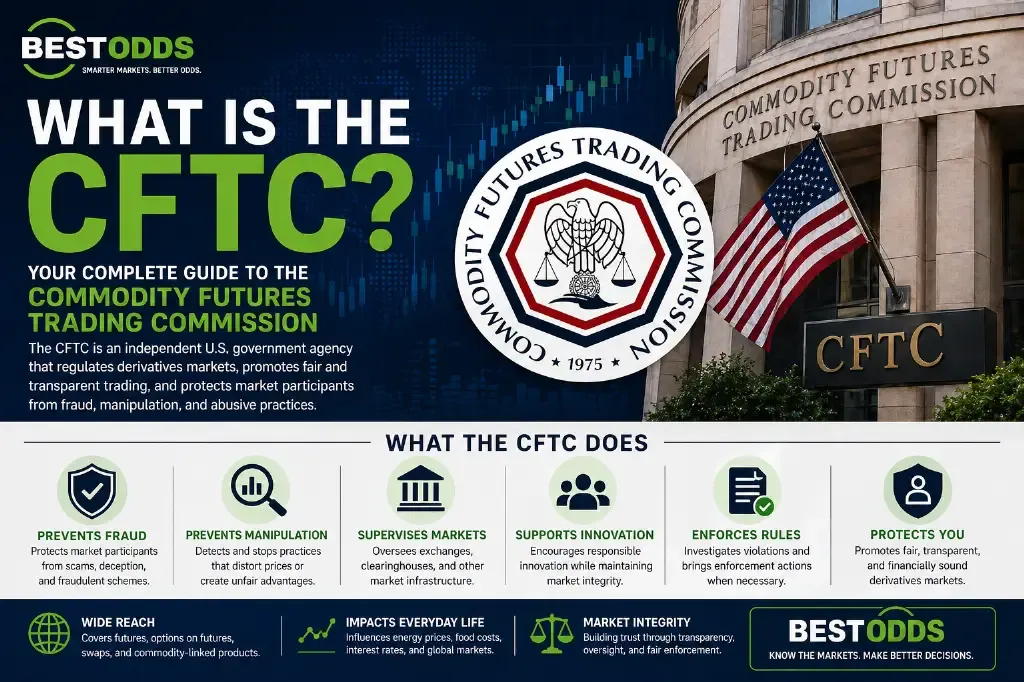
What Does CFTC Stand For?
CFTC stands for Commodity Futures Trading Commission.
It is an independent agency of the United States government responsible for regulating derivatives markets, especially markets involving:
- Futures contracts
- Options on futures
- Swaps
- Certain commodity-linked derivatives
- Related market infrastructure and participants
Its mission centers on promoting open, transparent, competitive, and financially sound markets while protecting participants from fraud, manipulation, and abusive practices.
Why the CFTC Was Created
The CFTC was established in 1974.
Before that, commodity futures oversight largely sat under older agricultural regulatory structures. As markets became more complex and expanded beyond traditional farm commodities, lawmakers determined that a dedicated regulator was needed.
Originally, commodity futures were strongly tied to products such as:
- Wheat
- Corn
- Soybeans
- Cotton
- Livestock
But over time, futures markets expanded into:
- Energy
- Metals
- Interest rates
- Foreign exchange
- Stock indexes
- Weather products
- Credit products
- Financial benchmarks
A modern specialist regulator became necessary.
What Is a Futures Market?
To understand the CFTC, it helps to understand futures.
A futures contract is an agreement whose value depends on the future price or value of something else.
Examples might include contracts tied to:
- Oil prices
- Gold prices
- Natural gas
- Corn
- Treasury yields
- Equity indexes
These contracts can be used for:
Hedging
Businesses reduce risk.
Example:
An airline may want protection against rising fuel costs.
Speculation
Traders express a view on future price movement.
Price Discovery
Markets help reveal expectations about future supply, demand, and risk.
Because these markets can influence the real economy, regulation matters.
Core Responsibilities of the CFTC
The CFTC has several central functions.
1. Preventing Fraud
The agency pursues schemes involving deception, false promises, fake trading operations, and dishonest solicitation.
2. Preventing Manipulation
It monitors for attempts to distort prices or unfairly influence markets.
3. Supervising Exchanges
It oversees regulated venues where certain derivatives trade.
4. Monitoring Clearinghouses
Clearing systems help reduce counterparty risk.
5. Supervising Market Participants
Some brokers, dealers, advisors, and other participants fall under relevant oversight.
6. Promoting Market Integrity
Confidence in pricing and settlement is crucial.
Why the CFTC Matters to Ordinary People
Many people assume the CFTC only matters to large traders.
That is not true.
Its work can indirectly affect:
- Gasoline prices
- Food markets
- Mortgage-related rates
- Pension exposure
- Investment products
- Energy hedging markets
- Crypto derivatives oversight debates
- Prediction market legality discussions
Even users who never trade a futures contract can be affected by the markets it regulates.
How the CFTC Is Structured
The agency is led by commissioners appointed through U.S. governmental processes.
Typically:
- Multiple commissioners serve staggered terms
- One serves as Chair
- Bipartisan structure is common
This design aims to support continuity and balanced governance.
What Markets Does the CFTC Regulate?
The exact boundaries can be technical, but broad categories include:
Futures
Standardized contracts traded on regulated exchanges.
Options on Futures
Contracts granting certain rights related to futures positions.
Swaps
Customized derivative agreements often used by institutions.
Commodity Derivatives
Products linked to commodities or relevant benchmarks.
Some Event Contracts / Prediction Market Questions
This area has drawn increasing public attention.
Commodities Are Broader Than Many People Realize
People hear “commodity” and think only wheat or oil.
But in legal and market contexts, commodities can be broader than that in some settings.
Traditional examples include:
- Crude oil
- Gold
- Silver
- Copper
- Corn
- Wheat
- Coffee
- Sugar
Modern derivatives discussions can involve far more complex references.
What Is Market Manipulation?
Manipulation can take many forms.
Examples may include:
- Artificially moving prices
- Cornering supply
- Spreading false information to distort markets
- Wash trading
- Spoofing or deceptive order behavior in relevant contexts
Manipulation harms trust and can damage real businesses using markets responsibly.
What Is Fraud?
Fraud usually involves deception.
Examples:
- Fake guaranteed returns
- Misappropriating customer funds
- False claims about licenses
- Pretending to run legitimate trading operations
- Misleading marketing
The CFTC often pursues such conduct where relevant to its jurisdiction.
CFTC vs SEC: What Is the Difference?
This is one of the most common questions.
The SEC (Securities and Exchange Commission) is generally associated with securities markets such as stocks and bonds.
The CFTC is generally associated with derivatives and commodity-linked markets.
This is simplified, because boundaries can become complex in modern finance.
But as a broad starting point:
- SEC = securities focus
- CFTC = derivatives / commodities focus
Why the Difference Matters
If a product resembles a stock investment, one framework may be more relevant.
If a product resembles a derivative contract tied to an external reference, another framework may be more relevant.
Modern innovation sometimes creates gray areas.
The CFTC and Clearinghouses
Many derivatives markets rely on clearing systems.
A clearinghouse helps stand between counterparties and reduce settlement risk.
Instead of every participant trusting every other participant directly, a central clearing mechanism can help stabilize obligations.
This became especially important after past financial crises exposed counterparty risk concerns.
The CFTC After the 2008 Financial Crisis
The global financial crisis changed derivatives regulation significantly.
One major issue involved opaque over-the-counter derivatives exposures.
Reforms increased emphasis on:
- Transparency
- Reporting
- Clearing
- Risk controls
- Capital considerations
- Systemic oversight
The CFTC gained an expanded role in important areas of swaps oversight.
What Are Swaps?
Swaps are derivative agreements where parties exchange financial exposures according to defined terms.
Examples may involve:
- Interest rates
- Credit risk
- Currency exposures
- Commodity pricing
They are often more institutional than retail-facing.
Why Swaps Matter
Large swaps markets can affect banks, corporations, pensions, and systemic risk.
That is why regulatory supervision became a major focus.
The CFTC and Retail Consumers
Retail users may encounter CFTC-related issues through:
- Forex scams
- Commodity pool schemes
- Fraudulent trading solicitations
- Unregistered platforms
- Crypto derivatives controversies
- Event contract debates
The agency often warns consumers about suspicious offers.
Red Flags Consumers Should Watch For
Regardless of product category:
- Guaranteed returns
- Pressure to act immediately
- Hidden fees
- No clear regulation
- Unverifiable performance claims
- Requests for unusual payment methods
- Lack of transparent risk disclosure
The CFTC and Digital Assets
The rise of crypto brought renewed attention to the CFTC.
Questions often include:
- Which digital products are commodities?
- Which derivative products fall under relevant oversight?
- How should leveraged crypto trading be supervised?
- How should fraud and manipulation be addressed?
This area continues evolving.
Why Crypto Users Hear About the CFTC
Because many crypto products involve leverage, futures, derivatives, or commodity-style arguments, the CFTC frequently appears in headlines.
The CFTC and Prediction Markets
This topic has become especially relevant.
Prediction markets often involve contracts tied to future real-world outcomes.
Examples may include:
- Elections
- Economic data
- Sports outcomes
- Weather
- Policy decisions
Depending on structure, regulatory treatment can become significant.
Why Prediction Markets Raise Regulatory Questions
They may touch issues such as:
- Whether the product is a derivative contract
- Public interest considerations
- Gaming vs financial framing debates
- Exchange structure
- Consumer protection
- Market integrity
That is why the CFTC often enters discussions around U.S. event-contract platforms.
Event Contracts Explained Simply
An event contract typically pays based on whether a defined event happens.
Examples:
- Yes / No outcomes
- Threshold outcomes
- Timed outcomes
Because value depends on a future event, regulatory classification questions naturally arise.
Why the CFTC Matters for Prediction Market Users
Users researching event markets often ask:
- Is this platform allowed?
- What rules apply?
- Who supervises the market?
- Are contracts clearly defined?
- What protections exist?
Understanding the CFTC helps frame these questions.
The CFTC and Enforcement Actions
The agency can pursue cases involving conduct within its remit.
Potential areas may include:
- Fraud
- Manipulation
- Registration failures
- Misuse of customer assets
- False statements
- Unlawful offerings
Enforcement can involve penalties, injunctions, bans, restitution efforts, and settlements depending on circumstances.
Why Enforcement Visibility Matters
Visible enforcement can deter misconduct and reassure legitimate participants.
The CFTC and Whistleblowers
Like some regulators, mechanisms may exist encouraging reporting of serious misconduct.
Whistleblowers can play a role in exposing hidden abuse.
Market Transparency
Healthy markets depend on trust.
Participants need confidence that:
- Rules are clear
- Prices are genuine
- Settlement works
- Fraud is punished
- Major players cannot cheat freely
The CFTC’s broader mission supports these goals.
Does the CFTC Control Prices?
No.
The agency does not set normal market prices.
Markets move based on supply, demand, expectations, macro conditions, and participant activity.
The regulator focuses more on fairness, legality, and integrity than price targeting.
Can the CFTC Stop Volatility?
Not directly.
Volatility can be natural.
Its concern is more whether volatility results from legitimate market forces or abusive behavior.
Why Commodity Markets Matter to the Economy
Commodity pricing influences:
- Fuel costs
- Food costs
- Manufacturing inputs
- Transport expenses
- Utility costs
Derivatives tied to these markets help businesses manage uncertainty.
Example: Airline Hedging
An airline exposed to rising fuel prices may hedge through relevant markets.
Without risk management tools, planning becomes harder.
Example: Farmer Hedging
A farmer may use futures markets to reduce uncertainty around crop prices.
Why Hedging Is Valuable
Many derivatives are not about gambling on prices.
They are about stabilizing real business risk.
This is an important distinction often misunderstood by the public.
Public Misconceptions About the CFTC
“It only regulates farmers.”
Outdated and false.
“It only matters to Wall Street.”
False.
“Commodity markets are just speculation.”
Incomplete. Hedging is central.
“Regulators control prices.”
Not in the ordinary sense.
How the CFTC Interacts With Other Agencies
Modern markets can involve multiple authorities depending on product type.
Possible overlapping relevance may involve:
- SEC
- Federal Reserve
- Treasury
- State regulators
- DOJ in criminal matters
- International regulators
Coordination can be important.
Why Jurisdiction Can Be Complex
A modern platform may involve:
- Securities-like elements
- Derivatives-like elements
- Payments components
- Consumer-protection concerns
- Data-security issues
No single agency necessarily covers everything.
What Users Should Look for in a Regulated Market Environment
Consumers often value:
- Clear rules
- Transparent fees
- Defined settlement terms
- Identity standards where applicable
- Risk disclosures
- Complaint processes
The CFTC and Innovation
Regulators face a recurring challenge:
How do you allow innovation without allowing chaos?
Move too slowly and innovation leaves.
Move too loosely and abuse flourishes.
This tension is central in modern finance.
Why the CFTC Is in More Headlines Now
Recent reasons include:
- Crypto growth
- Prediction markets
- Event contracts
- Volatile commodity prices
- Political attention on regulation
- Technology-driven market change
Is the CFTC Good or Bad for Markets?
Serious markets generally need credible rules.
Too little oversight can invite fraud.
Too much rigidity can stifle innovation.
Reasonable people debate where the balance should sit.
What the CFTC Does Not Do
It does not guarantee profits.
It does not remove all risk.
It does not prevent every fraud instantly.
It does not make markets predictable.
It does not eliminate personal responsibility.
Why Users Should Still Do Their Own Research
Even in regulated contexts, users should understand:
- Product mechanics
- Costs
- Risk
- Tax considerations
- Suitability for their finances
Regulation is not a substitute for judgment.
How CFTC Decisions Can Affect Platforms
For businesses operating in relevant sectors, regulatory decisions can influence:
- Product launches
- Market availability
- Compliance costs
- Allowed contract types
- User onboarding requirements
- Operational structure
Why Businesses Watch the CFTC Closely
Because regulatory clarity can shape commercial viability.
The Future of the CFTC
Likely continuing focus areas include:
- Digital assets
- Event contracts
- Market technology
- Cross-border activity
- Systemic risk
- Consumer protection
- Derivatives modernization
Why This Matters for BestOdds Readers
Users researching prediction markets or event trading often encounter CFTC references and may not know what they mean.
In many cases, the issue is not abstract bureaucracy. It can affect:
- Which products exist
- How they are structured
- Where users can participate
- What protections apply
- How disputes may be viewed
Practical Summary
If you remember only one thing:
The CFTC is a major U.S. regulator focused largely on derivatives and commodity-linked markets, with a mission centered on fair, transparent, and financially sound markets while combating fraud and manipulation.
That mission increasingly intersects with modern categories such as prediction markets and digital assets.
Frequently Asked Questions
What does CFTC stand for?
Commodity Futures Trading Commission.
Is the CFTC part of the SEC?
No. It is a separate U.S. regulator.
Does the CFTC regulate stocks?
Generally stocks are more associated with SEC oversight, not core CFTC focus.
Why is the CFTC relevant to prediction markets?
Because event-contract structures can raise regulatory questions depending on design and jurisdiction.
Does the CFTC regulate crypto?
Some crypto-related areas, especially derivatives and certain commodity-related issues, have drawn CFTC involvement.
Can the CFTC recover losses from scams?
Sometimes enforcement actions seek restitution or penalties, but recovery is never guaranteed.
History of the CFTC: How It Evolved Into a Modern Regulator
To understand the Commodity Futures Trading Commission properly, it helps to see how it developed over time. The CFTC did not emerge in a vacuum. It grew out of earlier efforts to supervise agricultural commodity trading in the United States.
In earlier eras, commodity markets were closely tied to farming and food production. Prices for wheat, corn, cotton, and livestock had direct consequences for producers, merchants, transport networks, and consumers. Because price instability or market abuse could damage real economic activity, oversight gradually became more formalized.
As financial markets expanded during the twentieth century, futures contracts were no longer limited to crops or livestock. New products developed around metals, energy, currencies, interest rates, and later sophisticated financial benchmarks. Older frameworks built for grain-era markets became less suitable for a rapidly modernizing system.
That is one reason Congress created the CFTC in 1974 as an independent regulator with broader responsibilities.
Its role then expanded further over subsequent decades as derivatives markets became larger, more global, more digital, and more systemically important.
Why Commodity Regulation Matters Beyond Agriculture
Many people still assume commodity regulation is mostly about farms. While agriculture remains important, the modern commodity ecosystem reaches into nearly every sector of the economy.
Examples include:
Energy Markets
Oil, natural gas, gasoline, diesel, and power markets influence transport costs, household budgets, and industrial activity.
Metals Markets
Gold, silver, copper, aluminum, and industrial metals affect manufacturing, construction, electronics, and investment products.
Interest Rate Markets
Derivatives tied to rates can affect corporate financing, mortgages, pensions, and macroeconomic expectations.
Currency Markets
Businesses exposed to international trade often manage foreign exchange risk through derivatives.
Supply Chains
Price volatility in raw materials can ripple through global commerce.
This is why the CFTC’s work often matters indirectly to people who never interact with a trading screen.
Why Futures Markets Exist in the First Place
A common misunderstanding is that futures markets exist only for speculation.
Speculation is one use case, but not the only one.
Many futures markets exist because businesses need tools to manage uncertainty.
Example: Farmer
A wheat producer may want to lock in pricing before harvest.
Example: Airline
An airline may want to manage fuel cost risk months ahead.
Example: Manufacturer
A company dependent on copper may want to reduce exposure to sudden price spikes.
Example: Exporter
A business selling internationally may want to manage currency swings.
Without these tools, planning can become harder and more expensive.
The CFTC’s oversight helps maintain confidence in systems that support these risk-management functions.
Price Discovery: An Underappreciated Role
Futures and derivatives markets do more than transfer risk. They also help create price signals.
When many participants bring information, forecasts, and incentives into one market, prices can reflect collective expectations about:
- future supply shortages
- demand changes
- inflation risk
- weather disruption
- geopolitical pressure
- central bank expectations
This process is called price discovery.
It is imperfect, but valuable.
For example, energy futures prices may provide clues about expected market tightness months ahead. Agricultural contracts may reflect crop concerns before retail consumers notice price changes in stores.
Why Integrity Is Essential
Price discovery only works well when markets are trusted.
If participants believe markets are manipulated, fake, or structurally abusive, price signals become less credible.
That is why anti-fraud and anti-manipulation enforcement is so important.
Trustworthy markets help:
- businesses hedge confidently
- investors allocate capital more rationally
- policymakers monitor signals
- consumers benefit indirectly from healthier systems
How the CFTC Oversees Exchanges
Many derivatives products trade on regulated exchanges or designated venues.
These venues typically require rules covering:
- fair access
- orderly trading
- surveillance systems
- reporting standards
- settlement procedures
- participant conduct
The CFTC’s oversight helps ensure exchanges maintain standards rather than operating as unchecked private arenas.
Why Clearinghouses Matter So Much
One of the least visible but most important parts of derivatives markets is clearing.
A clearinghouse helps stand between counterparties so participants do not rely solely on each other’s solvency.
Without robust clearing arrangements, market stress can spread when one major participant fails.
This became especially clear during past financial crises.
Strong clearing systems can help:
- reduce chain-reaction defaults
- improve confidence
- standardize collateral processes
- lower systemic contagion risk
Because of that, clearing oversight is a major regulatory priority.
The CFTC and the 2008 Financial Crisis
The 2008 financial crisis changed how many policymakers viewed derivatives risk.
Large opaque exposures in parts of the over-the-counter market raised concerns about interconnectedness, counterparty failure, and insufficient transparency.
Post-crisis reforms increased focus on:
- trade reporting
- clearing mandates in some areas
- capital and margin frameworks
- visibility into exposures
- risk management standards
The CFTC became even more relevant in supervising portions of this reformed landscape.
Why Swaps Sound Abstract but Matter Greatly
Swaps are often discussed in technical language, but their real-world purpose is usually understandable.
They allow parties to exchange or manage exposures.
Examples:
- fixed interest rate vs floating rate exposure
- currency risk conversion
- commodity price exposure transfer
- credit risk positioning
These are not usually casual consumer products, but they can affect banks, pension funds, insurers, corporations, and infrastructure financing.
That makes oversight important.
The CFTC and Market Surveillance
Modern markets generate enormous volumes of data.
Regulators monitor for patterns suggesting misconduct such as:
- suspicious concentration
- wash activity
- deceptive layering behavior
- attempted corners
- unusual settlement pressure
- misleading practices
Surveillance does not mean every anomaly is wrongdoing. Markets naturally move and large players naturally exist.
The challenge is distinguishing legitimate behavior from abusive conduct.
Why Manipulation Is So Harmful
Manipulation can damage markets in several ways:
Distorted Prices
Businesses hedging real risks may receive misleading signals.
Reduced Confidence
Participants may withdraw if they believe the game is rigged.
Economic Spillover
Artificial commodity prices can affect supply chains and consumers.
Unfair Advantage
Dishonest actors profit at the expense of others.
That is why enforcement against manipulation is a core priority.
Retail Fraud and Public Protection
Not all CFTC-relevant misconduct involves giant institutions.
Retail scams remain a recurring problem.
Examples may include:
- fake managed commodity accounts
- guaranteed-return trading schemes
- bogus AI trading systems
- impersonation of licensed firms
- offshore leverage scams
- fake crypto derivative offers
These often target ordinary people who may not understand product complexity.
Common Fraud Warning Signs
Consumers should be cautious when they hear claims such as:
- “Guaranteed profits”
- “No risk strategy”
- “Insider method”
- “Only available today”
- “Secret institutional algorithm”
- “Send funds privately now”
Complex markets always involve risk. Legitimate providers do not eliminate uncertainty through slogans.
The CFTC and Technology
Markets today are far more technological than decades ago.
Important issues now include:
- algorithmic trading
- low-latency infrastructure
- cyber resilience
- digital reporting systems
- automated surveillance
- cloud-based operations
Regulators must evolve continuously because markets no longer operate like paper pits or voice-only systems.
Why Market Speed Creates New Challenges
Fast electronic markets can be efficient, but speed also creates new risks:
- rapid feedback loops
- software errors
- flash volatility
- automated spoofing attempts
- cross-market contagion
Regulation increasingly involves technological competence, not only legal authority.
Global Coordination Matters
Commodity and derivatives markets are international.
Oil, metals, rates, currencies, and macro exposures cross borders constantly.
That means the CFTC often exists within a broader global ecosystem involving:
- foreign regulators
- central banks
- cross-border firms
- multinational exchanges
- international clearing networks
No major regulator operates in total isolation.
Why This Matters to Prediction Markets
Users researching event contracts may wonder why a derivatives regulator appears in those discussions.
The answer is that event contracts can resemble financial contracts tied to future outcomes, depending on structure.
Questions may include:
- Is it a gaming product?
- Is it a financial contract?
- Is it a public-interest concern?
- Is it an exchange-listed derivative?
- What consumer protections apply?
These are serious structural questions, not mere semantics.
Public Interest Debates
Some event-contract categories create broader debates about whether certain markets should exist, how they should be structured, and what societal effects they may have.
Reasonable people differ strongly on such topics.
That is one reason CFTC-related headlines can attract public attention beyond finance circles.
Why the CFTC Will Likely Stay Relevant
Even as markets change, the core needs remain:
- fair pricing
- honest conduct
- resilient infrastructure
- transparent systems
- fraud deterrence
- innovation with accountability
Whether the product is agricultural, financial, digital, or event-based, those principles remain central.
Practical Takeaway for Readers
If you follow prediction markets, crypto derivatives, commodities, or modern financial innovation, the CFTC is not an obscure background acronym.
It is one of the institutions helping shape what products are available, how they function, and what standards govern them.
Understanding that makes users far more informed than those who only notice the name when controversy appears.
Frequently Asked Questions
What does CFTC stand for?
CFTC stands for the Commodity Futures Trading Commission, an independent U.S. government agency that regulates derivatives markets such as futures, options on futures, swaps, and certain commodity-linked products.
What does the CFTC do?
The CFTC works to promote fair, transparent, and financially sound markets. Its responsibilities include combating fraud, preventing manipulation, supervising exchanges, overseeing clearing systems, and enforcing relevant market rules.
Is the CFTC a government agency?
Yes. The CFTC is an independent federal regulatory agency of the United States government.
When was the CFTC created?
The CFTC was established in 1974 to oversee expanding futures and derivatives markets beyond older agricultural-focused regulatory frameworks.
Why was the CFTC created?
It was created because commodity and derivatives markets had grown more complex and extended beyond farming products into energy, metals, currencies, rates, and financial contracts that required dedicated oversight.
What markets does the CFTC regulate?
The CFTC is primarily associated with:
- Futures markets
- Options on futures
- Swaps
- Commodity-linked derivatives
- Certain event-contract or prediction-market questions depending on structure and jurisdiction
Does the CFTC regulate stocks?
Generally, stocks are more closely associated with the Securities and Exchange Commission (SEC). The CFTC is more closely associated with derivatives and commodity-linked markets.
What is the difference between the CFTC and SEC?
Broadly speaking:
- CFTC: Futures, swaps, derivatives, commodity-linked markets
- SEC: Stocks, bonds, securities markets, many investment products
Some modern products can involve complex overlapping questions.
Does the CFTC regulate crypto?
The CFTC has been involved in areas related to digital assets, especially where derivatives, commodity treatment, fraud, or leveraged products are concerned.
Why is the CFTC mentioned with prediction markets?
Prediction markets often involve contracts tied to future outcomes. Depending on how a platform is structured, questions can arise about derivatives regulation, event contracts, consumer protections, and market oversight.
Does the CFTC control commodity prices?
No. The CFTC does not normally set prices for oil, gold, corn, or other commodities. Prices are determined by market supply, demand, and participant expectations. The agency focuses on market integrity and lawful conduct.
Can the CFTC stop volatility?
Not directly. Volatility can occur naturally in legitimate markets. The CFTC’s role is more about ensuring volatility is not caused by fraud, manipulation, or abusive behavior.
What is market manipulation?
Manipulation generally refers to attempts to unfairly distort prices or market behavior for gain. This can harm businesses, investors, and public trust.
What is futures trading?
Futures trading involves contracts whose value depends on the future price or value of something else, such as oil, gold, corn, interest rates, or indexes.
Why do futures markets matter?
They help businesses hedge risk, assist with price discovery, and allow participants to manage uncertainty in important economic sectors.
Does the CFTC protect consumers?
The CFTC works to combat scams, fraudulent solicitations, deceptive schemes, and abusive conduct within areas relevant to its authority.
Can the CFTC recover money lost in scams?
In some enforcement actions, penalties or restitution may be pursued, but recovery is never guaranteed and depends on the facts of each case.
Why does the CFTC matter to ordinary people?
Its work can indirectly affect fuel markets, food pricing, pensions, investment products, financial stability, crypto derivatives, and prediction market availability.
Is the CFTC becoming more important?
Many observers would say yes, especially because of growing interest in digital assets, prediction markets, electronic trading, and increasingly complex global derivatives markets.
What is the simplest way to understand the CFTC?
The CFTC is a key U.S. regulator that helps keep important derivatives and commodity-linked markets fair, transparent, and resistant to fraud or manipulation.
For almost two decades, Sadonna has remained at the forefront of the gambling industry in the US and abroad, covering the latest news and legal updates. Sadonna’s goal is to provide sports bettors and casino players with premium content, including comprehensive details on the US industry.