


Phoenix Fire (Playson) | BestOdds




 Get 200% More Coins on First Purchase – 1.5M CC + 75 SCCLAIM BONUS






 Get up to 750K Gold Coins + 65 SC FREECLAIM BONUS


 Get up to 500K Gold Coins + 105 FREE SC + 1000 VIP pointsCLAIM BONUS



 Exclusive Jackpot Prizes
New Games Added Weekly
0.2 FREE SC Daily Login Bonus
Exclusive Jackpot Prizes
New Games Added Weekly
0.2 FREE SC Daily Login Bonus
 Exclusive Jackpot Prizes
New Games Added Weekly
0.2 FREE SC Daily Login Bonus
120,000 GC + 60 Free SC + a chance to win 500 Free SC!CLAIM BONUS
Exclusive Jackpot Prizes
New Games Added Weekly
0.2 FREE SC Daily Login Bonus
120,000 GC + 60 Free SC + a chance to win 500 Free SC!CLAIM BONUS


 Variety of games
Multiple payment methods
10,000 GC daily reward
Variety of games
Multiple payment methods
10,000 GC daily reward
625K Golden Coins + Up to 125 SC FREE + 1250 VIP PointsCLAIM BONUS
Variety of games
Multiple payment methods
10,000 GC daily reward
Variety of games
Multiple payment methods
10,000 GC daily reward
625K Golden Coins + Up to 125 SC FREE + 1250 VIP PointsCLAIM BONUS

 150% First Purchase Offer: Up to 600K Gold Coins + 303 SC FREECLAIM BONUS

 100% More Coins: 80,000 GC + 40 FREE SC + 75 Free SC SpinsCLAIM BONUS




 Get extra 10 SC for FREE!CLAIM BONUS



 120,000 GC + 60 Free SC + a chance to win 500 Free SCCLAIM BONUS

 Get up to 103 SC + 20,500 GC for FREE with Legendz!CLAIM BONUS

 300% Value on Sign up + First Purchase 300,000 GC + 22 FREE SC for $9.99CLAIM BONUS





 200% Extra: 300,000 Gold Coins + 30 SCCLAIM BONUS


 120,000 GC + 60 FREE SC + Chance to Win 500 FREE SCCLAIM BONUS


 Exclusive Offer: 120000 GC + 50 SC FREE + 50 Free SpinsCLAIM BONUS

 25000 Gold Coins and 1 Free Shuffle CashCLAIM BONUS



 Up to 500% Extra on SC – 950,000 GC + 75 SC + 20 Free SpinsCLAIM BONUS

 200% First Purchase: 10,000 Gold Coins + 30 SC FREECLAIM BONUS



 200% Purchase Offer: 10K Gold Coins and 30 FREE SCCLAIM BONUS

 250% MORE Coins: 1,225,000 GC + 88 FREE SCCLAIM BONUS




 200% Extra: 30 SC FREE and 1.75M WOW CoinsCLAIM BONUS


 100% Matched Offer: 40 SC FREE + 80,000 Gold CoinsCLAIM BONUS


 200% First Purchase Offer: Up to 4.5M Gold Coins + 300 SC FREECLAIM BONUS


 Get 300,000 GC + 30 SC FREE!CLAIM BONUS

 350% Extra: 1 Million GC + 60 SCCLAIM BONUS

 200% EXTRA FREE: 1,005,000 GC + 77.3 SC FREE + 50 Free SpinsCLAIM BONUS


 40 SC FREE + 40K Gold Coins + 40 Gift SpinsCLAIM BONUS

 Get up to 4.4M Gold Coins + 200 SC FREE!CLAIM BONUS



 300% Extra: 2M GC + 100 SC FREECLAIM BONUS

 100% Bonus: 20,000 GC + 20 SC FREECLAIM BONUS

 150% Bonus: 6000 GC + 50 SC FREE and 1 KeyCLAIM BONUS

 100% Extra: 850000 GC + 50 SCCLAIM BONUS

 100% More Coins: 750k GC + FREE 40 SCCLAIM BONUS

 6000 SC FREE and 1.35 Million Gold CoinsCLAIM BONUS

 3000 SC + 250K Tao Coins FREECLAIM BONUS

 60 FC FREE and 850K Gold CoinsCLAIM BONUS

 170,000 GC + 7 SCCLAIM BONUS

 100% up to $100CLAIM BONUS

 Get 200% Extra BRACCO coinsCLAIM BONUS
Phoenix Fire is one of those deceptively simple slots that ends up feeling far more dynamic than its retro, fruit-machine styling suggests. On the surface, you are looking at a classic 5 reel layout, bright “Vegas cabinet” symbols, and a straightforward payline engine. Underneath, though, Playson has built the whole experience around one central mechanic: a Phoenix Wild that expands, sticks, and can trigger a chain of respins that gradually transforms the middle of the reels into a much more win-friendly canvas.
That design choice gives Phoenix Fire a very specific personality. It is not a feature-heavy modern video slot with layered bonus rounds, missions, or complex symbol collections. Instead, it is a tight, loop-driven game where the base spin is always “live” because any Phoenix landing in the right place can change the next several spins. The absence of traditional free spins is not a drawback here, because the respin loop is essentially the bonus experience, and it is integrated directly into normal play rather than being locked behind a separate, rarer feature gate.
The other element that makes Phoenix Fire stand out is that it pays both ways. For a game with only 10 paylines, that single rule upgrade materially changes the hit pattern. You are no longer relying exclusively on left-to-right alignment. Right-to-left line wins can save spins that would otherwise be dead, and during the respin sequence it becomes much easier to connect wins across the locked wild reels and the rerolling outer reels.
If you enjoy classic slots but want something with more momentum than “spin, win, repeat,” Phoenix Fire is built to keep you watching the center reels and hoping for the Phoenix to “ignite” the board.
Technical specifications
| Specification | Details |
|---|---|
| Provider | Playson |
| Game type | Video slot (classic style) |
| Reel layout | 5 reels, 3 rows |
| Paylines | 10 fixed paylines |
| Win direction | Both ways (left to right and right to left) |
| Primary feature | Expanding Wild with Sticky Wilds and Respins |
| Wild symbol | Phoenix (expands to full reel on eligible reels) |
| Wild placement | Middle reels only (reels 2, 3, and 4) |
| Respin trigger | Any Phoenix Wild landing on reels 2 to 4 triggers a respin of the non-wild reels |
| Sticky behavior | Expanded Phoenix Wild reels remain locked during respins |
| Respin limit | Up to 3 consecutive respins |
| “Full Phoenix” state | If all three middle reels become Phoenix Wild reels, the center forms a 3 reel wild block |
| Bonus rounds | No separate free spins bonus or standalone bonus game |
| RTP | Commonly listed as 96.05% (can vary by operator build) |
| Volatility | Commonly described as medium to medium-high (varies by database and casino implementation) |
| Maximum win | Commonly listed as 679x stake (varies by source and version) |
| Bet range | Varies by casino and coin configuration |
Theme, visuals, and overall presentation
Phoenix Fire sits in Playsons “Timeless Fruit” tradition: recognizable symbols, bold colors, and a cabinet-like look that feels familiar even if you have never played the title before. But unlike a plain fruit slot, the Phoenix is a large, highly animated centerpiece symbol that creates a real sense of escalation when it appears. The game does a good job of making the Phoenix feel important without turning the screen into visual chaos. When it lands, expands, and locks, you instantly understand that the next spin is not “just another spin.”
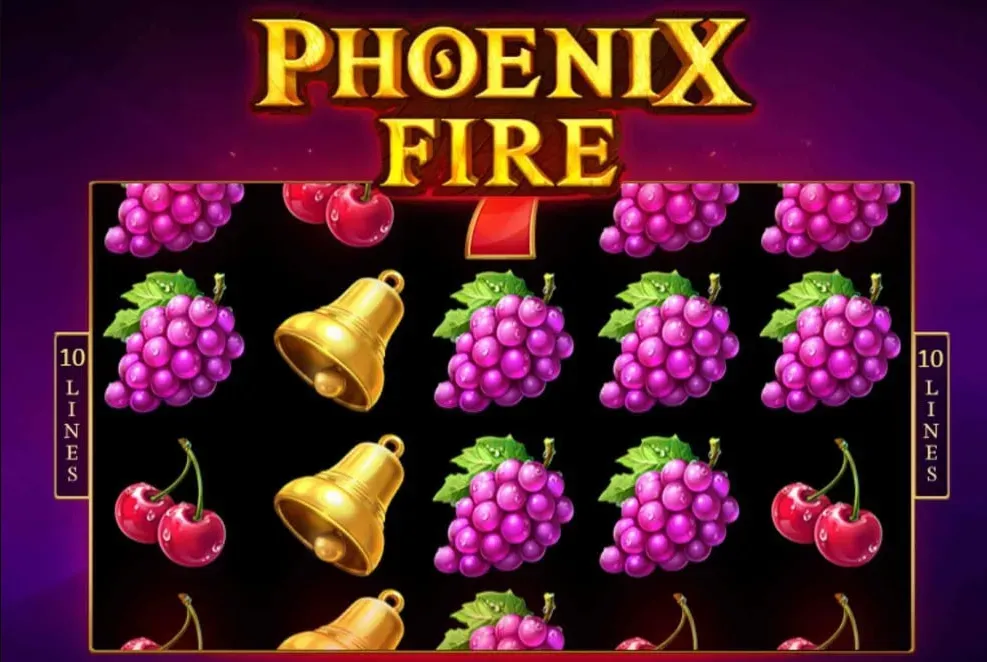
The audio and animation style leans more Vegas than cinematic. That works well for this format. Since the feature is respin-based, you spend a lot of time watching outer reels reroll while the middle stays locked. The presentation supports that loop with clear, event-driven cues that help the feature feel like it is building toward something.
How the base game works
Phoenix Fire uses 10 fixed paylines on a 5×3 grid. Because lines are always active, you do not manage gameplay by selecting paylines. Instead, you set your total bet through the coin value and stake controls offered by your casino version.
The “both ways” pay rule is a major structural point. Many 10-line classics feel narrow because you are always trying to start a win from the leftmost reel. Phoenix Fire broadens that by paying wins that start from either side. That means:
- A strong symbol cluster on reels 5 to 3 can pay even if reels 1 and 2 do not cooperate.
- During respins, when the middle reels are locked, wins can connect in either direction through those locked wild reels.
- The slot tends to feel more active than you would expect from a 10-payline game.
One important clarity note: while wins can pay both ways, a five-of-a-kind line win is still counted once rather than paying twice for both directions. The both-ways rule mainly increases win coverage and frequency rather than doubling payouts for full-length matches.
Symbols and paytable feel
Phoenix Fire mixes classic fruit-machine staples with a few higher-profile icons. In practical terms, it plays like a “top-heavy” paytable: the highest symbols matter, and the Phoenix mechanic is the true value driver.
Common symbol tiers you will notice in play:
Premium symbols
- Lucky 7 is typically the headline payer, the type of symbol that can swing a spin noticeably when it lines up well.
- Bell is usually the next strongest.These premiums are the ones you most want to connect through the locked wild reels during respins, because they provide the best return per line hit.
Mid-tier symbols
- Grapes and melon often fill the “middle value” space, showing up frequently enough to keep the base game moving while still being worth chasing during the feature.
Lower-tier symbols
- Lemon, plum, cherries, and orange typically serve as frequent fillers. They contribute to hit rate, and they can produce steady small wins, especially with both-ways evaluation. They are less exciting individually, but they become useful when the Phoenix creates a locked structure that lets even lower symbols connect more easily.
The Phoenix Wild and why it defines the game
The Phoenix is the Wild symbol, and it substitutes for other symbols to complete wins. That is normal. What is not normal is what happens when it lands on the middle reels.
When a Phoenix appears on reels 2, 3, or 4, it expands to cover the entire reel, turning that whole reel into a full wild reel. This instantly increases the number of possible line connections because any payline passing through that reel now has wild coverage for its middle position.
From a gameplay perspective, this is where Phoenix Fire begins to feel “bigger” than its 5×3 grid:
- A single Phoenix on reel 3 can act like a bridge between both sides of the screen.
- A Phoenix on reel 2 or 4 can anchor wins coming from either direction, especially since the game pays both ways.
- Because the Phoenix expands to a full reel, it does not matter where it lands vertically within the reel. The whole reel becomes wild, which simplifies the mental math and makes the feature feel powerful immediately.
Respins and Sticky Wild reels
The second half of the Phoenix identity is the respin system.
Whenever the Phoenix expands on one of the middle reels, it triggers a respin. In that respin:
- The expanded Phoenix reel remains locked in place as a sticky wild reel.
- Only the non-wild reels reroll, meaning reels 1 and 5 always respin, and any middle reel that is not currently a Phoenix reel can also respin.
- The respin happens even if the original spin was already a win. So the feature is not just a “second chance,” it is an added event layered on top of normal outcomes.
This is the core loop that makes Phoenix Fire entertaining. You are not just hoping for a single lucky line hit. You are hoping to land a Phoenix that forces extra reel movement while leaving wild reels behind, effectively increasing your odds of connecting something meaningful.
Chaining respins
The respin system can chain if another Phoenix lands during the respin outcome on a remaining middle reel. Each time a new Phoenix lands, it expands and becomes an additional locked wild reel, and another respin occurs.
The game caps this chain at three consecutive respins. That limit matters because it sets a clear maximum “build level” for the feature, and it creates a satisfying peak condition.
The “fully ignited” center
If you manage to land Phoenix Wild reels on reels 2, 3, and 4, the center becomes a three-reel wild block. This is effectively the best-case board state for Phoenix Fire because:
- Most paylines pass through the middle reels, and now those middle reels are fully wild.
- Only the outer reels (1 and 5) need to cooperate to create strong wins.
- Because wins can pay both ways, you have two chances to connect premium symbols into the center block.
This is where Phoenix Fire produces its most memorable moments. The slot is still not a “massive max win” modern title, but the feeling of watching the center ignite, lock, and then seeing the outer reels reroll into that structure is exactly what the game is built for.
No traditional free spins, and why that is intentional
Some slot databases label Phoenix Fire as having free spins, but in practical gameplay terms, it does not run a conventional free spins bonus with a scatter trigger and a separate bonus mode. Instead, the respins function as the bonus event, and they are activated through the Phoenix Wild mechanic.
That distinction is worth understanding because it changes expectations:
- You are not waiting for a rare three-scatter trigger.
- The feature appears through natural base play events.
- The “bonus time” is short, punchy, and repeatable rather than being one long, isolated feature round.
If you prefer slots where the excitement comes in bursts and where the base game constantly has the chance to escalate, Phoenix Fire’s integrated design is a plus.
RTP, volatility, and what a session feels like
Phoenix Fire is widely listed with an RTP around 96.05%, though real-world RTP can vary depending on the operator and jurisdictional configuration. In other words, the slot’s name does not guarantee a single fixed RTP everywhere. The best practice is always to verify the RTP displayed inside your casino’s game info.
Volatility is best described as medium to medium-high in feel, even though some summaries call it low. The reason it can lean upward is that a lot of the game’s value is concentrated in the chained respin outcomes. If you go a stretch without Phoenix events, the base game can feel modest. When the Phoenix triggers, the slot becomes much more generous in activity and win potential for a short burst.
This creates a session pattern that usually looks like:
- Regular base spins with small and mid-sized line hits, helped by both-ways payouts.
- Occasional Phoenix landings that create a short “event” and add a little extra value.
- Rarer moments where Phoenix events chain into two or three locked wild reels, producing the most exciting outcomes.
Because of that pacing, Phoenix Fire tends to suit players who like classic slots but want a feature that can meaningfully change a spin’s value without demanding a long bonus round.
Practical bankroll guidance for Phoenix Fire
Phoenix Fire does not have strategy in the sense of “play this way to win more,” because it is RNG-based. But you can approach it in a way that matches how it distributes its entertainment.
Pick a stake that allows for feature variance
The Phoenix mechanic is the point of the game, but it will not land every few spins on command. A stake that is too high can make the dead stretches feel harsh. A stake that is comfortable lets you ride the natural rhythm until the respins appear.
Expect value in clusters
Because respins can chain, Phoenix Fire often pays in clusters: several spins close together might deliver a chunk of your session’s value when the feature engages. That is normal for this design.
Be aware of bet-range differences by casino
Different casinos present different coin values and max stakes, and some databases report stake ranges that reflect a specific operator implementation. If you are writing a guide or comparing casinos, it is worth treating bet limits as “operator-specific,” not as a single universal truth.
Strengths and weaknesses
Strengths
- Simple classic format that is easy to understand and fast to play.
- Both-ways paylines make a 10-line game feel more active and forgiving.
- Expanding wild reels are genuinely impactful, not cosmetic.
- Sticky wild respins create repeatable “event moments” without requiring a separate bonus mode.
- The chained respin potential gives the slot a clear peak condition that feels exciting when it happens.
Weaknesses
- If you prefer long bonus rounds with lots of free spins, Phoenix Fire is not built that way.
- The base game can feel modest between Phoenix landings, especially if you are chasing premium symbol hits.
- Maximum win potential is relatively limited compared to modern high-volatility slots with 5,000x to 20,000x ceilings.
- Public summaries conflict on volatility classification and on whether it has “free spins,” so players should rely on the actual in-game rules for their version.
Final verdict
Phoenix Fire is a strong example of how to modernize a classic fruit-slot framework without burying it under complexity. The entire game revolves around one iconic symbol and one escalating mechanic, and that focus is what makes it work. The Phoenix Wild is not just a substitute. It is a board-shaping feature that can lock down the center reels, trigger extra reel motion, and create satisfying bursts of momentum when it chains.
If you want a slot that feels familiar, plays quickly, and still offers an authentic feature payoff through expanding sticky wild reels and respins, Phoenix Fire is a solid pick. Just go in with the right expectations: the fun is in the Phoenix-driven sequences, not in a traditional free spins bonus, and the ceiling is more “classic slot memorable” than “modern max-win chase.”
FAQs
- What is Phoenix Fire by Playson?Phoenix Fire is a 5 reel, 3 row slot that uses 10 fixed paylines and pays both ways (left to right and right to left). Its core mechanic is an expanding Phoenix Wild that can lock reels and trigger respins.
- How many paylines does Phoenix Fire have?It has 10 fixed paylines. All lines are always active, so you don’t choose the number of lines, you only adjust your stake.
- What does “pays both ways” mean in Phoenix Fire?It means winning combinations can be paid starting from reel 1 to reel 5 or from reel 5 to reel 1 on an active payline. This makes the game feel more active than a typical 10-payline slot.
- Does a five-of-a-kind win pay twice because it pays both ways?No, a full five-symbol line win is generally counted once. The both-ways rule increases the number of possible winning line directions rather than doubling the payout for the same five-of-a-kind result.
- What is the Wild symbol in Phoenix Fire?The Wild is the Phoenix symbol. It substitutes for regular symbols to help complete winning paylines.
- Where can the Phoenix Wild appear?The Phoenix Wild is typically restricted to the middle reels: reels 2, 3, and 4. This restriction is important because it’s what enables the central “wild reel block” build-up during respins.
- What happens when the Phoenix Wild lands on a middle reel?When a Phoenix lands on reels 2 to 4, it expands to cover the entire reel. That reel becomes a full wild reel for that spin, dramatically improving payline connectivity.
- Does the Wild expand in the base game or only in a bonus?The expansion is part of the base gameplay. Phoenix Fire does not rely on a separate free spins mode for its main mechanic, since the expanding wild and respin loop are integrated into normal play.
- What triggers respins in Phoenix Fire?A respin is triggered when a Phoenix Wild lands on reels 2, 3, or 4 and expands. The game then respins the reels that aren’t locked wild reels to try to create stronger line wins.
- Which reels respin during the feature?Reels that are not expanded Phoenix wild reels will respin. The expanded Phoenix reels remain locked, while the remaining reels (including the outer reels) reroll for improved outcomes.
- Are expanded Phoenix wild reels sticky?Yes, expanded Phoenix reels become sticky during the respin sequence. They remain locked in place for the next respin(s), which is what allows the feature to “build.”
- Can you get more than one sticky wild reel at the same time?Yes, you can lock multiple middle reels if Phoenix Wilds land on more than one of reels 2 to 4 during the sequence. This increases the chances of forming strong wins through the center of the grid.
- How many respins can you get in one sequence?The respin chain is typically capped at three consecutive respins. That cap defines the maximum “build” potential of the feature in a single triggered sequence.
- What is the strongest possible sticky wild setup?The strongest setup is when reels 2, 3, and 4 all become full Phoenix wild reels. This creates a three-reel wild block in the center, leaving only reels 1 and 5 to determine most outcomes.
- Why is the three-reel wild block so powerful?Most paylines pass through the middle reels, and with full wild coverage there, connecting symbols becomes much easier. It can create multiple line wins at once, including with higher-paying symbols.
- Does Phoenix Fire have Free Spins?It typically doesn’t have a traditional scatter-triggered Free Spins bonus like many modern slots. The respin mechanic acts as the game’s main “bonus-style” feature.
- Is there a bonus buy option in Phoenix Fire?Phoenix Fire is not commonly known for having a Bonus Buy feature. Most versions focus on natural base-game activation through the Phoenix Wild rather than paid entry.
- What is the RTP of Phoenix Fire?It is commonly listed around 96.05% RTP. RTP can vary by casino configuration, so checking the in-game info panel is the best way to confirm the version you’re playing.
- What volatility is Phoenix Fire?It’s commonly described as medium to medium-high volatility, depending on the source and version. Much of the value is concentrated in chained respin sequences rather than constant base hits.
- What is the maximum win in Phoenix Fire?The max win is commonly listed around 679x stake, though this can vary by version and reporting source. The biggest results usually come from the fully built center wild block connecting premium symbols.
- Which symbols pay the most in Phoenix Fire?Premium symbols typically include classics like Lucky 7s and Bells, with fruit symbols paying lower. The Phoenix Wild doesn’t just substitute, it also drives most of the game’s highest-value outcomes by creating wild reels.
- Does the Wild substitute for everything?Wilds typically substitute for regular paying symbols but not for special feature symbols (if any are present). The exact exclusions are always confirmed in the in-game rules.
- Can you win on multiple paylines at once?Yes. Because all 10 paylines are active, a single spin can create wins across multiple line patterns, especially during respins when the middle reels are locked wild.
- Does changing your bet size change the chance of triggering the Phoenix feature?In most slots, bet size changes payout size, not the probability of symbol outcomes. Your stake mainly affects win amounts in real-money terms rather than feature frequency.
- Is Phoenix Fire suitable for beginners?Yes, it’s generally beginner-friendly because the format is classic and the main feature is easy to understand once you see a Phoenix expand and lock. The only “advanced” concept is the respin chaining and how it builds the center reels.
- Is Phoenix Fire mobile-friendly?Yes, it is typically available in HTML5 and plays well on modern mobile devices. The 5×3 grid and clear central wild mechanic make it easy to follow on smaller screens.
- Why can Phoenix Fire feel streaky?Because the most exciting outcomes come in short clusters when Phoenix Wilds land and trigger respins. When the Phoenix doesn’t appear for a while, the base game can feel quieter by comparison.
- What type of player will enjoy Phoenix Fire most?It’s ideal for players who like classic fruit-slot presentation but want a feature that can meaningfully change spin outcomes. If you enjoy sticky wilds, respin bursts, and both-ways wins without a long bonus round, it’s a strong fit.
UK iGaming Writer - With 10+ years in tech, crypto, igaming, and finance, Ali has written across many platforms covering crypto, tech, and gambling news, reviews, and guides. He specialises in content on igaming, sports betting, and crypto trends in emerging markets. Outside of work, Ali enjoys cricket and travelling.


