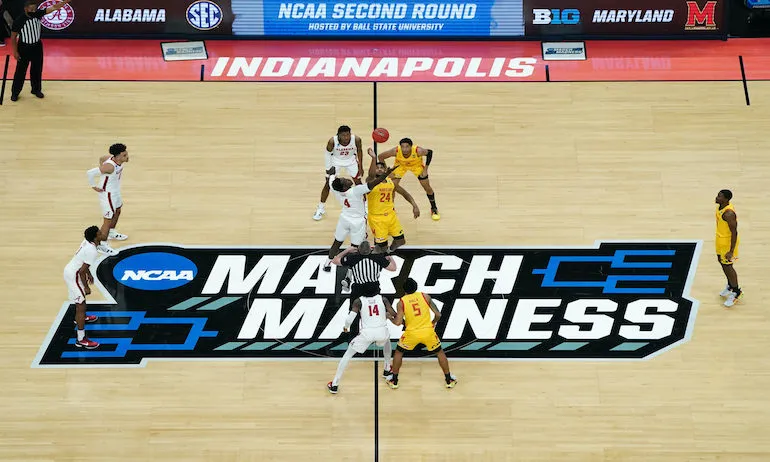
College Basketball Betting 2026
College basketball betting encompasses every form of licensed sports wagering conducted on NCAA competition, from regular-season conference matchups through the 67-game…


Division I basketball — the primary wagering tier, comprising approximately 363 member programs — generates billions of dollars in legal betting handle annually across the growing number of US states that have regulated sports wagering since the 2018 Supreme Court ruling that overturned the federal prohibition.
The American Gaming Association estimated that approximately 68 million Americans planned to wager on the 2024 NCAA Tournament alone, with projected legal handle exceeding $2.7 billion across licensed channels.
This guide provides a complete reference for college basketball wagering: a ranked and methodology-tested list of the best sportsbooks for NCAA basketball, a full taxonomy of available bet types, conference-by-conference betting analysis, a detailed breakdown of every round of the NCAA Tournament, step-by-step account and wagering tutorials with screenshot references, coverage of payment methods, bonus structures, live betting mechanics, futures strategy, bankroll management, and responsible gambling resources.
About BestOdds & Our College Basketball Betting Analysts
BestOdds is a US sports betting media brand dedicated to independent, real-money-tested reviews of licensed sportsbooks and authoritative educational content for American bettors.
The editorial team has covered college basketball wagering across multiple seasons, maintaining funded accounts at every featured operator and conducting structured evaluations through regular-season conference play, conference tournaments, and the NCAA Tournament postseason.
Best Sportsbooks for College Basketball Betting — 2026
Each sportsbook listed below was evaluated by BestOdds analysts through real-money account testing spanning a minimum of one full college basketball season, assessing NCAA market depth, live betting performance, payout processing speed, and customer support responsiveness. Full evaluation criteria are detailed in the sportsbook review methodology guide.
These sportsbooks were selected based on their performance across criteria directly relevant to college basketball bettors. DraftKings offers same-game parlay construction for every Division I basketball game during conference tournament weeks, including player-prop legs for points, rebounds, and assists alongside the game spread and total — a depth of market coverage that distinguishes it for high-frequency tournament bettors.
FanDuel provides player prop availability for mid-major programs outside the Power Four conferences, a meaningful differentiator during the NCAA Tournament when first-round matchups regularly feature teams from the Mountain West, Missouri Valley, and West Coast conferences.
BetMGM delivers odds boosts with measurable frequency during March Madness first-round games, and the M life Rewards program provides supplementary value for volume bettors placing wagers across the 67-game tournament slate.
bet365 offers live streaming coverage of college basketball events alongside its in-play markets, enabling bettors to monitor game developments and place live wagers through a single platform — a material advantage during regular-season midweek conference slates that may not receive national television coverage.
Caesars’ Rewards program generates meaningful loyalty value for bettors whose college basketball wagering volume is sustained across the full November–April season rather than concentrated in the tournament window.
DraftKings Sportsbook
DraftKings offers one of the most comprehensive college basketball market menus of any licensed US operator. Same-game parlay availability extends across the full Division I slate during conference tournament weeks.
Some of those include player-prop legs for points, rebounds, assists, and three-pointers made — not merely for marquee ACC and Big Ten matchups but for mid-major programs whose games would attract minimal attention at less market-deep competitors. The platform’s college basketball section allows filtering by conference, making it straightforward to navigate a day that may feature simultaneous ACC, Big Ten, and SEC games.
The DraftKings welcome offer structure applies to college basketball wagers subject to standard minimum odds requirements. Key terms vary by state and are subject to change; review current offer terms before depositing. Player prop settlement follows official NCAA box scores, and the DraftKings customer support team has demonstrated competence in resolving prop settlement disputes in BestOdds testing.
During the 2025 NCAA Tournament, DraftKings demonstrated reliable live betting performance during peak first-round traffic periods — bet acceptance latency remained low and market suspensions were brief relative to competing platforms observed during the same period.
FanDuel Sportsbook
FanDuel’s college basketball offering is distinguished by the breadth of player proposition markets available for programs outside the nationally televised Power Four tier.
During the NCAA Tournament’s first two rounds, FanDuel typically offers points, rebounds, and assists props for players from mid-major conference programs — a level of coverage that allows bettors with strong analytical knowledge of lesser-covered conferences to apply that edge in actual wagering markets.
The FanDuel interface is consistently rated by BestOdds analysts as among the most intuitive for new bettors navigating the platform under tournament-period pressure. The bet slip construction process for same-game parlays is streamlined, and the app’s performance during high-traffic March Madness periods has been reliable in analyst testing.
FanDuel’s welcome offer structure follows the bet-and-get format common at major US operators. The FanDuel Rewards program provides cash-back structures for active customers; value scales with betting volume during the regular season.
BetMGM Sportsbook
BetMGM has historically offered the deepest player proposition menus for Power Four conference regular-season games of any featured operator, making it a strong platform for bettors whose wagering activity is concentrated in the ACC, Big Ten, Big 12, and SEC during the November–March regular season. The platform regularly posts 15 or more individual player prop markets for nationally televised conference matchups.
During March Madness, BetMGM runs daily odds boost promotions on first-round tournament games. BestOdds analysts documented boosted prices on multi-team same-game parlays during the 2025 first round that offered materially better implied probability than the un-boosted equivalent market prices at competing sportsbooks — representing genuine value for informed bettors who evaluated the boost against market prices elsewhere.
The M life Rewards program integrates BetMGM’s sports betting loyalty structure with MGM Resorts’ hospitality benefits, providing supplementary value for high-volume bettors in states adjacent to MGM resort properties.
Caesars Sportsbook
Caesars Sportsbook consistently offers competitive juice on regular-season college basketball spread markets — BestOdds odds quality testing across a 25-game sample during the 2023–24 season found Caesars posting -108 on competitive conference spread markets with meaningful frequency, reducing the break-even win percentage from 52.38% (at -110) to 51.95%.
Over a full season of wagers, this pricing advantage compounds into a material reduction in the house edge.
The Caesars Rewards program is among the most structurally valuable loyalty systems for volume college basketball bettors. Reward Credits accumulate on every wager and can be applied toward hotel stays at Caesars’ resort network — meaningful supplementary value for bettors who attend bowl games, Final Four events, or other destination sporting events.
Caesars’ mobile app provides robust conference tournament coverage, including first-half and second-half lines for all Power Four conference tournament games from the opening round through the championship game.
bet365 Sportsbook
bet365 Sportsbook is the only featured sportsbook to offer live streaming of college basketball events integrated directly within its betting interface — bettors can monitor the game and access live markets through a single screen without switching between a broadcast source and the sportsbook app.
This integration is a meaningful functional advantage for live in-play bettors during the regular season, when many conference games do not receive national television broadcast.
bet365 offers the widest pre-season futures menu for college basketball among the featured operators, with national championship markets typically available for more than 50 programs before the season begins. Pre-season pricing at bet365 has historically been competitive relative to the broader market, providing value for futures bettors who wish to compare outright prices across multiple operators before committing to a position.
Hard Rock Bet Sportsbook
Hard Rock Bet provides comprehensive tournament market coverage across the full NCAA bracket, with spread, moneyline, and total markets available for all 67 games from the First Round through the National Championship.
The platform’s promotional calendar during the NCAA Tournament includes parlay insurance structures and reload bonus offers for existing customers.
Hard Rock Bet’s mobile app offers a clean navigation structure for the tournament bracket, allowing users to scroll through all available first-round matchups by region — a useful feature for bettors constructing multi-game parlays across the bracket.
What Is College Basketball Betting?
NCAA Division I Basketball — Structure, Conferences, and Scale
NCAA Division I basketball is the highest level of college basketball competition, comprising approximately 363 member programs organized into 32 conferences as of the most recent season.
The academic calendar governs the season timeline: non-conference games run from November through December, conference play spans January through early March, conference tournaments are held in the first two weeks of March, the NCAA Tournament runs from mid-March through early April, and the National Invitation Tournament (NIT) provides an alternative postseason for programs that did not receive an at-large bid to the NCAA field.
The conference structure is central to college basketball’s betting significance. The major conferences and their betting characteristics are:
- ACC (Atlantic Coast Conference): Historically the most nationally televised conference, generating strong two-way betting action from programs including Duke, North Carolina, and Syracuse. Conference realignment has altered the ACC’s composition; sportsbooks have adjusted their market offerings accordingly.
- Big Ten: The largest conference by membership, with programs including Michigan State, Indiana, Purdue, and Ohio State. Defensively oriented with lower average pace of play, producing totals that tend to run under relative to faster conferences. The Big Ten’s 2024 expansion introduced new travel and scheduling dynamics with betting implications.
- Big 12: Historically the most competitive major conference on a game-by-game basis, with programs including Kansas, Baylor, and Texas Tech. Conference parity compresses spreads and creates frequent close-game cover outcomes.
- SEC (Southeastern Conference): Programs including Kentucky, Tennessee, and Auburn have elevated the conference’s postseason presence. The SEC’s football-first regional audience can create public-money inefficiencies on college basketball lines.
- Big East: The only major conference operating exclusively as a basketball-first league, with no football programs. Programs including Villanova, Marquette, St. John’s, and Providence generate strong two-way action in the New York and Philadelphia media markets.
- Pac-12 / successor conferences: The 2024 conference realignment fundamentally altered the Pac-12’s structure; bettors should verify current conference affiliations at sportsbooks, as market availability for former Pac-12 programs has shifted.
Why College Basketball Generates Unique Betting Dynamics
College basketball wagering differs from NBA betting across several structural dimensions that create distinct market characteristics:
Talent differential: The range between programs is wider than between NBA franchises. The spread between a No. 1 seed and a No. 16 seed in the NCAA Tournament can exceed 25 points — a margin structurally impossible in professional basketball markets.
Home court advantage: Home court advantage is measurably stronger in college basketball than in the NBA, driven by smaller arenas, louder crowds relative to capacity, and a younger player profile more susceptible to crowd pressure. Venues such as Cameron Indoor Stadium (Duke) and Assembly Hall (Indiana) produce consistent home-court edges that do not always appear fully priced into early-season conference lines.
Coaching system variance: Each program operates a distinct offensive and defensive system that may match favorably or unfavorably against specific opponents. The coaching dimension in college basketball creates exploitable matchup inefficiencies that are less common at the NBA level, where player talent typically dominates system effects.
Pace of play variability: A KenPom adjusted-pace rating difference of 20 possessions per 40 minutes between two competing teams dramatically affects the reliability of a posted game total. Bettors who track pace data from efficiency rating databases have a structural informational advantage over those relying solely on sportsbook-posted totals.
Transfer portal impact: A single high-impact transfer can shift a program’s season trajectory in a way that pre-season futures lines may not fully reflect. The transfer portal has accelerated roster turnover to a degree unprecedented in college basketball history, creating annual repricing opportunities for bettors who track portal movement.
Absence of competitive balance mechanisms: No salary cap or draft system exists to redistribute talent among college programs. This sustains dynasties — Kentucky, Duke, Kansas, Gonzaga — whose brand recognition generates public-money betting distortions that sophisticated bettors can identify and exploit.
College Basketball Betting Markets — Full Taxonomy
Point Spread: The handicap applied by the sportsbook to equalize two opponents. Duke -7.5 vs. North Carolina means a bet on Duke requires Duke to win by 8 or more points; a bet on North Carolina requires North Carolina to win outright or lose by 7 or fewer. The half-point eliminates push outcomes. Lines are typically posted at -110 on both sides, meaning $110 wagered returns $100 in profit.
Moneyline: A straight wager on the winner with no spread applied. American odds format: a -200 favorite requires a $200 wager to generate $100 in profit; a +170 underdog returns $170 profit on a $100 wager. Implied probability: divide 100 by (100 + the positive number) for underdogs; divide the negative number by (the negative number + 100) for favorites.
Game Total (Over/Under): A wager on whether the combined final score exceeds or falls short of the sportsbook-set total. College basketball totals typically range from 125 to 155 depending on the pace profiles of both programs.
First-Half Lines: Spread, moneyline, and total markets for the first half only. Particularly active during March Madness when bettors seek action on games with wide full-game spreads — a 20-point favorite may produce a first-half spread of 10 to 11 points, a more actionable number for bettors with half-specific statistical models.
Futures: Pre-season and in-season wagers on outcomes determined at season’s or tournament’s end. Available markets include: national championship outright, Final Four appearance, conference tournament champion, regular-season conference winner, National Player of the Year, and conference Player of the Year awards.
Player Proposition Bets: Wagers on individual statistical performances within a game. Common markets include points scored, assists, rebounds, three-pointers made, and double-doubles. Prop depth varies by sportsbook and by game profile — nationally televised marquee matchups attract significantly deeper menus than mid-week non-conference games.
Same-Game Parlays (SGPs): Multiple selections from a single game combined into one wager — for example, the game spread, a first-half total, and a player points prop from the same matchup. Correlations between legs are priced into SGP odds, and the displayed parlay odds are typically lower than the true mathematical combination of the individual leg prices.
Live/In-Play Betting: Markets that update in real time as the game progresses. Spread, moneyline, total, and sometimes player props are available in-play. Live lines move within seconds of significant game events. Mobile app performance during peak March Madness traffic is a critical evaluation criterion for live bettors.
Parlays: Multiple individual game selections combined into one wager. Payout is calculated by multiplying the decimal odds of each leg. Each additional -110 leg reduces the implied probability of the parlay winning while compounding the sportsbook’s margin multiplicatively.
Teasers: Modified parlays where the bettor receives a points adjustment on each leg in exchange for reduced payout. Less structurally common in college basketball than in football due to the larger base spreads and less established teaser-key-number research.

How College Basketball Betting Works — From Account to Payout
State Licensing and Legal Eligibility
College basketball betting is legal in the majority of US states following the 2018 Supreme Court ruling in Murphy v. NCAA that overturned the Professional and Amateur Sports Protection Act (PASPA). Legal status is determined by physical location at the time of wagering — not state of residence.
A bettor residing in a non-legal state may legally place wagers while physically present in a regulated state; a bettor in a non-legal state cannot legally wager regardless of where the sportsbook’s servers are located.
Sportsbooks verify physical location using device geolocation — combining GPS data and IP address verification — in real time at the moment of wager placement.
Several states that have legalized sports betting impose additional restrictions: some prohibit wagering on in-state college teams; others restrict player proposition bets on college athletes under the age of 18 or impose specific limits on college prop markets. Verify current state-specific restrictions with your state gaming commission before placing wagers on local programs.
Reading College Basketball Odds
Spread example: Ohio State -6.5 (-110) vs. Michigan +6.5 (-110). Ohio State is the favorite by 6.5 points; Michigan is the underdog receiving 6.5 points. The (-110) on each side is the juice — $110 wagered returns $100 profit. The break-even win percentage at -110 is 52.38% (110 ÷ 210 × 100).
Moneyline example: Connecticut -185 vs. San Diego State +155. The implied probability of Connecticut winning: 185 ÷ (185 + 100) = 64.9%. The implied probability of San Diego State winning: 100 ÷ (100 + 155) = 39.2%. The combined implied probabilities sum to 104.1% — the excess above 100% represents the sportsbook’s margin.
Total example: Kansas vs. Baylor, total 151.5, Over -108, Under -112. The unequal pricing signals that the sportsbook has slightly more exposure on the Over side and has shaded the price to attract Under action. A bettor tracking where lines are asymmetrically priced can draw inferences about the sportsbook’s current book position.
How Sportsbooks Set College Basketball Lines
The line-setting process begins with a head trader opening an initial line derived from algorithmic models fed by historical performance data, efficiency ratings (KenPom, BartTorvik), injury reports, travel schedules, and advance market signals from other sportsbooks. The opening line represents the sportsbook’s best estimate of the true probability of each outcome before public betting begins.
As wagers arrive, the sportsbook adjusts lines to balance its book exposure and reduce liability. Sharp bettors — professional or semi-professional bettors with documented long-term winning records — move lines more than casual bettors because sportsbooks treat large wagers from known winning accounts as informational signals.
When sharp money arrives on one side, the line moves toward that side regardless of the public’s betting direction. Line shopping — comparing prices across multiple sportsbooks at the same moment — is a direct consequence of different books adjusting at different speeds in response to incoming action.
Bet Settlement — Grading, Pushes, and Voids
All game-level bet outcomes are determined by the official final score reported by the NCAA. A push occurs when the margin of victory equals the spread exactly — the stake is returned with no winner or loser declared.
A void occurs when a game is postponed, cancelled, or fails to complete the requisite proportion of scheduled play — the stake is returned. Futures bets on season or tournament outcomes settle when the final event of the relevant competition concludes.
Live bets may display immediate in-app grading but are subject to correction if the official score differs from the live data feed; final settlement always defers to official results.
Betting on College Basketball by Conference
ACC Betting
The ACC generates strong two-way betting action derived from high national television exposure, historically dominant programs, and engaged fan bases across multiple major media markets. Markets for ACC games are therefore relatively efficient — sportsbooks receive balanced action from both sides, reducing the likelihood of sustained pricing anomalies.
The most wagered regular-season college basketball matchup by betting handle is historically Duke vs. North Carolina, a rivalry that produces line movements of multiple points in either direction depending on roster developments and early-season performance.
Home-court advantages at signature ACC venues — Cameron Indoor Stadium (Duke), the Dean Smith Center (North Carolina), the Carrier Dome (Syracuse) — are genuine and measurable but are typically well-priced into the lines for marquee conference matchups.
Value opportunities in ACC betting are more likely to emerge in non-marquee conference road games, where the public’s attention is lower and line efficiency may be reduced.
The ACC Tournament, held annually at a neutral site in Washington D.C. or Charlotte, introduces different line-setting logic from home-and-away games; neutral-site adjustment for ACC programs has historically been less consistent at sportsbooks than for programs from the Big Ten and Big 12.
Big Ten Betting
The Big Ten is characterized by a defensive-oriented style of play and lower average pace relative to the ACC and SEC. Game totals in Big Ten matchups trend under more frequently than national averages suggest — bettors applying conference-specific pace and defensive efficiency data from KenPom and BartTorvik have a consistent informational framework for evaluating whether posted totals are reflective of the actual scoring environment.
Home-court advantages at Big Ten arenas have historically been underpriced in early-season conference games.
Crisler Center (Michigan), Assembly Hall (Indiana), and Mackey Arena (Purdue) produce measurable home edges, particularly in January when visiting teams are still acclimating to conference travel. The Big Ten’s 2024 expansion added programs from the West Coast, creating longer travel distances for visiting teams — a scheduling factor that has not yet been fully absorbed into early-season line-setting models.
Big 12 Betting
The Big 12 is historically the most competitive major conference on a per-game basis. In recent seasons, the conference has produced multiple programs with loss totals low enough to earn top-four NCAA Tournament seeds simultaneously, meaning no reliable dominant-favorite structure exists within the conference hierarchy.
This parity compresses average spreads, and favorites in Big 12 conference games cover at a rate that must be evaluated against the tighter numbers being offered rather than assumed from the conference’s competitive reputation.
The Big 12 Tournament, held annually in Kansas City, uses a compressed multi-day format in which programs may play three games in three days. The cumulative physical cost of this schedule affects teams differently depending on prior regular-season travel load and roster depth — a variable that bettors monitoring injury reports and coaching staff rotation decisions can exploit in second- and third-day tournament games.
SEC Betting
The SEC has historically been overshadowed by its football dominance in both national attention and betting volume, creating a structural condition where casual public bettors approach SEC basketball games with lower informational preparation than ACC or Big Ten markets.
Programs such as Kentucky, Tennessee, Auburn, and Arkansas have elevated the conference’s postseason presence and national profile, but the betting public’s collective attention on SEC basketball remains below the level of investment applied to the conference’s football markets.
This dynamic creates recurring public-money inefficiencies on SEC basketball lines when high-profile programs are involved in bracket matchups against nationally unfamiliar opponents.
The SEC Tournament, typically held in Nashville or Tampa Bay, generates neutral-site line-setting challenges analogous to those described for the ACC Tournament; SEC programs’ performance at neutral sites relative to their spread on those occasions is a documented area of analytical focus for bettors who specialize in the conference.
Big East Betting
The Big East’s status as the only major conference operating without football programs produces a uniquely engaged basketball audience in the New York and Philadelphia media markets.
Significant two-way betting action flows from these markets on games involving St. John’s, Providence, and Seton Hall — programs whose results attract concentrated local betting interest that can move lines in ways disproportionate to the programs’ national profiles.
The Big East Tournament is held annually at Madison Square Garden, a venue that generates measurably higher betting volume than comparable neutral-site conferences due to New York’s concentration of both casual bettors and professional wagering operations.
Line movements on Big East Tournament games have historically been among the sharpest of any conference tournament, and late line moves on Big East games are considered reliable signals of sharp action by the market-monitoring community.
Mid-Major Conferences and Tournament Value
Mid-major programs — drawn from conferences including the Mountain West, American Athletic Conference, West Coast Conference, Missouri Valley, and Atlantic 10 — regularly outperform their NCAA Tournament seed lines, creating value opportunities that recur with structural consistency.
The mechanism is identifiable: the general betting public and, historically, initial sportsbook lines, underweight efficiency metric performance from programs without national brand recognition. A team ranked in the top 40 of KenPom’s adjusted efficiency margin but seeded 11th or 12th by the selection committee is likely underpriced relative to the 6th- or 7th-seed opponent assigned to them.
The Gonzaga pricing dynamic of the early 2010s — before the Bulldogs became a widely recognized national contender — is a documented historical example of structural mid-major undervaluation.
The 5-seed versus 12-seed first-round matchup is among the most analyzed structural patterns in March Madness betting, with the 12-seed producing above-expected cover rates in specific contexts involving the type of program each seed typically represents.
NCAA Tournament Betting — Introduction to the Postseason
The NCAA Tournament is the largest single-event betting occurrence on the US sports calendar, generating handle that substantially exceeds the volume produced by any individual regular-season week. Sixty-seven games are played over three consecutive weekends in March and April, each contest a single-elimination matchup in which one program’s season ends and the other advances.
The American Gaming Association’s published estimates for the 2024 tournament placed total legal handle above $2.7 billion, a figure that does not include the billions wagered through informal channels.
The bracket format — 68 teams organized into four regions of 16 — is central to the tournament’s betting appeal. The First Four play-in games reduce the field to 64 before the First Round proper, which produces 32 games in two days — one of the highest-concentration betting periods in American sports.
The combination of simultaneous games, nationally broadcast coverage of every matchup, and the bracket pool ecosystem that draws tens of millions of casual participants into licensed sportsbooks creates a betting environment with no structural parallel in the regular season.
Casual bettors who participate in bracket pools throughout the tournament are statistically likely to make sportsbook accounts for the first time during March Madness or to increase their wagering frequency substantially compared to the regular season.
This influx of recreational money creates pricing inefficiencies that experienced bettors can identify — particularly on brand-name programs whose market prices reflect public betting volume rather than analytically assessed probability.
The bracket structure progresses: First Four (68 to 64), First Round (64 to 32), Second Round (32 to 16), Sweet 16 (16 to 8), Elite Eight (8 to 4), Final Four (4 to 2), National Championship (2 to 1). Each round is addressed in the dedicated subsections and L4 subpages below.

March Madness Betting
“March Madness” describes the NCAA Tournament as a whole but is most specifically associated with the First Round and Second Round — the four-day period in which the field narrows from 64 to 16 across simultaneous games on two consecutive Thursdays and Fridays.
This four-day window represents the highest-volume college basketball betting period of the year, with 32 games spread across four time windows on each day and live markets available simultaneously for multiple ongoing contests.
Line-setting across 32 simultaneous games on a single day presents a structural challenge for sportsbooks. Initial First Round lines are typically posted within 24 to 48 hours of Selection Sunday and are subject to significant movement as the public processes the bracket, bracket pools are submitted, and sharp bettors act on perceived mispricings relative to efficiency metric ratings.
The selection committee’s seedings are frequently misaligned with KenPom and BartTorvik efficiency rankings, and these discrepancies are among the primary sources of First Round betting value identified by analytically oriented bettors.
The 5-seed versus 12-seed and 10-seed versus 7-seed matchups attract disproportionate attention from sophisticated bettors because the historical performance patterns in these bracket slots are well-documented and the mechanism behind them — selection committee preference for win totals and conference reputation over pace-adjusted efficiency — is analytically understood.
Futures markets for the national champion, Final Four, and Elite Eight become available within hours of Selection Sunday’s bracket announcement and move rapidly over the days that follow. Bettors who identified futures value on specific programs before the bracket reveal should monitor these markets closely in the 48-hour window following the announcement, as line movement can be sharp.

NCAA Tournament Bracket Predictions
Bracket prediction — forecasting the outcome of all 67 games before the tournament begins — is the most widely participated-in gambling-adjacent activity in the United States, with tens of millions of Americans submitting brackets annually through platforms including ESPN, CBS Sports, and Yahoo Sports.
The analytical tools used by serious bracket participants overlap significantly with those used by sportsbook bettors: KenPom efficiency ratings, the NCAA’s official NET rankings, Bart Torvik ratings, tempo-free statistics, and the multi-decade historical seed performance database maintained by various college basketball analytics researchers.
The legal distinction between bracket pools and sportsbook wagering is meaningful: bracket pool contests are classified as contests of skill in the majority of US jurisdictions and do not require a licensed sports betting operator to conduct legally.
Sportsbook wagering on specific game outcomes requires physical presence in a regulated state and an account with a licensed operator. The analytical framework for both activities is largely shared, but the mechanics, legal status, and financial structure differ materially.
Sweet 16 Betting
The Sweet 16 comprises the third round of the NCAA Tournament — 16 programs remain, with each of the four regional brackets reduced to its final four competitors. Spreads in Sweet 16 matchups are structurally tighter than first-round games because extreme seed mismatches have been eliminated: a No. 16 seed has never reached the Sweet 16, and No. 15 seeds have done so only once in tournament history.
The programs remaining at this stage have demonstrated tournament-level defensive competence through at least two games, making game totals more predictable than in the opening round.
The neutral-site travel variable becomes more uniform at the Sweet 16: all remaining programs have played at least two games away from their home facilities, reducing the relative significance of travel fatigue as a differentiating factor.
Bettors should instead focus on the cumulative physical condition of programs that played close, high-possession games in the first two rounds versus those that won comfortably — the difference in possessions played and minutes logged by key players is measurable from official box scores.
Sweet 16 games also attract heightened public attention relative to second-round matchups, increasing the likelihood of brand-name programs being over-bet and their prices compressed. Line value in the Sweet 16 is most commonly found on programs whose first two wins did not generate broad national excitement — narrow wins over lower seeds that produced strong underlying efficiency numbers without the narrative momentum that drives casual money.
Elite Eight Betting
The Elite Eight consists of the four regional championship games, each determining which program advances to the Final Four.
At this stage, the remaining eight programs are among the most thoroughly analyzed teams in college basketball — every coaching staff has extensive film preparation on their opponent, and the markets are among the most efficiently priced of any college basketball event. The analytical edge available from efficiency ratings and historical patterns is smaller here than in any previous round.
The implication for bettors is that line shopping becomes disproportionately valuable in the Elite Eight. A half-point difference in spread pricing at this level of market efficiency has a measurable impact on long-term returns — identifying a -5.5 at one sportsbook versus -6 at another on the same game is the type of advantage that compounds over multiple seasons of Elite Eight wagering.
Futures market implications are significant: bettors holding pre-tournament national championship outright tickets at long odds track Elite Eight results closely, and the live championship futures market moves dramatically as the field narrows to four.
The methodology for evaluating whether live futures prices represent genuine value relative to an existing pre-tournament position is covered in the Futures section of this guide.
Final Four Betting
The Final Four — the national semifinals — consists of two games played on the same day at a pre-selected neutral site, typically on the first Saturday of April.
The Final Four host city rotates annually and is selected years in advance by the NCAA; the site selection has historically favored cities with large indoor arenas and strong hotel infrastructure, with recent hosts including Houston, New Orleans, Phoenix, and Atlanta.
Both Final Four games are broadcast on national television with extensive pre-game and halftime analysis, generating the largest single-day betting volume for college basketball aside from the First Round.
The compressed schedule — the National Championship game follows two days later — means fatigue is a minimal differentiating factor relative to earlier tournament rounds, where teams with closer first-round games may carry measurably higher cumulative fatigue into subsequent matchups.
Market availability at the Final Four is the broadest of any college basketball event: full-game spread, moneyline, and total; first-half and second-half lines; player props for star performers; same-game parlays; and live in-play markets throughout both games.
Some sportsbooks offer head-to-head futures markets for the National Championship matchup before the semi-final games are played — allowing bettors who hold futures positions on both remaining teams in a semi-final to evaluate their combined exposure before either game tips off.
National Championship Betting
The NCAA Basketball National Championship is the single most wagered college basketball event of the season and the culmination of the bracket structure that has engaged tens of millions of casual participants throughout the tournament.
The full range of markets available — full-game spread, moneyline, total, first-half and second-half lines, player prop markets, same-game parlays, live in-play betting, and method-of-victory markets at sportsbooks that offer them — is broader than any preceding tournament game.
The championship game’s attractiveness to casual bettors who have been engaged via bracket pools throughout the tournament generates significant public-money action. Programs with strong national brand recognition — Kentucky, Duke, Kansas, North Carolina — tend to attract disproportionate public money on the championship line regardless of analytical merit, creating potential line value on their opponents.
Bettors who placed national championship outright wagers at pre-season odds — sometimes available at 20/1, 30/1, or longer on eventual champions — face a specific decision framework at the championship game: evaluate whether the implied return on the existing futures ticket represents greater expected value than the live championship market available at tip-off.
Calculating the effective odds on an existing futures ticket relative to the closing line requires dividing the potential futures return by the live market implied probability of the same outcome. The decision to hedge or allow the existing ticket to ride depends on the discrepancy between these two values, the bettor’s risk tolerance, and the specific odds available on hedging instruments.
Live In-Play Betting on College Basketball
How Live College Basketball Betting Works
Live in-play markets for college basketball open within seconds of tip-off and update continuously as the game progresses. The live spread, live moneyline, and live total are recalculated after every possession by automated trading systems factoring in current score, time remaining, which team has possession, available timeouts, and the foul status of key rotation players. The displayed price represents a snapshot that may change before a bet is processed — a bettor who takes more than a few seconds to confirm a wager may receive a revised price or a rejection requiring re-acceptance at the new number.
Available live markets at major sportsbooks include: full-game spread and total adjusted for current score, next-score markets, halftime spread and total, quarter-by-quarter lines, and player live props where available. Live prop availability varies significantly by sportsbook and by game profile — nationally televised tournament games with large player markets attract deeper live menus than non-conference regular-season games between mid-major programs that may offer only live spread and total.
Live Betting Strategy for College Basketball
Pace exploitation: When a high-pace team falls behind early due to turnover variance rather than defensive breakdown, live totals may be depressed below the expected scoring rate for the remaining possessions. A bettor tracking real-time pace data can identify when a live total undervalues the likely final score given both teams’ pace profiles — the early score deficit does not change how many possessions the trailing team will generate.
Foul trouble adjustment: When a key player picks up two first-half fouls and is benched, the live spread on their team typically adjusts to reflect reduced scoring capacity. If that player’s value to their team’s offensive system is more central than the line movement implies — for example, a point guard whose absence disrupts the entire half-court offensive structure — the market adjustment may be insufficient. Real-time monitoring of substitution patterns is a meaningful live betting edge.
Halftime line evaluation: The first-half result generates a second-half line that may not fully account for the adjustments a coaching staff makes at the break. Programs with historically strong second-half performances under specific head coaches have covered second-half spreads at above-market rates in documented historical analysis. The halftime adjustment is the most significant strategic variable in college basketball that a live betting market cannot fully price because the information is not public until the second half begins.
Avoiding the recency trap: Casual live bettors systematically over-react to the most recent possession. After three consecutive made three-pointers, public money rushes to bet the live favorite’s cover line at a compressed number. Contrarian live wagering on regression-to-mean scenarios — waiting for the brief over-reaction window to pass and taking the adjusted line — has been among the more durable live betting strategies identified in high-tempo college basketball games.

Mobile App Performance for Live Betting
Mobile app performance during peak March Madness traffic is a direct determinant of live betting success. During the first round — when 16 games may be in progress simultaneously across two time windows — server capacity limits at lower-quality operators cause live market delays, bet acceptance latency, and temporary market suspensions that prevent bettors from executing at identified prices.
BestOdds analyst testing during the 2025 NCAA Tournament identified DraftKings and FanDuel as the most reliable performers for live college basketball wagering based on bet acceptance latency measurements and the frequency of live market suspension periods during simultaneous first-round games.
College Basketball Futures Betting
National Championship Futures
National championship outright markets open in the late summer or early fall — typically August or September — before the college basketball season begins.
Prices reflect pre-season uncertainty across the full field and are therefore at their most favorable for eventual champions during this window.
As the season progresses, strong performance contracts prices and weak performance extends them; by the time conference tournaments conclude, the market has substantially absorbed the season’s information and prices have moved materially from their October starting points.
A program priced at 15/1 in October that wins a conference tournament and enters the NCAA Tournament as a No. 2 seed will typically have contracted to 4/1 or 5/1 before the bracket is played.
Bettors who identified the eventual champion at pre-season odds of 15/1 or better had the opportunity at that Final Four stage to hedge — placing a smaller wager on the opposing finalist — to lock in a guaranteed profit regardless of the championship outcome, or to allow the original ticket to ride for maximum return.
The approach of building a futures portfolio — distributing exposure across four to eight programs at various prices — is particularly applicable to college basketball, where the eventual champion is more unpredictable than in professional sports due to single-elimination tournament variance.
A portfolio approach allows the bettor to construct a position where any one of the included teams winning the championship returns more than the combined cost of all tickets, structuring futures wagering as a positive-expectation diversified position rather than a single concentrated bet.
Conference Champion and Other Futures Markets
Secondary futures markets — conference regular-season champion, conference tournament champion, Final Four appearance, and individual award markets — are structurally softer than national championship markets because they attract lower total wagering volume and are therefore less efficiently priced.
Bettors with specific conference expertise, particularly in smaller conferences with fewer nationally prominent programs, can identify genuine long-term pricing advantages in these markets that are systematically unavailable in the heavily efficient national championship market.
BetMGM has historically offered pre-season national championship markets for 40 or more programs; bet365 typically provides the widest pre-season futures menu across all markets.
Comparing prices across multiple sportsbooks before committing to any futures position is mandatory practice — a 2/1 discrepancy on a conference champion future at two different operators represents a meaningful expected value difference over a portfolio of such wagers.
In-Season Futures Adjustment
A futures position taken at 20/1 in October that has contracted to 4/1 by February presents a specific management decision.
The bettor can calculate the value of their existing ticket’s return relative to the current market: if the original $50 wager at 20/1 returns $1,050 in total, and the current live market places the program’s championship probability at 25% (implied by a 3/1 price), the expected value of the existing ticket is $262.50 at current probabilities — above the $50 cost basis but below the $1,050 maximum return.
Hedging at this stage involves placing a wager on competing programs to guarantee a minimum profit regardless of outcome. The Kelly Criterion — which sizes hedging wagers proportionally to the expected value advantage of the hedge — provides a mathematical framework for determining whether a hedge is warranted and how large it should be.
The decision to hedge versus remain fully exposed depends on the bettor’s risk tolerance, the size of the existing position relative to their bankroll, and the specific live odds available on the hedging instrument.
College Basketball Betting Strategy and Bankroll Management
Bankroll Management for the College Basketball Season
A betting bankroll is a ring-fenced pool of funds allocated specifically for sports wagering, entirely separate from living expenses, emergency savings, and all non-discretionary financial obligations. The standard discipline is flat unit betting: designating a fixed percentage of the total bankroll as one unit — typically 1 to 2% — and placing that amount on every straight wager regardless of confidence level.
A $2,000 bankroll at 1.5% unit size equals $30 per bet. At this unit size, the bettor can sustain a 40-game losing streak before depleting 60% of the bankroll — providing sufficient runway to survive the variance inherent in college basketball spread betting without catastrophic drawdown.
A bettor with a genuine 54% win rate on -110 spreads will still experience losing streaks of 10 to 15 games on a regular basis due to the statistical properties of binomial outcomes at this win rate.
Bankroll management is the mechanism that converts a positive-expectation approach into a sustainable long-term practice rather than a short-lived one.
College basketball produces more upset outcomes than professional basketball due to pace discrepancies between programs, freshman execution errors under tournament pressure, and home court advantages that are measurably stronger than in the NBA.
These factors amplify short-term variance — a bettor should plan their unit sizing and emotional approach around the expectation that losing stretches will occur regardless of the quality of their selection process.
Understanding and Exploiting Line Value
Value betting is the identification of wagers where the bettor’s assessed probability of an outcome exceeds the implied probability embedded in the sportsbook’s price.
Converting American odds to implied probability: for negative lines, divide the absolute value of the odds by (absolute value + 100); for positive lines, divide 100 by (the odds + 100). Converting a probability to fair American odds: for probabilities above 50%, fair negative odds = -(probability ÷ (1 – probability)) × 100; for probabilities below 50%, fair positive odds = ((1 – probability) ÷ probability) × 100.
A bettor who consistently places wagers at prices above true fair value is employing a positive expected value (+EV) methodology — the only mathematically sustainable long-term approach to sports wagering.
Mid-major programs are structurally undervalued in early-round NCAA Tournament markets because the selection process used to set initial lines underweights efficiency metric performance relative to brand recognition and conference prestige.
A program ranked 25th nationally in adjusted efficiency that receives an 11 seed is likely priced below its true competitive probability in first-round futures and game markets.
Closing Line Value — The Most Reliable Performance Metric
Closing line value (CLV) is the most widely accepted measure of long-term betting skill among professional and serious recreational bettors. CLV is calculated by comparing the odds at which a bet was placed to the final pre-game price after all public and sharp betting has been incorporated.
A bettor who consistently obtains prices better than the closing line is demonstrating genuine predictive edge — they are identifying information or analytical advantages that the full market has not yet priced at the moment of their wager.
Tracking CLV across a college basketball season requires logging the exact price at which each wager was placed and the closing price for the same selection at the same sportsbook (or a consensus closing line aggregator).
A positive average CLV across a sample of 200 or more wagers is a stronger indicator of long-term skill than a positive win rate alone, because it demonstrates that the bettor’s edge is being identified before the market corrects — not merely the result of favorable variance.
Line Shopping and Multiple-Account Strategy
A bettor who consistently obtains -108 rather than -110 on spread bets reduces the break-even win percentage from 52.38% to 51.95%. Over a season of 200 wagers at $30 per bet, this 0.43 percentage point difference in break-even rate reduces the effective house edge by approximately $2.58 per bet — totaling more than $500 in reduced friction over the full sample.
Maintaining active accounts at a minimum of three to four licensed sportsbooks and comparing prices before placing each wager is the single easiest implementation of edge-reduction available to recreational college basketball bettors. Multiple accounts at licensed sportsbooks are both legal and operationally straightforward.
Tracking, Record-Keeping, and ROI Calculation
Every wager should be logged with: date, game, bet type, sportsbook, odds obtained, stake, result, profit/loss, and closing line. ROI calculation: total profit ÷ total amount wagered, expressed as a percentage.
A bettor who profits $450 on $9,000 in total wagers has generated a 5.0% ROI — strong by professional standards. A minimum sample of 500 bets is commonly cited as the threshold for results to be statistically distinguishable from short-run variance.
A realistic sustainable ROI for a skilled recreational bettor is 2 to 5% on turnover; results significantly above this threshold in a sample below 500 bets should be interpreted as potentially variance-driven rather than confirmed skill.
BestOdds Methodology for Reviewing College Basketball Sportsbooks
Real-Money Account Testing Protocol
BestOdds analysts create real accounts at every featured sportsbook using personal identity documentation and fund each account with a minimum of $500 in personal funds.
Testing spans a minimum of one full college basketball season — from November tip-off through the NCAA Tournament in early April — to evaluate performance across regular-season conference play, conference tournaments, and the postseason.
Each analyst maintains a detailed betting log recording market availability, price quality, bet acceptance speed, and any anomalies in live market performance during peak traffic periods.
NCAA Market Depth Assessment
For every featured sportsbook, BestOdds analysts assess college basketball market availability across: the number of games covered during a standard mid-week conference slate (including games featuring non-Power Four programs), player prop market availability for non-marquee games, same-game parlay availability across the full game slate, and live in-play market depth during first-round March Madness games.
Analysts document specific instances of market gaps — games available for moneyline wagering but without props or same-game parlay construction — as these represent meaningful limitations for high-frequency college basketball bettors.
Odds Quality Evaluation
BestOdds compares opening and closing line odds for a sample of 25 college basketball games per sportsbook per review cycle, spanning regular-season, conference tournament, and NCAA Tournament markets.
Lines are compared across all featured sportsbooks at the same timestamp to identify consistent pricing advantages or disadvantages. Sportsbooks that consistently offer -108 rather than -110 on competitive spread markets, or American odds of +104 rather than +100 on totals, score higher in the odds quality category. Results of this analysis are published on each sportsbook’s individual review page.
Withdrawal and Payout Testing
Every featured sportsbook undergoes at least two withdrawal tests per review cycle using different payment methods. Processing time is measured from withdrawal request submission to cleared funds in the receiving account.
Any verification requests — additional identity documentation, source of funds queries — triggered during the withdrawal process are documented in detail. BestOdds analysts have experienced withdrawal holds at two of the featured sportsbooks during periods of high account activity that required escalation to customer support; the resolution process is documented in the individual reviews.
Customer Support Evaluation
BestOdds analysts submit standardized customer support inquiries to each featured sportsbook covering three scenarios directly relevant to college basketball bettors: (1) a voided bet on a postponed game during conference tournament week, (2) a player prop bet settlement dispute where the official box score was amended post-game, and (3) a withdrawal delay inquiry.
Response time via live chat, email, and telephone is recorded. Resolution quality — whether the agent applied policy correctly, communicated clearly, and resolved the issue on first contact — is evaluated on a standardized scoring matrix. Results are detailed in individual sportsbook reviews linked from this page.

How to Bet on College Basketball — Step-by-Step Tutorial
Step 1: Confirming State Eligibility and Selecting a Sportsbook
Verify that sports betting is legal in the state where wagering will be conducted by visiting the state gaming commission’s official website. The legal landscape continues to evolve; confirming current status directly with the regulator is more reliable than consulting third-party sources.
Criteria for selecting a sportsbook specific to college basketball wagering: market depth for the conferences followed most closely, mobile app performance for live tournament betting, deposit and withdrawal method compatibility, and the applicable value of the welcome offer. The BestOdds college basketball sportsbook rankings above provide a tested starting point.
Step 2: Account Registration
Navigate to the sportsbook’s website or mobile app and select the registration option. Enter the required personal information: legal first and last name, date of birth, residential address, email address, and phone number.
Password security requirements at major sportsbooks typically include a minimum of 8 characters combining uppercase, lowercase, numeric, and symbol characters. A Social Security Number — typically the last four digits — is required for identity verification under US anti-money laundering regulations.
This information is processed by a regulated third-party identity verification service and is not stored directly by the sportsbook in unencrypted form.
Step 3: Identity Verification
The KYC (Know Your Customer) process requires uploading a photograph of a government-issued photo ID — driver’s license, state-issued ID card, or US passport. Geolocation verification confirms physical presence within a legal betting state using GPS and IP address data.
Proof of address documentation may be required in some cases. Most accounts are verified automatically within seconds via database matching. Cases requiring manual document review take 24 to 72 hours. Wagering is typically permitted while verification is pending; withdrawals are held until the process is complete.
Step 4: Making a First Deposit
Navigate to the cashier or banking section and select a deposit method (covered in the Payment Methods section below). Enter the deposit amount — typical minimums are $10 to $20 at major operators.
Confirm the transaction. Depositing triggers welcome offer eligibility — review the offer’s minimum deposit requirement and qualifying bet terms before completing the transaction, as these conditions vary by operator and are subject to change.
Step 5: Navigating to College Basketball Markets
Access college basketball markets through the sports navigation menu — typically labelled “College Basketball,” “NCAAB,” or “NCAA Basketball” — through the search function, or through the featured events section during tournament periods.
Filter by conference, game date, or market type as needed. Each game listing displays the two teams, scheduled tip-off time, and the default spread, moneyline, and total for that game.
Step 6: Building and Placing a Bet
Select a market by clicking or tapping the odds price for a chosen game, which adds it to the bet slip. The bet slip displays the selection, the odds, a stake entry field, and the calculated potential payout.
To build a parlay, add a second selection — the bet slip will automatically calculate combined odds by multiplying the decimal odds of each leg (with sportsbook parlay margin applied). Enter the stake amount, review the potential payout, and confirm the wager. Settled bets appear in the account’s transaction or bet history section.
Step 7: Withdrawing Winnings
Navigate to the cashier section and select the withdrawal tab. Select a withdrawal method — initial withdrawals typically must use the same method as the corresponding deposit to satisfy sportsbooks’ anti-money laundering requirements.
Enter the withdrawal amount within the operator’s stated limits. Processing timelines vary by method: PayPal typically within 24 hours, debit card 2 to 5 business days, ACH bank transfer 3 to 5 business days, check by mail 7 to 14 business days.
The first withdrawal may trigger an additional KYC verification step if identity verification was not completed during registration.
Payment Methods for College Basketball Betting Sites
Visa and Mastercard Debit
Debit cards are among the most widely accepted deposit methods at licensed US sportsbooks, with deposits processing instantly in most cases.
The distinction between debit and credit cards is material: many US banks classify credit card transactions to gambling operators as cash advances and may block them or apply additional fees. Debit card withdrawals are available at some sportsbooks — typically processing within 2 to 5 business days — but not all; some operators do not support card returns and require alternative withdrawal methods.
PayPal
PayPal is accepted at DraftKings, FanDuel, BetMGM, and several other major licensed operators. It offers the fastest withdrawal processing of any widely supported method, typically completing within 24 hours of the request being submitted.
Deposits via PayPal are instant. Availability varies by state — PayPal’s partnership agreements with individual sportsbooks are governed on a state-by-state basis, and the option may not appear in the cashier section in all licensed markets.
VIP Preferred / ACH Bank Transfer
ACH (Automated Clearing House) bank transfers, branded as VIP Preferred at major operators, allow direct transfers between a linked checking account and the sportsbook.
Standard ACH deposits take 1 to 3 business days; VIP Preferred, where available, enables instant deposits from a linked account, making it a strong alternative to card deposits. Withdrawals via ACH typically take 3 to 5 business days.
Apple Pay and Google Pay
Apple Pay and Google Pay are accepted at a growing number of licensed US sportsbooks, primarily through native iOS and Android apps. Deposits via these services are processed instantly using the payment card linked to the digital wallet.
Withdrawal availability is more limited — fewer operators support Apple Pay or Google Pay for outgoing funds than for deposits. For mobile-first bettors prioritizing deposit speed during live March Madness sessions, these methods offer a streamlined experience.
Play+ Prepaid Card
Play+ is a sportsbook-issued prepaid Discover card available at operators including DraftKings and Caesars. It functions as both a deposit and withdrawal method — funds transferred from the sportsbook account to the Play+ card are typically available within 24 hours.
The physical card can be used for purchases or withdrawn to a linked bank account at an ATM. ATM usage fees and card inactivity fees may apply; review current fee schedules at the relevant operator.
Online Banking Transfers
Some sportsbooks offer direct online banking integration, allowing users to authorize a transfer by logging into their bank account within the cashier interface, without manually entering account details. Processing times are comparable to standard ACH (2 to 5 business days for withdrawals) with improved security through bank-verified authorization.
Check by Mail
Paper check is available as a withdrawal method at all major US sportsbooks. Processing time from request submission to check receipt ranges from 7 to 14 business days.
Some operators charge a check issuance fee — typically $10 to $15, often waived for first requests or for members of upper loyalty tiers. Checks must be cashed within the validity window, typically 90 days from the issue date.
College Basketball Betting Bonuses and Promotions
Welcome Bonuses — Deposit Matches and Bet-and-Get Offers
Two primary welcome bonus structures exist at licensed US sportsbooks. The deposit match credits a percentage of the first deposit as bonus funds up to a specified cap — for example, a 20% match up to $1,000 on a $5,000 first deposit yields $1,000 in bonus funds that must meet a playthrough requirement before withdrawal.
The bet-and-get offer credits a bonus regardless of whether the first qualifying wager wins or loses — for example, “Bet $5, get $150 in bonus bets.”
The crucial mechanical distinction in bet-and-get offers: the bonus bet stake is not returned on a winning wager — only the profit. A $150 bonus bet placed at -110 odds that wins returns $136.36 in cash profit, not $150 plus profit.
This reduces the effective value of the bonus relative to an equivalent cash wager. Playthrough requirements compound this: a 3x playthrough on a $200 bonus requires $600 in qualifying wagers before any withdrawal is permitted. Parlay bets may contribute at a reduced rate or be excluded entirely from playthrough eligibility.
Odds Boosts for NCAA Basketball
Odds boosts are sportsbook-created promotions offering specific bets at enhanced prices. During March Madness, major sportsbooks typically offer daily boosted odds on high-profile tournament matchups — multi-leg parlays featuring teams from the same bracket region are commonly boosted.
Evaluating a boost requires comparing the boosted price to the market price at non-boosted operators and calculating the implied probability difference. A boost from +250 to +350 on a specific parlay represents a material reduction in the sportsbook’s effective margin if the true probability of the outcome is accurately assessed.
Parlay Insurance and Loss Rebates
Parlay insurance refunds the stake as a bonus bet if a parlay loses due to one leg failing, up to a stated maximum. A three-leg first-round parlay that falls because one game fails to cover may be refunded up to $25 as a bonus bet, subject to minimum odds requirements on each leg. The bonus bet stake is typically subject to a single-play-through requirement before becoming withdrawable cash.
Loss rebate promotions return a percentage of net losses over a specified period — typically weekly — as bonus bets. This structure reduces the effective cost of negative variance during high-volume periods such as March Madness first-round play without requiring any advance commitment of additional funds.
Reload Bonuses and Loyalty Programs
Reload bonuses are recurring deposit promotions for existing customers — typically 10 to 15% on subsequent deposits. Major loyalty programs and their structure for college basketball bettors: DraftKings Dynasty Rewards accumulates points on all wagers toward tiered rewards; FanDuel Rewards provides cash-back on net losses above defined thresholds; BetMGM M life Rewards links to MGM hotel and resort benefits for high-volume bettors in eligible states.
The value of these programs scales materially with betting volume — casual March Madness bettors extract limited value, while daily regular-season bettors can extract meaningful supplementary return.
Finding the Right College Basketball Sportsbook for Your Betting Style
No single sportsbook is optimal for every type of college basketball bettor. The right platform depends on betting frequency, preferred bet types, technical requirements, and the conferences followed most closely.
The Recreational Bettor — March Madness Focus
For bettors who wager primarily during the NCAA Tournament, priority criteria are: a high-value welcome offer applicable to tournament wagers, an intuitive mobile interface that does not require platform familiarity to navigate under tournament-period pressure, and broad market coverage for all 67 games including first-half lines and player props.
DraftKings and FanDuel consistently rate highest on these criteria based on app usability scores and tournament-specific promotional calendar depth in BestOdds testing.
The Regular-Season Conference Bettor
For bettors wagering consistently throughout the November–March regular season on specific conference matchups, priority criteria shift to: market availability for non-primetime mid-week conference games, player prop depth for conference-specific players, and competitive juice on spread markets.
bet365 and Caesars offer the most competitive regular-season line pricing among featured operators; BetMGM has historically provided the deepest prop menu for Power Four conference games.
The Live Betting Specialist
For in-play-focused bettors, server capacity and live market depth during peak periods are the determining criteria. First-round March Madness days — when 16 simultaneous games are available for live wagering — expose the capacity limits of operators with insufficient infrastructure.
BestOdds analyst testing during the 2025 NCAA Tournament identified DraftKings and FanDuel as the most reliable performers for live college basketball wagering based on bet acceptance latency measurements and live market suspension frequency.
The Futures and Tournament Outright Bettor
For bettors who specialize in pre-season and mid-season futures, the breadth of the futures market and competitive pricing relative to other operators are the critical criteria.
bet365 historically offers the widest pre-season futures menu for college basketball; BetMGM frequently offers pre-season national championship markets for 40 or more programs. The optimal strategy for futures bettors is to maintain accounts at multiple operators and compare pre-season prices across the full field before committing to a position.
The High-Volume Bettor
For bettors placing 50 or more wagers per month during the college basketball season, loyalty program structure and ongoing promotion quality for existing customers are the dominant criteria.
Additionally, high-volume bettors with sustained positive results are more likely to face account restrictions — reduced bet limits or reduced odds on specific markets — an industry-wide practice that should be factored into platform selection strategy.
Responsible Gambling for College Basketball Bettors
College basketball betting, like all forms of sports wagering against a margin-taking sportsbook, produces a negative expected return for the average recreational bettor.
The standard -110 juice on spread markets generates a sportsbook margin of approximately 4.5%, meaning a bettor selecting games at random will lose approximately $4.50 for every $100 wagered over a sufficiently large sample.
Even a skilled bettor with a genuine 55% win rate on -110 markets generates a modest ROI that requires disciplined bankroll management to sustain. Treating college basketball wagering as a form of entertainment with a known cost — rather than as a supplementary income stream — is the foundational principle of responsible gambling.
Every licensed US sportsbook is legally required to offer responsible gambling tools. These include deposit limits (daily, weekly, and monthly caps set by the account holder), wager limits (maximum stake per bet or per day), time-based session reminders, cooling-off periods (temporary account suspensions from one day to 90 days, activated immediately without customer service approval), and self-exclusion (permanent or multi-year account closure).
Self-exclusion in most states is processed through a statewide registry maintained by the state gaming commission, requiring all licensed operators in the state to honor the exclusion. These tools are accessible within account settings, typically under a “Responsible Gaming” or “Player Safety” tab.
The warning signs of problematic gambling behavior include: wagering with funds allocated to rent, bills, or other essential expenses; increasing bet sizes after losing runs in an attempt to recover losses (chasing losses); inability to stop wagering despite intending to do so; irritability or distress when unable to place bets; and concealing gambling activity from family members or close contacts.
These patterns are clinically recognized indicators of disordered gambling and warrant professional support. The prevalence of these behaviors is elevated among bettors whose initial engagement began through high-excitement events such as March Madness and whose activity subsequently escalated beyond a recreational context.
The following organizations provide free and confidential support:
- National Council on Problem Gambling (NCPG): 24/7 helpline — 1-800-522-4700 | Text “NCPG” to 53342 | ncpgambling.org
- Gamblers Anonymous: Peer support groups in every state — gamblersanonymous.org
- National Problem Gambling Helpline Chat: Live chat at ncpgambling.org/help-and-treatment/
- State gaming commission: Each regulated state maintains a directory of local treatment resources and operates its own self-exclusion registry
Main Takeaways — College Basketball Betting Summary
College basketball betting operates within a regulated framework established by the 2018 Supreme Court ruling that returned sports betting authority to individual states.
The market now encompasses the majority of US states, with licensed sportsbooks offering a full range of wagering products — from regular-season conference spread markets to real-time in-play betting during the 67-game NCAA Tournament — to bettors physically located within regulated jurisdictions.
The selection of an appropriate sportsbook is determined by the bettor’s specific activity profile: recreational tournament bettors, regular-season conference specialists, live betting practitioners, futures investors, and high-volume bettors each have distinct optimal platform criteria.
Long-term success in college basketball wagering requires a disciplined approach to bankroll management, consistent line shopping across multiple licensed operators, and a performance measurement framework centered on closing line value rather than win rate alone.
The NCAA Tournament provides both the highest-volume betting opportunity of the college basketball calendar and the most documented set of structural market inefficiencies — particularly in early-round games featuring mid-major programs whose efficiency metrics diverge from their selection committee seedings.
Understanding the conference system, the tournament bracket structure, and the specific betting characteristics of each tournament round provides the foundational knowledge required to approach the market analytically rather than recreationally.
Key Takeaways
- College basketball betting is legal in the majority of US states; physical location at the time of wagering — not state of residence — determines legal eligibility.
- Division I basketball comprises approximately 363 programs across 32 conferences, with the ACC, Big Ten, Big 12, SEC, and Big East generating the highest betting volumes.
- The NCAA Tournament’s 67-game single-elimination format produces the largest college basketball betting handle of the year, with legal handle estimated above $2.7 billion for the 2024 event.
- The standard -110 juice on spread markets generates a sportsbook margin of approximately 4.5%; the break-even win percentage required is 52.38%.
- Flat unit betting at 1 to 2% of total bankroll per wager is the standard discipline for managing the variance inherent in college basketball spread betting.
- Closing line value (CLV) is the most reliable indicator of long-term betting skill; consistently beating the closing line indicates genuine predictive edge.
- Line shopping across a minimum of three to four licensed sportsbooks — obtaining -108 rather than -110 on competitive markets — materially reduces the effective house edge over a full season.
- Mid-major programs are structurally undervalued in NCAA Tournament first-round markets due to selection committee preference for brand recognition over efficiency metrics.
- Live in-play betting requires a sportsbook with proven server capacity during peak March Madness traffic; DraftKings and FanDuel demonstrated the strongest performance in BestOdds 2024 testing.
- Futures portfolios distributed across multiple programs at various prices provide a structurally more reliable approach to national championship wagering than single-program concentrations.
- Player prop availability, same-game parlay construction, and live market depth vary significantly by sportsbook and by game profile; evaluating these criteria against specific betting habits is essential for platform selection.
- All licensed US sportsbooks are required to offer responsible gambling tools including deposit limits, cooling-off periods, and self-exclusion; these are accessible in account settings under “Responsible Gaming.”
- The National Council on Problem Gambling’s 24/7 helpline (1-800-522-4700) and Gamblers Anonymous (gamblersanonymous.org) provide free, confidential support for bettors experiencing signs of disordered gambling.
Frequently Asked Questions — College Basketball Betting
1. Is betting on college basketball legal in the US?
College basketball betting is legal in the majority of US states following the 2018 Supreme Court ruling that overturned the federal ban on sports betting. Legal status is determined by the state in which the bettor is physically located at the time of wagering, not their state of residence. Verify current legal status in your state via your state gaming commission.
2. Can I bet on my state’s in-state college team?
Some states that have legalized sports betting restrict wagering on teams from in-state universities. These restrictions vary by state and can change as state laws are updated. Review your state gaming commission’s current regulations before placing wagers on local programs.
3. What is the minimum age to bet on college basketball?
The minimum legal age for sports betting is 21 in the majority of US states. A small number of states permit wagering from age 18. All licensed sportsbooks verify age during account registration and are legally prohibited from accepting wagers from individuals below the applicable threshold.
4. Are offshore sportsbooks legal for college basketball betting?
Offshore sportsbooks operating without a valid US state license are not legally authorized to accept wagers from US residents in states with regulated betting markets. These operators are not subject to US consumer protection standards and offer no recourse if disputes arise. Wagering at a state-licensed operator is the legally compliant and consumer-protected option.
5. Why does a sportsbook need my Social Security Number?
US anti-money laundering regulations require licensed sportsbooks to verify the identity of every account holder. The last four digits of the SSN are used with name, date of birth, and address to confirm identity via regulated third-party verification services, processed securely and in compliance with applicable data protection regulations.
6. How long does account verification take?
Automated identity verification is typically completed within seconds for users whose details match available records. Cases requiring manual document review take 24 to 72 hours. Wagering is usually permitted during the verification period; withdrawals are held until verification is complete.
7. Can I have accounts at multiple sportsbooks?
Yes. Holding accounts at multiple licensed sportsbooks is both legal and strategically advantageous. Maintaining accounts at three or more operators enables line shopping — comparing prices to obtain the best available odds on each wager — which materially improves long-term returns.
8. What does -110 mean on a college basketball spread?
A -110 line means a wager of $110 is required to return $100 in profit. This standard juice is the sportsbook’s commission for offering the market. To break even at -110, a bettor must win 52.38% of their wagers over a sufficient sample.
9. Why are college basketball spreads larger than NBA spreads?
The talent differential between college programs is substantially wider than between NBA franchises, which benefit from salary caps and draft systems designed to promote competitive balance. A dominant program playing a weaker non-conference opponent may be favored by 30 or more points — a margin structurally impossible in professional basketball markets.
10. Are player prop bets available for all college basketball games?
Player proposition bet availability varies by sportsbook and by game profile. Nationally televised matchups between high-profile programs attract the deepest prop menus. Non-conference games between mid-major programs may offer only game-level markets. The featured sportsbooks on this page vary in their prop depth for lower-profile college games.
11. What is a same-game parlay in college basketball?
A same-game parlay combines multiple selections from a single game into one wager — for example, the game spread, a first-half total, and a player points prop from the same matchup. SGP odds are typically lower than the true mathematical combination of the individual legs because correlations between legs are priced into the parlay by the sportsbook.
12. How do live college basketball odds work?
Live in-play odds are calculated in real time by automated trading systems factoring in current score, time remaining, possession, foul trouble, and momentum. Markets update within seconds of significant game events and may be temporarily suspended during official reviews. Odds displayed on screen may change before a bet is processed if confirmation is delayed more than a few seconds.
13. When are March Madness betting lines released?
Game-specific lines for the First Round are typically posted within 24 to 48 hours of Selection Sunday, when the 68-team bracket is announced. Pre-tournament futures markets — national champion, Final Four, conference champion — are available from the start of the season in November and adjust continuously through March.
14. What is a 12-5 upset and why do bettors target it?
A 12-5 upset refers to a No. 12 seed defeating a No. 5 seed in the First Round. This matchup has historically produced a higher-than-expected upset rate due to the tendency of No. 5 seeds to be mid-tier Power Four programs that may be overpriced relative to the analytically strong mid-major programs that earn 12 seeds through strong conference tournament performance.
15. Can I bet on bracket outcomes directly?
Licensed sportsbooks offer futures markets for national champion, Final Four appearance, and regional champion that function similarly to bracket betting in terms of outcome prediction. Bracket pool entry — predicting all 67 games before the tournament — is a separate activity typically hosted by sports media platforms; its legal classification varies by state.
16. Do odds change after the bracket is announced?
Yes. National championship futures prices move immediately following Selection Sunday as specific bracket matchups become known. Favorable draw paths cause prices on contenders to shorten rapidly; programs in difficult regions see prices extend. Bettors who hold pre-bracket futures are unaffected by post-announcement market movements on their existing tickets.
17. Do welcome bonuses apply to college basketball wagers? Most welcome offers at licensed US sportsbooks are eligible for use on college basketball markets, provided the qualifying wager meets the minimum odds requirement in the offer terms. Certain bet types — parlays below a minimum leg count or live bets — may be excluded. Review the specific terms before depositing.
18. What is the difference between a bonus bet and cash?
A bonus bet stake is not returned on a winning wager — only the profit is credited as withdrawable cash. A cash balance returns both the stake and profit on a winning wager. A $100 bonus bet winning at -110 returns $90.91 in profit; a $100 cash wager winning at -110 returns the $100 stake plus $90.91 profit.
19. Do odds boosts during March Madness represent genuine value?
Odds boosts represent genuine value when the boosted price is materially higher than the market price at other sportsbooks for the same selection. Compare the boosted price against the equivalent price at non-boosted operators before wagering. Boosts on exotic multi-leg parlays — where true probability is difficult to assess independently — warrant additional scrutiny.
20. What is a unit in sports betting?
A unit is a standardized stake amount expressed as a percentage of the total betting bankroll — typically 1 to 2% per straight wager. Standardizing in units allows meaningful comparison of performance across bettors with different bankroll sizes and enables accurate long-term ROI calculation normalized for bet size.
21. What is closing line value and why does it matter?
Closing line value measures whether the price obtained on a bet was better or worse than the final pre-game market price. Consistently betting at prices above the closing line indicates genuine informational edge. Most long-term losing bettors obtain prices worse than the closing line; most long-term winning bettors consistently beat it.
22. Should I bet favorites or underdogs in college basketball?
Neither category offers systematic long-term value — the betting market is sufficiently efficient that blanket directional rules produce negative expected returns. The relevant question is whether the price offered on any specific selection is above or below the true probability of that outcome, regardless of which side of the spread it falls on.
23. Is parlaying college basketball games a good strategy?
Parlays produce higher potential payouts at the cost of compounding sportsbook margin. A four-leg parlay at standard -110 juice carries an effective sportsbook edge of approximately 17.6%, compared to 4.5% on a straight bet. Parlays are a higher-variance entertainment product and are not a positive-expectation strategy for the average bettor.
24. How do I set a deposit limit at a sportsbook?
Deposit limits are available within account settings at all licensed US sportsbooks, typically under “Responsible Gaming” or “Player Safety.” Limits can be set as daily, weekly, or monthly maximums. Decreases take effect immediately; increases are subject to a regulatory cooling-off period before activation.
25. What should I do if I think I have a gambling problem?
Contact the National Council on Problem Gambling’s 24/7 confidential helpline at 1-800-522-4700 or text “NCPG” to 53342. Gamblers Anonymous offers peer support groups accessible at gamblersanonymous.org. Contact your state gaming commission to initiate a statewide self-exclusion, which requires all licensed operators in the state to close your account.
26. Can I reverse a self-exclusion request? Self-exclusion programs are designed as permanent or long-term commitments and are generally not reversible during the selected exclusion period. Most state gaming commissions impose a mandatory minimum exclusion period — commonly one year — before a reinstatement application can be submitted, and reinstatement typically requires an in-person application and an additional waiting period.
27. Why was my live bet rejected during March Madness?
Live bet rejections during high-traffic periods are typically caused by a price change between the moment the bet was placed and the moment the sportsbook processed it, or by a temporary market suspension triggered by a significant game event. The sportsbook may offer the updated price for acceptance, or the market may be suspended momentarily before reopening.
28. Can I use a VPN to access sportsbooks in a non-legal state?
Using a VPN to circumvent geolocation restrictions violates the terms and conditions of every major US operator and may also violate state gaming regulations. Accounts found to be using VPNs to access betting markets in non-licensed states are subject to closure and potential forfeiture of pending withdrawals.
29. What is two-factor authentication and should I enable it?
Two-factor authentication (2FA) adds a verification step — typically a one-time code sent to the registered mobile number — to the login process. Enabling 2FA significantly reduces the risk of unauthorized account access. All major licensed US sportsbooks offer 2FA and it is recommended for all accounts, particularly those holding significant funds.
UK iGaming Writer - With 10+ years in tech, crypto, igaming, and finance, Ali has written across many platforms covering crypto, tech, and gambling news, reviews, and guides. He specialises in content on igaming, sports betting, and crypto trends in emerging markets. Outside of work, Ali enjoys cricket and travelling.