
Champions League Odds: The Definitive UK Guide to Reading, Interpreting and Using Prices


Unlike domestic leagues, where long-term trends smooth variance, Champions League betting requires constant reassessment of context, motivation, and tactical intent at each stage of the tournament.
This page serves as a complete reference guide to Champions League odds, explaining how they are constructed, how they move, how they should be interpreted, and how bettors can apply that understanding across match betting, outright markets, and live wagering. Every major market, pricing mechanism, and strategic consideration is covered in depth so that no external resource is required.
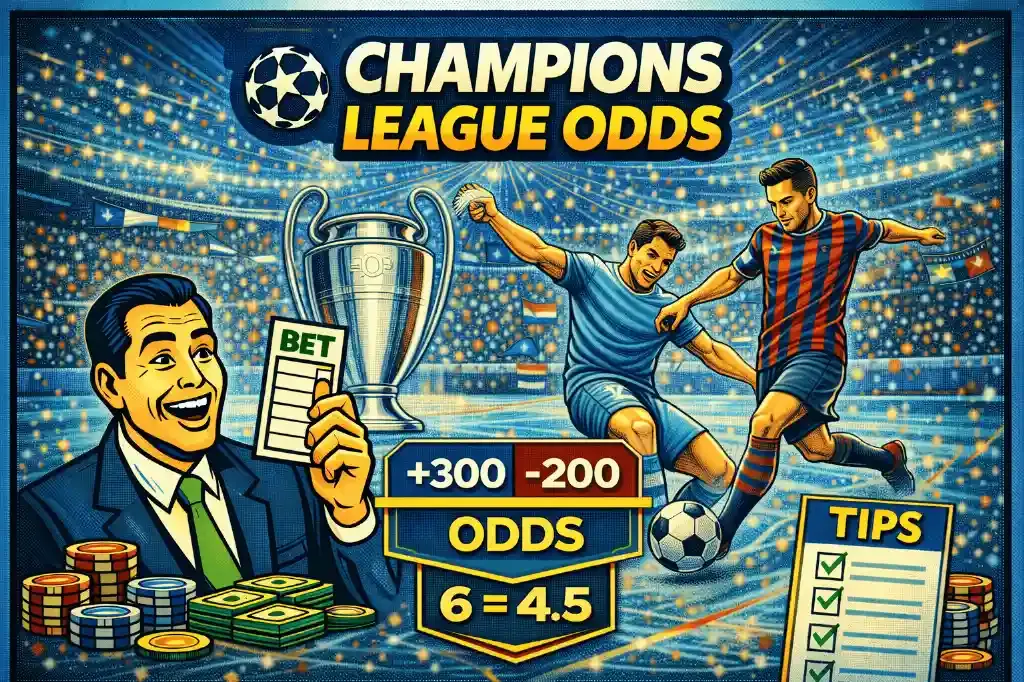
How Champions League Odds Are Built and Why They Differ from Domestic Football
Champions League odds are constructed using a layered pricing process that integrates statistical modelling, expert trading judgement, and real-time market feedback. At the core of this process lies probability estimation: bookmakers assign likelihoods to each possible outcome and convert those probabilities into decimal prices, embedding a margin that ensures long-term profitability.
What differentiates Champions League odds from domestic league pricing is the number of interacting variables that must be accounted for simultaneously. Teams arrive from different leagues with differing competitive baselines, meaning raw domestic form cannot be treated equally. A fourth-placed side from one major league may be priced similarly to a league leader from another, depending on historical European performance, squad depth, and tactical compatibility.
In addition, Champions League fixtures are embedded within congested calendars. Clubs frequently balance European ambitions against domestic priorities, leading to selective squad rotation that materially affects pricing. A team that appears strong on paper may enter a group-stage match with reduced intensity due to an upcoming domestic fixture of greater strategic importance. These nuances are priced into Champions League odds far more aggressively than in league football.
Understanding Implied Probability and Market Margin in Champions League Odds
Every set of Champions League odds represents a collection of implied probabilities rather than absolute predictions. Decimal odds can be converted into probability using a simple calculation: dividing one by the odds figure. For example, odds of 2.00 imply a fifty per cent chance, while odds of 4.00 imply a twenty-five per cent chance.
When all implied probabilities in a market are combined, the total will exceed one hundred per cent. This excess represents the bookmaker margin, also known as the overround. In Champions League markets, margins are typically tighter than in lower-tier competitions due to high betting volume and intense competition between UK-licensed operators. This efficiency makes casual mispricing less common, placing greater importance on contextual insight rather than surface-level analysis.
Understanding implied probability allows bettors to evaluate whether the price offered aligns with the realistic likelihood of an outcome, rather than focusing solely on perceived value based on reputation or recent results.
Champions League Match Result Odds in Context
The match result market remains the most recognisable Champions League betting option, offering prices on a home win, draw, or away win after ninety minutes. However, interpreting these odds correctly requires understanding how Champions League matches differ structurally from domestic fixtures.
In the group stage, match result odds are often influenced by qualification mathematics rather than pure competitive intent. Teams already qualified for the knockout rounds may approach later group matches conservatively, while clubs chasing progression may adopt higher-risk tactics. This asymmetry can create pricing inefficiencies, particularly in matches involving teams with uneven motivation levels.
In knockout rounds, match result odds are shaped heavily by aggregate scorelines. First-leg fixtures often favour cautious approaches, suppressing win probabilities for both sides and increasing draw likelihood. Second-leg matches introduce game-state dependency, where one team may require a result while the other benefits from containment, altering probabilities dynamically throughout the match.
Total Goals Markets and Tactical Incentives
Total goals markets are among the most analytically demanding Champions League betting options. While domestic leagues often exhibit stable scoring patterns, Champions League goal expectation fluctuates significantly based on tournament phase and tactical incentives.
Group-stage matches between mismatched opponents frequently produce higher goal lines, particularly when stronger sides dominate possession and weaker teams defend deep. Conversely, evenly matched group fixtures often see conservative approaches designed to avoid defeat rather than pursue victory, keeping goal totals modest.
In knockout rounds, especially in first legs, total goals markets are heavily influenced by risk aversion. Managers prioritise structural integrity over attacking expression, leading to suppressed goal expectancy even when elite attacking players are present. Understanding when bookmakers may overestimate attacking output based on reputation alone is central to interpreting these markets effectively.
Both Teams to Score and Defensive Structure
Both Teams to Score markets in the Champions League are shaped less by attacking reputation and more by defensive structure and transition quality. Many elite teams concede relatively few high-quality chances in European competition due to disciplined pressing, compact defensive lines, and controlled tempo.
In matches where one side prioritises containment, Both Teams to Score odds may appear attractively priced despite underlying tactical realities suggesting otherwise. Conversely, fixtures involving teams that rely heavily on transitional play may present stronger opportunities for Both Teams to Score selections, particularly when both sides favour aggressive pressing.
This market rewards bettors who evaluate how teams generate chances rather than simply how often they score domestically.
Handicap and Asian Line Markets in Champions League Betting
Handicap markets adjust for perceived imbalances between teams by applying virtual goal advantages or disadvantages. In the Champions League, handicaps are particularly useful when pricing does not fully account for squad rotation, tactical conservatism, or fixture prioritisation.
Strong favourites may be priced too aggressively when bookmakers assume full commitment, while underdogs receiving goal advantages may offer value when the favourite is content to manage a narrow lead rather than pursue dominance. Asian handicap lines further refine this approach by offering partial outcomes that reduce variance and improve price efficiency.
These markets require an understanding of match intent rather than simply comparative strength.
Champions League Outright Odds and Tournament Progression
Outright markets price teams to win the Champions League outright, projecting performance across an entire campaign. These odds are among the most complex in football betting, as they must incorporate not only team quality but also draw paths, potential match-ups, and resilience under knockout pressure.
Early outright prices often favour historically successful clubs with deep squads, but these markets can shift dramatically following the knockout draw. A favourable path can shorten odds significantly, while a difficult quarter-final or semi-final draw can cause sharp drift even for elite teams.
Because outright odds compress rapidly as the tournament progresses, timing is critical. Many bettors find greater flexibility and clarity by focusing on stage-specific markets rather than committing capital early to long-term outcomes.
Live Champions League Odds and In-Play Market Behaviour
Live betting plays a central role in Champions League wagering due to the competition’s momentum-driven nature. Odds update continuously in response to goals, substitutions, tactical shifts, and disciplinary events, often reacting faster than public perception.
In-play markets frequently overreact to early dominance or isolated incidents without fully accounting for tactical recalibration. Teams conceding early goals in two-legged ties may not immediately increase attacking intensity if aggregate mathematics remain favourable, creating discrepancies between perceived urgency and actual behaviour.
Successful live betting relies on understanding how managers adapt strategy in response to game state, rather than reacting emotionally to short-term momentum.

Champions League Betting at bet.bestodds.com
Champions League betting is available through bet.bestodds.com, a United Kingdom licensed operator providing comprehensive market coverage across all stages of the competition. The platform offers pre-match, outright, and live betting markets, supported by competitive pricing and fast in-play updates.
Markets include match result, goals, handicaps, qualification, outright winners, top scorer markets, and dynamic live odds during televised fixtures. Responsible gambling tools and United Kingdom regulatory compliance are integrated across the platform, ensuring a secure and transparent betting environment for Champions League wagering.
Champions League Betting Tips: Strategic Principles
Effective Champions League betting requires prioritising context over reputation. Elite clubs do not approach every European fixture with the same intent, and motivation often outweighs perceived quality. Understanding squad rotation patterns, aggregate incentives, and domestic scheduling pressures provides clearer insight than headline form.
Outright betting should be approached selectively, with greater emphasis placed on path difficulty and squad depth than early-season performance. Match-specific markets often offer greater clarity and flexibility, particularly when supported by tactical analysis and statistical indicators such as chance creation and defensive stability.
Bankroll discipline remains essential, as Champions League betting involves high variance due to the quality of opposition and limited sample sizes.
Familiarising yourself with case-by-case basis Champions League Betting Tips remains essential before making your first deposit.
Conclusion: What Champions League Odds Really Represent
Champions League odds are not merely reflections of team strength; they are condensed representations of probability shaped by tactical intent, tournament structure, scheduling pressures, and global betting sentiment. Understanding how these elements interact allows bettors to interpret prices accurately rather than react to surface narratives.
This guide demonstrates that Champions League betting rewards analytical discipline, contextual awareness, and selective market engagement. Those who understand how and why odds move are better positioned to identify value and manage risk effectively across the competition.
Key Takeaways
- Champions League odds reflect tactical and structural context, not just form
- Knockout incentives fundamentally alter pricing behaviour
- Live odds respond rapidly but may overreact to short-term momentum
- Outright markets reward timing and path analysis
- Match-specific markets often provide clearer value than long-term bets
Frequently Asked Questions
What makes Champions League odds different from domestic league odds?Champions League odds must account for international competition, varied league strengths, tactical conservatism, and compressed scheduling, making them more context-dependent than domestic prices.
Are Champions League odds more efficient than other football markets?Yes. High global betting volume typically results in tighter margins and fewer obvious mispricings, increasing the importance of situational analysis.
When do Champions League outright odds change most sharply?Significant movements occur after the knockout draw, major injuries, and unexpected eliminations of strong teams.
Is live betting more effective in Champions League matches?Live betting can offer opportunities, but only when bettors understand aggregate dynamics and tactical adjustments rather than reacting emotionally to goals.
Are UK betting winnings on Champions League bets taxed?No. Winnings from sports betting are currently tax free for customers in the United Kingdom.
What is the safest way to approach Champions League betting as a beginner?Begin with simple markets such as match result or total goals, use small stakes, and focus on understanding how odds reflect probability rather than chasing returns.
UK iGaming Writer - With 10+ years in tech, crypto, igaming, and finance, Ali has written across many platforms covering crypto, tech, and gambling news, reviews, and guides. He specialises in content on igaming, sports betting, and crypto trends in emerging markets. Outside of work, Ali enjoys cricket and travelling.